Handmade Japanese knives span kitchen gyutos, compact folding knives, and outdoor blades, so the right choice depends on how you plan to use one. My best overall pick is the Japanese Gyuto Knife Pro 8-inch, which pairs a versatile chef’s-knife shape with VG-10 Damascus steel. The Higonokami Blue Paper Steel 120mm stands out for traditional pocket carry, while the Mitsumoto Sakari 8-Inch Gyuto offers another kitchen-focused option. The main tradeoffs are kitchen performance versus portability, and harder steels’ edge potential versus their greater care needs. Read on for the full comparison and guidance on choosing among these handmade Japanese knives.

Get business pricing on tech for your team
- Business-only prices and quantity discounts
- Tax-exempt purchasing
- Multiple users, one account, clear invoices
Key Takeaways
- The lineup divides into distinct uses: six knives are aimed at kitchen or general cutting, while the Higonokami models and Minowe folding knife suit pocket carry and the DRGSKL is a fixed-blade option.
- The Japanese Gyuto Knife Pro is the most balanced kitchen pick because its 8-inch chef-knife format and VG-10 Damascus construction suit a broad range of prep tasks.
- The two Higonokami Blue Paper Steel knives differ mainly by blade length: the 120mm version favors a more substantial working blade, while the 90mm model is easier to carry compactly.
- A set is not automatically the best kitchen value: the Atumuryou offers three knives, but a buyer who mainly needs one dependable chef’s knife may prefer a single gyuto.
- Damascus appearance does not settle the buying decision: blade shape, handle fit, intended use, and willingness to maintain the edge matter more than the pattern alone.
| Minowe Handmade Damascus Folding Pocket Knife with VG10 Steel Blade |  | Best Modern Outdoor Folder | Blade length: 3.1 inches | Total length: 7.1 inches | Blade steel: VG10 Damascus steel | VIEW ON AMAZON | See Our Full Breakdown |
| Higonokami Folding Knife – Blue Paper Steel 120mm |  | Best Traditional Japanese Folder | Blade material: Blue Paper Steel | Handle material: Brass | Folded length: 120mm | VIEW ON AMAZON | See Our Full Breakdown |
| Atumuryou 3-Piece Damascus Chef Knife Set with VG10 Steel Core |  | Best Multi-Knife Kitchen Set | Set contents: 8-inch chef knife, 7-inch Santoku, 3.5-inch paring knife | Blade construction: 67-layer Damascus steel | Steel core: Japanese VG10 | VIEW ON AMAZON | See Our Full Breakdown |
| Japanese Gyuto Knife Pro 8-inch Handcrafted Chef Knife VG-10 Damascus Steel |  | Best Single Handcrafted Gyuto | Blade length: 8 inches | Blade material: VG-10 67-layer Damascus steel | Forging temperature: Over 1000°C | VIEW ON AMAZON | See Our Full Breakdown |
| Higo no Kami 10 Folding Pocket Knife by Nagao Seisakusho, Brass Finish | 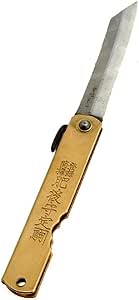 | Best Heritage Everyday Folder | Blade length: Approximately 3 inches | Handle length: Approximately 4 inches | Blade steel: Warikomi steel | VIEW ON AMAZON | See Our Full Breakdown |
| Higonokami Folding Knife – Blue Paper Steel 90mm |  | Best Traditional Folding Knife | Blade material: Blue Paper Steel | Handle material: Brass | Folded length: 90 mm | VIEW ON AMAZON | See Our Full Breakdown |
| DRGSKL D2 Steel Fixed Blade Knife with Walnut Handle and Sheath |  | Best Fixed-Blade Outdoor Pick | Blade material: D2 steel | Handle material: Walnut wood | Sheath material: Walnut wood | VIEW ON AMAZON | See Our Full Breakdown |
| Emojoy 8-Inch Damascus Chef Knife with Olive Wood Handle |  | Best for a Softer, More Forgiving Edge | Blade length: 8 inches | Blade material: 67-layer Damascus steel | Carbon content: 0.98% | VIEW ON AMAZON | See Our Full Breakdown |
| Mitsumoto Sakari 8-Inch Japanese Gyuto Chef Knife |  | Best Overall for Everyday Japanese-Style Prep | Blade length: 8.6 inches | Blade material: 3-layer 9Cr18MoV high-carbon steel | Construction: Forged San-Mai | VIEW ON AMAZON | See Our Full Breakdown |
| Japanese Chef Knife 8 Inch, Handcrafted Damascus VG10 Steel |  | Best for High Edge Retention | Blade length: 8 inches | Core material: VG-10 steel | Hardness: 62 HRC | VIEW ON AMAZON | See Our Full Breakdown |
| handmade japanese knife | Handle material | Blade length | Blade material |
|---|---|---|---|
| Minowe Handmade Damascus Foldi | Resin and maple | 3.1 inches | — |
| Higonokami Folding Knife | Brass | — | Blue Paper Steel |
| Atumuryou 3-Piece Damascus Che | Stabilized wood and ocean-blue resin | — | — |
| Japanese Gyuto Knife Pro 8-inc | — | 8 inches | VG-10 67-layer Damascus steel |
| Higo no Kami 10 Folding Pocket | — | Approximately 3 inches | — |
| Higonokami Folding Knife | Brass | — | Blue Paper Steel |
| DRGSKL D2 Steel Fixed Blade Kn | Walnut wood | — | D2 steel |
| Emojoy 8-Inch Damascus Chef Kn | Calabrian olive wood | 8 inches | 67-layer Damascus steel |
| Mitsumoto Sakari 8-Inch Japane | Rosewood | 8.6 inches | 3-layer 9Cr18MoV high-carbon steel |
| Japanese Chef Knife 8 Inch | Stabilized wood and resin | 8 inches | — |
More Details on Our Top Picks
Minowe Handmade Damascus Folding Pocket Knife with VG10 Steel Blade
The Minowe pairs a 3.1-inch VG10 Damascus blade with one-handed opening, making it the more modern, quick-access choice beside the friction-fold Higonokami Blue Paper Steel 120mm. Its resin-and-maple handle gives it a different feel from the brass-handled traditional folders, while the included case offers a place to store it between outings. At 4.7 ounces, it is compact but not especially featherweight. The listing describes the lock inconsistently as a “pad lock,” so I would not assume a particular lock design without confirming it with the seller. Its Damascus pattern and stated hardness suit buyers drawn to crafted Japanese-style steel, but this is a general-purpose outdoor folder, not a kitchen knife. Choose it over the Higo no Kami 10 if one-handed opening and a contemporary handle matter more than traditional simplicity.
Pros:- VG10 Damascus blade with stated 60 HRC hardness and 67-layer construction
- One-handed opening with a ceramic ball system
- Resin-and-maple handle offers an alternative to the brass handles on the Higonokami models
- Storage case is included
Cons:- The lock is described with inconsistent terminology, leaving its exact mechanism unclear
- At 4.7 ounces, it weighs more than a minimalist pocket-carry knife
- Its outdoor-folder format is not a substitute for a Japanese kitchen knife
Best for: Campers and hikers who want a compact VG10 Damascus folder with one-handed opening and a storage case.
Not ideal for: Buyers seeking a traditional Japanese friction folder, or anyone who needs clearly documented locking details before carrying a knife.
- Blade length:3.1 inches
- Total length:7.1 inches
- Blade steel:VG10 Damascus steel
- Blade hardness:60 HRC
- Blade layers:67
- Handle material:Resin and maple
- Opening system:Ceramic ball system
- Weight:4.7 ounces
- Included component:Storage case
Our verdict“Choose the Minowe if you want a modern VG10 Damascus outdoor folder rather than the simpler, non-locking Higonokami style.”
Higonokami Folding Knife – Blue Paper Steel 120mm
This Higonokami is the clearest choice here for buyers who value a traditional Japanese folding knife over modern convenience. Made by Nagao Seisakusho, it uses a brass handle and Blue Paper Steel blade in a friction-fold design that has no lock. That makes it a very different proposition from the one-handed, lock-equipped Minowe: the Higonokami asks the user to hold the spine for stability while cutting. Its 220mm full length gives it more reach than the Higo no Kami 10, while the 120mm folded length remains carryable. Blue Paper Steel is specified for wear resistance and edge holding, but it needs care to limit rust. I would pick this for deliberate everyday cutting, not for forceful tasks where a locking blade is the safer fit.
Pros:- Made in Japan by Nagao Seisakusho, with a stated manufacturing history dating to 1894
- Blue Paper Steel is specified for wear resistance and edge holding
- Brass handle and friction-fold construction retain a traditional design
- Longer full length than the Higo no Kami 10
Cons:- No locking mechanism; the user must hold the spine during use
- Blue Paper Steel requires regular care to help prevent rust
- The friction-fold format may feel less secure than the Minowe’s described locking design
Best for: Collectors and traditional-tool users who want a Japanese-made friction folder and are comfortable maintaining carbon steel.
Not ideal for: People who want a locking blade, use a knife for forceful outdoor work, or prefer low-maintenance stainless steel.
- Blade material:Blue Paper Steel
- Handle material:Brass
- Folded length:120mm
- Full length:220mm
- Blade thickness:Approximately 3mm
- Manufacturer:Nagao Seisakusho
- Origin:Japan
- Locking mechanism:None; friction fold
Our verdict“Pick this Higonokami for traditional Japanese construction and Blue Paper Steel, provided you accept a non-locking blade and regular upkeep.”
Atumuryou 3-Piece Damascus Chef Knife Set with VG10 Steel Core
For someone setting up a kitchen, the Atumuryou set covers more jobs at once than the single-blade Japanese Gyuto Knife Pro 8-inch: it includes a chef knife, Santoku, and paring knife. Each has a VG10 core in 67-layer Damascus construction, with a stated 12° edge per side and 62 HRC hardness. That harder, acute edge may appeal to cooks who value fine slicing, though it calls for careful handling and appropriate sharpening. Full-tang construction and stabilized wood-and-resin handles offer a substantial, distinctive feel, but the description does not provide individual knife weights or handle dimensions, making balance harder to judge in advance. The gift box adds presentation value, while unique handle variation means the set may not match a buyer seeking uniform appearance. I would favor it for range; choose the Gyuto Pro for a single handcrafted chef knife.
Pros:- Three blade shapes cover general prep, push-cutting, and smaller detail work
- VG10 steel core and 62 HRC hardness are specified
- Full-tang construction is intended to provide a secure, balanced handle build
- Gift box and distinctive stabilized wood-and-resin handles
Cons:- The listing gives no individual knife weights or balance details
- Handle appearance may vary, so the set may not look uniform
- A 12°-per-side edge and stated 62 HRC hardness call for careful edge maintenance
Best for: Home cooks furnishing a kitchen who want a chef knife, Santoku, and paring knife in one coordinated set.
Not ideal for: Cooks who want one carefully chosen blade, need detailed weight and balance data, or prefer a consistent handle appearance.
- Set contents:8-inch chef knife, 7-inch Santoku, 3.5-inch paring knife
- Blade construction:67-layer Damascus steel
- Steel core:Japanese VG10
- Hardness:62 HRC
- Edge angle:12° per side
- Handle material:Stabilized wood and ocean-blue resin
- Construction:Full tang
- Packaging:Gift box
Our verdict“Choose the Atumuryou set if you need three kitchen blade styles, rather than the single, handcrafted Gyuto Pro.”
Japanese Gyuto Knife Pro 8-inch Handcrafted Chef Knife VG-10 Damascus Steel
This 8-inch Gyuto is the most focused kitchen pick in the group: it offers one hand-forged, hand-polished VG-10 Damascus blade rather than the three-knife coverage of the Atumuryou set. The stated forging temperature exceeds 1000°C, and the listing describes a razor-sharp “0°” edge. That edge claim is unusual and does not explain how the angle is measured, so buyers should seek clarification rather than treat it as a conventional sharpening specification. As a single chef knife, it is better suited to someone who already has smaller prep blades and wants a main cutting tool. Its handcrafted finish fits the handmade Japanese knives theme, but the description provides no handle material, weight, or hardness figure. That leaves less practical detail than the VG10 specifications supplied for the Atumuryou set.
Pros:- Hand-forged and hand-polished construction
- 8-inch blade suits broad kitchen prep tasks
- 67-layer VG-10 Damascus steel is specified
- Single-knife focus suits buyers who do not need the Atumuryou set’s extra blades
Cons:- The listed 0° edge angle is unusual and is not explained
- No handle material, knife weight, or hardness value is provided
- Extreme sharpness calls for careful handling and regular maintenance
Best for: Cooks who want one handcrafted 8-inch Japanese-style chef knife as their primary kitchen blade.
Not ideal for: Buyers who need a complete knife set, clear edge-angle guidance, or stated handle, weight, and hardness specifications.
- Blade length:8 inches
- Blade material:VG-10 67-layer Damascus steel
- Forging temperature:Over 1000°C
- Listed edge angle:0° razor-sharp
- Construction:Hand-forged and hand-polished
Our verdict“Choose this Gyuto if you want a single handcrafted Damascus chef knife, but clarify the unusual edge-angle claim before buying.”
Higo no Kami 10 Folding Pocket Knife by Nagao Seisakusho, Brass Finish
The Higo no Kami 10 makes the most sense for buyers who want a handmade Japanese folder with a direct link to the traditional pattern. Nagao Seisakusho is identified as the last remaining maker authorized to produce the trademarked Higo no Kami knife. Its Warikomi steel blade, satin brass handle, and simple opening lever keep the design spare compared with the Minowe’s one-handed mechanism and resin-and-maple grip. The approximately 3-inch blade and 4-inch handle make it compact, though the description does not state a lock, so buyers should not expect the secure locking format found in many modern folders. Compared with the Higonokami Blue Paper Steel 120mm, this listing gives less material and dimension detail. Handmade variation is part of the appeal, but it can also mean small differences in appearance and specifications.
Pros:- Handmade in Japan by Nagao Seisakusho, the authorized Higo no Kami maker described in the listing
- Traditional folding design with a simple opening lever
- Compact approximate 3-inch blade and 4-inch handle
- Satin brass handle gives it a classic alternative to the Minowe’s composite-and-wood grip
Cons:- The description does not specify a locking mechanism
- Warikomi steel is named, but no hardness or further composition details are provided
- Handmade construction may lead to variation in appearance and specifications
Best for: Buyers who value a handmade Japanese traditional folder from Nagao Seisakusho and prefer a simple brass-handled design.
Not ideal for: Users who need a locking blade, detailed steel specifications, or consistent dimensions and finish for a precise fit.
- Blade length:Approximately 3 inches
- Handle length:Approximately 4 inches
- Blade steel:Warikomi steel
- Handle finish:Brass satin
- Manufacturer:Nagao Seisakusho
- Country of origin:Japan
- Construction:Handmade
- Recommended uses:Camping, fishing, hiking
Our verdict“Pick the Higo no Kami 10 for traditional handmade Japanese folder character, not for a modern lock or detailed technical documentation.”
Higonokami Folding Knife – Blue Paper Steel 90mm
For buyers drawn to Japanese knife-making beyond the kitchen, this Nagao Seisakusho Higonokami offers a compact, traditional folding design with a Blue Paper Steel blade chosen for wear resistance and edge holding. Its 90 mm folded length and 165 mm full length make it easier to carry than a fixed-blade outdoor knife such as the DRGSKL D2, while the brass handle keeps the construction simple and durable. The tradeoff is the friction-fold mechanism: there is no lock, so it is not a substitute for a locking folder when cutting demands firm pressure. The carbon-steel blade also needs prompt drying and regular care to limit rust. I’d choose it for its Japanese heritage and portable utility, not as a low-maintenance kitchen gyuto.
Pros:- Blue Paper Steel is specified for strong wear resistance and edge holding.
- Made in Japan by Nagao Seisakusho, a manufacturer described as having more than a century of history.
- Simple friction-fold construction avoids complex moving mechanisms.
- Compact 90 mm folded length and brass handle suit portable carry.
Cons:- The blade has no locking mechanism, limiting confidence during forceful cuts.
- Carbon steel needs regular care to help prevent rust.
- Its folding format is less suited to kitchen prep than the Emojoy 8-Inch Damascus Chef Knife.
Best for: Collectors and campers who want a compact, traditionally made Japanese folding knife and are comfortable caring for carbon steel.
Not ideal for: People who need a locking blade for forceful cutting, or cooks seeking a full-size kitchen knife that resists rust with little upkeep.
- Blade material:Blue Paper Steel
- Handle material:Brass
- Folded length:90 mm
- Full length:165 mm
- Blade thickness:3 mm
- Manufacturer:Nagao Seisakusho
- Origin:Japan
- Recommended uses:Camping, household, and outdoor use
Our verdict“Choose this Higonokami if you want a compact Japanese friction folder and accept its non-locking design and carbon-steel upkeep.”
DRGSKL D2 Steel Fixed Blade Knife with Walnut Handle and Sheath
The DRGSKL is the lineup’s fixed-blade choice for buyers who prefer a straightforward outdoor tool over a folding knife. Its D2 steel blade is paired with a hand-shaped walnut handle and matching walnut sheath, giving it a distinct wood-focused look compared with the brass-handled Higonokami 90mm. That fixed format avoids the Higonokami’s non-locking friction joint, but the supplied details do not state blade dimensions, weight, or a specific Japanese maker or origin. I’d treat it as an outdoor-oriented handmade-style knife rather than a clearly documented Japanese-made kitchen knife. The maintenance instructions also call for cleaning, drying, and oiling after use, and the natural wood grain will vary from knife to knife. It makes more sense for buyers prioritizing a sheath and fixed blade than for anyone seeking a verified Japanese gyuto.
Pros:- Fixed-blade format avoids the non-locking hinge design of the Higonokami 90mm.
- D2 steel blade is paired with a hand-shaped walnut handle.
- Matching walnut sheath is included.
- Intended for outdoor and everyday cutting tasks.
Cons:- The provided product details do not identify a Japanese origin or maker.
- Blade dimensions and weight are not specified in the supplied data.
- Care instructions call for cleaning, drying, and oiling after use, and wood grain varies.
Best for: Outdoor users who want a fixed blade with a matching wood sheath and are willing to clean, dry, and oil it after use.
Not ideal for: Buyers specifically seeking a documented Japanese-made knife, a kitchen gyuto, or detailed blade-size information before choosing.
- Blade material:D2 steel
- Handle material:Walnut wood
- Sheath material:Walnut wood
- Included component:Sheath
- Recommended use:Outdoor and everyday cutting tasks
- Finish:Polished blade with decorative accents
- Care guidance:Clean, dry, and oil the blade after use
Our verdict“Pick the DRGSKL if a walnut-sheathed fixed blade matters more than documented Japanese provenance or kitchen-specific design.”
Emojoy 8-Inch Damascus Chef Knife with Olive Wood Handle
The Emojoy combines an 8-inch chef-knife format with a 15° edge and Calabrian olive wood handle, making it the accessible-feeling kitchen option among these more specialized Japanese-style knives. Its stated 58 HRC hardness is lower than the Mitsumoto Sakari Gyuto’s approximately HRC 60 and the VG-10 knife’s 62 HRC, a distinction buyers may prefer if they want to avoid the highest-hardness edge in this group. The supplied description calls the blade hand-forged and 67-layer Damascus, but does not name a Japanese maker or confirm Japanese origin, so I would not treat the style as proof of Japanese manufacture. Its lifetime warranty and gift box add practical appeal; the tradeoff is less specific construction detail than the Mitsumoto’s San-Mai description.
Pros:- 15° edge is intended for precise slicing of meat, fish, and vegetables.
- 67-layer Damascus blade and Calabrian olive wood handle give it a distinctive kitchen-knife design.
- Stated 58 HRC hardness is lower than the Mitsumoto Sakari and VG-10 knife in this lineup.
- Includes a wooden gift box and a stated lifetime warranty.
Cons:- The supplied details do not identify a Japanese maker or confirm Japanese origin.
- Its 58 HRC hardness is below the Mitsumoto Sakari’s approximately HRC 60 and the VG-10 knife’s 62 HRC.
- The product information does not specify the blade’s weight or detailed core construction.
Best for: Home cooks who want an 8-inch chef knife with an olive wood handle, a 15° edge, and a stated lifetime warranty.
Not ideal for: Buyers who require a named Japanese maker or verified Japanese origin, or who want the higher stated hardness of the Mitsumoto Sakari or VG-10 option.
- Blade length:8 inches
- Blade material:67-layer Damascus steel
- Carbon content:0.98%
- Chromium content:18%
- Hardness:58 HRC
- Edge angle:15°
- Handle material:Calabrian olive wood
- Warranty:Lifetime
Our verdict“Choose the Emojoy for an 8-inch Damascus-style kitchen knife with olive wood, while treating its Japanese identity as unverified.”
Mitsumoto Sakari 8-Inch Japanese Gyuto Chef Knife
The Mitsumoto Sakari earns the everyday-prep role through a clearly described Gyuto profile and 3-layer San-Mai construction around a 9Cr18MoV core. Its 8.6-inch blade, approximately HRC 60 hardness, and 279 g weight give buyers more concrete guidance than the Emojoy’s less detailed construction data, while its octagonal rosewood handle offers a different grip shape from the VG-10 knife’s stabilized wood-and-resin handle. The hammered texture and kurouchi finish also set it apart visually from the Emojoy’s Damascus cladding. Its stated hardness and carbon-steel description call for attentive care to help prevent rust, so it is not the lowest-maintenance choice here. I’d put it ahead of the higher-hardness VG-10 option for buyers who value a named Gyuto construction and balanced everyday specifications over maximum stated hardness.
Pros:- 3-layer San-Mai construction uses a 9Cr18MoV high-carbon steel core.
- Deep-cryo treatment and approximately HRC 60 hardness are specified for edge stability.
- Hammered texture is intended to reduce food sticking during slicing.
- Octagonal rosewood handle and included sandalwood box add distinctive traditional details.
Cons:- The high-carbon blade needs careful maintenance to help prevent rust.
- Kurouchi and hammered finishes may not suit buyers who prefer a plain blade appearance.
- At 279 g, it may feel heavier than a lighter-preference cook expects.
Best for: Home cooks seeking a specified Japanese-style Gyuto with an octagonal rosewood handle and a balance of hardness, toughness, and edge stability.
Not ideal for: Cooks who want minimal blade care, prefer a plain finish, or specifically want the 62 HRC VG-10 core of the other 8-inch Damascus knife.
- Blade length:8.6 inches
- Blade material:3-layer 9Cr18MoV high-carbon steel
- Construction:Forged San-Mai
- Hardness:HRC 60±2
- Handle material:Rosewood
- Weight:279 g
- Model number:MS-135
- Included:Sandalwood storage box
Our verdict“Choose the Mitsumoto Sakari for a well-specified Gyuto with traditional handle and blade details, provided you will maintain the steel.”
Japanese Chef Knife 8 Inch, Handcrafted Damascus VG10 Steel
This knife targets cooks who want the highest stated hardness in this kitchen-knife group: its VG-10 core is rated at 62 HRC, above the Mitsumoto Sakari’s approximately HRC 60 and the Emojoy’s 58 HRC. The core is wrapped in 67 layers of Damascus cladding, and the description specifies hand sharpening, so it has a clear focus on a keen edge and layered appearance. A stabilized wood-and-resin handle also differs from the Mitsumoto’s rosewood octagonal handle, with the resin component intended to provide a slip-resistant grip. Those advantages come with incomplete product details: no weight, edge angle, maker name, or specific Japanese origin is supplied. Buyers should also expect a harder edge to call for careful handling and maintenance; the information does not support treating the knife as carefree or indestructible.
Pros:- VG-10 core is specified at 62 HRC, higher than the other two chef knives in this batch.
- 67-layer Damascus cladding provides a layered blade finish.
- Stabilized wood-and-resin handle is described as ergonomic and slip-resistant.
- Hand-sharpened edge is presented as ready for precise cutting.
Cons:- The supplied information does not name a maker or confirm a specific Japanese origin.
- Weight, edge angle, and detailed blade construction beyond the core and cladding are not given.
- Its 62 HRC hardness calls for careful handling rather than rough use.
Best for: Experienced home cooks who prioritize a high-hardness VG-10 core, layered Damascus cladding, and a stabilized grip material.
Not ideal for: Buyers who want a named Japanese maker, detailed dimensions beyond blade length, or a lower-hardness option like the Emojoy.
- Blade length:8 inches
- Core material:VG-10 steel
- Hardness:62 HRC
- Cladding:67-layer Damascus
- Handle material:Stabilized wood and resin
- Sharpening:Hand-sharpened
- Origin style:Japanese
Our verdict“Pick this VG-10 knife if a 62 HRC core and stabilized handle matter more than detailed maker and construction provenance.”

How We Picked
I ranked these options by how clearly each one serves its intended use, then weighed blade format, stated steel, handling details, and likely maintenance demands. Kitchen knives were judged on the usefulness of their chef-knife profile and suitability for everyday prep; folding and fixed blades were judged on portability and whether their format matches a real carry or outdoor need. I also treated a set differently from a single knife: extra pieces help only when the buyer will use them.
The Japanese Gyuto Knife Pro leads because its familiar 8-inch format and VG-10 construction make it the broadest kitchen choice in this group. Traditional Higonokami models rank higher for buyers who specifically want a Japanese folding knife, while the compact 90mm version trades reach for portability. The remaining rankings reflect narrower roles, including a three-piece set, other gyuto options, a Damascus folding knife, and a fixed blade. Product names and descriptions alone do not establish where a knife was made or how it was forged, so I avoid treating “handmade” or Damascus styling as proof of a particular production method.
Factors to Consider When Choosing Handmade Japanese Knives
Before choosing, separate the idea of a handmade Japanese knife from the job you need it to do. A kitchen gyuto, a traditional pocket folder, and an outdoor fixed blade have different shapes, handling demands, and care routines. These factors can help you avoid buying a visually appealing knife that does not fit your work.
Start With the Job, Not the Steel
Decide where the knife will work before comparing steel names or surface patterns. A gyuto is designed for kitchen prep, while a folding knife is easier to carry and a fixed blade may suit outdoor tasks better. Using a pocket knife as a stand-in for a chef’s knife can make repeated food prep awkward; a long kitchen blade is just as unsuitable for pocket carry. Think about the typical material, cutting board, and space available. If one knife must cover several tasks, favor the format that handles your most frequent job well rather than expecting it to excel everywhere.
Match Blade Length to Your Work Area
Blade length affects reach, control, storage, and how much room you need for a cut. The 120mm Higonokami offers more blade than the 90mm version, while the shorter model can be less cumbersome for compact carry. For kitchen use, an 8-inch gyuto gives a useful span for larger ingredients but may feel unwieldy on a small board. A common mistake is choosing the longest blade because it sounds more capable, without checking drawer space or counter habits. Consider the length you can control comfortably, not just the task you might occasionally tackle.
Read Steel Claims as Maintenance Clues
Steel labels can help set expectations, but they do not tell the whole story: heat treatment, geometry, and sharpening also shape how a knife cuts and holds an edge. VG-10 appears across several kitchen and folding options here, while the Higonokami models specify Blue Paper Steel and the DRGSKL lists D2. These labels should prompt questions about sharpening tools, corrosion care, and the maker’s guidance rather than serve as a simple quality ranking. A harder or more wear-resistant steel may ask for different sharpening effort than a softer, easier-to-maintain blade. Avoid assuming that a named steel is stainless or maintenance-free unless the product details clearly confirm it.
Judge Damascus for Construction, Not Decoration
Damascus describes a layered visual treatment or construction, but the pattern alone does not establish cutting performance, origin, or hand-forging. Several knives in this roundup use Damascus styling, so appearance cannot distinguish them reliably. Focus instead on the cutting core, blade profile, edge geometry, handle security, and clear maker information. Ask whether the listing explains which layers form the blade and what steel does the cutting. Paying extra for a pattern makes sense only if you value its look and the knife’s underlying design also fits your needs.
Choose a Handle and Opening Style You Can Control
Handle material and knife format affect grip, balance, and confidence as much as the blade does. Wood handles, such as walnut or olive wood, may appeal for their feel and appearance, but buyers should check how the handle is shaped and how it should be cared for. A traditional folding knife has different opening and locking characteristics from a modern folding design, so confirm how the blade stays in place before carrying or using it. Fixed blades avoid a folding joint but require a sheath and more storage space. Do not choose from handle material alone; fit and safe control matter more during regular use.
Plan for Sharpening, Cleaning, and Storage
Every knife needs care, but the routine depends on its steel, finish, and use. Food residue and moisture should be cleaned away promptly, especially when the maker does not describe the blade as stainless. Before buying, check whether you already have a sharpening method suited to the blade and whether you are willing to learn one. A set may require care for several edges, while a pocket knife adds a joint that can collect debris. Store kitchen knives so their edges do not knock against other utensils, and keep folding or fixed blades secured when not in use. The easier the care routine fits your habits, the more likely the knife is to remain useful.
Frequently Asked Questions
Does “handmade Japanese knife” mean the knife was made in Japan?
Not necessarily. “Handmade” and “Japanese” can refer to a claimed craft style, design, or origin, and a product title alone does not prove where a knife was produced. Check for a named maker, manufacturing location, and specific information about forging or assembly. If Japanese origin is a deciding factor, look for clear sourcing details rather than relying on Damascus styling or Japanese terminology. If those details are missing, treat the origin claim as unverified.
Should I choose the 90mm or 120mm Higonokami?
Choose based on the balance you want between compact carry and blade reach. The 90mm model is the smaller option and may suit buyers who prioritize portability or a more compact tool. The 120mm model gives you a longer working blade, which can feel more capable for tasks that benefit from added reach. Check local carry rules and the product’s opening and blade-retention details before buying either. Neither size replaces a full chef’s knife for regular kitchen preparation.
Is a Damascus knife a better cutter than a plain-finish knife?
A Damascus pattern does not by itself make a knife cut better. Cutting feel depends on factors such as blade geometry, edge sharpness, steel treatment, and how the knife is maintained. In this roundup, several choices have Damascus styling, so the pattern is not a useful way to separate them on its own. Compare the intended blade shape, handle, and care requirements first. Treat the finish as an aesthetic preference unless the maker provides concrete construction details that matter to your choice.
Is the Atumuryou three-piece set a better choice than one gyuto?
The set may suit someone who wants several blade options and expects to use each one. If your everyday cooking mainly involves one general-purpose chef’s knife, a single gyuto may be simpler to select, store, and maintain. More knives also mean more edges to sharpen and more space to organize. Before choosing the set, check which knife shapes it includes and whether they match tasks you regularly perform. Choose on useful coverage, not piece count alone.
Can I use one of these knives for both kitchen work and outdoor carry?
A knife may handle occasional tasks outside its intended role, but one format is rarely ideal for both regular kitchen prep and pocket or outdoor use. A gyuto’s long blade is designed around food preparation and needs suitable storage; folding and fixed blades prioritize portability or field handling instead. Using a folding knife for repeated kitchen cuts can limit control, while carrying a kitchen knife is impractical and may be unsafe. If you need both jobs covered, choose a dedicated knife for each rather than treating one as a compromise tool. Also check local rules before carrying a folding or fixed blade.
Conclusion
For most cooks seeking one versatile kitchen knife, I recommend the Japanese Gyuto Knife Pro 8-inch as best overall. The Atumuryou three-piece set is my value-oriented choice for buyers who will use multiple knives, while the Japanese Chef Knife 8 Inch, Handcrafted Damascus VG10 Steel is the premium-leaning pick for shoppers drawn to that stated combination of materials and finish, provided the product details meet their expectations. Beginners should start with a familiar 8-inch gyuto rather than a pocket or fixed blade, and choose based on comfortable handling and manageable care. For traditional pocket carry, pick the Higonokami Blue Paper Steel 120mm for more blade length or the 90mm version for a compact option; choose the DRGSKL fixed blade only if its outdoor format fits your needs. The best choice is the one whose purpose, size, and maintenance routine match how you will actually use it.
Halloween Picks
halloween
As an affiliate, we earn on qualifying purchases.