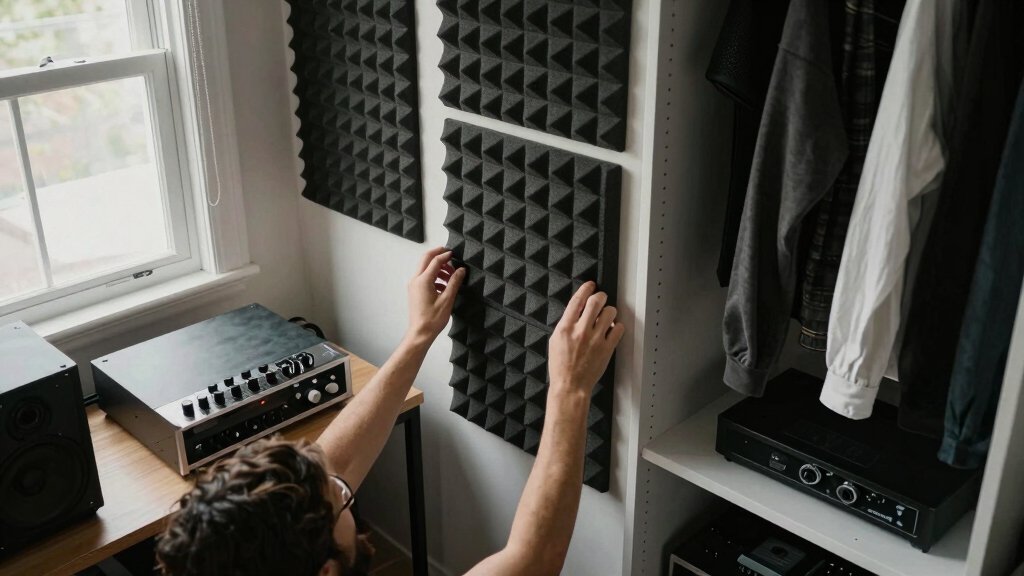

Acoustic Dampening, Placement, and the “Rig in the Closet” Setup

📊 Full opportunity report: Acoustic Dampening, Placement, and the “Rig in the Closet” Setup on ThorstenMeyerAI.com — validation score, market gap, and execution plan.

TL;DR

Moving your high-power rig into a closet significantly reduces noise and reflections. Proper placement, sealing gaps, and ventilation are essential for optimal sound and heat control. This guide offers practical advice for creating a quiet, effective workspace.

Moving a high-powered computer rig into a closet is confirmed as the most effective method to drastically reduce noise levels, according to recent expert guidance. Proper placement, sealing gaps, and managing heat are critical to maintaining performance and sound quality, making closet setups increasingly popular among content creators and AI practitioners.Experts agree that relocating a rig into a closet can cut noise and reflections more effectively than adding foam treatments alone. The key is strategic placement—positioning the rig away from reflective surfaces and near absorption materials—along with sealing gaps around doors and walls to prevent sound leaks. Ventilation is also crucial; installing quiet fans or ducted airflow helps manage heat buildup in enclosed spaces. DIY solutions like blankets, rugs, and foam can be effective if placed thoughtfully, but they must be combined with proper sealing and ventilation for best results. This approach not only reduces noise but also improves the clarity of recordings and AI processing environments, making small spaces viable for professional-quality setups.
Acoustic Dampening & Placement — Interactive Infographic
ThorstenMeyerAI.com · AI Workstation Guides
Lever 5 of 5 · Placement · Interactive
The last lever · move it out

Acoustic dampening
& the rig in the closet.

The most powerful noise fix isn’t a material — it’s a floor plan. A rig you can’t hear because it’s in another room beats any amount of foam. Tap the approaches in Part 1 to see what actually works.

1 The hierarchy people get backwards
Distance beats foam — by a lot
Acoustic treatment has a clear order of effectiveness. Most people buy foam first — it’s last. Tap a row for why.
1Distance & isolation
(another room)
most
2Reduce at the source
(levers 1–4)
high
3Block transmission
(door / barrier)
medium
4Absorb reflections
(acoustic foam)
least
#1 · Distance & isolationThe best soundproofing is a wall. Move the rig to another room and run it headless — the noise problem disappears instead of being mitigated.
2 Two kinds of noise, two fixes
Foam and pads solve different problems
Pick the wrong fix and you treat noise that was never going to respond to it.
Airborne
The whoosh of fans, the GPU hum — traveling through air.
Foam absorbs it (less echo in the room)
A barrier blocks it (stops it leaving)
×Foam alone won’t stop it passing through a wall
Structure-borne
The low hum the machine sends into the desk, floor & walls.
Anti-vibration pads / rubber feet decouple it
Soft-mount drives, or use silent SSDs
×Foam does nothing for this — it’s mechanical
3 The rig in the closet
Great noise fix — with one catch
Enclosing a hot rig works beautifully for noise. But a sealed space traps heat — the same trap as a sealed case, scaled to a room.
GPU rig cool in hot out (fan) it must breathe

Contain the noise, not the heat

Vent it — a passive path, or a quiet exhaust fan pulling hot air out.
Soundproof cabinets do both: foam lining + thermostat-controlled exhaust.
An AIO helps here — it exports CPU heat out a radiator.
⚠ Never fully seal a 24/7 rig. Trapped 600W+ of heat = the GPU breathing its own exhaust = throttling & roaring fans.
4 The few products worth it
Mostly free technique — a handful of items help
Anti-vibration pads
Best value here. Kills structure-borne hum for a few dollars.
Soundproof server cabinet
The engineered quiet + cool answer, with built-in exhaust.
Acoustic foam panels
Tames reflections in the room — not for blocking transmission.
Quiet exhaust fan
Ventilates a closet or cabinet so the heat can leave.
5 The numbers
What containment can buy
Counts animate to typical figures.
Soundproof cabinet cuts
~36%
of perceived noise — while still dissipating kilowatts.
Serious enclosures reach
30 dB
of reduction — up to 5× quieter than an open rack.
A wall between you & it
100%
of the problem, gone — the cheapest fix there is.
Acoustic principles from server-room and quiet-PC soundproofing references; cabinet figures from manufacturer specs (StarTech, SysRacks, UCoustic). Figures vary by enclosure and environment. Affiliate disclosure on page.
ThorstenMeyerAI.com

Why Closet Rigs Are a Game-Changer for Noise Reduction

Relocating rigs into closets offers a practical, cost-effective way to achieve near-silent operation, especially for content creators, streamers, and AI developers working in limited spaces. This approach is discussed in Acoustic Dampening, Placement, and the “Rig in the Closet” Setup. This method improves audio clarity and reduces disruptive noise, enabling more professional recordings and quieter working environments. Proper implementation of placement, sealing, and ventilation ensures hardware safety and performance, making closet setups a widely adopted solution for noise-sensitive applications.
Amazon

soundproof closet for computer rig

As an affiliate, we earn on qualifying purchases.

As an affiliate, we earn on qualifying purchases.

The Rise of Closet-Based Rigs and Acoustic Optimization Techniques

Traditionally, high-power computers and AI workstations generate significant noise, often limiting their use in home or small office environments. Recent expert advice emphasizes that moving these rigs into a closet can dramatically reduce noise and reflections, provided proper acoustic treatment and heat management are applied. This approach has gained popularity among content creators and AI practitioners seeking a balance between performance and a quiet workspace. For detailed guidance, see the original analysis. Prior efforts focused on adding foam panels; however, current best practices highlight the importance of placement, sealing gaps, and ventilation for optimal results. This shift reflects a broader trend toward maximizing small-space acoustics without sacrificing hardware performance.

"Relocating your rig into a closet is the most effective way to significantly cut noise and reflections, especially when combined with proper placement and sealing."

— Thorsten Meyer, acoustic expert

AC Infinity AIRPLATE S7, Quiet Cooling Fan System 12" with Speed Control, for Home Theater AV Cabinets

AC Infinity AIRPLATE S7, Quiet Cooling Fan System 12" with Speed Control, for Home Theater AV Cabinets

An ultra-quiet UL-certified fan system designed for cooling cabinets that requires minimal noise.

As an affiliate, we earn on qualifying purchases.

As an affiliate, we earn on qualifying purchases.

Remaining Questions About Long-Term Performance and Heat Management

It is not yet clear how well DIY closet setups perform over extended periods, particularly regarding heat dissipation and hardware longevity. While ventilation solutions are recommended, the optimal design for balancing noise reduction and cooling in various room sizes and configurations remains under discussion. Further empirical studies are needed to determine best practices for large or high-performance rigs in small, enclosed spaces.
Knightsacoustic 96 Pack Sound Proof Foam Panels for Walls, 1 X 12 X 12 Inches Acoustic Foam Panels, High Density Acoustic Panels Sound Absorbing, Black Noise Cancelling Studio Wedges(NOT Adhesive)

Knightsacoustic 96 Pack Sound Proof Foam Panels for Walls, 1 X 12 X 12 Inches Acoustic Foam Panels, High Density Acoustic Panels Sound Absorbing, Black Noise Cancelling Studio Wedges(NOT Adhesive)

PROFESSIONAL SOUND ABSORBING PROPERTIES – Our acoustic foam panels are expertly designed to reduce noise pollution by absorbing...

As an affiliate, we earn on qualifying purchases.

As an affiliate, we earn on qualifying purchases.

Future Developments in Closet Rig Design and Acoustic Treatments

Expect ongoing research and innovation in soundproofing, ventilation, and heat management tailored for closet setups. Manufacturers may develop specialized enclosures with integrated cooling and soundproofing features. Additionally, more detailed guidelines and standardized solutions are likely to emerge, helping users optimize their closet rigs for both noise reduction and hardware safety. Monitoring long-term performance and refining sealing and ventilation techniques will be key milestones.
118” Wedge-Shape Foam Window Weather Stripping Door Seal Strip,Soundproofing Frame Winter Insulation Tape for Exterior Front Door,Noise Cancelling Window Inserts,Door Gap Filler Light Blocker,White

118” Wedge-Shape Foam Window Weather Stripping Door Seal Strip,Soundproofing Frame Winter Insulation Tape for Exterior Front Door,Noise Cancelling Window Inserts,Door Gap Filler Light Blocker,White

Upgraded Wedge Design: This window draft stopper features an upgraded wedge design, tapering from 5/32" to 11/32" (0.16"–0.35")...

As an affiliate, we earn on qualifying purchases.

As an affiliate, we earn on qualifying purchases.

Key Questions

Can moving my rig into a closet completely silence it?

Moving your rig into a closet can greatly reduce noise, but it may not eliminate all sound. Combining relocation with sealing gaps and acoustic treatment improves isolation, but complete silence depends on the setup and environment.

What are the best materials for acoustic treatment in a closet?

Effective materials include thick foam panels, blankets, rugs, and bass traps placed at reflection points and corners. Proper placement is essential to maximize absorption and reduce echo.

How do I prevent overheating when placing a high-power rig in a closet?

Implement ventilation solutions such as quiet exhaust fans, ducted airflow, or passive vents. Using temperature monitoring and ensuring adequate airflow helps maintain safe operating temperatures.

Will sealing gaps affect the room’s sound naturalness?

Sealing gaps improves sound isolation but can deaden the room if overdone. The goal is to balance absorption and sealing to achieve natural, clear sound without excessive echo or muffling.

Is this approach suitable for long-term use?

While effective short-term, long-term success depends on proper heat management and ongoing monitoring. Further research is needed to establish best practices for extended use.

Source: ThorstenMeyerAI.com

You May Also Like

Which Field Has the Edge in 2025’s Job Market — AI or Data Science?

Just when you think data science leads, AI’s rapid job growth and higher salaries are reshaping the 2025 job market—discover which field truly has the edge.

Mesh Networking Made Easy: Building Resilient Wi‑Fi for Multi‑Story Homes

Discover how mesh networking simplifies building resilient Wi-Fi for multi-story homes and ensures reliable coverage—learn more to optimize your setup.

How Learning Systems Can Reframe Automation Into Opportunity.

Opportunity arises when learning systems reframe automation, unlocking personalized growth—discover how to harness its full potential.

Wi‑Fi Dead Zones No More: Mapping and Fixing Home Signal Blackspots in 30 Minutes

Here’s how to identify and fix Wi-Fi dead zones in your home in just 30 minutes—discover the simple steps to boost your signal now.