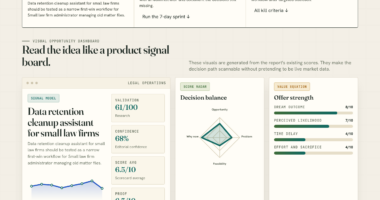
📊 Full opportunity report: The Stages Of A Restorative Justice Program Caseload Pipeline on IdeaNavigator AI — validation score, market gap, and execution plan.

Get business pricing on tech for your team
- Business-only prices and quantity discounts
- Tax-exempt purchasing
- Multiple users, one account, clear invoices
TL;DR

IdeaNavigator AI has described a proposed caseload pipeline for restorative justice programs, covering referrals, consent, circle scheduling and agreement completion. The outline is a product opportunity and validation plan, not evidence that a tool has been built, tested or adopted.
IdeaNavigator AI has outlined a proposed caseload pipeline for restorative justice programs, aimed at helping coordinators track referrals through consent, circle scheduling and completion of agreements. The proposal describes a potential workflow and a way to test demand; it does not report a launched product, completed pilot or measured results.
The concept targets case coordinators who manage referrals and related records across spreadsheets. The proposed system would give each case a status as it moves through intake, consent capture, circle scheduling and agreement-completion tracking, while flagging cases that are overdue. The outline identifies visibility into stalled cases and compliance with program processes as the central problem to address.
For an initial product, IdeaNavigator AI recommends a single-case pipeline rather than a broad administrative platform. The proposed fields would record whether the victim and responsible party have consented, when a restorative circle is scheduled, what terms were agreed and whether those terms have been completed. The outline does not specify how consent would be documented, which deadlines would trigger an overdue status or how programs would handle sensitive information.
The suggested validation exercise is to recruit four restorative justice coordinators and move their next ten live referrals through a manual pipeline board containing consent and completion fields. The test would assess whether improved visibility into overdue cases is valuable enough for programs to pay. The proposal also suggests an annual subscription billed per program, but gives no price, customer commitments or financial projections.
Tracking Cases Beyond Spreadsheets
Restorative justice programs coordinate multiple steps involving participants, facilitators and agreements. When those steps are recorded in separate spreadsheets, coordinators may have difficulty seeing which referrals are waiting for consent, which circles need scheduling and which agreements remain unfinished. A shared status view could make those handoffs easier to monitor, if it fits each program’s process.
The proposal frames rising referrals from courts and schools as a reason manual tracking may become harder to sustain, alongside greater reporting demands. It provides no caseload figures or independent evidence quantifying that pressure, so the scale of the problem is not established here. Still, the practical question is clear: can a narrowly scoped tool save coordinators enough time or improve follow-up enough to justify its cost?
That question matters because missed steps can affect participants and program operations. A clearer record may help staff follow up on stalled cases and report progress, but software alone cannot establish whether consent is informed, resolve disputes over agreement terms or guarantee completion. Those outcomes depend on program practice and the needs of the people involved.
Products Worth Considering

Logitech MX Brio Ultra HD 4K Webcam, Graphite

Amazon Kindle Paperwhite (12th Generation, 2024), 16 GB, 7-inch Display, Jade

Logitech MX Mechanical Wireless Illuminated Performance Keyboard – Clicky
As an affiliate, we earn on qualifying purchases.
From Referrals to Completion
Restorative justice processes vary, but the proposed workflow follows a sequence that programs may need to manage: a referral arrives, participants are contacted and consent is recorded, a circle is arranged, agreement terms are documented, and completion is followed up. The concept places those activities in a single case pipeline so staff can identify the current stage rather than relying on scattered records.
The outline presents this as a first-win workflow for coordinators, not a complete case-management system. It does not describe integrations with court or school records, participant communications, facilitator assignment, reporting exports or data-retention controls. Nor does it establish that all programs use the same stages or define “overdue” in the same way. Those omissions matter because a useful status board would need to reflect local procedures without treating different cases as interchangeable.
Pilot Results and Safeguards
No pilot findings are provided. It is not known whether coordinators have been recruited, whether any referrals have been tracked with the proposed board, or whether the workflow has improved overdue-case visibility. The outline also supplies no evidence that programs are prepared to pay an annual subscription or that a software product is under development.
Key implementation questions remain open: how participant consent and agreement details would be protected, who could access case records, how long information would be retained, and what reporting requirements a tool would need to meet. The proposal does not define an overdue threshold or explain how it would accommodate differing program policies. Its description of growing referrals and reporting demands is a stated rationale, not a quantified trend supported with figures in the outline.
Testing the Workflow With Coordinators
The next step set out in the proposal is to recruit four coordinators and track ten upcoming referrals per coordinator on a manual board. A useful evaluation would record whether staff can identify cases awaiting consent, scheduling or completion more readily, while also asking coordinators whether the process fits their existing safeguards and reporting duties.
After that test, the concept would need evidence of user benefit and willingness to pay before the proposed annual subscription model could be assessed. No timeline, pilot launch or development milestone has been announced. The proposed article-source attribution is included below; it does not change the status of the idea as a proposal without reported validation results.
Source: IdeaNavigator AI
Key Questions
Has a restorative justice case-tracking product launched?
The information available describes a product concept and a proposed manual test. It does not report a launch or identify a functioning software product.
What stages would the proposed pipeline track?
The outline covers intake, consent, circle scheduling and agreement completion, with a status view intended to flag overdue cases.
How would the idea be tested?
The proposed test would involve four coordinators using a manual board for their next ten live referrals each, with consent and completion fields. No results are reported.
What would the proposed service cost?
The outline suggests an annual subscription paid by each program, but provides no price or evidence of customer commitments.
What remains unknown about the proposal?
It is not clear whether a pilot is underway, whether coordinators would pay, or how the workflow would protect sensitive records and adapt to different program rules.
Source: IdeaNavigator AI