📊 Full opportunity report: How Advisors Can Track Trust Assets And Retitling on IdeaNavigator AI — validation score, market gap, and execution plan.
TL;DR
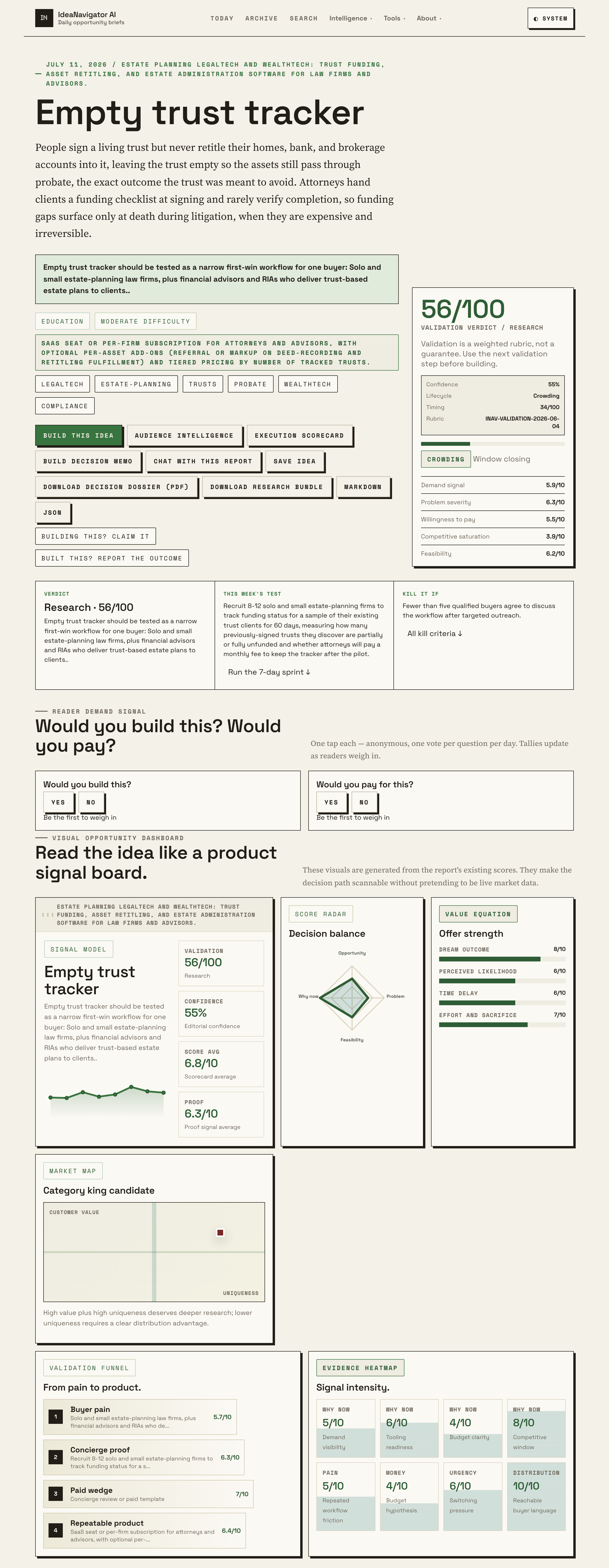
A proposed trust-funding tracker would let law firms and financial advisors record whether clients have retitled assets into living trusts, attach proof and send reminders. The concept has not been reported as a launched product: its proposed next step is a 60-day pilot with 8 to 12 small firms.
IdeaNavigator AI has proposed a trust-funding tracker for small law firms and financial advisors to monitor whether clients move assets into living trusts after signing estate-planning documents. The concept addresses a gap between creating a trust and funding it, but it remains a product opportunity and pilot plan, not a reported launch or tested service.
According to the IdeaNavigator AI proposal, the tracker would let an attorney or advisor create a checklist for each client trust, covering assets such as real estate, bank and brokerage accounts, business interests and beneficiary designations. Each item could be marked pending, in progress or confirmed funded. Firms could attach documentation, such as a recorded deed or an updated account statement, and send automated reminders when an item remains incomplete.
The proposal also describes a firm dashboard summarizing trust-funding status, including the percentage of listed assets marked funded. Its stated aim is to help professionals spot incomplete plans while clients can still take action. IdeaNavigator AI does not specify how the system would independently verify documents, connect with financial institutions or handle assets whose transfer requires separate legal or institutional steps.
IdeaNavigator AI suggests a subscription charged per firm or user, with pricing tiers based on the number of trusts tracked. It also raises optional fees or referral revenue tied to deed-recording and retitling services. The proposal recommends recruiting 8 to 12 solo or small firms for a 60-day pilot, then measuring how often previously signed trusts prove partly or wholly unfunded and whether firms would pay to continue using the tracker.
Closing the Trust-Funding Gap
A living trust document does not by itself place a person’s assets inside the trust. If property remains titled in an individual’s name, the trust may not control its transfer at death. That can leave families facing probate for assets the estate plan was intended to address. The IdeaNavigator AI proposal targets the administrative follow-through: keeping a record of what still needs to be retitled and whether the work appears complete.
As described in the proposal, a shared status view could make follow-up more systematic than a checklist handed over at signing and help firms identify clients who need attention before a transfer becomes time-sensitive. Those benefits are prospective; IdeaNavigator AI reports no pilot findings or evidence of reduced probate proceedings. The proposal does not establish that a tracking system could guarantee successful asset transfers or prevent disputes.
Top picks for "advisor track trust"
As an affiliate, we earn on qualifying purchases.
From Signed Plan to Funded Trust
The IdeaNavigator AI proposal targets solo and small estate-planning practices, as well as financial advisors or registered investment advisers that offer trust-based estate plans. It describes trust funding as a manual, fragmented step that document-drafting software does not close. The proposal also cites deed-funding services priced from $250 per deed as evidence of a market for fulfillment work. That is a figure cited in the proposal, not a standardized fee across providers.
IdeaNavigator AI estimates that about 11% of Americans hold a trust and describes estate-planning adoption and digital tools as growing in 2026. The proposal provides no survey citation, measurement period or definition of trust ownership for the 11% figure, so it should be treated as an estimate stated by the source rather than a fully documented market statistic. Its product thesis is that drafting tools and retitling services leave room for a separate layer that tracks completion across a client’s assets.
Pilot Evidence Still Missing
The IdeaNavigator AI proposal identifies no product launch, participating firms, customer interviews, pilot results or paying users. It remains unclear how often small firms encounter materially unfunded trusts, how much staff time a tracker would save, and whether clients would respond to reminders. The proposed 60-day test is intended to assess whether firms find incomplete trusts among existing clients and will pay a recurring fee afterward.
Several operational questions also remain open: what counts as sufficient proof for each asset, who reviews it, how the tracker handles sensitive financial records, and how it would distinguish a completed transfer from a document that has been submitted but not accepted. The proposal does not describe integrations, security controls or the legal responsibilities involved. It also does not establish that any tracked status would replace advice from an attorney or confirmation from a financial institution or recording office.
A 60-Day Firm Pilot
The next step in the IdeaNavigator AI proposal is to recruit 8 to 12 solo and small estate-planning firms and ask them to track funding for a sample of existing trust clients over 60 days. The test would count how many signed trusts are found to be partly or fully unfunded and gauge whether participating attorneys would pay a monthly fee to keep using the system. The proposal announces no start date or participating firms.
If the pilot proceeds, its results could show whether a funding dashboard and reminders fit firms’ existing workflows and whether the need is frequent enough to support subscription pricing. Until results are available, the tracker remains a proposed solution to a defined administrative problem rather than a validated product.
Source: IdeaNavigator AI
Key Questions
What would the proposed trust tracker do?
According to the IdeaNavigator AI proposal, it would let a firm list assets associated with each client trust, record whether retitling is pending, underway or confirmed, attach supporting documents and send reminders.
Has the tracker launched?
The IdeaNavigator AI proposal reports no launch. It suggests a 60-day pilot to test demand and willingness to pay.
Why does retitling matter?
A trust document does not automatically transfer assets into the trust. Assets left outside it may not be governed by the trust as intended and can require separate probate procedures.
How would the proposed idea be tested?
IdeaNavigator AI proposes recruiting 8 to 12 small firms to track a sample of existing trust clients for 60 days, count incomplete trusts and ask whether firms would pay to continue.
Source: IdeaNavigator AI