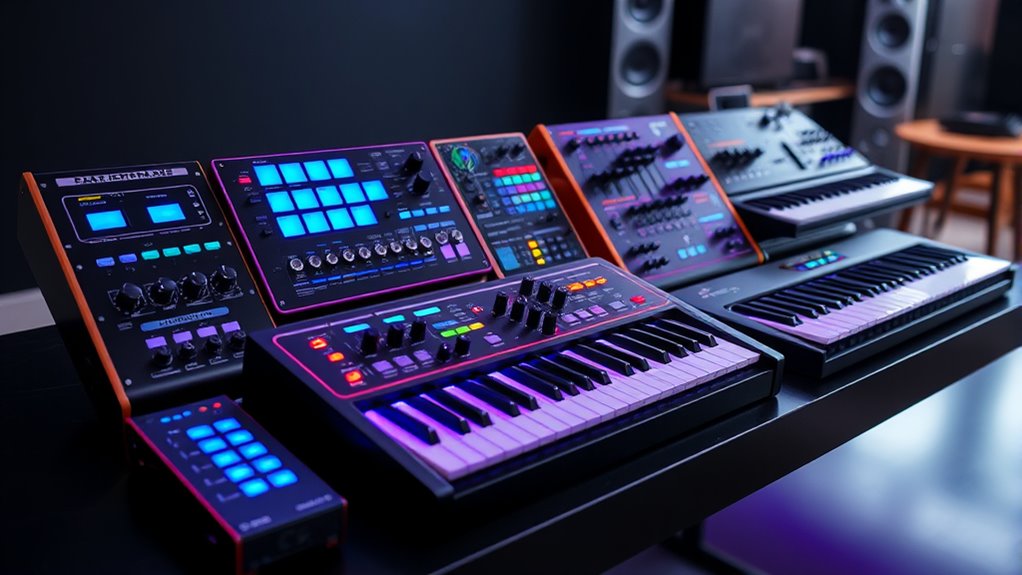

When it comes to synthesizers, choices can be overwhelming due to the wide range of styles, features, and price points. The MOOG Messenger stands out as the best overall for its rich analog sound and versatile sequencer, ideal for both studio and live use. The Korg Volca Bass offers a compact, affordable option perfect for beginners and on-the-go musicians. Meanwhile, the Stylophone GENX-2 provides a portable, feature-rich experience for curious newcomers and experimental players. As you browse options, you’ll face tradeoffs between sound quality, usability, portability, and price. Keep reading for a detailed breakdown to help you find the best synth for your music-making journey.

Get tech for your team delivered free — and shop member deals
- Fast, free delivery on millions of items
- Access to Prime Big Deal Days deals on October 6–7
- Prime Video, Amazon Music and more included
Key Takeaways
- Analog synthesizers like the MOOG Messenger deliver warm, classic tones but come with a higher price and larger footprint.
- Digital options such as the Korg Volca FM2 excel in versatility and affordability, making them attractive for beginners.
- Portability and built-in features vary widely; some models prioritize mobility, while others focus on studio-quality sound.
- Layering multiple synths can open creative possibilities but increases complexity and cost, so choose based on your experience level and goals.
- Many modern synths combine digital control with analog circuits, offering a blend of warmth and precision that appeals to a broad range of users.
| MOOG Messenger Monophonic Analog Synthesizer with 32 Keys, 64-Step Sequencer, 256 Presets, and RES BASS Compensation |  | Best Overall for Versatile Performance and Classic Sound | Number of Keys: 32 | Sequencer Steps: 64 | Presets: 256 | VIEW ON AMAZON | See Our Full Breakdown |
| Korg Volca Bass Analog Synthesizer |  | Best for Deep Basslines and Electronic Groove | Oscillators: 3 | Sequencer: 16-step | Power: Battery-powered | VIEW ON AMAZON | See Our Full Breakdown |
| Stylophone GENX-2 Portable Analogue Synthesizer with Built-in Speaker, LFO, Filter, Delay, and CV/Gate Output |  | Best for Creative Sound Design on the Go | Power: Battery operated | Built-in speaker: Yes | LFO: Yes, square and triangle waves | VIEW ON AMAZON | See Our Full Breakdown |
| Korg Volca FM2 Digital Synthesizer with 6 Voices and 16-step Sequencer |  | Best for Classic FM Synthesis in a Compact Package | Voices: 6 | Operators: 6 | Sequencer Steps: 16 | VIEW ON AMAZON | See Our Full Breakdown |
| Wireless Portable FM Synthesizer with Built-in Speaker and Battery |  | Best for On-the-Go FM Synthesis and Sound Exploration | Number of Operators: 6 | Algorithms: 32 | Preset Sounds: 128 | VIEW ON AMAZON | See Our Full Breakdown |
| Akai Professional MPK Mini MK3 25-Key USB MIDI Keyboard Controller |  | Best Compact MIDI Controller for Versatile Production | Keys: 25 velocity-sensitive keys | Pads: 8 backlit MPC-style drum pads | Knobs: 8 assignable knobs | VIEW ON AMAZON | See Our Full Breakdown |
| Stylophone The Original Pocket Electronic Synthesizer |  | Best Retro Pocket Synth for Beginners and Collectors | Sound: Analog, iconic retro sound | Octaves: 3 | Vibrato: Optional | VIEW ON AMAZON | See Our Full Breakdown |
| synthesizer | Connectivity | Power |
|---|---|---|
| MOOG Messenger Monophonic Anal | 6 CV patch points, external audio in, expression and sustain pedal ins, MIDI I/O, MIDI over USB-C | — |
| Korg Volca Bass Analog Synthes | SYNC jack, MIDI IN | Battery-powered |
| Stylophone GENX-2 Portable Ana | — | Battery operated |
| Korg Volca FM2 Digital Synthes | MIDI In/Out | Battery-powered |
| Wireless Portable FM Synthesiz | Bluetooth, USB, 3.5mm MIDI IN | — |
| Akai Professional MPK Mini MK3 | USB powered | — |
| Stylophone The Original Pocket | 3.5mm stereo input/output | 3 x AA batteries |
More Details on Our Top Picks
MOOG Messenger Monophonic Analog Synthesizer with 32 Keys, 64-Step Sequencer, 256 Presets, and RES BASS Compensation
The MOOG Messenger stands out for combining a portable design with high-quality analog sound and extensive modulation options. Its 32 semi-weighted keys and 64-step sequencer make it suitable for both live performance and studio work, especially compared to the more limited Korg Volca Bass, which is primarily a bass-focused machine. The Messenger’s wavefolding oscillators and next-gen ladder filter deliver rich, expressive tones, but its deep feature set can overwhelm beginners. Unlike the Volca FM2, which specializes in digital FM synthesis, this model offers a more tactile and warm analog experience, though at a higher price point. It’s perfect for those who want a portable, fully featured synth with versatile connectivity, but less so for casual users or those seeking immediate simplicity.
Pros:- Rich, authentic analog sound with wavefolding and resonance options
- Full-size keys suitable for performance and studio playing
- Versatile connectivity including MIDI and CV patch points
- Large preset library for quick sound access
Cons:- Complex interface may be daunting for beginners
- Lacks built-in effects or digital sounds
- Higher price compared to simpler synthesizers
Best for: Professional musicians and advanced enthusiasts who need a portable, feature-rich analog synth for performances and studio use.
Not ideal for: Beginners or casual hobbyists who may find its extensive features and higher price point intimidating.
- Number of Keys:32
- Sequencer Steps:64
- Presets:256
- Oscillators:2 wavefolding VCOs with sync and FM
- Filters:Next-Gen Ladder Filter with RES BASS
- Connectivity:6 CV patch points, external audio in, expression and sustain pedal ins, MIDI I/O, MIDI over USB-C
Our verdict“A top choice for experienced players seeking a portable, versatile analog synth with modern enhancements.”
Korg Volca Bass Analog Synthesizer
The Korg Volca Bass excels at delivering punchy, fat bass sounds with its three oscillators, making it ideal for genres like acid house or techno. Its 16-step sequencer allows for sequencing intricate bass lines, standing out against the simpler sequencing options of the Volca FM2. While it’s highly portable and battery-powered, its focus is narrow—limited mostly to bass synthesis—so it’s not suitable if you’re after a full synth experience like the MOOG Messenger. Tuning can drift over time due to its analog circuitry, and the onboard speaker isn’t designed for critical listening, making it less suited for studio use. Still, for bass-focused performers and producers, it offers incredible sound with minimal setup.
Pros:- Powerful analog bass sounds with three oscillators
- Built-in 16-step sequencer for complex bass lines
- Compact, battery-powered design for portability
- Simple controls for quick sound shaping
Cons:- Limited to bass sounds, not a full synth
- Analog tuning may require adjustments over time
- Built-in speaker offers limited audio quality
Best for: Electronic music producers and performers seeking a dedicated bass synth that’s portable and easy to use.
Not ideal for: Users looking for a versatile synthesizer capable of creating a wide range of sounds beyond bass tones.
- Oscillators:3
- Sequencer:16-step
- Power:Battery-powered
- Connectivity:SYNC jack, MIDI IN
- Features:Slide function, Active Step, Self-tuning
Our verdict“A highly capable bass synth ideal for performers and producers focused on deep, punchy basslines in portable setups.”
Stylophone GENX-2 Portable Analogue Synthesizer with Built-in Speaker, LFO, Filter, Delay, and CV/Gate Output
The Stylophone GENX-2 offers a highly portable, versatile synthesis platform with a stylus-powered keyboard and a range of sound-shaping tools. Its onboard LFO, resonant low-pass filter, and analog delay allow for expressive, evolving sounds, making it a strong choice for experimental musicians and sound designers. Compared to the more straightforward Korg Volca Bass, the GENX-2 provides greater modulation options and external connectivity, including CV/Gate outputs for integrating with modular setups. The built-in speaker and battery operation make it ideal for spontaneous music creation, though the learning curve for synthesis fundamentals can be steep for beginners. Its limited polyphony and preset library mean it’s better suited as a creative tool than a primary instrument.
Pros:- Portable with built-in speaker for on-the-go use
- Rich modulation and sound-shaping features including filter, delay, and LFO
- Flexible connectivity for modular and external gear
- Expressive performance controls with stylus keyboard
Cons:- Steep learning curve for newcomers
- Limited preset sounds, requiring external gear for more variety
- Polyphony may be limited for complex performances
Best for: Sound designers, experimental musicians, and portable synthesizer enthusiasts who want deep sound modulation options.
Not ideal for: Beginners or performers seeking a simple, plug-and-play synthesizer for live performance or production.
- Power:Battery operated
- Built-in speaker:Yes
- LFO:Yes, square and triangle waves
- Filter:Resonant low-pass
- Outputs:Headphone, audio, CV, Gate
- Keyboard:Stylus-powered with expression strip
Our verdict“An inventive, portable synth perfect for users who want in-depth sound manipulation and external connectivity in a small package.”
Korg Volca FM2 Digital Synthesizer with 6 Voices and 16-step Sequencer
The Korg Volca FM2 offers a straightforward approach to digital FM synthesis, with six voices and classic algorithms inspired by the DX7. Its 16-step sequencer makes it easy to create intricate, shimmering tones, especially compared to the more complex features of the MOOG Messenger. While six voices can limit dense arrangements, this compact device is ideal for melodic lines and layered textures. The built-in effects, such as chorus and reverb, add polish, though the limited polyphony might frustrate users seeking full arrangements. Battery operation and small size make it perfect for mobile musicians, but the built-in speakers are not suited for professional studio monitoring. It’s an accessible, reliable option for FM synthesis beginners and enthusiasts alike.
Pros:- Six-voice FM synthesis with classic algorithms
- Compact and portable with built-in speakers
- Includes 16-step sequencer for easy pattern creation
- Effects like chorus and reverb for sound enhancement
Cons:- Limited to 6 voices, restricting complex layering
- Built-in speakers are not suitable for studio use
- Battery life may be short with intensive use
Best for: Musicians and producers interested in classic FM sounds with simple programming in a portable format.
Not ideal for: Producers needing high polyphony or extensive effects for complex arrangements.
- Voices:6
- Operators:6
- Sequencer Steps:16
- Effects:Chorus and Reverb
- Connectivity:MIDI In/Out
- Power:Battery-powered
Our verdict“A user-friendly, portable FM synthesizer perfect for exploring classic digital sounds on the move.”
Wireless Portable FM Synthesizer with Built-in Speaker and Battery
The Wireless Portable FM Synthesizer combines 128 preset sounds, six operators, and 32 algorithms in a compact, battery-powered unit. Its extensive effects and arpeggiator expand creative possibilities, while Bluetooth and USB MIDI support enable seamless control and sound integration. Compared with the more specialized Korg Volca FM2, this model emphasizes versatility and modern connectivity, making it ideal for live performers and mobile producers. The 27-key silicone keyboard limits performance complexity somewhat, and its learning curve for advanced FM programming can be steep without prior experience. Nevertheless, its portability and extensive sound palette make it a compelling option for sound design on the go, especially for those who want a feature-rich FM synth in a small package.
Pros:- Portable, battery-powered design for mobility
- 128 presets and multiple effects for rich sound options
- MIDI and Bluetooth connectivity for flexible control
- User-friendly TFT display for navigation
Cons:- Limited keys may restrict performance complexity
- No external power supply option mentioned
- Advanced FM programming may be challenging for newcomers
Best for: Mobile musicians and sound designers seeking a versatile FM synth with modern connectivity and a broad sound library.
Not ideal for: Beginners or users requiring a full-sized keyboard for advanced performance or detailed programming.
- Number of Operators:6
- Algorithms:32
- Preset Sounds:128
- Effects:6 (Filter, Reverb, Delay, Distortion, Chorus, Phaser)
- Keys:27 full-range silicone keys
- Connectivity:Bluetooth, USB, 3.5mm MIDI IN
Our verdict“A flexible, portable FM synthesizer suited for sound exploration and live performance on the move.”
Akai Professional MPK Mini MK3 25-Key USB MIDI Keyboard Controller
The Akai MPK Mini MK3 stands out as the most portable and flexible MIDI controller in this lineup, offering a full range of control with only 25 keys, making it ideal for producers who need mobility without sacrificing features. Compared to the Stylophone, it provides a broader control surface, including 8 assignable knobs and drum pads, which are essential for more complex productions. The MK3’s integration with NKS and bundled sound library make it a compelling choice for users seeking professional software control in a compact form. However, its limited keys may frustrate keyboardists who need more range, and the setup process for full customization can be a hurdle for beginners. It excels for producers on the go or those with limited studio space but isn’t suited for those requiring a full-sized keyboard or advanced sound design.
Pros:- Highly portable and compact, ideal for on-the-go production
- Includes extensive sound libraries and software for immediate use
- 8 backlit drum pads and assignable knobs offer comprehensive control
Cons:- Limited to 25 keys, which may not suit all keyboardists or complex arrangements
- Requires software setup for full customization and advanced features
Best for: Musicians and producers who need a portable, feature-rich MIDI controller for studio and mobile use.
Not ideal for: Keyboard players requiring full-size keys or users seeking a simple, plug-and-play device with minimal setup.
- Keys:25 velocity-sensitive keys
- Pads:8 backlit MPC-style drum pads
- Knobs:8 assignable knobs
- Connectivity:USB powered
- Included Software:Music production software, Native Instruments sound package
- Special Features:4-way thumbstick, arpeggiator, NKS support
Our verdict“This pick makes the most sense for producers who prioritize portability and versatile control in a compact form.”
Stylophone The Original Pocket Electronic Synthesizer
The Stylophone offers a distinct flavor of vintage charm and straightforward playability, making it a favorite among beginners and collectors alike. Its analog, iconic sound differs sharply from the digital versatility of products like the Korg Volca FM2, appealing to those seeking a classic tone or a fun, tactile experience. The touch-sensitive metal surface and built-in speaker make it an instant musical toy, yet its limited 3-octave range restricts more complex melodic work. Its portability—fitting easily in a pocket—is unmatched, but relying on batteries and lacking rechargeable options can be inconvenient for frequent use. Additional software is necessary for advanced sound manipulation, which isn’t included. Overall, it’s perfect for those wanting a simple, nostalgic synth, but less so for serious musicians needing extended range or detailed editing.
Pros:- Extremely compact, easily fits in your pocket
- Simple, intuitive play via touch-sensitive surface
- Authentic analog sound loved by collectors
Cons:- Limited to just 3 octaves, which can restrict melodic options
- Battery-powered only, no rechargeable option, less eco-friendly
Best for: Beginners, portable musicians, and vintage sound enthusiasts seeking a compact, easy-to-play synth with a nostalgic vibe.
Not ideal for: Experienced producers or keyboardists who require a wider range, advanced features, or software integration for sound design.
- Sound:Analog, iconic retro sound
- Octaves:3
- Vibrato:Optional
- Power:3 x AA batteries
- Size:Less than 12cm wide
- Connectivity:3.5mm stereo input/output
Our verdict“This is a fun, nostalgic pocket synth best suited for beginners or those wanting a portable, vintage sound source.”

How We Picked
We evaluated synthesizers based on their sound quality, versatility, build quality, ease of use, and value for money. Our selection balances flagship models with affordable options, ensuring there’s a good fit for beginners and experienced musicians alike. We prioritized products with reliable controls, creative features such as sequencers and modulation, and those that suit various music styles. The ranking reflects a combination of user feedback, feature set, and overall performance, helping buyers find options that excel in real-world scenarios.Factors to Consider When Choosing Synthesizers
Choosing the right synthesizer depends on several factors beyond just sound quality. Understanding your intended use—whether for live performance, studio production, or experimentation—will guide your decision. Consider how much space you have, your budget, and whether you prefer analog warmth or digital flexibility. Being aware of typical pitfalls, such as overestimating the importance of presets or underestimating the learning curve, can save you time and money. Here are key factors to consider when selecting a synthesizer:Sound Quality and Tone
Sound quality is often the primary concern, especially for professional use. Analog synths tend to produce warmer, richer tones, but they also require more maintenance. Digital synths can offer a wider variety of sounds and easier recall of presets. Think about whether you want classic, vintage sounds or modern, experimental textures, and choose accordingly.
Portability and Size
If you plan to perform live or travel frequently, a compact, lightweight synth becomes essential. Many portable options include built-in speakers and battery power, but they may sacrifice some sound depth or control features. Larger studio-focused models often provide extensive control but are less convenient for on-the-go use.
Features and Interface
Look for a synth with intuitive controls and useful features like sequencers, modulation options, or effects. Beginners benefit from simplified interfaces, while advanced users may prioritize deep modulation capabilities and connectivity options. Avoid models that are overly complex if you’re just starting out, but ensure there is room to grow as your skills develop.
Budget and Value
Prices range from budget-friendly models to high-end instruments. Cheaper options may lack certain features or sound depth but are great for learning or casual use. Investing in a mid-range or premium synth can pay off in durability and sound quality if you have specific production needs or professional goals.
Compatibility and Connectivity
Consider how the synth integrates with your existing setup. MIDI compatibility, CV/gate outputs, and USB connectivity are common features that enable integration with other gear. Assess your workflow to avoid purchasing a synth that doesn’t connect easily with your DAW or hardware.
Frequently Asked Questions
Is it better to choose an analog or digital synthesizer?
The choice depends on your goals and budget. Analog synthesizers generally produce warmer, more organic sounds, which many musicians prefer for their character and depth. However, they tend to be more expensive and require more maintenance. Digital synthesizers offer a broader palette of sounds, are often more affordable, and provide easier presets and memory storage. For versatility and convenience, many users opt for digital or hybrid models, especially when starting out.
Can I use a synthesizer live without a lot of experience?
Yes, but with some caveats. Simpler, user-friendly models with preset banks and straightforward controls are best suited for live use by beginners. Features like built-in arpeggiators, step sequencers, and easy connectivity can make live performance smoother. As you gain experience, more complex synths will offer additional creative options, but starting with an accessible model helps build confidence and avoids frustration.
Do I need a keyboard synthesizer or a module?
This depends on your playing style and setup. Keyboard synthesizers include built-in keys, making them more intuitive for performance and playing melodies. Modules, on the other hand, are often more compact and can connect to external controllers, which is ideal if you already own a MIDI keyboard or want a minimal setup. Consider your space, budget, and whether you prefer playing directly or controlling via a separate MIDI device.
Are presets important for beginners?
Presets can be a helpful starting point for beginners, providing instant access to a variety of sounds without deep programming. However, relying solely on presets might limit learning about synthesis fundamentals. As you progress, customizing and creating your own sounds becomes more rewarding and essential for developing your unique style. Choose a synth that offers both good presets and the ability to tweak sounds easily.
How much should I expect to spend for a good beginner synth?
Entry-level synthesizers typically range from $100 to $500. In this range, you can find models with decent sound quality, basic features, and portability. Investing slightly more—around $300–$500—often provides better sound diversity, more control options, and durability, making it a worthwhile upgrade for those serious about learning. Avoid very cheap models if you want a reliable instrument that can grow with your skills.
Conclusion
Choosing the right synthesizer hinges on your experience level, budget, and intended use. For beginners or those seeking affordability, the Korg Volca Bass or Stylophone GENX-2 provide excellent starting points. If you desire a versatile, high-quality instrument, the MOOG Messenger offers a superb balance of sound and features for both studio and live settings. For professionals seeking premium craftsmanship and deep control, investing in a high-end analog or hybrid synth makes sense. Ultimately, your ideal choice depends on how you plan to use your synth and what sounds inspire you most.
As an affiliate, we earn on qualifying purchases.Halloween Picks
halloween