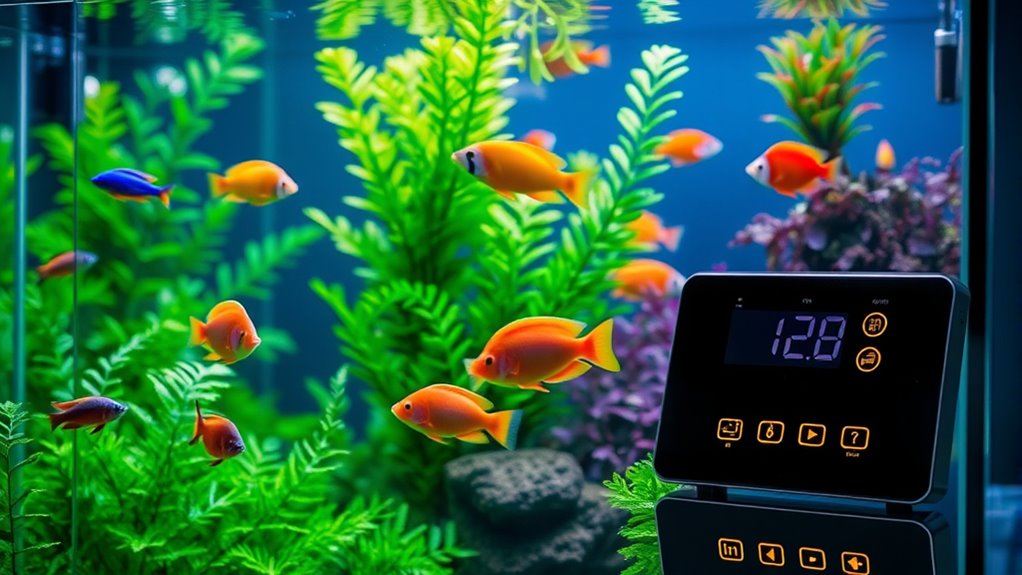

Choosing an aquarium controller depends on what you need it to control: tank temperature, heating and cooling together, or conditions in the surrounding room. The Inkbird ITC-308S models lead for temperature management because they operate separate heating and cooling devices; the ITC-308S with a submersible probe is my strongest all-around pick for aquarium-focused use. The simpler Inkbird day-and-night controller suits tanks that only need heat, while the AvidAqua Insight Pro tracks ambient air conditions rather than controlling aquarium equipment. The main tradeoffs are control versus monitoring, probe placement, and the stated 1200-watt output limit on the Inkbird temperature controllers.

Get business pricing on tech for your team
- Business-only prices and quantity discounts
- Tax-exempt purchasing
- Multiple users, one account, clear invoices
Complete the kit


Key Takeaways
- The Inkbird ITC-308S with a submersible probe is the clearest fit when you need a temperature controller designed around aquarium water monitoring and both heating and cooling.
- The other Inkbird ITC-308S is also a dual-stage choice; compare its stated high- and low-temperature alerts and broad tank suitability with the submersible-probe model’s explicit probe detail.
- The Inkbird day-and-night controller is the simpler pick for heat-only setups, with separate temperature settings for daytime and nighttime but no cooling outlet.
- AvidAqua Insight Pro monitors room temperature, humidity, carbon dioxide, and VOCs; it does not control tank heaters or chillers based on the supplied product details.
- All three Inkbird temperature controllers list a 1200-watt maximum at 110 volts, so check connected equipment loads before relying on them.
| Inkbird ITC-308S Aquarium Temperature Controller with Submersible Probe |  | Best Overall for Aquarium Temperature Control | Brand: Inkbird | Model: ITC-308S | Control mode: On/off | VIEW ON AMAZON | See Our Full Breakdown |
| Inkbird ITC-308S Dual-Stage Aquarium Temperature Controller |  | Best for Broad Tank Compatibility | Control type: Dual-stage heating and cooling | Display: Measured and set temperatures | Temperature units: Celsius or Fahrenheit | VIEW ON AMAZON | See Our Full Breakdown |
| Inkbird Digital Outlet Temperature Controller with Day and Night Control |  | Best for Heat-Only Day and Night Settings | Control mode: Heating only; on/off control | Temperature display: Measured and set temperatures | Temperature units: Celsius or Fahrenheit | VIEW ON AMAZON | See Our Full Breakdown |
| AvidAqua Insight Pro Aquarium Controller Display |  | Best for Ambient Air Monitoring | Monitoring: Ambient temperature, humidity, carbon dioxide (CO₂), and volatile organic compounds (VOCs) | Temperature location: Surrounding environment | Water-temperature control: Not specified | VIEW ON AMAZON | See Our Full Breakdown |
| aquarium controller | Maximum output load | Alarms | Control mode | Display |
|---|---|---|---|---|
| Inkbird ITC-308S Aquarium Temp | 1200 W at 110 V | — | On/off | Measured and set temperatures |
| Inkbird ITC-308S Dual-Stage Aq | 1200 W at 110 V | High temperature, low temperature, and sensor failure | — | Measured and set temperatures |
| Inkbird Digital Outlet Tempera | 1200 watts at 110 volts | Over-temperature and sensor fault | Heating only; on/off control | — |
| AvidAqua Insight Pro Aquarium | — | Not specified | — | — |
More Details on Our Top Picks
Inkbird ITC-308S Aquarium Temperature Controller with Submersible Probe
This is my top pick for a buyer who wants one controller to manage both sides of aquarium temperature. The separate heating and cooling outlets let it switch a heater or cooling device as readings call for, while the fully submersible probe is directly suited to measuring aquarium water. That makes its role more tank-specific than the AvidAqua Insight Pro, which tracks room conditions but is not described as controlling equipment.
The dual display shows the measured and target temperatures together, so it is easier to see the gap between current conditions and your setting at a glance. Calibration and over-temperature and sensor-fault alarms add useful checks for a setup where probe readings matter. Compared with the heat-only Inkbird day-and-night model, this controller gives up scheduled day/night targets but gains cooling control. That is a meaningful exchange for tanks where room heat or seasonal changes can push water above the desired range.
Its main constraint is the 1200-watt limit at 110 volts. I would check the combined requirements of the connected equipment and the electrical setup before choosing it. The supplied description lists a controller but does not establish extras such as remote access, data logging, or a broader automation system. Buyers seeking those capabilities should not assume they are included. For a straightforward aquarium temperature task, though, its probe and dual-stage control make the strongest package in this group.
Pros:- Controls heating and cooling through separate outlets
- Fully submersible probe is suited to aquarium water
- Shows measured and set temperatures together
- Includes calibration and over-temperature and sensor-fault alarms
Cons:- Maximum output load is 1200 W at 110 V
- Day-and-night scheduling is not listed
- The supplied details do not describe remote access or data logging
Best for: Aquarium keepers who want one controller with a submersible probe to switch both heating and cooling equipment.
Not ideal for: Buyers who need day-and-night temperature scheduling, remote monitoring, or a controller for loads above the stated limit.
- Brand:Inkbird
- Model:ITC-308S
- Control mode:On/off
- Temperature control:Heating and cooling
- Probe:Fully submersible
- Display:Measured and set temperatures
- Maximum output load:1200 W at 110 V
- Alarms and adjustment:Calibration, over-temperature, and sensor-fault alarms
Our verdict“I would choose this ITC-308S first for straightforward aquarium water-temperature control that needs both heating and cooling.”
Inkbird ITC-308S Dual-Stage Aquarium Temperature Controller
This second dual-stage Inkbird is a strong alternative when you want heating and cooling control across different aquarium types. Its description explicitly names freshwater and saltwater aquariums, coral tanks, ornamental shrimp, and tropical fish. It also specifies high- and low-temperature alerts, a sensor-failure alarm, Celsius and Fahrenheit display, and an input range of 100–240 VAC. Those details make it easier to match to a varied tank setup than the simpler heat-only option.
Compared with the submersible-probe ITC-308S, this listing gives more detail about supported tank categories and power input, but it does not explicitly call out a fully submersible probe. If that probe characteristic is a deciding factor for your installation, the other ITC-308S has the clearer description. Both models list the same 1200-watt maximum at 110 volts and dual-stage control, so the distinction here rests on the stated specifications, not a claim that one has greater control capacity.
The unit still uses on/off switching, and the product details do not describe advanced scheduling, phone alerts, or historical temperature records. Its load limit deserves attention when pairing it with larger equipment. For a keeper who wants a dual-stage controller and values stated compatibility across common freshwater and marine setups, this is a sensible pick; for a tank where probe immersion is the key requirement, I would favor the submersible-probe listing instead.
Pros:- Controls heating and cooling devices
- Lists suitability for freshwater and saltwater tanks, coral, shrimp, and tropical fish
- Displays measured and set temperatures in Celsius or Fahrenheit
- Includes high- and low-temperature and sensor-failure alarms
Cons:- Maximum output load is 1200 W at 110 V
- Probe immersion rating is not specified in the supplied details
- Remote access and temperature logging are not listed
Best for: Keepers of freshwater, saltwater, coral, shrimp, or tropical fish tanks who want dual-stage control and clearly specified temperature alerts.
Not ideal for: Buyers who need explicit confirmation of a fully submersible probe or advanced connectivity and scheduling.
- Control type:Dual-stage heating and cooling
- Display:Measured and set temperatures
- Temperature units:Celsius or Fahrenheit
- Alarms:High temperature, low temperature, and sensor failure
- Maximum output load:1200 W at 110 V
- Input power:100–240 VAC, 50/60 Hz
- Maximum current:10 A
- Suitable for:Freshwater and saltwater aquariums, coral tanks, ornamental shrimp, and tropical fish
Our verdict“I would pick this model when its stated tank compatibility and alert details matter more than an explicitly specified submersible probe.”
Inkbird Digital Outlet Temperature Controller with Day and Night Control
The defining reason to choose this Inkbird is its separate day and night temperature settings. For a tank that only needs a heater, scheduled targets can match a keeper’s intended daily temperature pattern without adding a separate timer. It also displays the measured and set temperatures together and includes calibration, over-temperature alerts, and sensor-fault alerts. That is a useful step up from a basic thermostat that only switches heat around one fixed target.
Compared with the two ITC-308S controllers, the tradeoff is direct: this unit is for heating only. It cannot run cooling equipment, so it is a poor match if a tank regularly gets too warm or needs active temperature reduction. The dual-stage ITC-308S models are more flexible for that situation, while this one offers a schedule they are not described as having. I would choose it when the day/night feature matters more than cooling.
The listed maximum is 1200 watts at 110 volts, so heater demand still needs checking. It is a plug-and-play option, but its simple remit should not be confused with a full aquarium automation system. The product details describe temperature control and alarms, not lighting, water-level management, pumps, or network alerts. If those systems are already handled separately and heat is the only gap, this controller has a focused and understandable job.
Pros:- Plug-and-play design
- Supports separate day and night temperature settings
- Displays measured and set temperatures simultaneously
- Includes calibration and over-temperature and sensor-fault alarms
Cons:- Heating only, with no cooling function
- Maximum output load is 1200 W at 110 V
- Does not replace a broader controller for other aquarium equipment
Best for: Aquarium owners who need a straightforward heater controller with distinct day and night temperature targets.
Not ideal for: Tanks that need active cooling, dual-stage control, or broader aquarium automation.
- Control mode:Heating only; on/off control
- Temperature display:Measured and set temperatures
- Temperature units:Celsius or Fahrenheit
- Time cycles:Separate day and night temperature settings
- Maximum output load:1200 watts at 110 volts
- Alarms:Over-temperature and sensor fault
Our verdict“I would choose this Inkbird for a heater-only tank where day and night targets are more useful than cooling control.”
AvidAqua Insight Pro Aquarium Controller Display
The AvidAqua Insight Pro occupies a different place in this roundup: it monitors the air around the aquarium, including ambient temperature, humidity, carbon dioxide, and volatile organic compounds. Those readings can help a keeper understand room conditions that may affect the aquarium environment, especially where ventilation or nearby equipment is a concern. It is the only product here with stated CO₂ and VOC detection.
That makes it a companion monitor rather than a replacement for the Inkbird temperature controllers. The ITC-308S models read tank temperature and switch heating or cooling equipment; the AvidAqua description does not say it measures water temperature, connects to outlets, or controls a heater or chiller. Buyers seeking an aquarium thermostat should choose one of the Inkbirds. Buyers who already manage tank temperature and want additional information about the room have a more relevant use for this display.
The supplied details are sparse: they do not identify the display’s connectivity, alert behavior, accuracy, calibration, or data history. I would not rely on it for a control action that is not specified. Its value in a controller roundup is the distinct monitoring role, but that narrow role and missing control information place it behind the Inkbirds for direct aquarium management.
Pros:- Monitors ambient temperature and humidity
- Detects carbon dioxide
- Detects volatile organic compounds
- Adds room-condition information beyond the Inkbird temperature readings
Cons:- Tank-temperature control is not specified
- Heater and cooling outlets are not listed
- The supplied details do not describe alarms, connectivity, or data history
Best for: Aquarium keepers who want to monitor room temperature, humidity, CO₂, and VOCs alongside a separate tank controller.
Not ideal for: Anyone looking for water-temperature measurement or automatic heater and chiller switching.
- Monitoring:Ambient temperature, humidity, carbon dioxide (CO₂), and volatile organic compounds (VOCs)
- Temperature location:Surrounding environment
- Water-temperature control:Not specified
- Heating or cooling outlets:Not specified
- Alarms:Not specified
- Connectivity:Not specified
Our verdict“I would treat the Insight Pro as a room-condition monitor that complements a tank controller, not as the aquarium’s temperature controller.”

How We Picked
I ranked these options by how directly they help an aquarium keeper monitor or manage the tank. A true temperature controller should connect the temperature reading to a useful action, such as switching a heater or cooling device. On that basis, the two dual-stage Inkbird controllers come first: both can handle heating and cooling, while the submersible probe description makes the ITC-308S especially clear for water-temperature use. I distinguish the two by the details provided about probe design, alarms, units, and intended tank types rather than treating their similar names as proof they are identical.
The heat-only Inkbird ranks behind them because its day-and-night schedule and fault alarms are useful, but it cannot activate cooling equipment. AvidAqua Insight Pro fills a different role: it monitors ambient temperature, humidity, CO₂, and VOCs, but the listing does not describe tank-temperature control or outlets. I include it as a complementary monitoring option, not as a substitute for a heater controller. I also weighed practical constraints, including probe suitability and the stated 1200-watt at 110-volt maximum on the Inkbird units. I did not infer features the product details do not state.
| aquarium controller | Control mode | Alarms |
|---|---|---|
| Inkbird ITC-308S Aquarium Temp | On/off | — |
| Inkbird ITC-308S Dual-Stage Aq | — | High temperature, low temperature, and sensor failure |
| Inkbird Digital Outlet Tempera | Heating only; on/off control | Over-temperature and sensor fault |
| AvidAqua Insight Pro Aquarium | — | Not specified |
Factors to Consider When Choosing Aquarium Controllers
I would start by separating tank control from room monitoring, then match the controller’s outputs and probe to the equipment and conditions in your aquarium.Decide whether you need heat, cooling, or both
A heater-only controller can maintain a target when water runs cool, but it cannot respond when the tank overheats. The day-and-night Inkbird is the only option here with separately stated time-based temperature targets, making it a fit for a heat-only routine. The ITC-308S models add cooling control alongside heating, which matters in warm rooms or setups with a chiller or fan connected. Match the function to the problem you need to solve; a controller cannot switch equipment it does not support.
Check what the probe actually measures
For aquarium temperature control, the reading needs to represent the water you want to regulate. The ITC-308S with a fully submersible probe states that use plainly. The other ITC-308S listing describes temperature control but does not specify probe immersion in the supplied details. AvidAqua Insight Pro monitors the surrounding environment, which can add room context but does not replace water measurement. Before choosing, confirm that probe placement and the intended measurement point suit your tank.
Match alerts and displays to your routine
All three Inkbird descriptions include a display of measured and set temperatures, and each mentions alarms related to temperature or probe faults. The dual-stage models specify separate high- and low-temperature alerts in one listing, while the heat-only model emphasizes over-temperature and sensor-fault warnings. These features make it easier to notice a reading problem or temperature excursion, but none of the supplied descriptions promises phone notifications. If you need alerts when away from the tank, verify that capability before buying.
Check electrical capacity and the equipment setup
The Inkbird temperature controllers state a 1200-watt maximum at 110 volts. Compare that limit with the equipment you intend to connect, and confirm your local voltage and outlet requirements. The dual-stage model listing also states a maximum current of 10 A and a 100–240 VAC input, but its output load still needs to fit your devices. An undersized controller is a poor match even if its temperature functions otherwise suit the tank.
Treat monitoring and control as different jobs
A monitor reports conditions; a controller uses a reading to switch equipment. The AvidAqua display’s ambient temperature, humidity, CO₂, and VOC readings may be useful around an aquarium, but the details do not describe heater or chiller switching. The Inkbirds directly manage temperature equipment. If you want both kinds of information, think of the AvidAqua as a possible addition to a separate tank-temperature controller rather than a direct substitute.
Frequently Asked Questions
Which of these aquarium controllers can manage both heating and cooling?
Both Inkbird ITC-308S models are described as dual-stage controllers for heating and cooling. The B07RXYS17V listing explicitly specifies a fully submersible probe, while the B07R195CQF listing provides additional details about tank types, temperature alerts, and input power. The Inkbird day-and-night model is heating only, and AvidAqua Insight Pro is described as an ambient monitor rather than an equipment controller.
Is the AvidAqua Insight Pro a replacement for a tank thermostat?
Not based on the supplied product details. It monitors ambient temperature, humidity, carbon dioxide, and VOCs, but those details do not say that it reads aquarium water temperature or controls heater and cooling outlets. I would pair it with a dedicated tank-temperature controller if automatic temperature management is the goal.
What does day-and-night temperature control add?
The heat-only Inkbird supports separate temperature settings for daytime and nighttime, so a keeper can set different targets across those periods without relying on a single fixed target. That feature may suit a scheduled heating routine, but it does not add cooling. If water can become too warm, one of the dual-stage ITC-308S models is a better functional match.
Do the Inkbird controllers support any equipment load?
The supplied specifications list a maximum output load of 1200 watts at 110 volts for all three Inkbird temperature controllers. Check the electrical demands of the heater and cooling equipment you plan to connect, as well as your outlet and voltage setup. The dual-stage B07R195CQF listing also gives a 10 A maximum current and a 100–240 VAC input specification.
Which controller is the best fit for a saltwater or coral tank?
The dual-stage Inkbird ITC-308S B07R195CQF explicitly lists saltwater aquariums and coral tanks as suitable uses, with heating and cooling control and high- and low-temperature alerts. The B07RXYS17V is also a strong option when its fully submersible probe is the deciding factor. Neither supplied description establishes advanced remote monitoring, so buyers who need that should check for it separately.
Conclusion
For all-around tank temperature control, I recommend the Inkbird ITC-308S with the submersible probe; it combines water-focused sensing with heating and cooling. Choose the other ITC-308S if its stated support for freshwater, saltwater, coral, shrimp, and tropical setups and its alert specifications align better with your tank. For a heater-only aquarium with scheduled day and night targets, the first Inkbird is the more focused choice. Pick AvidAqua Insight Pro only when room-condition monitoring is your goal or a complement to a separate thermostat. In every case, check the listed load and confirm the functions you need are specified before connecting equipment.
Fall Picks
fall essentials
As an affiliate, we earn on qualifying purchases.