

Corporate funding is rapidly boosting classroom AI adoption by investing in teacher training and AI tools. This support helps teachers incorporate AI for personalized feedback, lesson planning, and reducing workload. As a result, more educators feel comfortable using AI, making lessons more innovative and efficient. The trend is expanding across all education levels, transforming teaching practices. Stay with us to discover how these investments are shaping the future of education even further.
Key Takeaways
- Corporations are investing heavily in AI training programs for teachers to support classroom integration.
- Increased funding has led to widespread adoption of AI tools by educators across all levels.
- Teacher training initiatives focus on developing AI literacy, ethical use, and effective classroom implementation.
- AI adoption is accelerating, with many educators incorporating generative AI weekly to improve instruction.
- The shift toward AI in classrooms is driven by corporate investments aiming to enhance educational outcomes and efficiency.
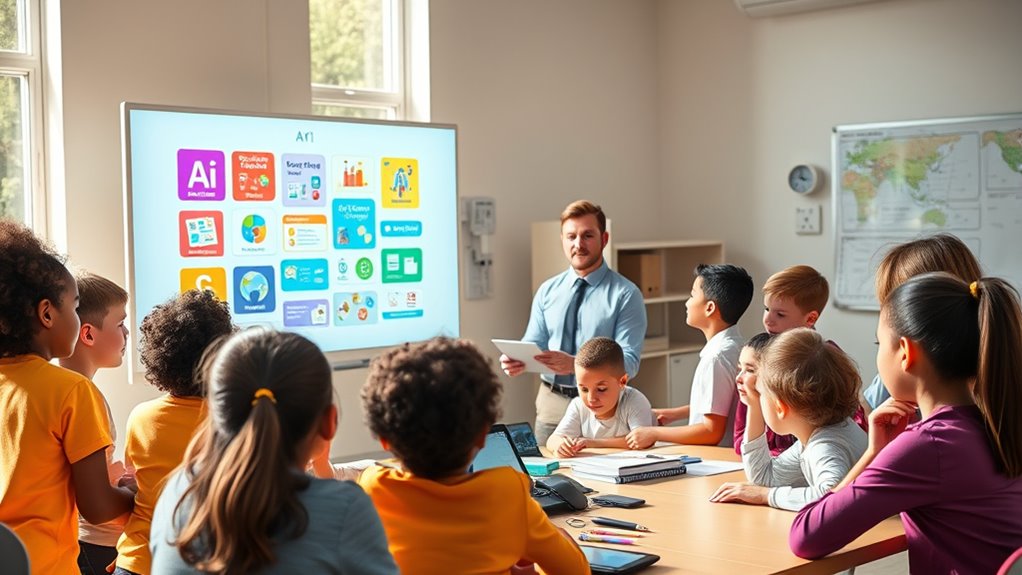
Artificial intelligence is rapidly transforming classrooms worldwide, with adoption rates soaring among educators, students, and institutions alike. You’re likely noticing how AI tools are becoming integral to daily teaching and learning. The global AI in education market hit $7.57 billion in 2025, marking a 46% jump from the previous year. This growth isn’t slowing down, with projections estimating the market could reach over $112 billion by 2034. What’s driving this surge? Schools and companies are investing heavily in AI-driven tools to enhance learning outcomes and cut costs. Notably, 86% of education organizations now use generative AI, the highest adoption rate across all industries, emphasizing how essential AI has become in education.
AI in education market surpasses $7.5 billion in 2025, with expected growth to over $112 billion by 2034.
As a teacher, you’re probably aware that many of your peers are integrating AI into their routines. Nearly 60% of educators used AI during the 2024–25 school year, with one-third doing so weekly. Those weekly users report saving about six hours each week—equivalent to six full weeks of teaching time annually. This extra time isn’t wasted; it’s redirected toward providing personalized feedback, designing tailored lesson plans, and communicating more effectively with parents. AI isn’t replacing you; it’s supporting your work, helping you focus on the human aspects of teaching that matter most. Demand for AI tools, especially those aiding in classroom assistance and tutoring, is rising sharply—about a 15% increase year-over-year—highlighting how AI is becoming a staple in educational settings. The role of AI in education is akin to how high refresh rates enhance gaming experiences.
In higher education, faculty members are cautiously adopting AI. About 61% have used AI in their teaching, but many are hesitant to rely heavily on it. Still, there’s strong interest—88% of faculty want AI literacy and skills training, aligning with students’ increasing AI use. Students are quick to adopt AI, frequently using it for coursework, brainstorming, and research. They find AI beneficial but also raise concerns about ethical use and academic integrity. Universities are under pressure to provide all-encompassing AI training for both faculty and students, ensuring responsible and effective use of these tools. This emphasis on AI literacy is crucial for ensuring its ethical and effective integration into education systems.
In K–12 schools, AI’s presence is even more widespread. By mid-2025, 84% of high school students reported using generative AI for schoolwork, with 69% specifically using ChatGPT for assignments. Students turn to AI for ideas, editing, and research, which boosts productivity but also sparks debate about policy gaps and ethical boundaries. Teachers’ comfort with AI is growing, rising from 31% in 2024 to 59% in 2025, reflecting increased acceptance. Educators’ optimism about AI’s role in education has also improved, with 81% now viewing it positively—up from 67%. This shift is linked to more hands-on experience and clear benefits, especially in reducing workload and improving instructional support. As corporations continue investing in teacher training and AI integration, the landscape of education is poised to become more innovative, efficient, and responsive to student needs.
Frequently Asked Questions
What Are the Main Challenges Teachers Face With AI Integration?
You face several challenges with AI integration. You might struggle due to a lack of proper training and ongoing support, making it hard to effectively use new tools. Ethical concerns, data privacy risks, and potential bias can also cause hesitation. Additionally, balancing AI with meaningful teacher-student interactions, adapting your curriculum, and overcoming logistical costs pose further hurdles. Your attitudes vary, with some feeling uncertain or opposed, which can impact your readiness to embrace AI fully.
How Do Students Respond to Ai-Assisted Learning Methods?
You find AI-assisted learning exciting, yet sometimes overwhelming. You use AI tools like ChatGPT and Grammarly regularly, boosting your engagement and understanding. Personalized feedback and quick corrections help you grasp concepts faster, making studying more dynamic. However, you feel unprepared for an AI-driven future and crave better integration into your coursework. Overall, you see AI as a powerful aid, but want more support to fully harness its potential in your learning journey.
Are There Specific AI Tools Preferred for Different Subjects?
You prefer different AI tools for each subject to maximize learning. For English, you use tools like ChatGPT and Grammarly for writing and editing. In math and science, adaptive platforms like Khan Academy and problem-solving apps help you grasp concepts. For computer science, coding assistants like GitHub Copilot support projects. Across subjects, AI homework helpers and translation tools make learning more personalized, interactive, and accessible, helping you stay engaged and improve your understanding.
What Privacy Concerns Arise From Using AI in Classrooms?
You might not realize it, but using AI in classrooms raises serious privacy concerns. Your students’ personal data, including assignments and behavior, gets collected and stored—sometimes without clear policies. Facial recognition and PII expose them to risks of misuse or breaches. And with outdated laws, there’s little protection or transparency. Without proper training, you might accidentally compromise student privacy, making safeguarding their data an urgent, ongoing challenge.
How Is AI Effectiveness Measured in Educational Settings?
You measure AI effectiveness in education through improved student outcomes, like up to 30% better performance on standardized tests, and increased engagement, which generates ten times more participation than passive methods. You also track academic growth via assessments, monitor reductions in achievement gaps, and evaluate teacher and student feedback. Additionally, you consider operational metrics such as time saved in lesson planning and system reliability, ensuring AI supports equitable and effective learning experiences.
Conclusion
As you embrace classroom AI, remember that Rome wasn’t built in a day. With corporations funding teacher training, you’re gaining powerful tools to enhance learning. Keep in mind that progress takes time, but with steady effort, you’ll see positive change. By staying adaptable and committed, you’ll help shape a future where technology and education work hand in hand. After all, every journey begins with a single step—your proactive approach makes all the difference.