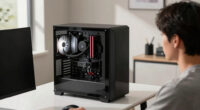
📊 Full opportunity report: Best Quiet Case Fans + the Airflow Setup That Actually Works on ThorstenMeyerAI.com — validation score, market gap, and execution plan.
Prime for Young Adults — start your free trial
Fast free delivery, streaming and member deals for eligible 18–24 year olds.
Try it freeAs an affiliate, we earn on qualifying purchases.
TL;DR
This article identifies the best quiet case fans for 2026 and explains the airflow setup that ensures both cooling and silence. It emphasizes large, slow-moving fans and proper placement for optimal performance.
In 2026, the top recommended case fans for quiet, high-performance AI workstations are the Noctua NF-A12x25 and the Arctic P12 Pro, paired with an airflow setup that prioritizes large, slow-moving fans for optimal noise reduction and cooling efficiency.
The Noctua NF-A12x25 is widely regarded as the best-engineered 120mm fan, moving over 100 CFM at less than 16 dB, thanks to its refined bearing and motor. For larger cases, the NF-A14 offers similar performance at 140mm. The Arctic P12 Pro and P14 PWM PST are notable for delivering near-premium airflow and static pressure at a fraction of the cost, making them ideal for budget-conscious builders. The ‘silent wings’ fans from be quiet! are optimized for minimal noise, maintaining around 17 dB even at higher RPMs, suitable for quiet office environments. For radiator cooling, static-pressure fans like the Arctic P12 Pro and Noctua NF-F12 are recommended, as they efficiently push air through dense fin stacks while remaining quiet. The core principle is to use large, slow fans to move air gently through the case, reducing noise without sacrificing cooling performance.Best quiet case fans
+ the airflow that works.
The best fan won’t help if it’s pointed the wrong way. The whole recipe: big fans, running slowly, in a clean front-to-back path, with slightly more intake than exhaust. Build a config in Part 2 and watch the pressure balance respond.
Why Proper Fan Selection and Airflow Setup Matter in 2026
Choosing the right fans and airflow configuration directly impacts the noise levels and thermal performance of high-power AI workstations. Proper setup ensures sustained performance, reduces noise pollution in shared workspaces, and extends hardware longevity. As AI workloads increase in complexity, efficient cooling becomes even more critical, making these recommendations essential for builders prioritizing silence and reliability.As an affiliate, we earn on qualifying purchases.
Evolution of Quiet Cooling in High-Power PCs
Over recent years, the focus on quiet yet effective cooling has grown, driven by the rise of AI and high-performance computing. Earlier models relied on small, high-RPM fans that generated significant noise. The shift toward larger, slower fans with better engineering—such as Noctua's NF-A12x25—has transformed the landscape. These fans, combined with optimized airflow setups, now enable builders to achieve both low noise and high thermal efficiency. The principles of moving large volumes of air at low RPM remain central, supported by advancements in fan blade design and bearing technology. This development aligns with the broader trend of building quieter, more efficient workstations for professional and hobbyist use."Our NF-A12x25 is designed to move a lot of air quietly, making it ideal for continuous operation in demanding environments."
— Noctua engineer
As an affiliate, we earn on qualifying purchases.
Unconfirmed Aspects of Long-Term Fan Performance
While current fans like the Noctua NF-A12x25 and Arctic P12 Pro perform well in tests, long-term durability and performance under continuous high loads in diverse environments remain to be fully verified. Variations in case design and ambient conditions can influence effectiveness, and ongoing testing will clarify these aspects over time.As an affiliate, we earn on qualifying purchases.
Next Steps for Builders and Manufacturers in 2026
Manufacturers are expected to release new fan models with further noise reduction and efficiency improvements. Builders should monitor updates and consider testing different configurations to optimize their specific setups. Future research may refine airflow principles further, especially for ultra-quiet, high-density AI workstations. Additionally, more case designs will likely incorporate larger fan mounts, making the principles of large, slow fans more accessible.As an affiliate, we earn on qualifying purchases.
Key Questions
What size fans should I prioritize for quiet operation?
Prefer 140mm fans over 120mm where possible, as they move more air at lower RPMs, reducing noise.
Can I use smaller fans if I tune them properly?
While tuning can help, larger fans inherently produce less noise for the same airflow, making them more effective for quiet builds.
Are static-pressure fans necessary for radiators?
Yes, static-pressure fans like the Arctic P12 Pro or Noctua NF-F12 are optimized for pushing air through dense radiator fins efficiently and quietly.
Will these recommendations change in the future?
As fan technology advances, new models may offer even better noise-to-performance ratios, but the core principles of large, slow fans will likely remain relevant.
Source: ThorstenMeyerAI.com
Fall Picks
fall essentials
As an affiliate, we earn on qualifying purchases.