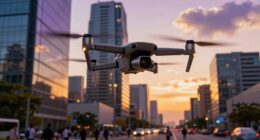
Swarm robotics involves multiple robots working together to explore and search environments efficiently, inspired by nature’s collective behavior like bird flocks and ant colonies. You’ll find that these robots act independently using simple local rules, enabling them to adapt and coordinate without centralized control. This approach offers robustness, scalability, and resilience, making them ideal for tasks in unpredictable or hazardous areas. Keep exploring how these intelligent systems can revolutionize search and exploration missions in complex environments.
Key Takeaways
- Swarm robotics enable multiple robots to coordinate through local interactions, mimicking natural collective behaviors for exploration and search tasks.
- Decentralized control allows swarm systems to adapt dynamically to unpredictable environments without reliance on central commands.
- Simple communication protocols and local sensing facilitate scalable, resilient operations even with individual robot failures.
- These systems are ideal for disaster zone exploration, search and rescue, and mapping in complex, hazardous environments.
- Security and ethical considerations ensure safe, trustworthy deployment of swarm robots in sensitive or critical applications.

Have you ever wondered how a flock of birds or a colony of ants coordinates their actions seamlessly? It’s fascinating how these groups operate with remarkable efficiency, relying on collective intelligence and decentralized control. In swarm robotics, this natural phenomenon inspires the design of robot teams that work together without a central leader. Instead of a single robot directing the others, each robot follows simple rules and communicates locally, allowing the entire group to adapt and respond to changing environments. This approach mimics nature’s way of solving complex problems through simple, distributed interactions.
Decentralized control is at the core of swarm robotics. Each robot acts independently, making decisions based on the information it gathers from its surroundings and its neighbors. This means there’s no need for a central command system, reducing vulnerabilities and increasing robustness. If one robot fails, the rest continue working, seamlessly adjusting their actions to fill the gap. This decentralized method also enhances scalability; you can add more robots to the swarm without overhauling the entire system. The collective behavior emerges from the interactions of individual units, creating a flexible and resilient network capable of tackling tasks like exploration, search, and rescue missions.
Imagine deploying a swarm of robots into a disaster zone. Instead of relying on a single, large robot or human teams, your robot swarm can quickly disperse, exploring different areas simultaneously. They communicate through simple signals or local sensing, sharing essential information about hazards, obstacles, or points of interest. Thanks to collective intelligence, the robots adapt their movements based on what they learn, avoiding dangers and covering more ground efficiently. The decentralized control ensures that even if some robots get stuck or damaged, the remaining units continue the mission without disruption. This self-organizing capability makes swarm robotics highly suitable for unpredictable and complex environments.
Furthermore, the power of collective intelligence allows these robots to perform tasks that are difficult for individual units. For example, they can collectively carry objects too heavy for one robot or coordinate to build structures. The simple rules each unit follows lead to sophisticated, emergent behaviors that are greater than the sum of their parts. By leveraging local interactions and decentralized control, swarm robotics offers a scalable, robust, and adaptable approach to exploration and search operations. It’s a technology that, inspired by nature, is transforming how we think about autonomous systems working together seamlessly as a single, intelligent entity.
Additionally, integrating security considerations into swarm robotics design can help prevent malicious interference and ensure safe operation in sensitive environments.
Top picks for "swarm robotic coordinat"
Open Amazon search results for this keyword.
As an affiliate, we earn on qualifying purchases.
Frequently Asked Questions
How Do Swarm Robots Communicate in Noisy Environments?
You use wireless protocols designed for robustness in noisy environments, like Bluetooth or Zigbee, which help maintain communication despite interference. Additionally, you implement noise filtering techniques that distinguish signals from background noise, ensuring reliable data exchange. By combining these methods, your swarm robots stay coordinated and effective, even when communication channels face challenges from environmental noise. This approach keeps your robots working seamlessly during exploration and search tasks.
What Are the Limitations of Current Swarm Robotics Algorithms?
Your current swarm robotics algorithms face significant hurdles, like limited algorithm robustness and hardware reliability issues that can cripple operations. These limitations make the system vulnerable to unpredictable environments and hardware failures, risking mission success. Despite advances, you still struggle with scalability, energy efficiency, and real-time adaptability. Overcoming these challenges demands innovative approaches to enhance robustness and guarantee hardware can withstand the chaos of real-world scenarios.
How Scalable Are Swarm Robotics Systems for Large Areas?
Swarm robotics systems face scalability challenges when it comes to large area deployment. As the number of robots increases, coordination becomes more complex, communication can slow down, and resource management may falter. You might find that maintaining efficiency over expansive regions requires advanced algorithms and robust communication methods. While these systems are promising, scaling them effectively for large areas still demands ongoing innovation to overcome these hurdles.
Can Swarm Robots Adapt to Unpredictable Terrain?
Yes, swarm robots can adapt to unpredictable terrain through advanced terrain adaptability and dynamic navigation strategies. You’ll find they use sensors to detect obstacles and adjust their paths accordingly, allowing for flexible exploration. Their decentralized coordination helps them overcome environmental challenges, making them effective in complex or changing terrains. This adaptability guarantees the swarm can continue its mission efficiently, even when faced with unexpected obstacles or unpredictable conditions.
What Are the Energy Consumption Challenges for Long-Term Missions?
Ever wonder how your swarm robots keep going in remote missions? The biggest challenge is managing energy efficiently. You need to optimize battery efficiency and implement smart power management to extend operational time. Without these, robots risk running out of power in critical moments. Effective energy strategies guarantee they stay active longer, explore more thoroughly, and accomplish their goals without interruption.
Conclusion
In summary, swarm robotics showcases the superb synergy of simple systems working seamlessly to solve complex challenges. By harnessing harmonious, heterogeneous, and highly adaptive robots, you can achieve extraordinary exploration and efficient search operations. Remember, with coordinated collaboration and clever communication, your swarm can swiftly and successfully survey uncharted territories. So, embrace the power of collective cooperation, and watch your robotic domain revolutionize reconnaissance, rescue, and research with remarkable resilience and remarkable results.