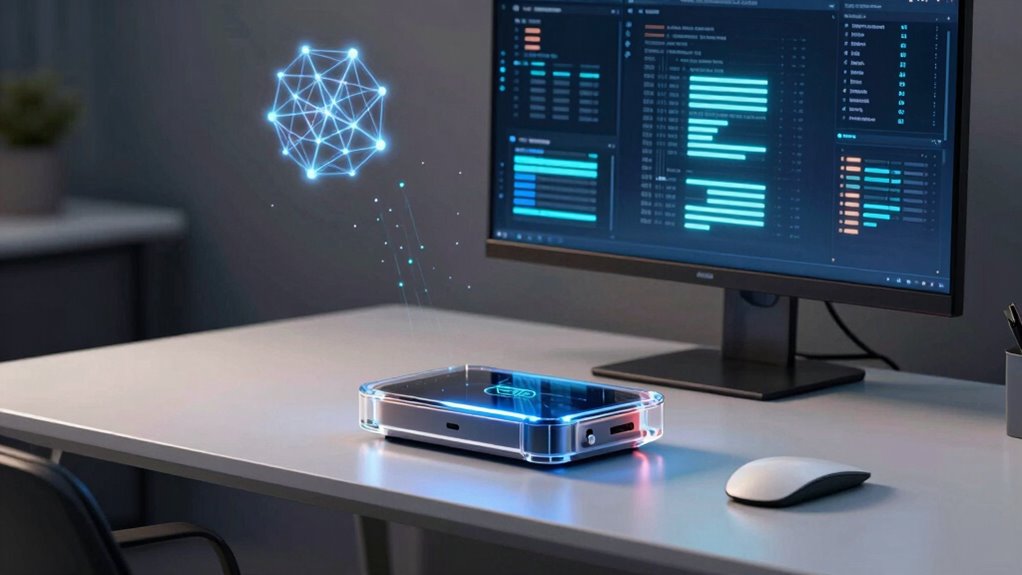

Personal AI can substantially boost the value of your hardware by making it smarter, faster, and more personalized. Instead of passive devices, your tech becomes an active partner, adapting to your routines and preferences in real-time. It reduces reliance on cloud processing, boosting privacy and responsiveness. As hardware becomes specialized for AI tasks, you’ll experience more seamless, intuitive interactions. Discover how these innovations transform everyday technology and what it means for your future setup.

Get business pricing on tech for your team
- Business-only prices and quantity discounts
- Tax-exempt purchasing
- Multiple users, one account, clear invoices
Key Takeaways
- Personal AI hardware enhances device responsiveness and personalization by enabling real-time, on-device processing.
- Dedicated AI hardware reduces reliance on cloud services, increasing privacy and data security.
- Advances in AI-specific processors improve efficiency, power, and speed, boosting overall device value.
- Edge computing with AI hardware allows for faster, more private interactions, elevating user experience.
- Specialized AI hardware transforms human-device interactions, making them more intuitive and seamlessly integrated.
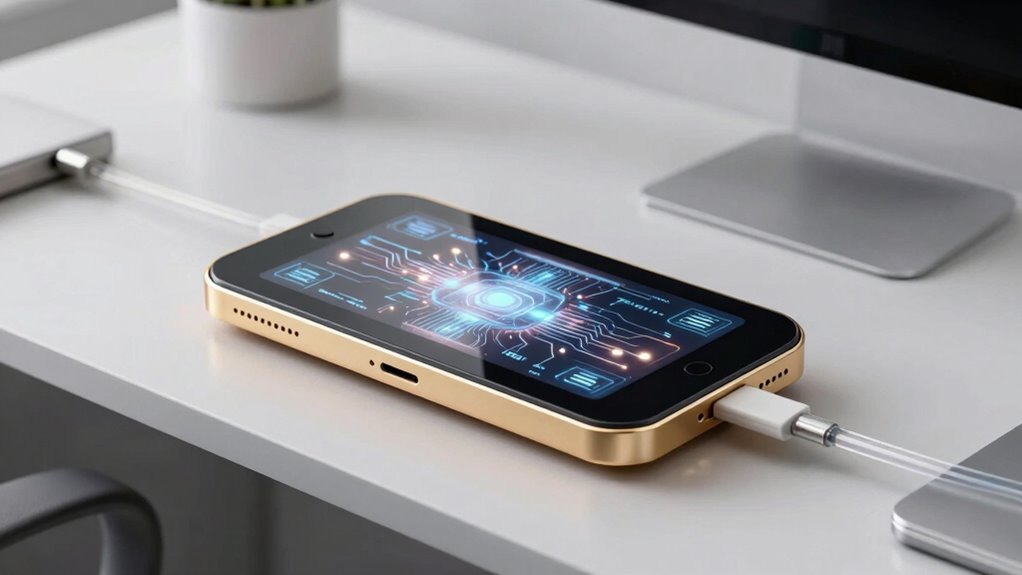
As artificial intelligence becomes more personalized, the value of dedicated hardware is increasingly clear. When you tailor AI to your specific needs, you’re not just using a generic tool—you’re creating a system that adapts seamlessly to your routines, preferences, and workflows. This level of AI customization means that hardware isn’t just a passive platform but an active participant in delivering smarter, faster, and more responsive experiences. Hardware integration becomes essential because it allows your AI to function at peak efficiency without the bottlenecks of relying solely on cloud-based solutions. Instead, your devices and processors are designed to work in harmony with your AI, reducing latency and increasing reliability.
Imagine having a device that learns your habits, anticipates your needs, and adjusts its behavior accordingly—all without constant internet dependency. This is only possible through dedicated hardware that’s optimized for AI tasks. When hardware is integrated specifically for AI functions, it can process complex algorithms locally, making your interactions smoother and more immediate. For example, a smart home system with dedicated AI hardware can recognize patterns in your daily routine and adjust lighting, temperature, or security settings without delay. The hardware integration ensures that these adjustments happen in real time, enhancing comfort and efficiency. Dedicated hardware plays a crucial role in enabling this level of responsiveness. Additionally, advancements in AI hardware design are making these capabilities more accessible and affordable for everyday users. The development of specialized processors tailored for AI workloads is accelerating this trend, leading to more powerful and efficient hardware solutions. Your AI’s ability to deliver meaningful personalization hinges on the hardware’s capability to support AI customization.
Furthermore, the shift towards edge computing allows processing to occur closer to the source, further reducing latency and increasing privacy since sensitive data stays on your device. Off-the-shelf devices may struggle to keep up with the demands of tailored AI, but dedicated hardware allows for deeper customization and more advanced features. You can expect faster processing, more accurate recognition, and greater privacy since sensitive data stays on your device. This shift from general-purpose hardware to specialized AI hardware transforms how you interact with technology daily.
dedicated AI hardware for computers
As an affiliate, we earn on qualifying purchases.
As an affiliate, we earn on qualifying purchases.
Frequently Asked Questions
How Secure Is Personal AI in Protecting User Data?
Personal AI can be quite secure in protecting your data if it uses strong data encryption and prioritizes user privacy. You’re protected when your AI employs end-to-end encryption, ensuring only you can access your information. Additionally, responsible AI systems minimize data sharing and give you control over your data, enhancing your privacy. However, remain vigilant, as vulnerabilities can exist if security measures aren’t properly implemented or maintained.
Will Personal AI Increase or Decrease Hardware Longevity?
Personal AI is likely to increase hardware longevity, as it can optimize device performance and manage wear more efficiently. You might worry about AI obsolescence, but as AI becomes more integrated, hardware durability will improve, reducing the need for frequent replacements. This technological synergy encourages you to see your devices as more resilient, ensuring they last longer and serve you better, defying fears of rapid AI-driven obsolescence.
Can Personal AI Be Integrated With Existing Devices Easily?
Yes, personal AI can be integrated with existing devices more easily than you might think. It largely depends on device compatibility and software integration capabilities. Many modern devices support updates or new apps that enable AI features. If your device is compatible and the software integrates seamlessly, you can enjoy the benefits of personal AI without needing to replace hardware entirely. Just make certain your device meets the necessary specifications for smooth integration.
How Does Personal AI Affect Hardware Manufacturing Costs?
Think of personal AI as a catalyst in a bustling factory, shaking up the entire process. It raises manufacturing costs by demanding advanced components and sophisticated design, prompting market disruption. Supply chains need to adapt to new hardware requirements, which can inflate expenses. However, over time, efficiencies from AI integration may reduce costs, balancing the initial spike. Overall, personal AI’s impact on hardware costs depends on how quickly the industry adapts to these changes.
Will Personal AI Lead to More Hardware Customization Options?
Yes, personal AI will lead to more hardware customization options. You’ll be able to tailor hardware aesthetics and features to match your preferences, thanks to AI-driven design tools. This personalization enhances user experience, making devices feel uniquely yours. As AI integrates more deeply, manufacturers will offer flexible configurations, allowing you to select style, functionality, and performance, creating a more personalized and engaging hardware experience.
As an affiliate, we earn on qualifying purchases.
Conclusion
As you embrace personal AI, imagine it as a guiding light woven into your hardware, transforming simple devices into trusted partners. The true value no longer lies just in the metal and circuits, but in the seamless, intelligent connections you share with your technology. Your hardware becomes a canvas for endless possibilities, where your personal AI shapes a future that’s more intuitive, responsive, and uniquely yours—turning everyday gadgets into gateways to your world.
As an affiliate, we earn on qualifying purchases.
As an affiliate, we earn on qualifying purchases.
Halloween Picks
halloween
As an affiliate, we earn on qualifying purchases.