TL;DR
AI performance has become much cheaper, while reported token use and data center electricity consumption have increased. The IEA links efficiency gains to broader AI adoption, a pattern associated with Jevons paradox; how much of the power growth is caused by AI demand remains uncertain.
The IEA reports that electricity use at AI-focused data centers rose 50% in 2025. Across all data centers, use reached 485 terawatt-hours (TWh). The agency projects that total could reach about 950 TWh in 2030. That projection covers data centers generally, rather than AI facilities alone.

Get business pricing on tech for your team
- Business-only prices and quantity discounts
- Tax-exempt purchasing
- Multiple users, one account, clear invoices
The source article cites Epoch AI’s estimate that the cost of a given level of AI performance has fallen about 13 times per year since 2023. It also reports that Google’s monthly token count increased from 9.7 trillion in May 2024 to more than 3.2 quadrillion in May 2026. The two measurements describe different things: lower performance costs and higher token volume. They do not by themselves show that lower prices caused the increase in tokens.
The IEA says efficiency improvements are “also fuelling broader adoption of AI services,” describing the dynamic as Jevons paradox, and expects total electricity use from AI to rise in the near term. The source does not give a separate forecast for AI-only electricity demand in the figures cited here.
Lower AI Costs, Higher Power Demand
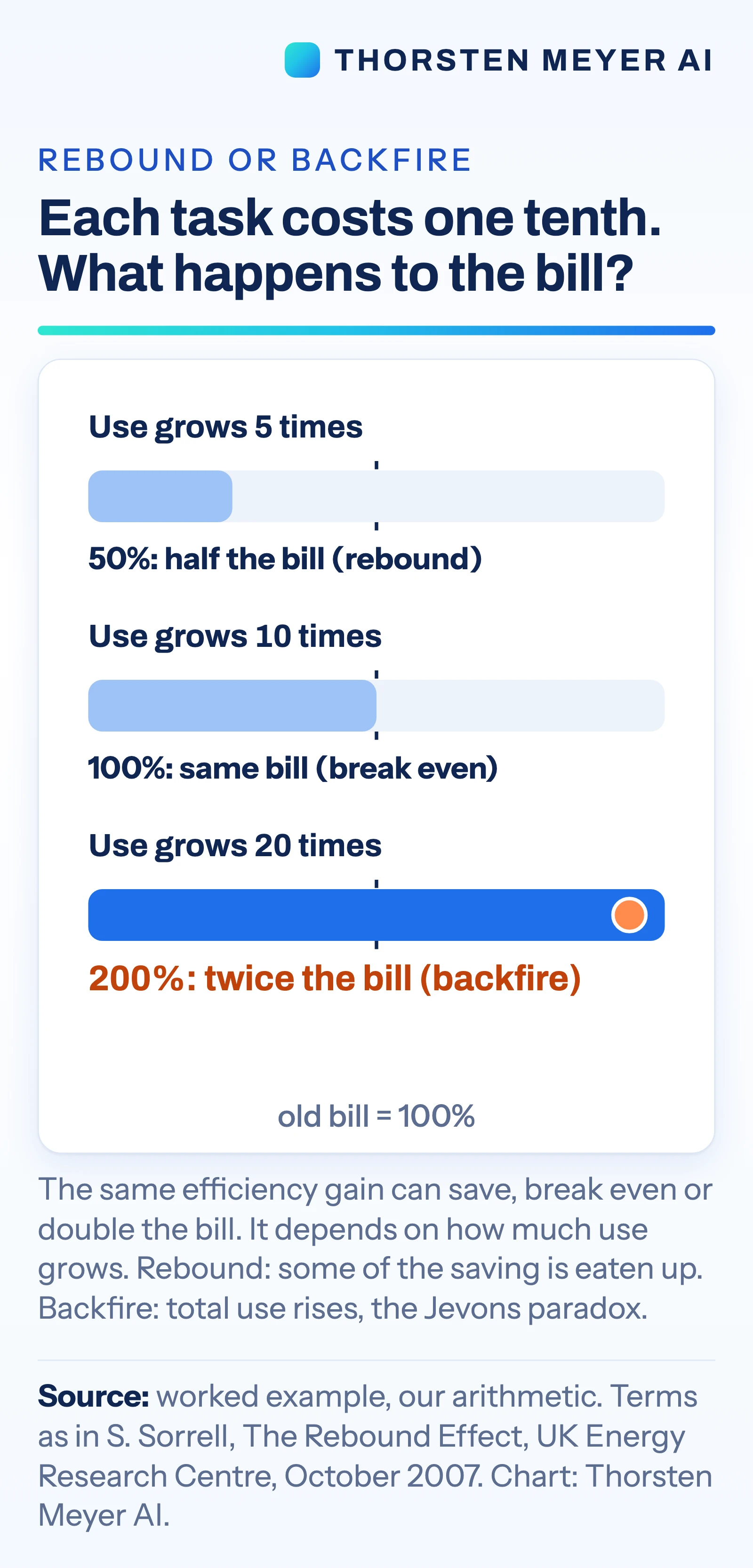
For businesses, cheaper individual tasks do not guarantee lower overall spending. Firms may use AI in more workflows, run more requests or adopt resource-intensive features such as reasoning and agents. The source article recommends tracking cost per completed task alongside token prices, since a lower unit price can coexist with a higher total bill.
For electricity users and grid planners, the distinction is between the energy used by one request and the energy used across millions or billions of requests. A simple text prompt may use little electricity on its own, while aggregate demand and heavier applications can add up. The cited figures show a rising data center load, but do not quantify the contribution from each kind of AI use.
The practical question is whether new demand grows faster than efficiency improves. If it does, total energy use can rise even as each task takes less energy. If demand grows more slowly, efficiency can still reduce total use.
Products Worth Considering

Jackery HomePower 2000 Plus v2 Portable Power Station, 2048Wh

Samsung Galaxy Tab S11 128GB Wi-Fi Android Tablet with S Pen, Silver

Bose Home Speaker 500 Smart Bluetooth Speaker, Black
As an affiliate, we earn on qualifying purchases.
Jevons’s Coal-Era Argument
British economist William Stanley Jevons described the mechanism in his 1865 book, The Coal Question. Writing about industrial fuel use, he argued that more efficient engines could make coal-powered work profitable in more settings. Lower costs could expand production and demand enough to offset fuel savings per unit.
Jevons used the iron industry as an example: a furnace that used less coal per ton could lower production costs, attract investment and increase demand for iron. He reported that in Scotland, coal use per ton of iron fell to less than a third of its earlier level while total consumption increased tenfold. Those are historical figures as presented in Jevons’s account, not a direct comparison with modern AI.
The term does not describe an automatic outcome. A 2007 review by the UK Energy Research Centre found that efficiency improvements generally still save energy overall, though often by less than engineering estimates suggest. A rise in total use that fully offsets or exceeds the expected savings is commonly called “backfire.”
““It is wholly a confusion of ideas to suppose that the economical use of fuel is equivalent to a diminished consumption. The very contrary is the truth.””
— William Stanley Jevons, in The Coal Question (1865)
How Much Demand Comes From AI?
The figures cited do not isolate how much of the overall increase in data center electricity use came from AI, or how much resulted specifically from lower AI costs. The reported rise in Google token volume also lacks a comparison baseline for total industry demand and does not show the energy consumed per token.
It remains unclear whether AI demand will continue growing faster than efficiency improves. The Jevons effect is a possible outcome, not a rule: efficiency can reduce total energy use when the increase in usage is limited. The IEA projection of about 950 TWh for 2030 concerns data centers overall, and the source material does not provide the assumptions behind that forecast.
Track Usage Alongside Efficiency
The next useful evidence will be updated IEA reporting that separates AI-related demand from other data center workloads and shows how electricity use changes over time. Comparable measures of energy per task, total task volume and the mix of AI applications would help distinguish efficiency savings from demand growth.
Businesses can track spending and energy use per completed task alongside the volume and type of AI workloads they run. Whether the current pattern persists will depend on how quickly adoption expands relative to improvements in model and hardware efficiency.
Key Questions
What does Jevons paradox mean for AI?
It describes the possibility that greater efficiency lowers costs, prompting enough additional use that total resource consumption rises. It does not mean this will always happen.
What did the IEA report about data center electricity?
The IEA reports that data centers used 485 TWh in 2025, up 17% year over year. It says electricity use at AI-focused data centers rose 50% that year and projects about 950 TWh for data centers overall in 2030.
Does the evidence prove cheaper AI caused power use to rise?
No. The figures show falling AI performance costs alongside rising token counts and data center electricity use, but they do not establish how much of the power increase was caused by lower costs.
Will more efficient AI reduce electricity consumption?
It can reduce energy per task. Total consumption depends on whether usage expands enough to offset those savings; the source material does not establish how that balance will develop.
Source: Thorsten Meyer AI