AI productivity software can help with writing, planning, research, and automation, but the right choice depends on how you work and what you want AI to take off your plate. For an all-around starting point, The AI Productivity Bible offers a workflow-by-workflow approach; Your Personal AI System is a stronger fit for building a connected digital brain, while AI Productivity for ADHD Professionals focuses on reducing executive-function and email burdens. These are books and practical guides rather than software products, so they help readers choose and use tools rather than replace them. The main tradeoff is between broad guidance and advice tailored to a specific role or challenge. Read on for how the seven guides differ and which one best matches your needs.

Get business pricing on tech for your team
- Business-only prices and quantity discounts
- Tax-exempt purchasing
- Multiple users, one account, clear invoices
Key Takeaways
- The AI Productivity Bible takes the broadest workflow-based approach, making it the most adaptable starting point for readers who have not settled on one use case.
- Your Personal AI System focuses on organizing work and life knowledge, a different goal from automating isolated tasks or improving team coding practices.
- AI Productivity for ADHD Professionals is the most targeted guide in the lineup, centering on externalizing executive function and reducing email overload.
- Building the Agentic Software Factory and The Technical Program Manager’s Guide to Practical AI are role-specific picks for engineering teams and TPM work, respectively.
- The comparison favors guides with a clear audience and actionable workflow focus; readers seeking software features, integrations, or hands-on product testing will need to evaluate the actual tools separately.


| AI productivity software | Subject | Target audience |
|---|---|---|
| Building the Agentic Software | Agentic software development | — |
| AI Productivity for ADHD Profe | — | ADHD professionals |
| The Technical Program Manager’ | — | Technical program managers |
| AI Productivity for Profession | AI productivity | Professionals |
| AI Workflows: How Smart Profes | — | Professionals |
| Your Personal AI System: How t | Building a personal AI system | — |
| The AI Productivity Bible: A P | AI productivity | — |
More Details on Our Top Picks
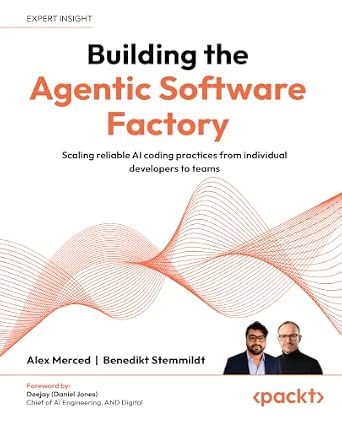
Building the Agentic Software Factory: Scaling Reliable AI Coding Practices from Individual Developers to Teams
Building the Agentic Software Factory is the most specialized choice here: its focus is on applying agentic coding practices across both individual developers and software teams. That makes it a closer fit for engineering leads than AI Productivity for Professionals, whose description promises broader workplace guidance. The team-scale focus may help readers think beyond one-off prompts toward repeatable coding practices, but the available product details do not specify particular tools, exercises, or implementation frameworks. This is a book, so readers should expect guidance rather than built-in software or automation. My ranking gives it a distinct place for software organizations, while its narrow coding focus makes it a weaker match for program managers or professionals seeking general-purpose AI workflows.
Pros:- Focuses specifically on agentic AI coding practices.
- Addresses both individual developers and team adoption.
- Centers reliable practices rather than general AI productivity.
- Book format supports learning without adopting a new software platform.
Cons:- The subject is narrow compared with general professional AI guides.
- The supplied product details do not identify specific tools or templates.
- A book offers guidance rather than built-in coding automation.
Best for: Engineering leads and software teams looking to develop shared practices for AI-assisted coding.
Not ideal for: Professionals outside software development or readers seeking named tools, detailed templates, or broad office workflows.
- Format:Book
- Subject:Agentic software development
- Focus:Reliable AI coding practices
- Audience:Individual developers and software teams
- Scope:Scaling practices from individuals to teams
- Product type:Book
Our verdict“Choose this book if you lead developers and want a team-oriented perspective on reliable AI coding practices.”
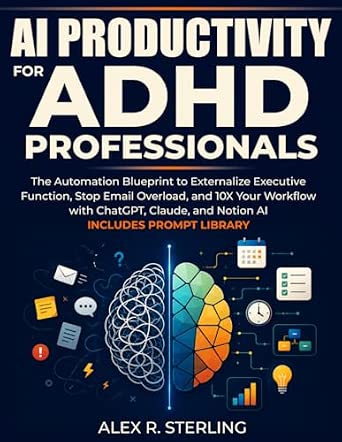
AI Productivity for ADHD Professionals: Automation Blueprint to Externalize Executive Function, Stop Email Overload, and 10X Your Workflow with ChatGPT, Claude & Notion AI. Includes Prompt Library
AI Productivity for ADHD Professionals has the clearest audience and problem focus in this group: it connects AI tools to executive function and email overload. Its coverage of ChatGPT, Claude, and Notion AI gives readers several possible starting points, while the prompt library may make the ideas easier to put into practice than the broad promise of AI Productivity for Professionals. That specificity is also the tradeoff: readers need to be willing to build new automation habits and use the platforms covered. The supplied description does not detail the prompts or the extent of the workflows, so buyers cannot judge their depth from the product data alone. I rank it for fit with ADHD professionals, rather than for universal workplace use.
Pros:- Tailored to executive function challenges faced by ADHD professionals.
- Covers ChatGPT, Claude, and Notion AI.
- Includes a prompt library for practical starting points.
- Targets email overload and workflow automation.
Cons:- Useful workflows depend on adopting new habits and automations.
- Requires access to the AI platforms covered.
- The supplied details do not describe the prompt library’s depth.
Best for: ADHD professionals who want AI-supported routines for email and executive function.
Not ideal for: Readers who do not identify with the target audience, avoid workflow changes, or want a guide centered on a single tool.
- Target audience:ADHD professionals
- Tools covered:ChatGPT, Claude, Notion AI
- Included resource:Prompt library
- Workflow focus:Automation
- Productivity focus:Externalizing executive function
- Work challenge addressed:Email overload
Our verdict“Pick this guide if you are an ADHD professional seeking practical AI support for email and everyday workflow management.”
The Technical Program Manager’s Guide to Practical AI: Workflows and Frameworks for Smarter, Faster, Higher-Impact TPM Execution
The Technical Program Manager’s Guide to Practical AI is the role-specific pick for people coordinating technology initiatives. Its stated emphasis on practical workflows and frameworks links AI use to project delivery and decision-making, giving it a narrower, more execution-focused angle than AI Workflows, which describes automation and thinking for smart professionals more broadly. The product description also mentions real-world examples, though the supplied details do not name particular tools or provide a list of those examples. This focus is a strength for experienced TPMs and a barrier for readers new to either AI or program management. Compared with the general-purpose professional guide, this one is better suited to readers whose daily work centers on cross-team execution.
Pros:- Targets technical program management work directly.
- Describes practical workflows and frameworks for execution.
- Connects AI use to project delivery and decision-making.
- Includes real-world examples according to the product description.
Cons:- Assumes some familiarity with TPM responsibilities and AI concepts.
- The supplied details do not identify specific AI tools.
- Its specialized focus may not transfer directly to other roles.
Best for: Technical program managers who want role-specific AI workflows for coordinating projects and decisions.
Not ideal for: AI newcomers or professionals outside technical program management who need introductory, general-purpose guidance.
- Target audience:Technical program managers
- Focus:Practical AI workflows and frameworks
- Work context:Technology initiatives
- Key outcome:Project delivery
- Additional focus:Decision-making
- Examples:Real-world examples
Our verdict“Choose this guide if you are an experienced TPM seeking AI workflows tied to technology project execution.”
AI Productivity for Professionals: A Practical Guide to Working Smarter, Saving Time, and Getting More Done with AI
AI Productivity for Professionals is the broad entry for workplace readers who want practical guidance without committing to a role-specific playbook. Its promise is less specialized than The Technical Program Manager’s Guide to Practical AI, which centers on technology project execution, and less audience-specific than the ADHD-focused guide. That breadth may suit professionals exploring where AI fits into their work, but the supplied description does not name tools, workflows, or included resources. Buyers therefore have fewer concrete signals about how the guide turns general productivity aims into repeatable actions. I place it as the generalist option: more accessible in scope than the specialized books, but harder to evaluate for practical depth from the available product information.
Pros:- Addresses AI productivity across professional work.
- Focuses on practical ways to save time and increase output.
- Has broader role coverage than the TPM-specific guide.
- May suit readers still deciding where AI fits into their work.
Cons:- The supplied description does not name tools or specific workflows.
- Broad scope offers less role-specific direction than the TPM and ADHD guides.
- The available product data does not list included resources.
Best for: Professionals in varied office roles who want a general introduction to using AI for work.
Not ideal for: Readers seeking a specialized playbook, named tools, or detailed workflows confirmed in the product description.
- Target audience:Professionals
- Subject:AI productivity
- Approach:Practical guide
- Stated goal:Work smarter
- Stated goal:Save time
- Stated goal:Get more done with AI
Our verdict“Consider this guide if you want a broad workplace introduction and do not need role-specific AI instructions.”
AI Workflows: How Smart Professionals Use AI to Automate Work, Think Better, and Make Faster Decisions
AI Workflows links three kinds of work—automation, thinking, and decision-making—under one broad professional theme. That makes it a useful contrast with Building the Agentic Software Factory, which focuses specifically on coding practices, and the TPM guide, which is tied to a particular job. Its place in the AI Productivity Series gives it a stated series identity, but the product details do not name tools, templates, or a specific audience beyond smart professionals. Readers who want a role-specific playbook may get clearer direction from the TPM or ADHD-focused titles. I give this book a distinct role for buyers interested in shaping workflows across several types of knowledge work, with limited product information on how the ideas are taught.
Pros:- Covers work automation, thinking, and decision-making.
- Takes a workflow-centered approach to AI productivity.
- Part of the AI Productivity Series.
- Has broader role coverage than the software factory and TPM books.
Cons:- The supplied product details do not identify tools or workflow examples.
- Its broad audience may offer less tailored advice than the ADHD and TPM guides.
- No included templates or other resources are specified.
Best for: Knowledge workers who want to explore AI workflows spanning automation, analysis, and decisions.
Not ideal for: Readers who need role-specific instructions, named tools, or described templates before choosing a guide.
- Series:AI Productivity Series
- Target audience:Professionals
- Focus:AI workflows
- Work application:Automation
- Cognitive application:Thinking support
- Decision application:Faster decision-making
Our verdict“Choose this book if you want a broad workflow lens connecting AI automation with thinking and decisions.”
Your Personal AI System: How to Build Your Digital Brain for Work and Life
Your Personal AI System is the most personal, broad-scope pick in this batch: its premise is building an AI-supported digital brain for both work and life. That makes it a better fit for readers trying to organize information and routines across contexts than The AI Productivity Bible, which centers on applying AI one workflow at a time. Its place in the AI Productivity Series signals a productivity focus, but the supplied description does not specify methods, tools, or example workflows, so buyers have less detail to judge before choosing. The broad remit could suit someone seeking one system rather than separate task-by-task tactics; it could also feel less targeted than the TPM guide or the ADHD-focused book. I would choose it for the personal-system approach, while readers who need immediately specified steps may prefer a more explicit workflow guide.
Pros:- Centers on building a personal AI system rather than isolated productivity tips
- Addresses both work and life, suiting readers with information spread across contexts
- Belongs to the AI Productivity Series, giving it a clear productivity-oriented framing
Cons:- The supplied description does not identify specific tools, workflows, or implementation steps
- Its broad work-and-life scope may be less focused than the TPM and ADHD-specific guides
Best for: Readers who want to organize work and personal information around a single AI-supported system
Not ideal for: Buyers seeking detailed, verified tool instructions or a narrowly focused professional workflow, since the supplied product details do not specify either
- ASIN:B0GTYTR6L1
- Series:AI Productivity Series
- Format:Book
- Subject:Building a personal AI system
- Intended scope:Work and life
- Stated purpose:Support work and life with a digital brain
Our verdict“Choose this book if you want a broad AI-supported system for organizing work and life, and prefer a more explicitly actionable guide if you need defined workflows.”
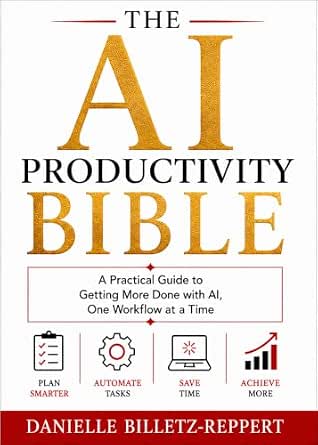
The AI Productivity Bible: A Practical Guide to Getting More Done with AI, One Workflow at a Time
The AI Productivity Bible is the most explicitly practical choice here: it frames AI adoption as a sequence of workflows readers can apply and improve. That incremental approach gives it a clearer starting point than Your Personal AI System, whose supplied description sets out a broad digital-brain goal without naming particular workflows. The book’s focus on specific tasks may also make it easier to act on than the more specialized TPM and ADHD guides if a reader wants general productivity tactics. The tradeoff is longevity: AI tools change quickly, so instructions can age, and the stated scope may not satisfy readers already comfortable with AI. I would pick it for concrete, stepwise workflow ideas, while advanced users may get more from a specialized framework or a deeper technical resource.
Pros:- Emphasizes practical advice readers can apply directly
- Organizes guidance around specific workflows rather than abstract concepts
- Supports gradual productivity improvements through incremental adoption
Cons:- Advice may become outdated as AI tools and capabilities change
- May not offer enough depth for readers already familiar with AI tools
Best for: Professionals who are new to applying AI at work and want practical workflows they can adopt incrementally
Not ideal for: Experienced AI users seeking advanced technical depth or guidance that is less exposed to rapid tool changes
- ASIN:B0HGKYNDRJ
- Series:Complete AI Guides
- Format:Book
- Subject:AI productivity
- Approach:One workflow at a time
- Stated focus:Integrating AI into daily workflows
Our verdict“Choose this guide for practical, incremental AI workflows; experienced users seeking advanced depth should look to a more specialized resource.”

How We Picked
I compared these seven titles by how clearly they connect AI to a reader’s daily work, how specific their intended audience is, and whether their stated focus suggests practical workflows rather than general encouragement. I also considered breadth: a general guide can serve more kinds of readers, while a specialized guide may offer a closer fit for a defined role or challenge.
The order reflects that balance. The AI Productivity Bible leads as the broadest workflow-centered entry point, followed by guides that build a personal AI system or address professional productivity directly. More focused books follow for ADHD professionals, TPMs, and software teams. These titles are guides to using AI, not software packages, so this ranking does not compare app performance, integrations, privacy controls, or subscription terms.
| AI productivity software | Subject | Target audience |
|---|---|---|
| Building the Agentic Software | Agentic software development | — |
| AI Productivity for ADHD Profe | — | ADHD professionals |
| The Technical Program Manager’ | — | Technical program managers |
| AI Productivity for Profession | AI productivity | Professionals |
| AI Workflows: How Smart Profes | — | Professionals |
| Your Personal AI System: How t | Building a personal AI system | — |
| The AI Productivity Bible: A P | AI productivity | — |
Factors to Consider When Choosing AI Productivity Software
Choose a guide by the work you want to change and the kind of help you need to make that change stick. These titles vary in audience and scope, so a useful first step is separating learning about AI workflows from selecting the software that will run them.
Start With the Bottleneck You Want to Fix
Write down one recurring task that costs you time or attention, such as sorting email, drafting reports, or coordinating a project. Then look for a guide whose stated focus matches that task closely enough to offer relevant examples. A broad productivity book may help you spot several opportunities, while a specialized title can speak directly to a narrower problem. A common mistake is choosing a guide because its title sounds ambitious, without checking whether its subject matches your everyday work. Pick the bottleneck first, then judge the book by how directly it addresses it. That keeps the decision tied to a result you can recognize.
Choose Breadth or Role-Specific Advice
Broad guides can help readers in different jobs build a shared vocabulary for AI workflows. Role-specific books may be more useful when your work has distinct constraints, such as technical program management or software engineering across a team. The tradeoff is flexibility versus relevance: a general framework may need more translation, while specialized advice may cover fewer situations. Avoid assuming a job title alone makes a guide a fit; compare its stated workflow focus with the tasks you actually own. If you expect your responsibilities to change, broader material may travel with you longer. If your current role is the main reason for reading, targeted guidance can save adaptation effort.
Decide Whether You Need a System or Individual Workflows
Some readers want to improve separate tasks, while others want a durable way to store, retrieve, and connect useful information. Those aims call for different learning paths. A personal AI system approach may appeal if scattered notes and repeated searching slow you down. Workflow-by-workflow guidance may be easier to apply when you want to improve one task at a time. Consider how much setup and maintenance you are willing to take on, since a larger personal system requires habits that persist beyond initial configuration. Do not build an elaborate knowledge structure before confirming that retrieval is a real problem in your day-to-day work.
Match the Advice to Your Attention and Support Needs
AI advice can assume that readers already have time, focus, and confidence to design new routines. If those are the very things you are trying to improve, look for material framed around reducing cognitive load and making steps easier to externalize. A targeted guide may feel more relevant than a general productivity framework, but it still cannot account for every person’s needs or replace professional support. Think about whether you prefer prompts, repeatable checklists, or conceptual frameworks before choosing what to read. The common trap is collecting techniques without deciding when to use them. A smaller routine you can repeat often has more practical value than a long list of possibilities.
Separate Learning Material From the Software Decision
A book about using AI does not tell you by itself whether a particular app fits your security, accessibility, or integration requirements. Before adopting a tool, check how it handles your data, whether it works with the systems you already rely on, and what human review its outputs need. This matters especially for sensitive workplace information and decisions that affect other people. You can use a guide to identify a promising workflow, then test that workflow with tools approved for your context. Avoid committing to a platform just because a guide names it as an example. The best learning resource and the best software choice may be different decisions.
Pay More Attention to Fit Than Grand Promises
Claims about saving time or transforming work are less useful than a clear match between the guide’s audience and your own needs. Look for a practical scope you can apply, and be wary of treating any productivity multiplier in a title as a guaranteed outcome. A specialized resource may earn its place when it addresses a costly, recurring problem that broad advice leaves untouched. For a first exploration, a broad workflow guide may be enough to help you decide where AI belongs in your work. Consider the time you will spend implementing the ideas, not just the appeal of the promise. Choose the guide that makes your next action clearer.
Frequently Asked Questions
Are these seven picks AI productivity software I can install?
No. The listed items are books and practical guides about applying AI to work, rather than software products or subscriptions. They can help you identify workflows and approaches, but you will still need to choose the underlying tools. Check each tool’s data handling, integrations, and approval status before using it for workplace information. This distinction matters if you arrived expecting a direct comparison of apps.
Which guide makes sense if I have not chosen a specific AI workflow yet?
A broad, workflow-centered guide such as The AI Productivity Bible is a reasonable place to explore multiple kinds of work before narrowing your focus. It may help you identify whether writing, planning, automation, or decision support is the best first target. A specialized book can be more relevant once you know the problem you want to address. Start with one workflow and judge the advice by whether it helps you take a concrete next step. You do not need to redesign your entire work routine at once.
Which title is most relevant if email and task initiation are difficult for me?
AI Productivity for ADHD Professionals is the most directly aligned title in this group because its stated focus includes externalizing executive function and reducing email overload. Its audience-specific framing may make it easier to find relevant ideas than in a general productivity book. Still, a guide cannot guarantee a fit for every reader or replace individualized support. Look for practices that lower friction in your actual routine, and try them in small steps. If your main challenge is unrelated to attention or email, a broader or role-specific title may fit better.
Should I choose a guide for my job or one for my personal knowledge system?
Choose based on where you lose the most time. If the main issue is executing work in a defined role, a title aimed at TPMs or software teams may provide a closer frame. If information is scattered across work and life and hard to retrieve, Your Personal AI System aligns more closely with that goal. You can also use role-focused guidance for work tasks and build a personal system later, since they solve different problems. Avoid starting both projects at once if you have limited time to establish new habits.
How do I know whether a workflow from a guide is safe to use at work?
Check your organization’s rules for AI tools and data before entering work material into any service. Consider whether the information includes confidential, personal, regulated, or client details, and use only tools cleared for that data. Keep a human review step for factual claims, external communications, and decisions with meaningful consequences. A guide may help shape the workflow, but it cannot establish whether a tool meets your workplace’s security or legal requirements. When in doubt, test the process with non-sensitive material and consult the relevant internal policy.
Conclusion
For the best overall starting point, choose The AI Productivity Bible if you want workflow-by-workflow guidance that can apply across different tasks. For a personal knowledge system, pick Your Personal AI System; for a targeted approach to email and executive-function friction, look at AI Productivity for ADHD Professionals. Readers seeking beginner-friendly breadth can start with AI Productivity for Professionals, while TPMs and engineering leads have more focused options in The Technical Program Manager’s Guide to Practical AI and Building the Agentic Software Factory. AI Workflows suits readers most interested in automation and faster decisions. There is no software value or premium tier to compare here: these are learning resources, so choose the one whose audience and workflow focus match your next practical need.