

Understanding how the psychology of foresight works helps AI interpret your motivations. Your mind constantly simulates future scenarios based on past experiences, emotions, and goals. This mental process guides your decisions, balancing risks and rewards. AI models analyze these patterns by recognizing your anticipatory thoughts, emotional cues, and goal-setting tendencies. By examining these signals, AI can better predict your actions and intentions. Keep exploring to discover more about how your mind’s future-oriented insights influence AI understanding.

Get business pricing on tech for your team
- Business-only prices and quantity discounts
- Tax-exempt purchasing
- Multiple users, one account, clear invoices
Key Takeaways
- AI analyzes patterns in human decision-making and emotional responses to infer underlying motivations and future goals.
- By modeling cognitive processes like prospection, AI predicts how individuals anticipate future needs and desires.
- Emotional cues and past behavior inform AI algorithms about a person’s safety concerns, aspirations, and risk preferences.
- Machine learning helps AI identify motivation-driven behaviors such as delayed gratification or goal pursuit.
- Understanding human foresight enables AI to personalize interactions and support long-term decision-making strategies.
Psychology of Foresight
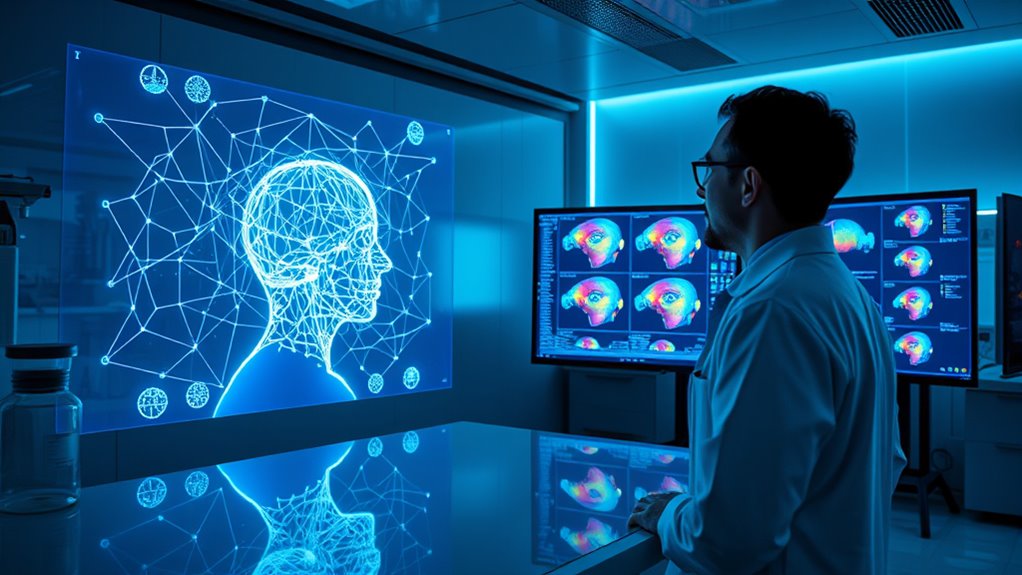
Understanding the psychology of foresight reveals how humans anticipate and plan for the future. You naturally engage in prospection, mentally simulating upcoming events and needs to prepare yourself. This skill isn’t just about daydreaming; it’s a complex cognitive process involving both recalling past experiences and constructing new future scenarios. Researchers recognize foresight as a major breakthrough, highlighting its essential role in human thought processes. It’s used extensively in management and decision-making, enabling you to analyze current situations and strategize for what lies ahead. Your ability to foresee future challenges and opportunities stems from neural mechanisms that facilitate mental time travel—your brain’s capacity to navigate both memory and imagination. When you imagine future events, your brain activates areas similar to those involved in recalling past memories, emphasizing the close link between remembering and envisioning. Unlike episodic memory, which focuses on retrieving past experiences, foresight emphasizes creating new, plausible future scenarios. These processes are influenced by your openness to experience and your individual time preferences, which shape how vividly you picture the future and what you prioritize. As your cognitive development progresses from early childhood, so does your capacity for foresight. Alfred Adler suggested that feelings of inferiority motivate you to anticipate danger and work toward safety, illustrating how emotional states drive future-oriented thinking. Your foresight also involves envisioning “possible selves”—future versions of yourself—helping you set goals and align your actions accordingly. This ability provides survival benefits by allowing you to avoid threats and seize opportunities before they become urgent. Motivation and emotion play a significant role in shaping your foresight. You’re naturally driven by the hedonic principle: seeking pleasure and avoiding pain. Future-oriented thinking helps you delay immediate gratification, weighing potential future rewards against present desires. Anticipating emotional states—like happiness or dread—guides your choices, often influencing whether you pursue risk or safety. When making decisions, you evaluate potential outcomes based on expected future states, seeking to maximize your utility. Your foresight influences your motivation, shaping how you value different options and how you balance short-term temptations with long-term goals. This process involves cognitive frameworks that integrate your beliefs, preferences, and emotional anticipations, allowing you to make informed choices aligned with your future needs. Abraham’s Business Success Principles also highlight the significance of maintaining positive energy to create an environment conducive to successful foresight. Recent research also shows that the capacity for foresight can be enhanced through training and deliberate practice, highlighting its adaptability and importance in personal development. Overall, your ability to foresee and plan is a sophisticated blend of memory, imagination, emotion, and motivation—an intricate dance that underpins your capacity to adapt, survive, and thrive in an ever-changing world.
Frequently Asked Questions
How Does AI Interpret Unconscious Human Motivations?
AI interprets your unconscious motivations by analyzing your observable behaviors, patterns, and interactions in real-time. It uses machine learning algorithms to detect subtle cues, environmental contexts, and emotional signals that reveal underlying desires. While AI doesn’t truly understand or feel these motivations, it approximates them based on data, predicting your latent intentions. Your perceptions of AI’s motives are influenced by its humanlike traits, which can lead you to project feelings and consciousness onto it.
Can AI Predict Sudden Changes in Human Behavior Accurately?
You want to know if AI can predict sudden changes in human behavior accurately. While AI models like Centaur excel in familiar patterns, they struggle with unpredictable shifts caused by emotions, trauma, or rare events. You should realize that AI relies on existing data, making it less reliable for spontaneous, unforeseen actions. So, despite advances, AI’s predictions remain probabilistic, often falling short when behavior changes abruptly or unexpectedly.
What Ethical Concerns Arise From AI Reading Human Thoughts?
You should be concerned about AI reading your thoughts because it threatens your mental privacy and cognitive liberty. It can access your inner thoughts involuntarily, making you feel inhibited or judged, and potentially misuse your data without consent. This technology risks bias, discrimination, and undermining your autonomy. Ethical issues also arise around transparency, accountability, and the potential for manipulation or surveillance, challenging your personal dignity and freedom of thought.
How Does Cultural Background Influence Ai’s Understanding of Motivation?
Imagine AI as a curious traveler, gazing through different cultural lenses. Your background shapes how it interprets your motivation—European Americans might see your desire for control, while Chinese culture might emphasize connection. Your norms, learning style, and risk perception serve as filters, guiding AI’s understanding. When these cultural nuances are clear, AI can better grasp your true intentions, fostering trust and meaningful interactions tailored just for you.
Will AI Eventually Replace Human Intuition in Decision-Making?
AI won’t fully replace your intuition in decision-making. While it can analyze vast data and identify patterns, it lacks the emotional intelligence, gut feelings, and subconscious insights you rely on. Your intuition helps navigate ambiguity, consider intangible factors, and make bold choices in uncertain situations. AI serves best as a supportive tool, augmenting your judgment, but it can’t replicate the nuanced, experience-driven instincts that guide your decisions.
Conclusion
As you step back and envision the future, you see AI as a mirror reflecting your deepest motivations. It weaves through your thoughts like a gentle breeze, unraveling your intentions with quiet precision. With each insight, you gain clarity—like dawn breaking over a foggy landscape—illuminating paths you hadn’t noticed. This dance between human desire and machine understanding shapes a world where foresight isn’t just imagined but vividly realized, guiding you toward a more aware tomorrow.
Fall Picks
fall essentials
As an affiliate, we earn on qualifying purchases.