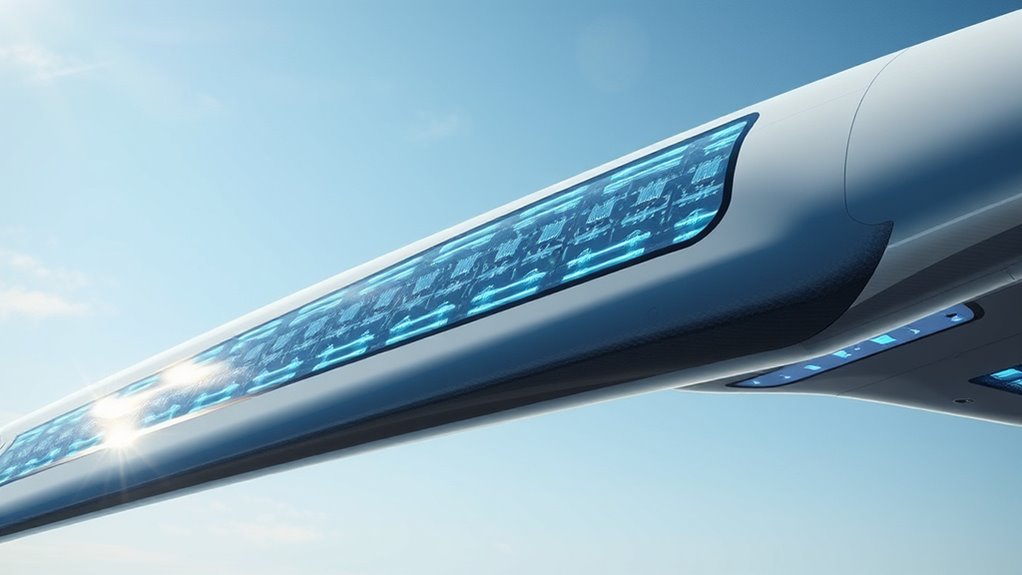

Structural battery composites combine load-bearing materials with energy storage, making aircraft and vehicles lighter and more efficient. They eliminate the need for bulky batteries, allowing for streamlined, aerodynamic designs. While they offer high energy density, balancing strength and storage capacity remains a challenge. Manufacturing complexity and durability under operational stresses are ongoing hurdles. Exploring further reveals how advances in materials and techniques are shaping the future of integrated energy solutions.
Key Takeaways
- Structural battery composites integrate energy storage directly into load-bearing components, reducing weight and space in aircraft and vehicles.
- Achieving high energy density while maintaining mechanical strength is essential for effective structural battery performance.
- Manufacturing challenges include uniform material integration, precise layering, and ensuring durability under operational stresses.
- Durability considerations involve resistance to vibration, temperature fluctuations, and mechanical loads to ensure safety and longevity.
- Advancements in materials and fabrication methods aim to scale production, improve energy capacity, and enable widespread industry adoption.
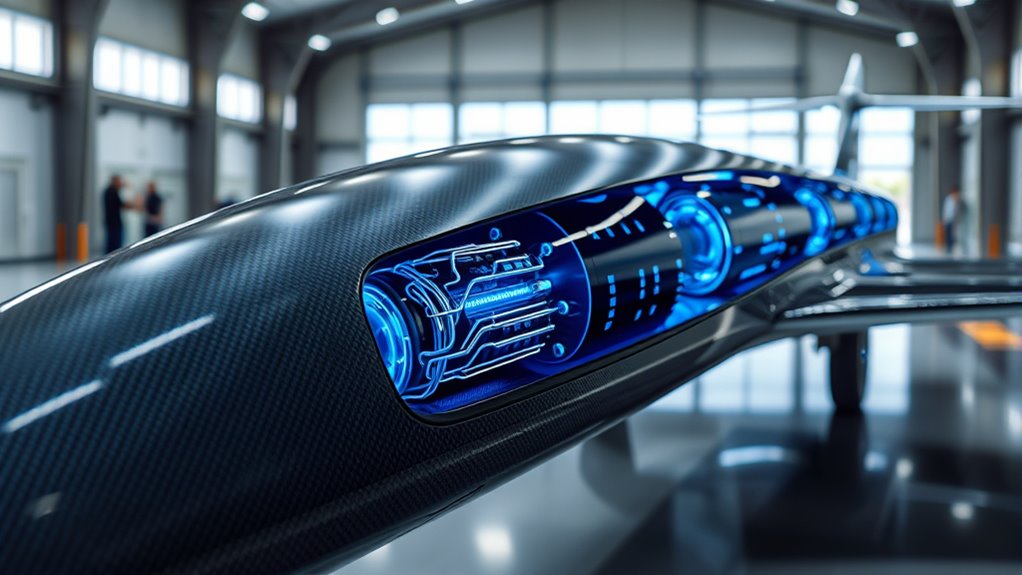
Structural battery composites represent a breakthrough in material science by combining the functions of load-bearing structures and energy storage into a single component. This innovation has the potential to revolutionize how you design and build aircraft and vehicles, making them lighter and more efficient. By integrating energy storage directly into the structural elements, you can eliminate the need for separate batteries, reducing weight and freeing up space. This integration not only improves performance but also opens new possibilities for more streamlined, aerodynamic designs. However, achieving high energy density in these composites remains a significant challenge. You need to balance the material’s strength and stiffness with its ability to store enough energy to be practical. Higher energy density is *vital* because it determines how much energy the composite can hold relative to its weight, directly impacting the range and endurance of your vehicle or aircraft. Pushing for better energy density involves complex trade-offs; increasing storage capacity often compromises mechanical integrity, making manufacturing more difficult. These manufacturing challenges stem from the need to incorporate conductive, energy-storing materials without weakening the structural components. You must *guarantee* uniform distribution of these materials within the composite to prevent weak points that could lead to failure or reduced lifespan. The process demands precise control over layering, curing, and material interfaces, which can complicate production and increase costs. Additionally, *guaranteeing* the durability of these composites under operational stresses—such as vibrations, temperature variations, and mechanical loads—adds to the complexity. You’ll need innovative manufacturing techniques, such as advanced layering methods or novel fabrication processes, to overcome these challenges. As research advances, you may see new materials and methods that improve energy density while maintaining structural integrity. Still, current manufacturing challenges highlight the importance of optimizing the balance between energy storage capabilities and mechanical performance. The development of advanced composite materials is crucial to overcoming these hurdles and realizing the full potential of structural battery composites. Despite these hurdles, the potential benefits of structural battery composites are enormous. They promise lighter, more efficient vehicles and aircraft with longer operational ranges and reduced maintenance needs. As you explore this technology, you’ll find that ongoing innovations aim to make manufacturing more scalable and cost-effective. Ultimately, overcoming these challenges could lead to a new era where energy storage is seamlessly integrated into the very fabric of your vehicle’s structure, transforming design paradigms and boosting performance across multiple industries.
structural battery composites for aircraft
As an affiliate, we earn on qualifying purchases.
As an affiliate, we earn on qualifying purchases.
Frequently Asked Questions
How Long Is the Lifespan of Structural Battery Composites?
You can expect the lifespan of structural battery composites to be around 10 to 20 years, depending on material durability and operating conditions. While they offer innovative energy storage, maintenance challenges like managing wear and preventing degradation can affect longevity. Proper inspection and timely repairs help extend their life, but ongoing research aims to improve durability, ensuring these composites remain reliable in demanding applications.
Are They Cost-Effective Compared to Traditional Batteries?
Sure, structural battery composites are the future, right? Well, when it comes to cost comparison, they’re currently pricier than traditional batteries due to higher manufacturing costs and complex production processes. While they offer space-saving benefits, you’ll pay a premium for that innovation. So, unless you’re building a spaceship or a flying car, traditional batteries still win on cost-effectiveness for now. Keep dreaming, though—tech might change that!
What Are the Safety Risks Associated With These Composites?
You should be aware that these composites pose fire hazards if damaged or improperly manufactured, which could lead to dangerous fires. Maintaining their structural integrity is vital because any compromise might cause failure under stress, increasing safety risks. Although they offer innovative energy storage, you need to monitor and manage potential safety risks carefully, ensuring proper design, handling, and maintenance to prevent accidents related to fire hazards and structural weaknesses.
Can They Be Recycled or Reused After End-Of-Life?
You can recycle or reuse structural battery composites, but recycling challenges often make this difficult due to their complex materials. The reuse potential exists, especially if components are designed for disassembly, but current technology limits efficient recycling. You might find opportunities to repurpose parts, yet developing better recycling methods remains essential for sustainable end-of-life management of these composites.
How Do They Perform Under Extreme Temperature Conditions?
You might think structural battery composites can’t handle extreme temperatures, but research shows they actually offer impressive thermal stability and temperature resilience. They perform well under high and low-temperature conditions, maintaining their structural integrity and energy storage capabilities. While prolonged exposure to extreme heat or cold can affect performance, advances in materials design continually improve their resilience, making them suitable for challenging environments in aircraft and vehicles.
energy storage load-bearing materials
As an affiliate, we earn on qualifying purchases.
As an affiliate, we earn on qualifying purchases.
Conclusion
Imagine a future where your aircraft and vehicles are powered by their very own bones—structural battery composites. By integrating energy storage directly into load-bearing materials, you’re not just saving space; you’re revolutionizing efficiency and design. It’s as if these composites breathe life into structures, turning them into both strength and power. Embrace this innovation, and you’re not just observing change—you’re shaping a smarter, lighter, more sustainable world where energy and structure become one.
advanced composite materials for vehicles
As an affiliate, we earn on qualifying purchases.
As an affiliate, we earn on qualifying purchases.
manufacturing equipment for structural batteries
As an affiliate, we earn on qualifying purchases.
As an affiliate, we earn on qualifying purchases.