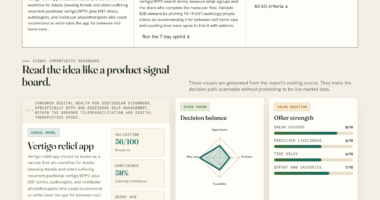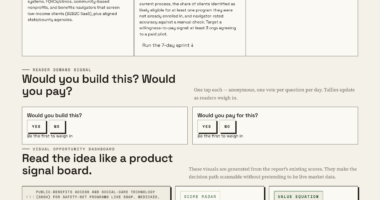
📊 Full opportunity report: Death Certificate Assistance For Funeral Service Providers on IdeaNavigator AI — validation score, market gap, and execution plan.

Get business pricing on tech for your team
- Business-only prices and quantity discounts
- Tax-exempt purchasing
- Multiple users, one account, clear invoices
TL;DR

IdeaNavigator AI has proposed a death-certificate tracking and reminder tool for independent funeral homes and small groups. The concept responds to new state requirements in Michigan and Virginia, but it remains an untested product proposal, not an announced or operating service.
IdeaNavigator AI has proposed a tracking and reminder workflow to help funeral homes follow up on unsigned death certificates, citing new certification requirements in Michigan and Virginia. The proposal describes a potential product for independent funeral homes and small multi-location groups; it does not establish that a tool has been built, adopted or tested.
The proposed system would give funeral-home staff a case board showing each death record’s certification status. Staff could enter updates manually or use electronic death-registration status where a state system makes that information available. The board would also store certifiers’ office contacts and preferred ways to receive follow-ups.
Under the concept, reminders would be sent by email, fax or text message on a schedule tied to the relevant state deadline. The tool would log contact attempts, flag cases nearing a deadline, provide families with a plain-language status update and generate a monthly report on slow certification. These are proposed features, not confirmed capabilities of an existing product.
IdeaNavigator AI identifies funeral directors and office managers as the intended users. Its suggested business model is a monthly subscription per funeral-home location, with a discounted option for state funeral directors’ associations that enroll members in bulk. No price, launch date, vendor, customer commitments or financial results are supplied.
Death certificate follow-up A proposed tool, not a live service
IdeaNavigator AI outlines a tracking and reminder workflow for funeral homes facing new requirements in Michigan and Virginia. No product or pilot is confirmed.
What the concept would do
The proposed workflow aims to make unsigned cases and follow-ups easier for staff to track.
A shared board would show certification status, entered manually or from available state system data.
Scheduled email, fax or text reminders would go to certifiers, with contact attempts logged.
The tool would flag approaching deadlines, provide family updates and report slow certification.
Why delays matter
The proposal links outstanding certification to practical effects for families and funeral-home teams.
Next steps may wait
Permits, cremations, insurance claims and benefit payments may be delayed while certification is outstanding.
Follow-ups are scattered
A shared record could replace separate calls, faxes and individual notes; that benefit has not been measured.
State context and limits
The concept focuses first on Michigan and Virginia, but the proposal leaves key implementation details open.
- The proposal says House Bills 4077 and 4078 require certification within 48 hours through the state system.
- The proposal says House Bill 156 adds a state electronic registration tutorial for certain clinicians as part of licensing.
How a pilot would be assessed
The suggested test compares each participating home’s experience with its own previous 60 days.
| Measure | Comparison |
|---|---|
| Time to medical certification | Pilot period versus prior 60 days |
| Staff time spent following up | Pilot period versus prior 60 days |
Certification Delays Affect Families
A death certificate can be needed before funeral arrangements and later administrative tasks move forward. The proposal says that a burial or cremation permit may depend on a physician or medical examiner certifying the cause of death. It also points to possible delays for cremations, insurance claims and benefit payments when certification is outstanding.
For funeral-home staff, the proposed value is operational: a shared record of which cases remain unsigned and which office has been contacted could replace scattered calls, faxes and individual notes. That potential benefit has not been measured. IdeaNavigator AI recommends a pilot that would compare time to medical certification and staff minutes spent following up against each participating home’s previous 60 days.
New state rules give the concept a defined setting in which to test its usefulness. They do not, by themselves, show that a reminder system will make certifiers respond faster or that funeral homes will pay for one. The proposal’s practical significance will depend on whether staff can access accurate status information and whether reminders reduce delays without adding administrative work.
Products Worth Considering

Sony WH-1000XM4C (M4 2nd Gen) Wireless Noise-Cancelling Headphones, Black

LG UltraGear 32-inch 4K UHD OLED Gaming Monitor, 165Hz

Logitech MX Mechanical Wireless Illuminated Performance Keyboard, Clicky
As an affiliate, we earn on qualifying purchases.
Michigan and Virginia Rules
The proposal cites two 2026 legislative developments. It says Michigan House Bills 4077 and 4078, signed on March 17, 2026, require death certificates to be certified within 48 hours through the state’s secure web-based system. It also says Virginia House Bill 156 requires physicians, advanced practice registered nurses and physician assistants who expect to sign death certificates to complete the state’s electronic death registration system tutorial as part of licensing.
Those descriptions are the legislative context presented for the product idea. The proposal does not provide bill text, implementation guidance or details about how the requirements apply in specific cases. Nor does it establish that every state exposes certification status in a way an outside product can access. It therefore presents manual entry as an alternative to system integration.
The suggested initial market is deliberately narrow: independent funeral homes or small groups in Michigan or Virginia. Rather than recommending an immediate broad rollout, IdeaNavigator AI proposes testing the workflow with five funeral homes over 60 days.
Product Status and Access Questions
The proposal does not identify a developer, product release, participating funeral homes or state-agency partner. It gives no evidence that the system has been built or that a pilot is underway. Its suggested performance measures are plans for a future test, not reported results.
Several implementation questions remain open. The proposal does not explain whether state electronic death registration systems allow outside access, what data-sharing permissions would be needed, or how case information and family updates would be protected. It also gives no detail on how reminder schedules would account for different state rules, weekends, holidays or individual case circumstances.
The cited requirements are described in the proposal, but the material does not include the statutory text or official implementation details. It is also unclear whether funeral homes would use the tool themselves, whether associations would help administer it, and whether certifiers would respond differently to automated reminders than to existing follow-up calls.
A Five-Home Pilot Would Test It
The next step set out in the proposal is a 60-day test with five funeral homes in Michigan or Virginia. Participating homes would record the time between a death and medical certification, as well as the staff time spent chasing signatures, then compare those figures with the prior 60 days at each location.
That comparison could show whether the workflow changes follow-up time or certification timing, but the proposal reports no pilot findings and sets no start date. Any later evaluation would also need to clarify how records were tracked, whether results differed by location and how the team handled cases where electronic status data was unavailable.
For now, the development is a product concept tied to changing state requirements. Whether it advances beyond that stage depends on finding pilot sites, confirming what information can be accessed and measuring results against the homes’ earlier experience.
Key Questions
Is a death-certificate tracking product already available?
No availability is confirmed. IdeaNavigator AI describes a proposed workflow, but does not name a vendor, announce a launch or report that the system has been built.
Who is the proposed tool for?
The intended users are funeral directors and office managers at independent funeral homes or small multi-location groups, initially in Michigan or Virginia.
What would the proposed workflow do?
It would track certification status, record follow-up attempts and send scheduled reminders. Other proposed features include deadline warnings, family status updates and monthly reports on slow certification.
Have funeral homes tested the idea?
No test results are reported. The proposal recommends a 60-day pilot with five homes, comparing certification times and staff follow-up minutes with the previous 60 days.
What remains uncertain?
It is not clear whether state systems will permit outside status access, what privacy and data-sharing arrangements would be required, or whether automated reminders would reduce delays. A product launch and pilot date have not been announced.
Source: IdeaNavigator AI