
AI automation platforms for small businesses can help reduce repetitive work, but the options in this roundup are books and practical guides—not software platforms themselves. My best overall pick is AI Automation Made Simple for Small Business, which pairs a beginner-friendly 30-day plan with no-code workflow building. For hands-on workflow ideas, AI Agents for Small Business stands out for its ready-to-use examples, while DM Automation That Sells is the clearest fit for businesses focused on social messaging and lead capture. The main tradeoff is whether you need broad guidance, step-by-step implementation, or advice for a specific channel—and how much technical detail you can handle. Continue reading for the full breakdown and help matching a guide to your business needs.

Get business pricing on tech for your team
- Business-only prices and quantity discounts
- Tax-exempt purchasing
- Multiple users, one account, clear invoices
Key Takeaways
- The strongest beginner signal is a defined learning path: the 30-day no-code guide gives readers a clearer route from learning to building than titles that promise broad AI benefits.
- Workflow examples separate practical guides from general overviews: the ready-to-use workflow and 30-workflow titles point toward implementation, while broader small-business guides cover more functions without signaling the same hands-on scope.
- Channel-specific books are better for narrow jobs than general automation: the DM and social-media titles focus on messages, content, and leads, making them more targeted choices for marketing teams.
- Tool-specific guidance may age faster: the n8n and Make.com guide offers a concrete no-code focus, but readers should check that its examples match their current software stack.
- No title alone proves business results: claims about saving time, scaling, or performance should be weighed against the guide’s actual workflow detail, implementation steps, and fit with the buyer’s processes.
| AI Agents for Small Business: 30 Ready-to-Use Workflows |  | Best for Workflow Ideas | Format: Practical playbook | Workflow count: 30 | Approach: AI-agent workflows | VIEW LATEST PRICE | See Our Full Breakdown |
| AI for Entrepreneurs & Small Business Owners: How to Compete with Larger Businesses Using AI Tools and Automation |  | Best for Competitive Strategy | Audience: Entrepreneurs and small-business owners | Main focus: Using AI tools and automation to compete with larger businesses | Guidance: Practical tools and step-by-step strategies | VIEW LATEST PRICE | See Our Full Breakdown |
| AI Automation Made Simple for Small Business: A 30-Day Beginner’s Guide to Building No-Code Workflows | 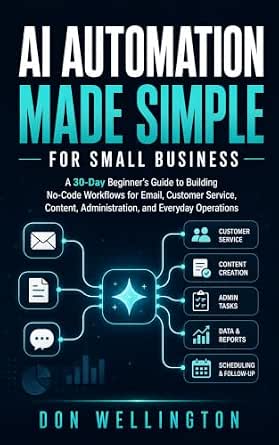 | Best for Beginners | Format: Book | Program length: 30 days | Audience: Beginners at small businesses | VIEW LATEST PRICE | See Our Full Breakdown |
| AI-Powered Automation and Workflows for Small Business Owners |  | Best for Productivity Planning | Format: Book | Series: AI Productivity for Small Business Owners | Volume: 5 | VIEW LATEST PRICE | See Our Full Breakdown |
| DM Automation That Sells: Answer Every Message with AI on Instagram, WhatsApp, and 9 More Platforms, and Find Partners Without Spam |  | Best for Messaging Automation | Format: Book | Topic: AI-powered direct-message automation and partner discovery | Named platforms: Instagram and WhatsApp | VIEW LATEST PRICE | See Our Full Breakdown |
| AI Automation for Small Businesses: Build Semi-Passive Income Systems Without Hiring or Coding |  | Best for Lean, Nontechnical Owners | Product type: Guide | Primary subject: AI automation for small businesses | Stated goal: Build semi-passive income systems | VIEW LATEST PRICE | See Our Full Breakdown |
| AI Automation for Small Businesses: A Practical Guide to Save Time, Work Smarter, and Grow with AI |  | Best for Practical, Broad Orientation | Product type: Guide | Primary subject: AI automation for small businesses | Stated focus: Saving time | VIEW LATEST PRICE | See Our Full Breakdown |
| AI Automation for Small Businesses: Build Smarter Workflows, Save Time, Reduce Costs, and Scale Your Business with AI |  | Best for Cost-Conscious Workflow Planning | Product type: Guide | Primary subject: AI automation for small businesses | Workflow focus: Building smarter workflows | VIEW LATEST PRICE | See Our Full Breakdown |
| AI Automation for Small Business: Build 30 No-Code Workflows in 30 Days with n8n, Make.com, and AI |  | Best for Structured No-Code Implementation | Product type: Book | Workflow count: 30 | Program length: 30 days | VIEW LATEST PRICE | See Our Full Breakdown |
| AI Automation for Small Business: A Practical Guide |  | Best for Cross-Department Coverage | Product type: Book | Primary subject: AI automation for small business | Approach: Practical guide | VIEW LATEST PRICE | See Our Full Breakdown |
| AI for Small Business and Social Media Automation: A Playbook for Scaling Content, Automating DMs, and Capturing Leads |  | Best for Social Media Lead Capture | Product type: Playbook | Primary focus: AI for small-business social media automation | Stated topic: Scaling content | VIEW LATEST PRICE | See Our Full Breakdown |
| AI Automation Mastery for Small Businesses: A Guide to Streamlining Business Operations |  | Best for Broad Operations Orientation | Product type: Guide | Primary focus: AI automation for small businesses | Stated aim: Streamlining business operations | VIEW LATEST PRICE | See Our Full Breakdown |
| AI Automation for Small Business: Simple Workflows for Everyday Tasks |  | Best for Everyday Workflow Coverage | Product type: Book | Primary focus: AI workflows for small-business tasks | Stated topic: Email | VIEW LATEST PRICE | See Our Full Breakdown |
| AI for Performance Marketing: From Prompts and Platform Automation to Measurable Business Outcomes |  | Best for Performance Marketing Focus | Primary focus: AI for performance marketing | Stated topic: Prompts | Stated topic: Platform automation | VIEW LATEST PRICE | See Our Full Breakdown |
| AI for Small Business: Using Artificial Intelligence in Marketing, Sales, HR, and Operations |  | Best for Cross-Department AI Planning | Product type: Book | Primary focus: Artificial intelligence for small business | Topic: Marketing | VIEW LATEST PRICE | See Our Full Breakdown |
| AI automation platforms for small businesse | Product type | Stated topic |
|---|---|---|
| AI Agents for Small Business: | — | — |
| AI for Entrepreneurs & Small B | — | — |
| AI Automation Made Simple for | — | — |
| AI-Powered Automation and Work | — | — |
| DM Automation That Sells: Answ | — | — |
| AI Automation for Small Busine | Guide | — |
| AI Automation for Small Busine | Guide | — |
| AI Automation for Small Busine | Guide | — |
| AI Automation for Small Busine | Book | — |
| AI Automation for Small Busine | Book | — |
| AI for Small Business and Soci | Playbook | Scaling content |
| AI Automation Mastery for Smal | Guide | — |
| AI Automation for Small Busine | Book | |
| AI for Performance Marketing: | — | Prompts |
| AI for Small Business: Using A | Book | — |
More Details on Our Top Picks
AI Agents for Small Business: 30 Ready-to-Use Workflows
AI Agents for Small Business: 30 Ready-to-Use Workflows is the most task-focused pick here: its 30 workflows span sales, marketing, operations, and control, giving owners a menu of places to explore agent-based help. That breadth makes it a stronger starting point for mapping possible automations than DM Automation That Sells, which concentrates on messaging and partner discovery. The tradeoff is that the available description does not explain the individual workflows, tools, or how the agent systems work. Buyers who need step-by-step setup instructions or platform-specific guidance may have to look elsewhere. I’d choose this playbook to identify candidate tasks before selecting software, not as a substitute for technical implementation guidance.
Pros:- Lists 30 ready-to-use workflow ideas
- Covers sales, marketing, operations, and control
- Offers broader functional coverage than the messaging-focused DM Automation That Sells
Cons:- The supplied description does not detail the 30 workflows
- No agent platforms, integrations, or technical requirements are specified
- May help with task selection more than implementation
Best for: Small-business owners who want a cross-functional shortlist of tasks to explore for AI-agent automation before choosing tools.
Not ideal for: Readers who need named platforms, technical setup steps, or detailed explanations of how each agent workflow operates.
- Format:Practical playbook
- Workflow count:30
- Approach:AI-agent workflows
- Sales coverage:Included
- Marketing coverage:Included
- Operations coverage:Included
- Control coverage:Included
Our verdict“Choose this playbook if you need a broad set of AI-agent workflow ideas; skip it if you need tool-specific build instructions.”
AI for Entrepreneurs & Small Business Owners: How to Compete with Larger Businesses Using AI Tools and Automation
AI for Entrepreneurs & Small Business Owners frames AI automation as a way for smaller firms to compete with larger ones, pairing practical tools and step-by-step strategies with real-world examples. That makes it a broader business-planning choice than AI Automation Made Simple for Small Business, whose 30-day format is more directly aimed at beginners building no-code workflows. The competitive lens may help owners connect automation choices to efficiency and business goals, rather than treating each workflow as an isolated task. Its breadth is also a limitation: readers seeking deep technical instructions may find the coverage too general, and the guide assumes some comfort with technology. I’d favor it for owners who want direction and examples, not a detailed engineering manual.
Pros:- Tailors AI and automation guidance to entrepreneurs and small businesses
- Connects adoption to competing with larger businesses
- Includes step-by-step implementation guidance
- Uses real-world examples
Cons:- May be too broad for readers looking for deep technical detail
- Assumes a basic level of technology familiarity
- The supplied information does not identify specific tools or integrations
Best for: Entrepreneurs and small-business owners who want to connect AI tools and automation with efficiency and competing against larger firms.
Not ideal for: Readers seeking advanced technical walkthroughs or owners who need especially gradual, low-tech instruction.
- Audience:Entrepreneurs and small-business owners
- Main focus:Using AI tools and automation to compete with larger businesses
- Guidance:Practical tools and step-by-step strategies
- Examples:Real-world examples
- Application:Integrating AI into daily operations
- Intended outcome:Improved efficiency
Our verdict“Pick this guide for a business-focused AI strategy with examples, but choose a more technical resource for detailed platform setup.”
AI Automation Made Simple for Small Business: A 30-Day Beginner’s Guide to Building No-Code Workflows
AI Automation Made Simple for Small Business gives newcomers a defined route into automation: a 30-day beginner’s program centered on no-code workflows. Its coverage of email, customer service, content, administration, and everyday operations makes it more implementation-oriented than AI for Entrepreneurs & Small Business Owners, which is framed around broader competitive strategy. The no-code focus also suits owners who want to work on processes without starting with programming. The main limitation is a lack of named platforms, tools, or technical requirements in the available details, so readers cannot tell whether the lessons fit their existing software. I’d pick it for structure and accessible workflow practice, while owners needing platform-specific recipes should seek more explicit tool guidance.
Pros:- Organizes learning into a 30-day program
- Focuses on no-code AI automation
- Covers email, customer service, content, administration, and daily operations
- Provides a more structured beginner path than the broader strategy focus of AI for Entrepreneurs & Small Business Owners
Cons:- The supplied details do not name platforms or tools
- Technical requirements are not specified
- The 30-day structure may be less useful to readers who want a quick reference rather than a paced guide
Best for: First-time automation learners at small businesses who want a structured, no-code plan covering routine business tasks.
Not ideal for: Owners who need instructions for a particular automation platform, integrations, or technical requirements before committing to a workflow.
- Format:Book
- Program length:30 days
- Audience:Beginners at small businesses
- Automation approach:No-code AI workflows
- Email:Covered
- Customer service:Covered
- Content:Covered
- Administration and everyday operations:Covered
Our verdict“Choose this guide if you want a paced, no-code introduction; skip it if platform-specific setup directions are your priority.”
AI-Powered Automation and Workflows for Small Business Owners
AI-Powered Automation and Workflows for Small Business Owners is aimed at owners looking to streamline operations and improve productivity through practical AI applications. Its place in the AI Productivity for Small Business Owners series gives it a defined productivity focus, while AI Agents for Small Business: 30 Ready-to-Use Workflows offers a stated count of workflows across several business functions. This book’s description supports a strategy-led choice, but provides fewer specifics about workflow quantity, tools, or implementation steps. It is also Volume 5, so readers may want to check whether the series’ earlier material is needed to follow its approach. AI guidance can age quickly, and the available details do not indicate how often the content is updated. It suits owners seeking productivity ideas more than those comparing named platforms.
Pros:- Focuses specifically on small-business owners
- Centers on productivity and operational streamlining
- Provides practical AI automation strategies
- Belongs to a named small-business productivity series
Cons:- The supplied description does not specify platforms or technical steps
- AI guidance may age as tools and capabilities change
- As Volume 5, it may be less suitable as a standalone starting point for readers seeking a sequenced series
Best for: Small-business owners who want AI automation strategies framed around productivity and streamlining operations.
Not ideal for: Readers who need a stated workflow count, named automation platforms, detailed setup instructions, or guidance known to be frequently updated.
- Format:Book
- Series:AI Productivity for Small Business Owners
- Volume:5
- Audience:Small-business owners
- Main focus:AI-powered automation and workflows
- Productivity focus:Enhancing productivity
- Operations focus:Streamlining operations
Our verdict“Choose this book for productivity-oriented automation strategy, but compare its scope with the more explicitly mapped workflows in AI Agents for Small Business.”
DM Automation That Sells: Answer Every Message with AI on Instagram, WhatsApp, and 9 More Platforms, and Find Partners Without Spam
DM Automation That Sells takes the narrowest, most channel-specific approach in this group: AI-assisted replies across Instagram, WhatsApp, and nine more platforms, plus guidance on finding partners without spam. That focus can make it a better fit for businesses that handle prospects and customer questions through direct messages than AI-Powered Automation and Workflows for Small Business Owners, which addresses productivity and operations more broadly. The specialization is also the tradeoff: it does not claim to cover email, administration, or general business workflows. The available details do not name the nine additional platforms, which makes it harder to judge fit with an existing channel mix. I’d choose it for a DM-heavy sales or customer-service process, not as an all-purpose automation guide.
Pros:- Focuses on AI-assisted direct-message responses
- Names Instagram and WhatsApp among supported platforms
- Covers 11 platforms in total according to the title
- Includes partner discovery guidance that avoids spam
Cons:- The nine additional platforms are not identified in the supplied details
- The scope is narrower than general small-business workflow guides
- The description does not specify messaging integrations or setup requirements
Best for: Small businesses that receive meaningful sales or customer-service inquiries through Instagram, WhatsApp, and other direct-message channels.
Not ideal for: Owners seeking broad automation across back-office work, email, or operations, or who need the full supported-platform list before choosing a guide.
- Format:Book
- Topic:AI-powered direct-message automation and partner discovery
- Named platforms:Instagram and WhatsApp
- Platform count:12 total, based on the title
- Additional platforms:Nine, not named in the supplied details
- Messaging use:AI-assisted responses to direct messages
- Partner discovery:Guidance on finding partners without spam
Our verdict“Pick this guide if direct messages are a central sales or service channel; choose a broader workflow guide for automation across the whole business.”
AI Automation for Small Businesses: Build Semi-Passive Income Systems Without Hiring or Coding
This guide’s clearest appeal is its focus on small-business owners without coding or hiring capacity. Its semi-passive income angle makes it distinct from AI Automation for Small Business: Build 30 No-Code Workflows in 30 Days with n8n, Make.com, and AI, which names tools and sets a defined workflow-building schedule. Here, the available description points to a broader goal—creating systems that can keep working with less hands-on effort—rather than a specific technical curriculum.
That makes it a plausible starting point for solo operators who want to explore automation without taking on software setup or adding staff. The tradeoff is limited evidence about the actual systems, examples, or methods inside. Buyers who need step-by-step instructions or a clear tool path may get more direction from the 30-workflow guide; choose this one if the low-resource, semi-passive business premise is the main draw.
Pros:- Directly addresses automation for small businesses
- Aims at readers who cannot hire developers or additional staff
- Presents a noncoding path to automation
- Centers on building systems intended to reduce ongoing manual work
Cons:- Available product information does not identify the systems or methods taught
- No specific software, workflow examples, or implementation sequence is provided
- The semi-passive income framing may not suit buyers focused on automating existing daily tasks
Best for: Solo business owners with limited technical skills or staff who want to explore AI automation as a way to create repeatable, lower-touch business systems.
Not ideal for: Readers who need named tools, detailed implementation steps, or a verified list of automation methods before choosing a guide.
- Product type:Guide
- Primary subject:AI automation for small businesses
- Stated goal:Build semi-passive income systems
- Coding requirement:Designed for readers without coding
- Hiring requirement:Designed for readers without hiring resources
- Specific methods:Not specified in the available product data
Our verdict“Choose this guide if you are a nontechnical owner drawn to lower-touch business systems, but favor a tool-specific workflow guide if you need concrete build instructions.”
AI Automation for Small Businesses: A Practical Guide to Save Time, Work Smarter, and Grow with AI
This guide frames AI automation around three everyday business aims: saving time, working more efficiently, and supporting growth. That broad framing gives it a different emphasis from AI Automation for Small Business: Build 30 No-Code Workflows in 30 Days with n8n, Make.com, and AI, which offers a named toolkit and a fixed 30-day workflow plan. This title may suit owners who want to connect automation to business priorities before committing to a particular build path.
The limitation is that the available description does not identify covered departments, tools, or concrete exercises. Compared with AI Automation for Small Business: A Practical Guide, whose stated scope spans marketing, sales, customer service, and operations, this book’s practical focus is clear but its topic coverage is less defined. I’d shortlist it for a general introduction, not for buyers seeking a tightly specified implementation manual.
Pros:- Connects automation to time savings and day-to-day efficiency
- Addresses business growth as well as task reduction
- Clearly targets small-business use rather than general AI adoption
- Practical framing may help owners relate automation to operational goals
Cons:- Available product details do not name tools or specific workflows
- The topics and depth of coverage are not described
- No implementation timeline or coding requirements are specified
Best for: Small-business owners who want an accessible, goal-oriented introduction to using AI for efficiency and growth before selecting specific workflows.
Not ideal for: Operators who need named platforms, department-by-department coverage, or a defined schedule of tasks and exercises.
- Product type:Guide
- Primary subject:AI automation for small businesses
- Stated focus:Saving time
- Efficiency focus:Working more efficiently
- Growth focus:Using AI to support business growth
- Named tools:Not specified in the available product data
Our verdict“Pick this for a broad, practical orientation to AI and business efficiency, but choose a more specifically scoped guide if you need a clear workflow roadmap.”
AI Automation for Small Businesses: Build Smarter Workflows, Save Time, Reduce Costs, and Scale Your Business with AI
This title puts workflow improvement and cost reduction at the center, making it a natural fit for owners looking to improve processes without expanding overhead. Its emphasis differs from AI Automation for Small Businesses: Build Semi-Passive Income Systems Without Hiring or Coding, which focuses on lower-touch income systems, and from the 30-workflow n8n and Make.com guide, which advertises a specific tool-based program. This guide instead frames automation as a way to save time, manage costs, and support scale.
That combination may help a buyer evaluate automation as an operational decision, rather than simply a collection of AI experiments. However, the available description does not reveal the workflows, platforms, or cost-reduction methods covered. Compared with the more explicitly structured 30-day guide, this one offers less visible implementation detail. I’d favor it for strategic workflow priorities, while hands-on builders may want the named tools and schedule elsewhere.
Pros:- Makes workflow improvement a central theme
- Addresses both time savings and cost reduction
- Connects automation to business growth and scaling
- Focuses on small-business process needs
Cons:- Available product details do not identify specific workflows or tools
- No implementation schedule or required skill level is stated
- The methods behind its cost-reduction focus are not described
Best for: Owners of small businesses trying to reduce manual workload and operating costs while preparing existing processes to handle growth.
Not ideal for: Readers who want a specified no-code platform, detailed workflow recipes, or a documented step-by-step program.
- Product type:Guide
- Primary subject:AI automation for small businesses
- Workflow focus:Building smarter workflows
- Stated efficiency goal:Save time
- Growth focus:Scale a business with AI
Our verdict“Choose this if your main objective is to connect workflow automation with lower operating costs and growth, rather than follow a named tool-by-tool course.”
AI Automation for Small Business: Build 30 No-Code Workflows in 30 Days with n8n, Make.com, and AI
This is the most implementation-focused option in the group: it promises 30 no-code workflows across 30 days and names n8n and Make.com alongside AI. That makes its path easier to picture than the broader aims of AI Automation for Small Businesses: A Practical Guide to Save Time, Work Smarter, and Grow with AI, which does not specify tools or a schedule in the available details. The daily structure may help an owner turn automation from an abstract goal into a sequence of projects.
The tradeoff is a heavier commitment: readers need time to work through the program and willingness to learn the named platforms. The description also does not establish how detailed the instructions are or what skill level they assume. Compared with the semi-passive-systems guide, this one is more concrete about tools and output, but less suited to someone seeking a general, low-technical overview.
Pros:- Sets a defined target of 30 workflows
- Uses a clear 30-day program structure
- Names n8n and Make.com as workflow tools
- Focuses on no-code automation without hiring a developer
Cons:- The stated program requires sustained time and follow-through
- Available details do not specify the depth or format of instruction
- A tool-centered approach may be less useful to readers who have not chosen a platform
Best for: Small-business owners ready to spend a month building no-code automations with n8n, Make.com, and AI, without hiring a developer.
Not ideal for: Owners who want a quick conceptual introduction, cannot commit to a 30-day program, or need the book’s level of detail confirmed before choosing.
- Product type:Book
- Workflow count:30
- Program length:30 days
- Tools:n8n, Make.com, and AI
- Automation approach:No-code workflows
- Intended audience:Small businesses
- Developer requirement:Designed to avoid hiring a developer
Our verdict“Choose this if you want a scheduled, tool-specific route to building no-code workflows; skip it if you need only a high-level introduction.”
AI Automation for Small Business: A Practical Guide
This guide’s differentiator is its stated reach across marketing, sales, customer service, operations, and everyday work. That breadth makes it a useful candidate for owners who want to scan multiple parts of a business rather than focus on one automation goal. Compared with AI Automation for Small Businesses: Build Smarter Workflows, Save Time, Reduce Costs, and Scale Your Business with AI, which emphasizes workflow efficiency and cost reduction, this title gives a clearer map of the departments it addresses.
The tradeoff is that broad coverage can mean less depth in any one area, and the available details do not name tools or describe specific examples. It also lacks the explicit build schedule and platform choices of Build 30 No-Code Workflows in 30 Days with n8n, Make.com, and AI. I’d choose this as a cross-functional starting point, not as a substitute for a focused, tool-by-tool implementation plan.
Pros:- Covers several major areas of small-business work
- Includes both customer-facing functions and operations
- Addresses everyday work in addition to named departments
- Presents AI automation as a practical business topic
Cons:- The available description does not name software platforms
- No workflow count or implementation schedule is provided
- Breadth across departments may not provide the depth a specialist needs
Best for: Small-business owners who want to identify AI automation opportunities across marketing, sales, customer service, operations, and routine work.
Not ideal for: Readers who need a 30-day project plan, named no-code platforms, or deep instructions for a single department.
- Product type:Book
- Primary subject:AI automation for small business
- Approach:Practical guide
- Topics:AI automation, marketing, sales, customer service, operations, everyday work
- Marketing coverage:Included
- Sales coverage:Included
- Customer service coverage:Included
- Operations coverage:Included
Our verdict“Choose this for a broad view of automation opportunities across your business, but select a tool-specific guide if you are ready to build workflows now.”
AI for Small Business and Social Media Automation: A Playbook for Scaling Content, Automating DMs, and Capturing Leads
Social-first small businesses may find this playbook more directly relevant than AI Automation for Small Business: Simple Workflows for Everyday Tasks, which spans email, invoices, and other routine work. Its stated focus connects three steps—scaling social content, automating direct messages, and capturing leads—so it speaks to owners who want social activity to feed a sales pipeline, not just fill a posting calendar. That narrow emphasis is also its main limitation: the available description does not identify specific tools, implementation steps, or the book’s format, so I can’t judge how readily a reader could put its advice into practice. It is a subject-focused guide rather than a verified automation platform, and it may leave readers wanting broader help with back-office workflows.
Pros:- Targets practical small-business social media use
- Covers content scaling alongside DM automation
- Includes lead capture as part of the social workflow
Cons:- Specific tools and implementation strategies are not identified in the supplied details
- The format and depth of the material are not specified
- Its social focus leaves broader business automation needs outside its stated scope
Best for: Small-business owners who receive customer inquiries through social media and want guidance focused on content, DMs, and lead capture.
Not ideal for: Owners seeking verified software integrations, detailed setup instructions, or guidance across finance and operations; the supplied details do not establish those elements.
- Product type:Playbook
- Primary focus:AI for small-business social media automation
- Stated topic:Scaling content
- Stated topic:Automating direct messages
- Stated topic:Capturing leads
- Specific tools:Not specified in the supplied data
Our verdict“Choose this playbook if social DMs and lead capture are your main automation priorities, but look elsewhere for documented tools or broad operational workflows.”
AI Automation Mastery for Small Businesses: A Guide to Streamlining Business Operations
This guide is positioned around streamlining small-business operations across different phases of work, giving it a wider operational frame than AI for Small Business and Social Media Automation, which concentrates on content, DMs, and lead capture. That breadth may suit an owner who wants to think beyond marketing, but the supplied description does not name the processes covered, the tools used, or the format. That makes it hard to tell whether the material offers implementable workflows or a high-level overview. I would treat it as a possible orientation guide, not a confirmed software platform or a step-by-step automation manual. Buyers who need concrete examples before choosing tools may prefer a title with explicitly listed tasks, such as AI Automation for Small Business: Simple Workflows for Everyday Tasks.
Pros:- Frames AI automation around small-business operations
- Addresses efficiency across different phases of business activity
- Offers a broader operational focus than a social-media-only guide
Cons:- The supplied description does not identify specific processes or examples
- Tools and integrations are not specified
- The format and practical depth are not provided
Best for: Small-business owners seeking a general introduction to applying AI automation across business operations before choosing specific workflows.
Not ideal for: Owners who need named tools, documented integrations, or a clearly scoped how-to format to implement automation right away.
- Product type:Guide
- Primary focus:AI automation for small businesses
- Stated aim:Streamlining business operations
- Coverage:Different phases of small-business operations
- Format:Not specified
- Specific tools:Not specified in the supplied data
Our verdict“Consider this as a broad operations-oriented guide if you do not need confirmed tools or step-by-step workflows.”
AI Automation for Small Business: Simple Workflows for Everyday Tasks
Everyday task coverage is this book’s clearest advantage: the stated topics include email, customer support, content creation, invoices, lead management, and daily operations. That gives an owner more concrete areas to investigate than AI Automation Mastery for Small Businesses, whose description does not name specific processes. It also has broader back-office relevance than the social-focused AI for Small Business and Social Media Automation. The tradeoff is that the supplied details do not identify workflow tools or integrations, and they do not clarify whether the book provides step-by-step setup instructions. So the topic list helps readers match it to common work, but it does not confirm how much implementation detail they will get. I’d choose it for breadth of task examples, not as a substitute for a named automation platform.
Pros:- Covers email and customer-support workflows
- Includes content creation and lead management
- Addresses invoicing as well as daily operations
- Names a broad range of everyday small-business tasks
Cons:- Workflow tools are not identified in the supplied data
- The level of step-by-step implementation detail is unclear
- The description does not confirm integrations or software compatibility
Best for: Owners of small service or retail businesses who want to explore automation across customer messages, invoicing, leads, and recurring daily work.
Not ideal for: Readers looking for guidance tied to specific automation software, integrations, or verified setup instructions.
- Product type:Book
- Primary focus:AI workflows for small-business tasks
- Stated topic:Email
- Stated topic:Customer support and content creation
- Stated topic:Invoices and lead management
- Stated topic:Daily operations
- Workflow tools:Not specified in the supplied data
Our verdict“Pick this book for a broad menu of routine tasks to automate, but verify its tool guidance if you need implementation-ready steps.”
AI for Performance Marketing: From Prompts and Platform Automation to Measurable Business Outcomes
This title is the most specialized choice here: it links prompts and platform automation with measurable marketing outcomes, rather than covering a small business’s full range of operations. That focus sets it apart from AI for Small Business: Using Artificial Intelligence in Marketing, Sales, HR, and Operations, which spans several departments. For a business owner focused on marketing campaigns, the performance-outcome framing may be a better match than a general automation guide. The limitation is that the supplied description offers no detail about platforms, measurement methods, campaign types, or the book’s format. I can’t tell whether it provides hands-on instructions or a conceptual overview. It is best treated as a marketing-specific resource, not a broad guide to automating customer support, invoicing, or internal operations.
Pros:- Connects prompt use with platform automation
- Frames marketing around measurable business outcomes
- Offers a more specialized marketing angle than broad small-business AI guides
Cons:- Specific platforms and campaign workflows are not named in the supplied data
- Measurement methods and outcome examples are not described
- The format and implementation depth are unspecified
Best for: Small-business marketers or owner-operators who want to focus AI use on campaign execution and measurable marketing results.
Not ideal for: Owners seeking broad coverage of HR, sales operations, customer support, or finance, or readers who need named platforms and confirmed setup steps.
- Primary focus:AI for performance marketing
- Stated topic:Prompts
- Stated topic:Platform automation
- Stated aim:Measurable business outcomes
- Format:Not specified in the supplied data
- Platforms:Not specified in the supplied data
Our verdict“Choose this for a focused performance-marketing perspective, not for broad small-business operations automation.”
AI for Small Business: Using Artificial Intelligence in Marketing, Sales, HR, and Operations
Among these options, this is the clearest choice for owners who want to think about AI across marketing, sales, HR, and operations, rather than solving one narrow workflow. That range makes it a broader planning companion than AI for Performance Marketing, which focuses on marketing outcomes, and less task-specific than AI Automation for Small Business: Simple Workflows for Everyday Tasks, whose description names email, invoices, and lead management. The breadth can help an owner spot opportunities across a business, but the supplied details do not confirm particular automation tools, integrations, or how-to steps. It is also framed around artificial intelligence generally, so buyers seeking a dedicated automation platform should not mistake the book for software. Its value is in the cross-functional scope, not confirmed implementation detail.
Pros:- Covers four core business areas
- Presents AI applications from a small-business perspective
- Offers wider departmental scope than a marketing-only guide
Cons:- Specific automation tools and integrations are not identified in the supplied data
- The description does not establish the level of practical implementation detail
- Its broad AI scope may be less direct for readers seeking task-by-task automation instructions
Best for: Small-business owners or managers planning AI opportunities across marketing, sales, human resources, and operations.
Not ideal for: Buyers who need a specific automation platform, verified software integrations, or detailed instructions for building workflows.
- Product type:Book
- Primary focus:Artificial intelligence for small business
- Topic:Marketing
- Topic:Sales
- Topic:Human resources
- Topic:Operations
- Format:Book
Our verdict“Choose this book to map AI opportunities across departments, but use a more tool-specific resource for building automations.”

How We Picked
I compared these 15 titles as learning resources for small-business AI automation, not as software products. I looked for signals of practical value: named workflows, a clear learning sequence, no-code guidance, coverage of everyday operations, and specificity about marketing, sales, messaging, or other business tasks. I also considered how much prior knowledge a title appears to expect and whether its stated focus could help a reader choose a first project.
The ranking favors titles that signal a usable path from learning to action, with distinct advantages for broad workflow building, beginners, and focused marketing needs. Broad titles remain useful for orientation, but they rank below guides whose titles promise concrete workflows or a defined method. Because the supplied information consists of titles rather than full contents, I do not treat marketing claims as verified outcomes; buyers should confirm the edition, tools covered, and depth of examples before choosing.
Factors to Consider When Choosing AI Automation Platforms For Small Businesses
Choosing an AI automation guide is different from choosing automation software: the book or course can shape your plan, but your tools, data, and day-to-day processes determine what you can actually automate. I would choose by starting with a business bottleneck and checking whether the resource offers a credible path to solve it.
Start With One Repetitive Task
List recurring tasks that consume staff time, such as sorting inquiries, drafting routine replies, or moving information between forms and spreadsheets. Pick a task with clear inputs and an easy way to check the result rather than beginning with a broad goal like “automate operations.” A common mistake is choosing a guide because it promises business growth before identifying the work that needs changing. The first project should be small enough to test without disrupting customer service or financial records. If a workflow touches sensitive information or makes decisions on behalf of customers, plan for human review from the outset. A guide is most useful when its examples map to a task you can name today.
Match the Learning Style to Your Starting Point
Some readers need a sequenced introduction; others already understand automation and want examples to adapt. A dated, step-by-step plan can lower the barrier to starting, while a collection of workflows may suit someone comfortable learning by modifying examples. Do not confuse “simple” in a title with a guarantee that no technical setup is involved. Check whether the material explains prerequisites, troubleshooting, and how to maintain a workflow after it is running. If you are learning alongside a team, favor a resource that can support shared terminology and repeatable documentation. Paying for more advanced material makes little sense if the basic concepts and process ownership are still unclear.
Check Tool and Integration Fit
A workflow is only practical when it connects to the systems your business already uses. Before selecting a guide centered on a named automation tool, compare its examples with your CRM, email, booking, accounting, and messaging setup. Tool interfaces and AI capabilities change, so look for signs that the author explains the underlying logic rather than relying only on fixed screenshots or steps. A guide tied to a specific platform can offer clearer instructions, but it may require extra translation if your stack differs. Avoid choosing a resource solely because it names popular tools; confirm that it addresses the integrations and permissions your process requires. This check can prevent a promising example from becoming a dead end.
Set Boundaries for Accuracy, Privacy, and Human Review
Automation can speed up routine work while also multiplying mistakes when a prompt, connection, or source record is wrong. Decide which tasks can run unattended and which need approval, especially for customer commitments, hiring, billing, and regulated data. Check whether a proposed workflow sends business or customer information to an external AI service, and review the provider’s data controls before implementation. Small businesses often underestimate the work needed to test edge cases and handle failed runs. Keep a manual fallback and assign a person to monitor the workflow. A useful guide should support sound operating habits, not just show how to connect tools.
Judge Value by Implementation Help, Not Big Promises
Claims about passive income, reduced costs, or measurable marketing results need a practical method behind them. Look for clear examples, setup steps, decision points, and advice for measuring whether a workflow helps. A narrowly focused resource can be a better fit than a broad business guide if it addresses an expensive bottleneck, but its scope may not transfer to other departments. Consider the time required to apply the material as well as the effort required to maintain the resulting automations. Before committing, check publication details and whether the tools or workflows have been updated for the systems you use. The best value is guidance your team can put into practice and keep running.
Frequently Asked Questions
Are these recommendations software platforms or books about automation?
They are book and guide titles, not automation software subscriptions. That distinction matters because none of these entries can connect your apps or run workflows on its own. Use the roundup to choose a learning resource, then separately evaluate the software that fits your business systems, security needs, and budget. A guide may teach a method or tool, but you should verify its current coverage before relying on it for a live setup. If you wanted a direct comparison of automation apps, this list is not a substitute for one.
Which kind of guide should I choose if I have never built an automation?
Look for a resource that lays out a sequence, explains basic concepts, and starts with low-risk tasks. The 30-day beginner guide is the clearest match by title because it signals a staged no-code learning plan. Before choosing, check whether it explains setup, testing, and common failures rather than presenting only finished examples. Start with one workflow that has a clear success condition, such as routing a form submission to the right inbox. Do not begin with a customer-facing or financial process that has no review step.
Should I choose a broad guide or one focused on social messaging?
Choose based on the work you need to improve first. A broad guide can help you survey marketing, operations, sales, and other functions, while a messaging-focused title may offer more relevant direction for handling DMs and capturing leads. A narrow resource can be more immediately useful but may not help with back-office processes. Check whether your main channels and current messaging tools match the guide’s stated coverage. If you need both, begin with the urgent workflow and add broader learning later rather than trying to automate every channel at once.
How can I tell whether a workflow guide will work with my existing tools?
Look for named automation platforms, integration examples, and clear descriptions of required apps or accounts. Compare those requirements against the systems your business already uses, including any limits on permissions or data access. A guide built around n8n or Make.com may offer useful specificity, but its steps may need adaptation if your business uses another tool. Check publication and update information because connectors and interfaces change. If the details are not available before purchase, treat compatibility as an open question rather than assuming that a general AI title covers your stack.
What should I automate first if customer information is involved?
Start with a low-risk task that supports staff rather than making decisions or sending sensitive information automatically. For example, a draft or classification step can be reviewed by an employee before it reaches a customer or changes a record. Map what data enters the workflow, where it goes, and which services can access it. Set up permission limits, a manual fallback, and a way to inspect errors before expanding the automation. For sensitive or regulated information, consult the relevant privacy and compliance requirements before using an AI service.
Conclusion
My best overall choice is AI Automation Made Simple for Small Business for its clear beginner-oriented, no-code learning plan. For best value in practical ideas, I would start with AI Agents for Small Business if you want a collection of ready-to-use workflow concepts, while recognizing that examples still need to be checked against your tools. Best for beginners is the 30-day guide; best for social messaging is DM Automation That Sells; and best for a named no-code tool focus is the n8n and Make.com workflow guide. I cannot name a meaningful best premium option from titles alone because no price, format, or depth details were provided. Choose the resource that addresses one real bottleneck, confirm its contents and tool fit, and keep a person responsible for testing and monitoring each workflow.
Black Friday Picks

Amazon Kindle Paperwhite (12th Generation, 2024), 16 GB, 7-inch Display, Black
As an affiliate, we earn on qualifying purchases.