
TL;DR
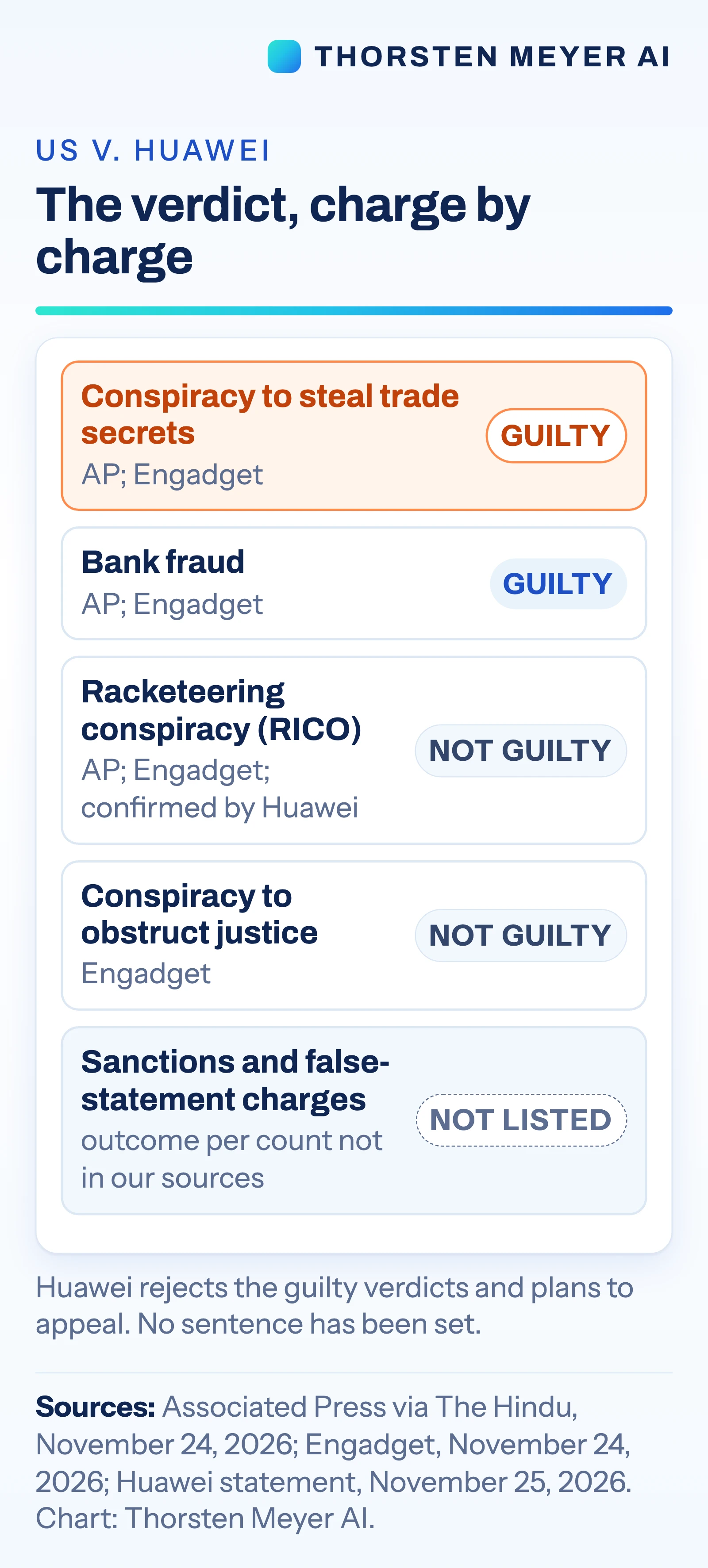
A federal jury in Brooklyn convicted Huawei on conspiracy to steal trade secrets and bank fraud charges, while acquitting the company of racketeering conspiracy. Huawei rejects the remaining charges and plans to appeal, according to its lawyer; the sources reviewed do not give a sentencing date or potential penalty.
The verdict followed an **11-week trial** in federal court in Brooklyn. Prosecutors accused Huawei of obtaining confidential technology from US companies and of misleading banks and officials about business involving countries under US sanctions. The jury convicted the company of trade secret conspiracy and bank fraud, according to the AP, but found it not guilty of the racketeering conspiracy charge, described in coverage as the most serious charge.

Get business pricing on tech for your team
- Business-only prices and quantity discounts
- Tax-exempt purchasing
- Multiple users, one account, clear invoices
Huawei said it welcomed the racketeering acquittal but rejected the other charges as **“without legal or factual merit,”** according to the company statement dated November 25. The company also said it rejects the remaining charges. Its lawyer told the AP that Huawei intends to appeal. The verdict establishes the jury’s decisions on the charges; the accusations presented by prosecutors should not be treated as findings beyond those convictions.
The case began with criminal charges announced by the US in early 2019 and was later expanded, the AP reported. Prosecutors’ allegations, as summarized in the AP’s account of the indictment, included copied source code, covert photographs of a competitor’s device at a Chicago trade show, and a robotic arm removed from a rival’s laboratory to be measured. The companies named as alleged victims included Cisco Systems, Motorola Solutions, T-Mobile, Quintel USA and Fujitsu. The verdict source material does not establish that every alleged incident resulted in a separate finding of guilt.
The Split Verdict’s Legal Reach
The verdict draws a **legal distinction between the charges**: jurors convicted Huawei of trade secret conspiracy and bank fraud but did not find it guilty of racketeering conspiracy. That difference matters because prosecutors had used the racketeering count to frame the alleged conduct as a broader pattern. The acquittal means that count did not result in a conviction; it does not erase the other guilty findings.
For companies that hold valuable technical information, the case puts workplace access and confidential material in focus. Prosecutors’ examples included alleged access to source code, device circuitry and laboratory equipment. Huawei’s defense, according to the source material, argued that learning from competitors must be distinguished from stealing protected secrets. The jury’s verdict makes the convictions specific to this case; it does not establish that every form of competitive research is unlawful.
The decision also has a narrower immediate effect on Huawei’s business than a new trade restriction would. Huawei was already barred from selling its equipment in the United States, according to the source material. The verdict is a criminal case outcome, not a new US trade rule, and the reviewed sources identify no immediate change to products used by Huawei customers outside the country. The company’s role as an alternative to Nvidia chips in China, noted by the AP, supplies industry context but does not itself change because of this verdict.
Products Worth Considering

Apple AirPods Pro 3 Wireless Earbuds with Active Noise Cancellation

Kindle Paperwhite Signature Edition (2024), 32 GB, Metallic Black

Anker SOLIX S2000 Portable Power Station, 2,010Wh, 1,500W
As an affiliate, we earn on qualifying purchases.
From 2019 Charges to Trial
US authorities announced criminal charges against Huawei in **early 2019** and later expanded the case, the AP reported. The prosecution’s allegations included trade secret theft, dealings with sanctioned countries, and false statements to banks and US officials. The trial in Brooklyn lasted 11 weeks, and Huawei denied wrongdoing, according to the source material.
In plain terms, a trade secret is commercially valuable information kept confidential, such as source code or a circuit design. A conspiracy charge concerns an alleged agreement to commit a crime and steps taken toward it; the jury’s guilty verdict applies to the charge as brought against Huawei. Racketeering conspiracy was a separate count. Engadget described racketeering as a charge traditionally associated with organized criminal activity, while prosecutors argued the alleged conduct fit a repeated pattern. Jurors acquitted Huawei on that count.
Prosecutor Meredith Arfa told jurors, **“The tone was set at the top,”** according to the supplied reporting. That was the prosecution’s characterization of Huawei’s alleged conduct, not a standalone verdict on every allegation. Huawei’s statement after the trial accepted the racketeering acquittal and rejected the convictions.
““Without legal or factual merit.””
— Huawei
Sentencing and Appeal Remain Open
The reviewed sources do not identify a **sentencing date**, the penalty prosecutors may seek, or the sentence the judge may impose. They also do not provide a detailed timetable for Huawei’s planned appeal or specify which parts of the verdict the company will challenge. Those matters remain open as of November 27.
The sources summarize several prosecution allegations but do not give a charge-by-charge account of how jurors evaluated each alleged incident. The bank fraud conviction is reported, but the supplied material does not spell out the jury’s reasoning or the precise conduct underlying that count. Huawei’s rejection of the convictions is the company’s position; the available material does not describe any separate court ruling on its planned appeal.
Sentencing, Then Possible Appeal
The next identified step is sentencing on the convictions, but a date and possible penalty were not available in the sources reviewed. The court’s eventual sentence will clarify the immediate consequences of the guilty findings.
Huawei’s lawyer told the AP the company plans to appeal, though the supplied reports do not say when it will file or set out the appeal arguments. Further court filings and scheduling decisions will show how the case proceeds. Until then, the verdict remains split: **two reported convictions and a racketeering acquittal**.
Key Questions
What did the jury find Huawei guilty of?
The jury convicted Huawei of **conspiring to steal trade secrets** and of **bank fraud**, according to the Associated Press.
What charge did Huawei beat?
The jury acquitted Huawei of **racketeering conspiracy**, which the coverage described as the most serious charge in the case.
Will Huawei appeal?
Huawei rejects the remaining charges, and its lawyer told the AP that the company plans to appeal. The reviewed reports do not give a filing date or detailed appeal grounds.
Has the court set a sentence?
The sources reviewed as of November 27, 2026, do not identify a sentencing date or possible penalty.
Does the verdict change Huawei’s US sales status?
The source material says Huawei was already barred from selling its equipment in the United States. The verdict is a criminal case outcome, not a new trade rule; the reviewed sources report no immediate change for customers outside the US.
Source: Thorsten Meyer AI