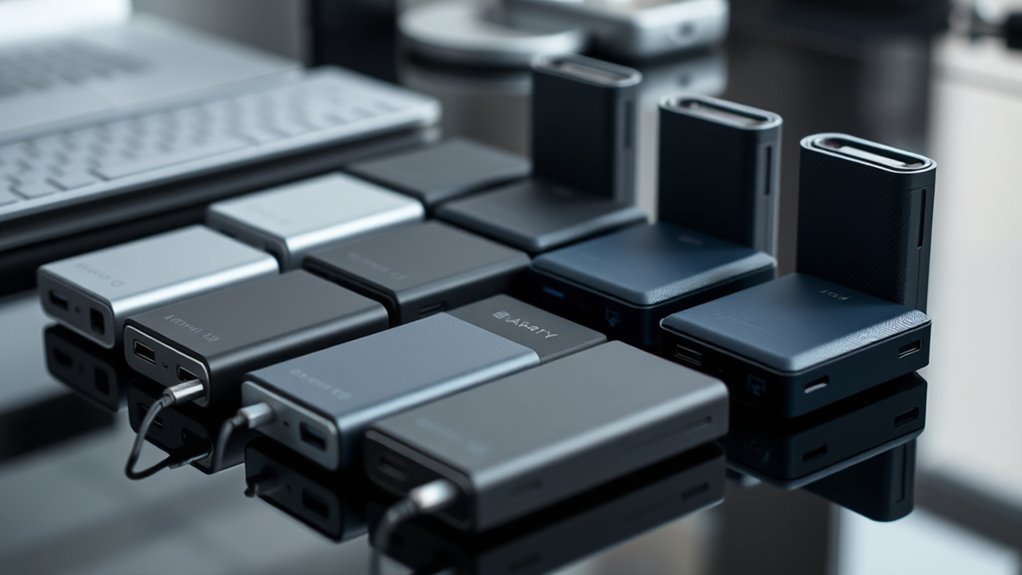

USB-C PD power banks can charge a phone quickly, but choosing one that also suits a tablet or laptop means balancing output, capacity, and carry weight. I rank the UGREEN Nexode 100W 20000mAh as the best overall pick for its strong laptop-ready output in a relatively compact capacity class. The INIU 45W 20000mAh is a more approachable fit for phones and tablets, while the Anker 25,000mAh 165W is built for travelers powering several devices. Higher wattage can improve laptop compatibility, but it often adds bulk; built-in cables simplify packing, while fixed capacity affects how long you can stay away from an outlet. Read on for the full breakdown and a guide to matching a USB-C PD bank to your devices.

Get tech for your team delivered free — and shop member deals
- Fast, free delivery on millions of items
- Access to Prime Big Deal Days deals on October 6–7
- Prime Video, Amazon Music and more included
Key Takeaways
- The UGREEN Nexode 100W 20000mAh leads the lineup for balancing laptop-capable output with a capacity that is easier to carry than the 25,000mAh and 50,000mAh options.
- 45W models suit phone-and-tablet buyers; the 20,000mAh INIU and JUOVI models offer more reserve capacity than the 10,000mAh options without targeting high-power laptop use.
- Built-in cables are a practical dividing line. The Anker 20,000mAh, Baseus 20,000mAh, and INIU 10,000mAh cable models reduce what you need to pack, while separate-cable designs allow more flexibility if a cable wears out.
- Higher output and capacity serve different needs. The Anker 25,000mAh 165W and Nexode 25,000mAh 145W are better aligned with demanding multi-device or laptop use; the 50,000mAh Seaistar prioritizes reserve capacity over easy everyday carry.
- Three compact INIU 10,000mAh options target similar phone-first use, so cable integration and form factor matter more here than capacity differences within the lineup.
| JUOVI Power Bank 45W 20000mAh Portable Charger |  | Best for Port Variety | Capacity: 20,000mAh | Maximum USB-C output: 45W | Maximum USB-A output: 30W | VIEW ON AMAZON | See Our Full Breakdown |
| INIU Portable Charger, 45W Fast Charging Power Bank, 20000mAh, Black |  | Best for Built-In Cable Convenience | Capacity: 20,000mAh | Maximum output: 45W PD | External ports: 2 | VIEW ON AMAZON | See Our Full Breakdown |
| INIU 10,000mAh Portable Charger with Built-In USB-C Cable, 45W Fast Charging, Black |  | Best Compact Pick | Capacity: 10,000mAh | Maximum output: 45W | Ports: 2 | VIEW ON AMAZON | See Our Full Breakdown |
| UGREEN Nexode 100W 20000mAh Power Bank |  | Best for High-Power Laptop Charging | Capacity: 20,000mAh | Maximum output: 100W | Ports: 2 USB-C, 1 USB-A | VIEW ON AMAZON | See Our Full Breakdown |
| INIU Laptop Power Bank, Smallest 20000mAh 65W Fast Charging Battery Pack |  | Best for Laptop Travel | Capacity: 20,000mAh | Maximum output: 65W | Ports: 3 | VIEW ON AMAZON | See Our Full Breakdown |
| Anker Power Bank 20,000mAh Travel Essential Built-in USB-C Cable (Black) |  | Best for Laptop Charging on the Go | Capacity: 20,000mAh | Total output: Up to 87W | Maximum single-device output: Up to 65W | VIEW ON AMAZON | See Our Full Breakdown |
| INIU Mini Portable Charger, 10,000mAh 45W Power Bank |  | Best Compact Pick with a Replaceable Cable | Capacity: 10,000mAh | Maximum output: 45W | Cable: Detachable braided USB-C lanyard cable | VIEW ON AMAZON | See Our Full Breakdown |
| Baseus 20000mAh 45W Portable Charger with Built-in USB-C Cables |  | Best for Charging Several Devices | Capacity: 20,000mAh | Maximum output: 45W | Input: 30W | VIEW ON AMAZON | See Our Full Breakdown |
| NOBIS 20000mAh Portable Charger 65W Power Bank |  | Best for Port Flexibility | Capacity: 20,000mAh | Maximum output: 65W | Maximum input: 45W | VIEW ON AMAZON | See Our Full Breakdown |
| Anker Laptop Power Bank, 25,000mAh Travel Essential with 165W Total Output |  | Best Premium Laptop Travel Pick | Capacity: 25,000mAh | Total output: 165W | USB-C ports: 3, each rated up to 100W | VIEW ON AMAZON | See Our Full Breakdown |
| INIU Power Bank, Compact 10000mAh 45W PD Fast Charging Portable Charger |  | Best Compact | Battery capacity: 10,000mAh | Maximum output: 45W | Dimensions: 4.4 × 2.7 × 0.7 inches | VIEW ON AMAZON | See Our Full Breakdown |
| Nexode 25000mAh 145W 3‑Port USB‑C Power Bank |  | Best for Laptop Charging | Battery capacity: 25,000mAh | Maximum output: 145W total; up to 140W from one USB-C port | Ports: 2 USB-C and 1 USB-A | VIEW ON AMAZON | See Our Full Breakdown |
| Seaistar 50000mAh Portable Charger, 30W PD and QC 4.0 Fast Charging |  | Best for Maximum Capacity | Battery capacity: 50,000mAh | Battery type: Lithium polymer | Ports: 4 USB outputs, 1 USB-C input/output, 1 Micro USB input | VIEW ON AMAZON | See Our Full Breakdown |
| usbc pd power bank | Capacity | Maximum output | Ports |
|---|---|---|---|
| JUOVI Power Bank 45W 20000mAh | 20,000mAh | — | 2 USB-C, 2 USB-A |
| INIU Portable Charger | 20,000mAh | 45W PD | — |
| INIU 10,000mAh Portable Charge | 10,000mAh | 45W | 2 |
| UGREEN Nexode 100W 20000mAh Po | 20,000mAh | 100W | 2 USB-C, 1 USB-A |
| INIU Laptop Power Bank | 20,000mAh | 65W | 3 |
| Anker Power Bank 20,000mAh Tra | 20,000mAh | — | — |
| INIU Mini Portable Charger | 10,000mAh | 45W | — |
| Baseus 20000mAh 45W Portable C | 20,000mAh | 45W | — |
| NOBIS 20000mAh Portable Charge | 20,000mAh | 65W | 4: 2 USB-A and 2 USB-C |
| Anker Laptop Power Bank | 25,000mAh | — | — |
| INIU Power Bank | — | 45W | — |
| Nexode 25000mAh 145W 3‑Port US | — | 145W total; up to 140W from one USB-C port | 2 USB-C and 1 USB-A |
| Seaistar 50000mAh Portable Cha | — | 30W × 1, 18W × 2, 22.5W × 1 | 4 USB outputs, 1 USB-C input/output, 1 Micro USB input |
More Details on Our Top Picks
JUOVI Power Bank 45W 20000mAh Portable Charger
The JUOVI is a practical choice when several people need to plug in at once: its four ports include two USB-C and two USB-A, a broader mix than the three-port INIU 20,000mAh 45W model. A single USB-C connection can deliver up to 45W, but that headroom is aimed more at phones, tablets, and gaming devices than routine laptop charging; the product description recommends laptops for emergency use. When multiple devices are connected, total output is capped at 40W, so sharing reduces the power available to each one. The 20,000mAh capacity and 74Wh rating suit commutes and short trips, while the display makes the remaining charge easy to check. Its tradeoff is a heavier, less compact setup than the built-in-cable INIU, and the fast recharge requires a separate 45W-plus charger.
Pros:- Four ports cover a wider mix of USB-C and USB-A devices than the three-port INIU 45W model
- Up to 45W USB-C output suits compatible phones, tablets, and gaming devices
- 20,000mAh capacity and 74Wh rating are suited to short trips and carry-on travel
- Digital display shows remaining charge, and low-current mode supports small accessories
Cons:- Shared output tops out at 40W across multiple connected devices
- Laptop charging is described as emergency use, limiting its appeal as a laptop power source
- A 45W-plus PD wall charger is required for the advertised fast recharge and is not included
Best for: Traveling pairs or families carrying a mix of USB-C and USB-A phones, earbuds, and tablets
Not ideal for: Laptop-first travelers who need sustained high-wattage charging or a cable built into the bank
- Capacity:20,000mAh
- Maximum USB-C output:45W
- Maximum USB-A output:30W
- Ports:2 USB-C, 2 USB-A
- Shared output:Up to 40W
- Maximum USB-C input:45W
- Weight:373g
- Dimensions:5.39 × 2.76 × 1.04 inches
Our verdict“Choose the JUOVI if you value four mixed-format ports for phones and accessories more than laptop-focused power or a built-in cable.”
INIU Portable Charger, 45W Fast Charging Power Bank, 20000mAh, Black
The built-in braided USB-C cable gives this INIU an everyday convenience advantage over the JUOVI 20,000mAh: there is one less cable to pack or misplace, and it doubles as a way to connect a third device. Its 45W PD output serves compatible phones and tablets, while the 20,000mAh capacity brings more reserve than the 10,000mAh INIU compact model. A flashlight and digital display add useful travel touches. The port count needs careful reading, though: the specifications list two ports, so three-device charging depends on using the integrated cable alongside those ports. That cable also makes the bank less adaptable if your devices need a different connector. At 11.5 ounces, it remains a substantial item despite the description’s claim that it is smaller than competing models.
Pros:- Built-in braided USB-C cable reduces the need to pack a separate lead
- 45W PD output and 20,000mAh capacity balance charging speed with substantial reserve
- Flashlight and digital display add practical travel functions
- Can charge up to three devices using the built-in cable and external connections
Cons:- Only two external ports; three-device charging depends on the integrated cable
- The fixed USB-C cable is less flexible for devices needing another connector
- 11.5-ounce weight may feel heavy for minimalist daily carry
Best for: Phone and tablet owners who want a high-capacity bank with a USB-C cable always at hand
Not ideal for: Buyers who need several independent ports, a detachable cable, or a lighter low-capacity carry
- Capacity:20,000mAh
- Maximum output:45W PD
- External ports:2
- Connectors:USB-A, USB-C
- Built-in cable:Braided USB-C
- Weight:11.5oz
- Recharge time:2 hours
- Special features:Digital display, flashlight, overcharging protection
Our verdict“Pick this INIU when a ready-to-use USB-C cable matters more than having four separate ports or a lighter 10,000mAh bank.”
INIU 10,000mAh Portable Charger with Built-In USB-C Cable, 45W Fast Charging, Black
For a smaller bag or a daily commute, this 10,000mAh INIU cuts capacity in half compared with its 20,000mAh sibling while keeping the same stated 45W maximum output. That makes it the more portable choice for topping up a compatible phone, tablet, or accessory, though it offers fewer charging reserves for a long trip. Its built-in USB-C cable also serves as a lanyard, so the charging lead is less likely to be left behind than with the JUOVI, which has more ports but needs separate cables. There are only two ports, and the fixed cable cannot serve devices that need another connector. This is a focused everyday carry bank; buyers charging several devices over multiple days will get more from the 20,000mAh models.
Pros:- 10,000mAh capacity makes it a more compact carry than the 20,000mAh INIU
- Up to 45W output supports fast charging for compatible devices
- Built-in USB-C cable doubles as a lanyard and reduces loose accessories
- Digital display shows remaining battery
Cons:- Half the capacity of the 20,000mAh INIU, so it has less reserve for longer trips
- Only two ports limit how many devices can connect at once
- Fixed USB-C cable does not fit devices that require a different connector
Best for: Commuters and day-trip travelers who want a smaller bank for a phone and a second USB device
Not ideal for: Multi-day travelers, laptop users, or households that need to charge several devices at once
- Capacity:10,000mAh
- Maximum output:45W
- Ports:2
- Connectors:USB-C, USB-A
- Built-in cable:USB-C
- Cell type:Lithium polymer
- Features:Digital display, flashlight, slim design
- Warranty:3-year INIU Care
Our verdict“Choose this model for a compact daily carry with fast USB-C charging, and choose a 20,000mAh option for longer trips or more devices.”
UGREEN Nexode 100W 20000mAh Power Bank
Among these 20,000mAh options, the UGREEN Nexode’s 100W maximum output gives it the clearest laptop-first role. It has two USB-C ports and one USB-A port, and its included 100W cable is intended to support high-power devices without requiring a separate cable purchase. Compared with the INIU 65W bank, that higher output gives compatible laptops more charging headroom; compared with the JUOVI, it is better suited to laptop charging than to sharing across four ports. The bank can also accept 65W input, with a stated 1.6-hour recharge time, so its large capacity need not mean a long wait between outings. The tradeoff is cable dependence: the product data says full laptop speed requires a 5A/100W cable, and three ports offer less connection flexibility than the JUOVI.
Pros:- 100W maximum output targets compatible laptops and other high-draw devices
- Two USB-C ports support a laptop-and-phone setup
- 65W input and stated 1.6-hour recharge shorten time spent replenishing the bank
- Includes a 100W cable intended to support its high-output use
Cons:- Full laptop charging speed depends on a compatible 5A/100W cable
- Three ports provide fewer connections than the four-port JUOVI
- The supplied data gives no absolute weight, making carry comparisons harder
Best for: Travelers carrying a compatible laptop and phone who want high USB-C output and fast bank recharging
Not ideal for: Buyers who need four connections, the lightest carry, or a power bank mainly for phones and earbuds
- Capacity:20,000mAh
- Maximum output:100W
- Ports:2 USB-C, 1 USB-A
- Maximum input:65W
- Stated recharge time:1.6 hours
- Included cable:100W cable
- Laptop cable requirement:5A/100W for full charging speed
Our verdict“Choose the UGREEN Nexode if your priority is high-output USB-C laptop charging with a quick recharge, rather than extra ports or minimal carry weight.”
INIU Laptop Power Bank, Smallest 20000mAh 65W Fast Charging Battery Pack
The INIU 65W aims at travelers who want laptop-capable output without stepping up to the UGREEN Nexode’s 100W maximum. Its 20,000mAh capacity and three-port layout can serve a laptop alongside a phone and small accessory, while the short detachable USB-C cable works as a carry handle and can be replaced if needed. The stated 65W output is a better fit for compatible ultraportables and handheld consoles than the JUOVI’s emergency-only laptop guidance. It also makes a more modest claim on power than the UGREEN, so buyers with higher-draw laptops should check their device’s charging needs. The cable is only 12cm long, which can limit where the bank sits while connected, and the product data supplies no numerical weight or recharge time for an apples-to-apples travel comparison.
Pros:- 65W output is suited to compatible laptops and Steam Deck-class devices
- 20,000mAh capacity offers more reserve than the 10,000mAh INIU compact model
- Three ports allow a laptop, phone, and accessory to connect
- Detachable braided USB-C cable can be replaced and doubles as a carry handle
Cons:- 65W maximum output is below the UGREEN Nexode’s 100W ceiling
- The included cable is only 12cm long, limiting placement while charging
- The provided specs do not state weight or recharge time
Best for: Ultraportable laptop and handheld-console owners who want 20,000mAh capacity with a detachable USB-C lead
Not ideal for: Users with laptops needing more than 65W or buyers who prefer a longer included charging cable
- Capacity:20,000mAh
- Maximum output:65W
- Ports:3
- Connectors:2 USB-C, 1 USB-A
- Voltage:20V
- Included cable:Detachable 12cm braided USB-C
- Cell type:Lithium polymer
- Features:Digital display, fast charging, overcharging and short-circuit protection
Our verdict“Pick this INIU for a compact laptop-oriented kit when 65W is enough for your device and a short detachable cable suits your setup.”
Anker Power Bank 20,000mAh Travel Essential Built-in USB-C Cable (Black)
The Anker Travel Essential is a strong fit when a USB-C power bank needs to handle a laptop as well as phones. Its 65W single-device output gives compatible laptops more charging headroom than the 45W Baseus 20000mAh Portable Charger, while 87W shared output can serve multiple devices at once. The 20,000mAh capacity and built-in cable make it a practical travel option for someone who wants fewer loose accessories. The tradeoff is that its cable is permanently attached: if it wears out, you cannot swap it as you could with the detachable cable on the INIU Mini Portable Charger. At 15.5 ounces, it is also heavier than the listed Baseus model. I’d choose it for laptop-ready output and cable convenience, provided that fixed cable suits your travel habits.
Pros:- Up to 65W to one device supports compatible laptop charging
- 87W total output allows charging multiple devices
- Built-in USB-C cable reduces the need to pack a separate lead
- 20,000mAh capacity suits longer days away from an outlet
Cons:- Built-in cable cannot be replaced if damaged
- At 15.5 oz, it is heavier than the listed Baseus 20,000mAh model
- A 65W charger is needed to reach the stated approximately 1.5-hour recharge time
Best for: Travelers who regularly charge a USB-C laptop and phone and prefer carrying an integrated cable
Not ideal for: Buyers who want a replaceable cable or the lightest possible 20,000mAh pack
- Capacity:20,000mAh
- Total output:Up to 87W
- Maximum single-device output:Up to 65W
- Built-in cable:USB-C
- Dimensions:6.2 × 2.9 × 1.0 in
- Weight:15.5 oz
- Recharge time:Approximately 1.5 hours with a 65W charger
- Warranty:18 months
Our verdict“Choose this Anker if laptop charging and a built-in cable matter more than having a lighter pack or a replaceable lead.”
INIU Mini Portable Charger, 10,000mAh 45W Power Bank
The INIU Mini makes the most sense when easy carry matters more than topping up a laptop through a long workday. Its 10,000mAh capacity keeps the pack smaller in scope than the 20,000mAh Anker Travel Essential, while 45W USB-C output gives it more charging capability than a basic phone-only backup. The braided lanyard cable detaches, so a worn or inconvenient cable can be replaced; that is a useful difference from the fixed cable on the Anker. It is better suited to phones, tablets, watches, and handheld gaming devices than to buyers who need repeated laptop charges. Its stated charging speeds can vary by device, and the supplied details do not give dimensions or weight, so I can’t compare its carry size precisely with the Baseus model.
Pros:- 45W maximum output supports fast charging for compatible devices
- 10,000mAh capacity offers a smaller-capacity option than the 20,000mAh models here
- Detachable braided USB-C lanyard cable can be replaced
- Temperature management is included
Cons:- 10,000mAh capacity provides less reserve than the Anker 20,000mAh Travel Essential
- Charging times depend on the device and its charging support
- Dimensions and weight are not specified in the supplied product data
Best for: Commuters and handheld gaming users who want a compact-capacity pack with a detachable USB-C cable
Not ideal for: Laptop users or travelers who need the longer runtime of a 20,000mAh or larger bank
- Capacity:10,000mAh
- Maximum output:45W
- Cable:Detachable braided USB-C lanyard cable
- Temperature management:TempGuard 2.0
- Travel approval:Airline approved
- Supported device types:Phones, tablets, watches, and handheld gaming devices
Our verdict“Pick the INIU Mini for portable phone and accessory charging with a replaceable cable, and choose a larger bank for laptop-heavy days.”
Baseus 20000mAh 45W Portable Charger with Built-in USB-C Cables
Baseus puts multi-device convenience ahead of maximum laptop output. Two built-in USB-C cables, a USB-C port, and USB-A port give you several ways to connect, with support for charging up to four devices at once. Its 20,000mAh capacity is on par with the Anker Travel Essential, but its 45W maximum output is lower than that Anker’s 65W single-device ceiling, so it is the less compelling choice for a laptop that needs higher-power charging. At 12.8 ounces, it is also lighter than the Anker based on the supplied figures, though still substantial for a pocket. The fixed cables keep packing simple but cannot be replaced if damaged. I’d favor Baseus for shared phone and accessory charging, not for buyers whose main priority is faster laptop charging.
Pros:- Two integrated USB-C cables reduce the number of separate leads to carry
- Can charge up to four devices simultaneously
- 20,000mAh capacity provides a substantial reserve for several devices
- Listed weight is lower than the Anker Travel Essential’s
Cons:- 45W maximum output is below the Anker Travel Essential’s 65W single-device output
- Built-in cables cannot be replaced if damaged
- 12.8 oz may feel heavy for everyday pocket carry
Best for: Travelers or families who want to charge several USB-C devices without packing separate cables
Not ideal for: Laptop owners whose devices benefit from more than 45W, or buyers who want replaceable built-in cables
- Capacity:20,000mAh
- Maximum output:45W
- Input:30W
- Ports and cables:2 built-in USB-C cables, 1 USB-C port, 1 USB-A port
- Simultaneous charging:Up to 4 devices
- Dimensions:4.3 × 2.6 × 1.2 in
- Weight:12.8 oz
- Certification and travel:CCC certified; airline approved
Our verdict“Choose Baseus for convenient shared charging across several devices, but favor the Anker when higher single-device output is the priority.”
NOBIS 20000mAh Portable Charger 65W Power Bank
The NOBIS is the port-focused alternative for buyers who want 65W USB-C output without relying on integrated cables. Two USB-C and two USB-A ports allow connections for a mix of newer and older devices, and the digital display makes the remaining charge easier to check than on the INIU Mini, whose supplied details list no display. Its 20,000mAh capacity matches the Anker Travel Essential, while both offer up to 65W to a device; the Anker adds a built-in cable and specifies its size and weight, which makes travel planning more straightforward. NOBIS instead provides low-current mode for small electronics such as earbuds. The missing dimensions and weight make its portability harder to judge, and no bundled cable is listed, so bring suitable leads.
Pros:- 65W maximum output supports compatible laptop charging
- Four ports accommodate a mix of USB-C and USB-A devices
- Digital display shows battery status
- Low-current mode is intended for devices such as earbuds
Cons:- Dimensions and weight are not provided, making portability difficult to assess
- No built-in or bundled cable is specified
- Maximum input is 45W, below the Anker Travel Essential’s stated 65W recharge requirement
Best for: People carrying a laptop, phone, and small accessories who want multiple ports and visible battery status
Not ideal for: Travelers who prioritize known dimensions, a built-in cable, or the lightest possible carry
- Capacity:20,000mAh
- Maximum output:65W
- Maximum input:45W
- Ports:4: 2 USB-A and 2 USB-C
- Charging protocols:PD and QC
- Display:Digital battery display
- Low-current mode:Included
- Safety:Multi-layer safety protection
Our verdict“Choose NOBIS if multiple ports, battery visibility, and low-current charging matter more than a built-in cable or clearly stated size.”
Anker Laptop Power Bank, 25,000mAh Travel Essential with 165W Total Output
This Anker is the high-output choice for travelers charging a laptop alongside other gear. Its 165W total output and three 100W USB-C ports provide more shared charging headroom than the 65W NOBIS, while 25,000mAh capacity gives it more reserve than the 20,000mAh Anker Travel Essential. Two retractable USB-C cables, including a longer 2.3-foot lead, cut down on loose accessories and offer more reach than a short fixed cable. That capability comes with a larger carry footprint in practice than a compact everyday bank, and the listed data does not give weight or dimensions. It also does not include a charger, so recharging requires a separate compatible one. I’d reserve it for laptop-heavy trips where multiple connections and extra capacity justify carrying a larger pack.
Pros:- 165W total output supports charging multiple high-demand devices
- Three 100W USB-C ports offer flexible laptop connections
- Two retractable USB-C cables reduce loose accessories
- 25,000mAh capacity exceeds the 20,000mAh Anker Travel Essential
Cons:- Charger is not included
- The larger capacity is less suited to pocket carry
- Weight and dimensions are not specified in the supplied data
Best for: Remote workers and frequent travelers charging a laptop and several USB-C devices during long days away from outlets
Not ideal for: People seeking a light everyday phone bank or anyone who wants a charger included
- Capacity:25,000mAh
- Total output:165W
- USB-C ports:3, each rated up to 100W
- Additional ports:1 USB-A and 1 USB-C
- Built-in cables:2 retractable USB-C cables
- Cable lengths:2.3 ft and 0.98 ft
- Airline compliance:100Wh carry-on limit compliant
- Charger included:No
Our verdict“Choose this Anker for high-output laptop travel and multiple devices, provided you are prepared to carry a larger bank and separate charger.”
INIU Power Bank, Compact 10000mAh 45W PD Fast Charging Portable Charger
The INIU 10,000mAh is the easier daily carry in this group: at 6.5 ounces, it pairs a pocketable size with 45W charging for compatible phones, tablets, and handheld consoles. Its built-in stand and flashlight add practical touches for watching a video or finding gear in a dim bag, while the detachable USB-C lanyard means one less cable to pack. Compared with the INIU 10,000mAh model with a built-in USB-C cable, this one trades an integrated charging cable for a stand and flashlight. It also has far less capacity than the Nexode 25,000mAh, so it suits a day out better than laptop backup or multi-day travel. The main compromise is simple: frequent travelers will need to recharge it sooner.
Pros:- 45W output supports compatible phones, tablets, and handheld consoles
- Compact 6.5-ounce design is easier to carry than high-capacity laptop banks
- Detachable USB-C lanyard doubles as a charging cable
- Built-in stand and flashlight add useful everyday functions
Cons:- 10,000mAh capacity limits repeat charging and extended trips
- No laptop-level output claims are provided, unlike the 145W Nexode
- The stand and flashlight add functions but do not replace a dedicated cable or larger backup bank
Best for: Daily commuters and travelers who want a lightweight phone-and-tablet backup with a stand and attached USB-C lanyard
Not ideal for: Laptop users or travelers needing several days of backup, since its 10,000mAh capacity is much smaller than the Nexode 25,000mAh
- Battery capacity:10,000mAh
- Maximum output:45W
- Dimensions:4.4 × 2.7 × 0.7 inches
- Weight:6.5 oz
- Included cable:Detachable nylon-braided USB-C lanyard
- Additional features:Built-in phone stand and flashlight
Our verdict“Choose this INIU for lightweight daily charging and handy extras, and pick a larger bank if laptop runtime or multi-day capacity matters more.”
Nexode 25000mAh 145W 3‑Port USB‑C Power Bank
The Nexode 25,000mAh is the laptop-first choice here, with up to 140W from one USB-C port and 145W maximum output across the bank. That headroom makes it a stronger match for demanding USB-C laptops than the 30W Seaistar, while its three ports can cover a laptop and smaller devices on the same trip. The digital display helps track remaining capacity, and the listing says the bank can recharge in about two hours with a 65W adapter. That adapter is not included, though, and the supplied cable count is limited to one USB-C-to-USB-C cable. At 25,000mAh, it offers less reserve than the Seaistar 50,000mAh; the trade is higher single-port power and a more laptop-focused charging profile for less total capacity.
Pros:- Up to 140W output from one USB-C port suits compatible high-power laptops
- 25,000mAh capacity supports repeat laptop and phone charging
- Three ports allow charging several device types
- Digital display shows remaining capacity
Cons:- A 65W or higher adapter is needed for the listed roughly two-hour recharge and is not included
- 25,000mAh is less capacity than the Seaistar 50,000mAh
- Only one USB-C-to-USB-C cable is supplied
Best for: Travelers carrying a USB-C laptop that needs high-wattage PD, plus a phone or tablet to charge from the same bank
Not ideal for: Buyers prioritizing the longest possible reserve for several devices, or anyone unwilling to bring or source a 65W adapter for faster bank recharging
- Battery capacity:25,000mAh
- Maximum output:145W total; up to 140W from one USB-C port
- Ports:2 USB-C and 1 USB-A
- Input:28V, 5A
- Recharge time:About 2 hours with a 65W adapter; up to 6 hours with a 20W adapter
- Display:Digital remaining-capacity display
- Battery cell:Lithium-ion
- Color:Space Grey
Our verdict“Pick the Nexode if high-wattage laptop charging matters more than maximum capacity or a fully supplied travel kit.”
Seaistar 50000mAh Portable Charger, 30W PD and QC 4.0 Fast Charging
For buyers who want a large shared reserve, the Seaistar P500 brings 50,000mAh and can charge up to four devices at once. Its 30W PD port supports faster charging for a compatible phone or tablet, while the other outputs make it more useful for a group than the laptop-centered Nexode 25,000mAh. That comparison also reveals the main limit: Seaistar’s listed maximum is 30W on one output, so it is a poor match for laptops that need the Nexode’s 140W USB-C output. The digital percentage display makes a large reserve easier to monitor, but the 1.4-pound weight and 6.5-inch length make this a bag-bound bank, not a casual pocket carry. Its wall charger is not included, and the listed recharge time varies with the adapter.
Pros:- 50,000mAh capacity provides a large reserve for extended outings
- Four USB outputs can charge multiple devices at the same time
- 30W PD and QC 4.0 support fast charging for compatible devices
- Digital battery percentage display shows remaining charge
Cons:- At 1.4 pounds, it is heavy for everyday carry
- 30W maximum output is far below the Nexode’s 140W USB-C output for laptop charging
- Wall charger is not included, and recharge takes six to eight hours with the listed adapters
Best for: Campers, families, and group travelers who need a large reserve for several phones and small devices
Not ideal for: Laptop owners needing high-wattage USB-C PD, or commuters who want a light power bank to carry in a pocket
- Battery capacity:50,000mAh
- Battery type:Lithium polymer
- Ports:4 USB outputs, 1 USB-C input/output, 1 Micro USB input
- Maximum output:30W × 1, 18W × 2, 22.5W × 1
- Fast charging:PD 30W and QC 4.0
- Recharge time:Listed as 6 hours; up to 8 hours with a 5V/3A charger
- Weight:1.4 lbs
- Dimensions:6.5 × 3.15 × 1.3 inches
- Display:Digital battery percentage
Our verdict“Choose the Seaistar when shared capacity for phones and smaller devices matters more than light weight or laptop-level output.”

How We Picked
I compared these USB-C PD power banks by the decisions that affect daily use: rated output, stated capacity, portability cues in the product descriptions, number of ports where specified, and whether a cable is built in. Output matters because a phone-focused bank may not meet a laptop’s charging needs, while extra capacity can mean more weight and longer charging time at the wall. I treated cable integration as a convenience tradeoff, not an automatic advantage, since a fixed cable is easy to pack but cannot be swapped as freely as a separate one.
The ranking favors versatility for common devices first, then specialized strengths such as compact size, integrated cables, or unusually high capacity and output. That puts the UGREEN 100W 20,000mAh near the top for its balance, with 45W 20,000mAh models serving buyers who mainly charge phones and tablets. Higher-output 25,000mAh banks rank well for laptop-heavy travel but are less suitable as casual pocket companions; the 50,000mAh model serves a narrower, reserve-capacity need. Product descriptions do not establish real-world charging speed, exact dimensions, or device-specific compatibility, so buyers should check their device’s required USB-C PD wattage and the bank’s port-level output before choosing.
Factors to Consider When Choosing Usbc Pd Power Banks
Before choosing a USB-C PD bank, I would start with the devices and charging situations it must cover. A large capacity or high wattage figure can sound reassuring, but neither tells the whole story: output must match the device, and capacity must be weighed against portability and recharge time.
Match USB-C PD Output to Your Hungriest Device
Start with the device that asks the most from a charger, often a laptop rather than a phone. Check the manufacturer’s recommended USB-C charging wattage, then compare it with the power bank’s output for the port you plan to use. A bank labeled with high total output may divide power across ports, so simultaneous charging can change what each device receives. For a phone-first setup, buying far more wattage than the phone can accept may add bulk without changing charging speed. If you need laptop charging, confirm both that the laptop supports USB-C PD input and that the bank’s individual port can supply enough power. This check avoids choosing by the headline number alone.
Choose Capacity for Your Time Away From an Outlet
Capacity is most useful when tied to a real trip or routine: a commute, a full workday, or a weekend away from reliable outlets. A 10,000mAh bank is easier to carry for backup charging, while 20,000mAh and 25,000mAh choices offer more reserve for repeat top-ups or multiple devices. Those figures do not translate directly into the same amount of energy reaching a device, since conversion losses and device battery sizes affect the result. Larger banks also take longer to recharge, especially if the wall charger and input rate are modest. Think through how often you can recharge the bank itself before choosing maximum capacity. A huge reserve is useful for long trips but can become dead weight in an everyday bag.
Check Shared Output Before Charging Several Devices
Port count only tells you how many connections are available; it does not say how much power each device gets when all are occupied. Look for port-level output and shared-power details in the manufacturer’s specifications, especially if you plan to charge a laptop and phone together. A single high-output port may be a better fit for one laptop than several lower-output ports used at once. For mixed-device travel, decide whether simultaneous charging saves enough time to justify a larger bank. If you normally charge one device at a time, extra ports may matter less than capacity or cable convenience. This is a frequent source of disappointment when buyers assume the largest printed wattage applies to every port at once.
Decide Whether a Built-In Cable Fits Your Routine
A built-in USB-C cable reduces loose accessories and makes a bank quicker to grab for short trips. The tradeoff is that a fixed cable is harder to replace if it frays, and its length or placement may not suit every setup. A separate cable gives you more choice and can be replaced independently, but it is one more item to remember. Check whether the bank also has a port for charging devices with your preferred cable, since an integrated lead may not cover every device or charging arrangement. Cable durability and strain relief matter for an accessory that gets pulled from a bag repeatedly. Choose integrated wiring for packing simplicity and a separate cable when flexibility matters more.
Treat Portability as More Than a Capacity Number
Two banks with similar capacity can feel quite different to carry because cell layout, casing, and cable design affect their size and weight. Product descriptions such as “mini” or “compact” are useful clues, but they do not replace checking listed dimensions and weight before purchase. A pocketable 10,000mAh bank fits daily errands better than a high-capacity travel brick, while a 20,000mAh model is often a more practical bag choice for longer days. For air travel, check current airline rules for power banks and the unit’s clearly marked energy rating; capacity in mAh alone may not make those limits easy to verify. Carrying a bank you will actually bring is more useful than owning extra capacity that stays at home. Let your usual bag and charging routine set the size limit.
Pay More for a Specific Problem, Not a Bigger Headline
Higher output is worth prioritizing when a laptop or other demanding device is part of your regular charging plan. Extra capacity makes more sense when you need several top-ups between outlets, while multiple ports help when several devices must charge together. For a phone-only buyer, those upgrades may add bulk without solving a frequent problem. Also check input charging specifications: a high-capacity bank that recharges slowly can be inconvenient between travel days. Compare the full set of specifications and warranty information rather than relying on a single wattage or capacity figure. The right upgrade is the one that addresses a recurring limitation in your current setup.
Frequently Asked Questions
Can a 45W USB-C PD power bank charge my laptop?
It depends on the laptop’s USB-C PD requirements and the power bank’s output for the port you use. Some lightweight laptops can accept lower-wattage charging, while others need more power or may charge slowly under load. Check the laptop’s included charger rating and its USB-C input specifications, then compare those with the bank’s port-level output. A 45W bank is generally a more natural match for phones and tablets than for demanding laptops. If laptop charging is a regular need, a higher-output option such as the 100W or 145W Nexode models may be a better fit, subject to the laptop’s compatibility.
Should I choose a 10,000mAh bank or a 20,000mAh bank for travel?
Choose based on how long you will be away from outlets and how much weight you are willing to carry. A 10,000mAh option is easier to bring for phone backup or a day trip, while a 20,000mAh model offers more reserve for repeated charges or sharing power between devices. Neither capacity guarantees a fixed number of full charges because device battery size and conversion losses vary. Larger banks also need more time to recharge. For a short outing, the smaller format is often easier to live with; for a full travel day with multiple devices, extra capacity can be more useful.
Is a built-in USB-C cable more reliable than carrying a separate cable?
It is more convenient to pack, but it is not automatically more reliable. A built-in lead can be damaged through repeated bending and may be difficult to replace independently, while a separate cable can be swapped if it fails. On the other hand, an integrated cable is less likely to be forgotten and is ready for quick phone charging. Check whether the bank has a USB-C port as well, so you can use another cable if needed. Choose the integrated design when fewer loose accessories matter most, and a separate cable when replacement and flexibility matter more.
Will a power bank keep charging at its full rated wattage when I use multiple ports?
Not necessarily. A bank’s headline wattage may describe its maximum total output or the maximum from one port, and those limits can change when more than one device is connected. Read the manufacturer’s port-by-port output and shared-power table for the exact arrangement you plan to use. If you need to charge a laptop and phone together, confirm that the laptop still receives enough power in that configuration. A bank with several ports can be convenient even when output is shared, but it may charge devices more slowly than a single-port setup. This check matters more than port count alone.
Can I bring a 50,000mAh USB-C PD power bank on a flight?
Do not decide from the mAh figure alone. Airlines and aviation authorities commonly assess portable batteries by watt-hours, and permitted limits or approval requirements can vary by route and carrier. Check the bank’s printed Wh rating and the current rules for every airline on your itinerary before travel. Keep the bank in your cabin baggage when required and follow any quantity limits that apply. A 50,000mAh model is much larger than the 10,000mAh and 20,000mAh options here, so its travel eligibility deserves particular attention before you pack it.
Conclusion
I would choose the UGREEN Nexode 100W 20,000mAh as the best overall option for buyers who want one bank to cover phones, tablets, and compatible laptops. For best value among the feature-focused choices, the INIU 45W 20,000mAh is a sensible phone-and-tablet pick when laptop-level output is not a priority. Beginners who want a straightforward everyday backup can start with a 10,000mAh INIU 45W model, choosing the built-in cable version if packing simplicity matters. For premium, demanding travel use, compare the Anker 25,000mAh 165W with the Nexode 25,000mAh 145W against your laptop and multi-device needs. Choose the Seaistar 50,000mAh for a large reserve when portability is secondary, and the cable-integrated Anker or Baseus models when fewer accessories matter more than maximum output. Before ordering, verify device compatibility, port-level output, and travel rules for the capacity you choose.
Fall Picks
fall essentials
As an affiliate, we earn on qualifying purchases.