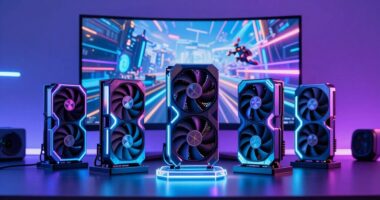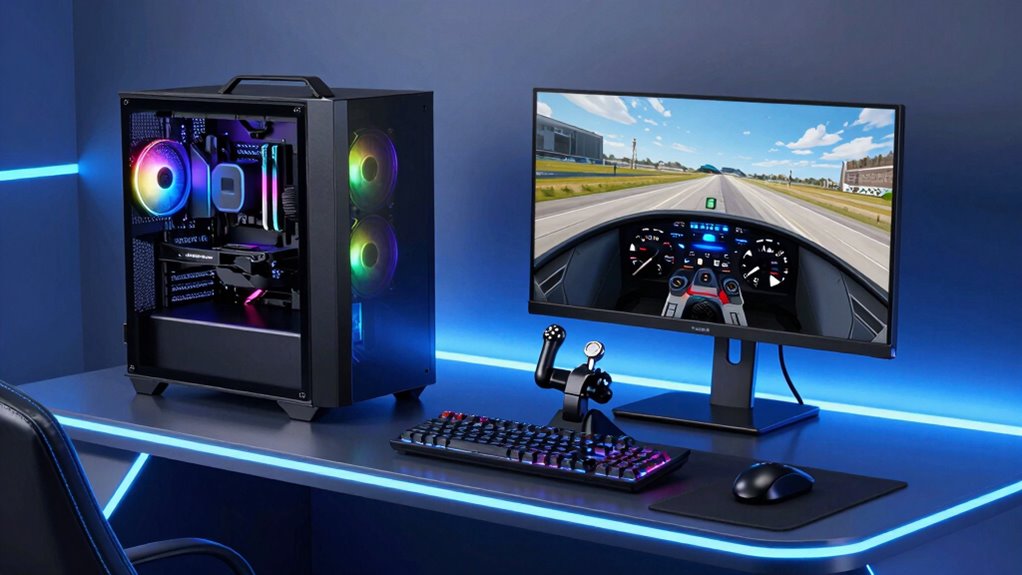

For serious flight sim enthusiasts, a VR ready gaming PC is essential to enjoy immersive virtual cockpit experiences. The best options balance powerful graphics, fast processing, and smooth gameplay, but they vary significantly in price and features. The Stormcraft Sirius offers solid performance at a good value, while the Horizon Autherium Dragon stands out for premium specs and future-proofing. Buyers often face tradeoffs between high-end performance and affordability, as well as ease of setup versus raw power. Continue reading for a detailed comparison to help you choose the right machine for your flight sim VR adventures.

Get business pricing on tech for your team
- Business-only prices and quantity discounts
- Tax-exempt purchasing
- Multiple users, one account, clear invoices
Complete the kit

Key Takeaways
- High-end GPUs like the RTX 5070 significantly improve VR flight sim performance but come at a premium price.
- Balance between CPU power and GPU is crucial; top picks feature high-performance CPUs paired with capable GPUs for smooth VR experience.
- The choice of RAM and SSD impacts load times and multitasking, with 16GB RAM and at least 1TB SSD being common standards.
- Prebuilt PCs offer convenience but may limit upgrade paths; custom builds can be more adaptable but require more knowledge.
- VR headsets’ resolution and field of view are key factors—higher specs demand more from your PC, influencing the choice of components.
| Pimax Crystal Super VR Headset, 3840×3840 per Eye, Ultrawide, 140° FOV, Eye-Tracking, PC Connection |  | Best for Visual Fidelity and Immersive Flight Simulation | Resolution: 3840×3840 per eye | Field of View: 140° | Display Technology: QLED & Mini-LED with Local Dimming | VIEW ON AMAZON | See Our Full Breakdown |
| Stormcraft Sirius Gaming PC i5-14400F, RTX 5060 Ti, 16GB RAM, 1TB SSD |  | Best Value for Balanced Flight Sim VR Performance | CPU: Intel i5-14400F | GPU: RTX 5060 Ti 16GB | RAM: 16GB | VIEW ON AMAZON | See Our Full Breakdown |
| Horizon Autherium Dragon RGB Gaming PC with Intel Core i9 and RTX 5070 |  | Best for Premium Performance and Future-Proofing | Processor: Intel Core i9 up to 5.4GHz | Graphics: NVIDIA GeForce RTX 5070 OC 12GB | RAM: 64GB | VIEW ON AMAZON | See Our Full Breakdown |
| CyberpowerPC Gamer Xtreme VR Gaming PC with Intel Core Ultra 5 225F and GeForce RTX 5060 8GB |  | Best for Mid-Range VR Flight Simulation | Processor: Intel Core Ultra 5 225F | Graphics: NVIDIA GeForce RTX 5060 8GB | RAM: 32GB DDR5 | VIEW ON AMAZON | See Our Full Breakdown |
| Pimax Crystal Light VR Headset for PC, 2880×2880 per Eye, 8K QLED Display with Local Dimming, Inside-Out Tracking, PC VR Headset for Flight Sims, iRacing & Gaming |  | Best for High-Resolution Flight and Racing VR Experiences | Resolution: 2880×2880 per eye | Display Technology: QLED with local dimming | Refresh Rate: 120Hz | VIEW ON AMAZON | See Our Full Breakdown |
| DeadEyeVR Advanced Flight Stick – Magnetic HOTAS Joystick Adapter |  | Best for Immersive Flight Control Enhancement | Compatibility: Touch controllers | Handle: Detachable | Base: Magnetic spherical base | VIEW ON AMAZON | See Our Full Breakdown |
| CyberPowerPC Gamer Xtreme VR Gaming PC with Intel Core i9-14900KF and GeForce RTX 5070 |  | Best High-End Powerhouse for Flight Sim VR | Processor: Intel Core i9-14900KF 3.2GHz | Chipset: Intel Z790 | RAM: 32GB DDR5 | VIEW ON AMAZON | See Our Full Breakdown |
| vr ready gaming pc for flight sim vr | RAM | Storage | Connectivity |
|---|---|---|---|
| Pimax Crystal Super VR Headset | — | — | — |
| Stormcraft Sirius Gaming PC i5 | 16GB | 1TB SSD | USB-C, Wi-Fi 6E, Bluetooth 5.3 |
| Horizon Autherium Dragon RGB G | 64GB | 5TB (1TB NVMe SSD + 4TB HDD) | USB-C 3.2, 8x USB 3, LAN 2.5GB/s, WiFi 2.4GB/s, Bluetooth |
| CyberpowerPC Gamer Xtreme VR G | 32GB DDR5 | 2TB PCIe 4.0 SSD | WiFi 6, Bluetooth 5.3 |
| Pimax Crystal Light VR Headset | — | — | — |
| DeadEyeVR Advanced Flight Stic | — | — | — |
| CyberPowerPC Gamer Xtreme VR G | 32GB DDR5 | 2TB PCIe 4.0 NVMe SSD | WiFi 5, Bluetooth 4.2, HDMI, DisplayPort, USB-C, USB-A, LAN |
More Details on Our Top Picks
Pimax Crystal Super VR Headset, 3840×3840 per Eye, Ultrawide, 140° FOV, Eye-Tracking, PC Connection
The Pimax Crystal stands out for its stunning 3840×3840 per eye resolution, significantly surpassing the Pimax Light VR Headset with its sharper visuals and reduced screen-door effect. Its expansive 140° FOV enhances peripheral awareness crucial for flight simulators, and the high-fidelity spatial audio elevates immersion. Compared to the Pimax Light, this model demands a much more powerful GPU and a complex setup, reflecting its premium features. While the advanced eye-tracking and dynamic FOV adjustment are impressive, they also add to setup complexity and cost. This headset is ideal for flight sim enthusiasts seeking maximum visual immersion and who are prepared for a higher-end PC build, but it’s less suitable for casual or budget-conscious users due to its price and setup intricacies.
Pros:- Ultra-high resolution with 3840×3840 per eye eliminates screen-door effect
- Wide 140° FOV enhances peripheral situational awareness
- High-fidelity spatial audio enriches immersion
- Dynamic FOV adjustment optimizes performance
Cons:- Requires a very powerful PC with compatible graphics hardware
- High cost due to advanced features and build quality
- Setup process can be complex and time-consuming
Best for: Avid flight sim players who prioritize top-tier visuals and immersive peripheral awareness
Not ideal for: Casual gamers or users with limited PC hardware who need a plug-and-play solution
- Resolution:3840×3840 per eye
- Field of View:140°
- Display Technology:QLED & Mini-LED with Local Dimming
- Refresh Rate:90Hz and beyond
- Tracking:Inside-Out
- Audio:3D spatial audio with noise-canceling mic
Our verdict“This headset is best suited for serious flight sim enthusiasts who demand the highest visual fidelity and are ready to invest in a compatible high-end PC setup.”
Stormcraft Sirius Gaming PC i5-14400F, RTX 5060 Ti, 16GB RAM, 1TB SSD
The Stormcraft Sirius offers a compelling balance of performance and affordability, making it suitable for flight sim VR users who want smooth gameplay without the premium price of high-end models like the Horizon Autherium. Its Intel i5-14400F CPU and RTX 5060 Ti GPU deliver excellent frame rates at 1080p and 1440p, supporting immersive VR flight experiences. Compared to the Horizon Autherium, it sacrifices some raw power and large memory capacity but remains a strong performer for most flight sim titles. The 16GB RAM and 1TB SSD ensure quick load times and smooth multitasking, though upgradeability details are limited. Overall, this PC is a practical choice for budget-conscious enthusiasts who want solid VR performance without extensive customization.
Pros:- Solid CPU and GPU for smooth VR flight simulation
- Fast SSD for quick load times and responsive gameplay
- Good value with balanced specs for price
Cons:- Limited upgradeability or expansion options
- No mention of advanced cooling solutions
- Potentially high price for hardware specs compared to custom builds
Best for: Budget-conscious flight sim VR players seeking reliable performance and upgrade potential
Not ideal for: Extreme users requiring ultra-high settings or future-proofing for demanding VR environments
- CPU:Intel i5-14400F
- GPU:RTX 5060 Ti 16GB
- RAM:16GB
- Storage:1TB SSD
- Connectivity:USB-C, Wi-Fi 6E, Bluetooth 5.3
- Case:Tempered glass with RGB lighting
Our verdict“This PC offers a balanced performance-to-price ratio, ideal for flight sim VR players who want dependable gaming without overspending.”
Horizon Autherium Dragon RGB Gaming PC with Intel Core i9 and RTX 5070
The Horizon Autherium Dragon stands apart with its high-end Intel Core i9 processor and RTX 5070 OC GPU, making it an excellent choice for demanding flight sim VR scenarios and future titles. Its 64GB RAM and 5TB storage, including SSD and HDD, support extensive multitasking and rapid data access. The 360mm liquid cooling system ensures quieter operation under load, which benefits long gaming or flight sessions. Compared to the Stormcraft Sirius, this setup offers more headroom for upgrades and more comprehensive cooling, but the higher power consumption and size mean it’s less suitable for smaller spaces or casual users. It’s a clear pick for enthusiasts seeking maximum performance and longevity in their VR flight simulations.
Pros:- Extreme processing power with Core i9 and RTX 5070 OC
- Massive 64GB RAM for demanding multitasking
- Advanced cooling for quiet operation during extended use
- Large storage capacity supports extensive game and data libraries
Cons:- High energy consumption and potentially higher operational costs
- Significantly larger size may be impractical for small spaces
- Expensive price point for most users
Best for: High-end flight sim VR players who want the best performance and future-proofing
Not ideal for: Budget or space-constrained users who need a more compact or cost-effective system
- Processor:Intel Core i9 up to 5.4GHz
- Graphics:NVIDIA GeForce RTX 5070 OC 12GB
- RAM:64GB
- Storage:5TB (1TB NVMe SSD + 4TB HDD)
- Cooling:360mm Liquid Cooling
- Connectivity:USB-C 3.2, 8x USB 3, LAN 2.5GB/s, WiFi 2.4GB/s, Bluetooth
Our verdict“This system is perfect for enthusiasts demanding ultimate VR flight simulation performance and are prepared for a larger, costlier build.”
CyberpowerPC Gamer Xtreme VR Gaming PC with Intel Core Ultra 5 225F and GeForce RTX 5060 8GB
The CyberpowerPC Gamer Xtreme provides a solid upgrade path for VR flight sims, combining an Intel Core Ultra 5 225F and RTX 5060 8GB graphics card for dependable performance at 1080p and 1440p. Its 32GB DDR5 RAM and 2TB PCIe 4.0 SSD ensure fast load times and multitasking, making it suitable for immersive VR experiences like iRacing or Flight Simulator. Compared to the Stormcraft Sirius, it offers a more balanced price point and decent future upgrade options, though it doesn’t match the raw power of the Horizon Autherium for extreme VR settings. Its modern connectivity—including WiFi 6 and Bluetooth—supports seamless VR peripherals. It’s an excellent middle ground for users who want reliable VR flight simulation without the expense of ultra-high-end systems.
Pros:- Reliable performance with RTX 5060 8GB and fast CPU
- Ample 32GB DDR5 RAM for multitasking and smooth VR
- Fast 2TB PCIe 4.0 SSD supports quick loading and data access
- Modern connectivity options including WiFi 6 and Bluetooth 5.3
Cons:- Limited upgradeability compared to higher-end models
- No advanced cooling features or extensive customization
- Price may be high relative to entry-level options
Best for: Mid-tier VR flight sim enthusiasts seeking dependable performance without overspending
Not ideal for: Users aiming for maxed-out settings or who need extensive future expandability
- Processor:Intel Core Ultra 5 225F
- Graphics:NVIDIA GeForce RTX 5060 8GB
- RAM:32GB DDR5
- Storage:2TB PCIe 4.0 SSD
- Connectivity:WiFi 6, Bluetooth 5.3
- Case Features:Tempered side panel, custom RGB lighting
Our verdict“This PC offers dependable VR flight sim performance for users who want a balanced setup without overspending, but it’s less suited for future-proofing or maxed settings.”
Pimax Crystal Light VR Headset for PC, 2880×2880 per Eye, 8K QLED Display with Local Dimming, Inside-Out Tracking, PC VR Headset for Flight Sims, iRacing & Gaming
The Pimax Crystal Light pairs impressive 2880×2880 per eye resolution with an 8K QLED display, making it a compelling choice for flight and racing simulations that demand vivid visuals. Its lightweight 815 grams and ergonomic design allow for extended comfort during long VR sessions, unlike heavier headsets that cause fatigue. The inside-out tracking and fixed foveated rendering technology provide a seamless experience, comparable to more expensive models like the Pimax Crystal. However, the high resolution and advanced display technology require a powerful PC, similar to the Pimax Crystal, making it less suitable for users with limited hardware. For those seeking crisp, vibrant visuals in flight sims like X-Plane or iRacing, this headset offers an immersive experience, but it’s not ideal for casual or budget-focused gamers.
Pros:- High-resolution 8K QLED display with vivid color reproduction
- Lightweight and ergonomic for extended comfort
- Inside-out tracking for seamless VR experience
- Supports SteamVR and popular controllers
Cons:- Heavy for some users despite being lightweight
- Premium price point may be prohibitive for casual buyers
- Requires a high-end PC for optimal performance
Best for: Avid flight and racing sim fans who want high-resolution VR with comfortable wear for long sessions
Not ideal for: Casual users or those with less powerful PCs, due to its demanding hardware needs
- Resolution:2880×2880 per eye
- Display Technology:QLED with local dimming
- Refresh Rate:120Hz
- Weight:815 grams
- Tracking:Inside-Out
- Foveated Rendering:Fixed 2.0 technology
Our verdict“This headset is ideal for dedicated VR flight and racing enthusiasts seeking exceptional visual fidelity and comfort, assuming their PC can support it.”
DeadEyeVR Advanced Flight Stick – Magnetic HOTAS Joystick Adapter
The DeadEyeVR Advanced Flight Stick stands out for transforming your VR touch controllers into intuitive flight controls with minimal setup effort. Its magnetic spherical base and detachable handle make attaching and removing the device straightforward, which is a significant advantage over more cumbersome alternatives like specialized controllers that require complex mounting. However, its compatibility is limited strictly to touch controllers, which could be restrictive if you’re seeking a dedicated hardware upgrade. Compared to full flight stick controllers, this option offers flexibility and ease but sacrifices some precision and durability for dedicated sim hardware. It’s ideal for users who want an immersive, customizable flight experience without needing a full HOTAS setup, though it’s not suited for those seeking the most realistic or durable hardware.
Pros:- Easy to install and detach thanks to magnetic design
- Provides a wide range of motion for realistic flight simulation
- Compatible with common VR touch controllers, adding flexibility
Cons:- Limited to specific touch controllers, reducing versatility
- May require additional accessories for full setup
- Designed solely for VR flight simulation, limiting broader use
Best for: VR flight sim enthusiasts who want an easy, versatile way to enhance immersion without investing in a full HOTAS system
Not ideal for: Serious flight sim pilots or those looking for highly durable, professional-grade hardware, as it’s more of an accessory than a dedicated flight stick
- Compatibility:Touch controllers
- Handle:Detachable
- Base:Magnetic spherical base
- Includes:Controller cup, spherical base, velcro strips, velcro pads
- Made in:USA
Our verdict“This pick makes the most sense for casual to semi-serious VR flight sim players seeking immersive control with quick setup and removal.”
CyberPowerPC Gamer Xtreme VR Gaming PC with Intel Core i9-14900KF and GeForce RTX 5070
The CyberPowerPC Gamer Xtreme with an Intel Core i9-14900KF and RTX 5070 delivers exceptional performance for VR flight sims, outperforming models like the Stormcraft Sirius with its more powerful CPU and GPU combination. Its 32GB DDR5 RAM and 2TB PCIe 4.0 SSD mean fast load times and smooth gameplay even at high settings, which is vital for VR experiences that demand both CPU and GPU strength. Compared to more budget-oriented options, this PC offers a significant performance leap but comes with a higher price tag and larger physical footprint, requiring ample space. This system is best suited for dedicated flight sim enthusiasts who want maximum detail and fluidity in VR, though it may be overkill for casual players or those on a tight budget.
Pros:- Powerful Intel Core i9 processor ensures excellent multitasking
- NVIDIA GeForce RTX 5070 offers high frame rates for VR
- Fast 2TB PCIe 4.0 SSD minimizes load times
- Upgradeable with extensive connectivity options
Cons:- Price point may be prohibitive for casual users
- Large size requires substantial space and setup planning
- Complex interior can be difficult to upgrade without technical knowledge
Best for: Hardcore flight sim VR users demanding the highest graphical fidelity and smoothest performance
Not ideal for: Budget-conscious buyers or users with limited space, as this PC’s size and cost are considerable
- Processor:Intel Core i9-14900KF 3.2GHz
- Chipset:Intel Z790
- RAM:32GB DDR5
- Storage:2TB PCIe 4.0 NVMe SSD
- Graphics:NVIDIA GeForce RTX 5070 12GB
- Operating System:Windows 11 Home
- Connectivity:WiFi 5, Bluetooth 4.2, HDMI, DisplayPort, USB-C, USB-A, LAN
Our verdict“This system is the top choice for dedicated VR flight sim players who prioritize maximum performance and are prepared for a higher investment.”

How We Picked
Our evaluation focused on performance, build quality, and compatibility with high-end VR headsets used in flight simming. We prioritized systems with powerful GPUs, recent CPUs, and sufficient RAM to handle demanding VR environments without lag or stuttering. Ease of setup and upgrade potential were also key considerations, along with overall value for the price. We ranked products by balancing raw specs with user experience factors, ensuring each picks fits specific user needs—from casual enthusiasts to serious sim pilots. Our goal was to identify options that deliver reliable, immersive VR flight simulation while considering budget and future-proofing.| vr ready gaming pc for flight sim vr | Connectivity |
|---|---|
| Pimax Crystal Super VR Headset | — |
| Stormcraft Sirius Gaming PC i5 | USB-C, Wi-Fi 6E, Bluetooth 5.3 |
| Horizon Autherium Dragon RGB G | USB-C 3.2, 8x USB 3, LAN 2.5GB/s, WiFi 2.4GB/s, Bluetooth |
| CyberpowerPC Gamer Xtreme VR G | WiFi 6, Bluetooth 5.3 |
| Pimax Crystal Light VR Headset | — |
| DeadEyeVR Advanced Flight Stic | — |
| CyberPowerPC Gamer Xtreme VR G | WiFi 5, Bluetooth 4.2, HDMI, DisplayPort, USB-C, USB-A, LAN |
Factors to Consider When Choosing Vr Ready Gaming Pc For Flight Sim Vr
Choosing the right VR ready gaming PC for flight sim VR involves more than just high specs. It’s important to consider how the system will handle demanding VR environments, including graphics fidelity, frame rates, and latency. Compatibility with your preferred VR headset, upgrade potential, and overall value are also key factors. Understanding these broader considerations can help you avoid common pitfalls like bottlenecked performance or future obsolescence, ensuring your investment remains relevant and enjoyable for years to come.GPU Power and VR Performance
The graphics card is the heart of your VR experience, directly impacting frame rates and visual quality. For flight sim VR, a high-performance GPU like the RTX 5070 or higher ensures smooth, tear-free visuals, especially at high resolutions and wide field of view. Cheaper GPUs may save money initially but can cause stuttering or latency issues, breaking immersion. Investing in a top-tier GPU is often worth it for serious sim pilots, but it’s also important to match it with a capable CPU to prevent bottlenecks.
CPU and System Balance
A powerful CPU is essential for processing complex flight calculations and maintaining high frame rates in VR. Modern high-end processors like the Intel Core i9 series strike a good balance with high core counts and clock speeds, reducing stuttering and lag. Pairing these with a mid-range GPU can still deliver good performance but may limit maximum settings. Conversely, a top GPU paired with a weaker CPU can cause bottlenecks, hampering your overall experience. Striking the right balance is key to smooth VR flight simulation.
Memory and Storage
Flight sim VR environments are demanding on system memory and storage. At least 16GB of RAM ensures smooth multitasking and prevents slowdowns during intensive sessions. An SSD, particularly 1TB or larger, drastically reduces load times and asset streaming delays. Cheaper systems with HDDs can cause stuttering in large scenery loads, breaking immersion. Future upgrades are easier with systems that have available RAM slots and M.2 SSD slots, so consider these if you plan to expand later.
Compatibility and Upgradability
Ensure the PC you choose supports your VR headset’s requirements and has enough ports for peripherals like flight sticks and HOTAS controllers. Some systems are more flexible for upgrades, allowing you to swap out GPUs or add more RAM down the line. Prebuilt systems offer convenience but often have limited upgrade paths, while custom builds can be tailored to your evolving needs. Be mindful of power supply capacity and case size, especially if you plan to upgrade components frequently.
Budget and Value Considerations
High-end gaming PCs deliver top performance but come with a higher price tag. Balance your budget with your performance needs—sometimes, a mid-tier system with a capable GPU and CPU can offer excellent value and still run VR flight sims smoothly. Beware of overpaying for features you won’t use or need, and consider future-proofing components to extend the lifespan of your investment. Look for systems that include warranties and good customer support to avoid costly repairs or upgrades down the line.
Frequently Asked Questions
Will a mid-range PC be enough for high-quality flight sim VR?
A mid-range PC can handle many flight sim VR titles at decent settings, especially if it features a GPU like the RTX 3060 Ti or RTX 4070 and a recent CPU. However, for the most demanding environments or future upgrades, a higher-end system with an RTX 5070 or better might be necessary. It’s a matter of balancing performance with your budget and expectations—mid-range systems may require lowering some settings to maintain smoothness but often provide a better entry point for enthusiasts on a budget.
Is it better to buy a prebuilt or build my own VR gaming PC?
Prebuilt systems offer convenience and immediate compatibility, which is appealing for many VR flight sim enthusiasts. They often come with warranties and support, reducing setup headaches. Building your own can be more cost-effective and customizable, allowing you to select exact components to match your needs and future plans. However, DIY builds require more technical knowledge and time, and sometimes come with compatibility challenges. Your choice depends on comfort with hardware assembly and how much you value convenience versus customization.
How much should I spend for a VR-ready flight sim PC?
Expect to spend roughly between $1,500 and $3,000 for a system capable of handling demanding flight sim VR experiences at high settings. Lower budgets might get you playable performance but could limit visual fidelity or introduce lag. Investing toward the higher end ensures better longevity, higher frame rates, and smoother immersion, especially with high-resolution VR headsets. Consider the value of future upgrades and warranty coverage when evaluating price, as a slightly higher initial investment can pay off in long-term satisfaction.
What are the most important specs to prioritize for VR flight sim performance?
The most critical specs include a high-end GPU like the RTX 5070 or above, a fast multi-core CPU such as an Intel Core i9, and at least 16GB of RAM. Storage speed also matters; an SSD reduces load times and prevents stuttering during scenery transitions. Additionally, a robust power supply and good cooling are essential to support these components under load. Prioritizing these specs helps ensure your VR flight sim runs smoothly, with high visual fidelity and minimal latency.
Can I upgrade my VR gaming PC later if I want better performance?
Many modern gaming PCs are designed with upgradability in mind, allowing you to swap out GPUs, add RAM, or upgrade storage over time. However, some prebuilt systems have limited upgrade options due to proprietary cases or power supplies. When choosing a system, look for models with available slots and sufficient wattage to support future upgrades. Planning ahead can save money and extend the lifespan of your VR setup, keeping it capable of handling next-generation flight sim titles.
Conclusion
For casual users or newcomers to VR flight simulation, a mid-tier system like the Stormcraft Sirius offers great value without sacrificing core performance. Serious sim pilots who want the best experience should consider high-end options like the Horizon Autherium Dragon, which excel in graphics power and future-proofing. Those on a tight budget might find the CyberPowerPC Gamer Xtreme models to be a sensible choice, especially if upgrades are planned later. If maximum performance and immersion are your goals, investing in the top-tier builds will provide the most seamless, realistic flight sim VR experience for years to come.
Halloween Picks
halloween
As an affiliate, we earn on qualifying purchases.