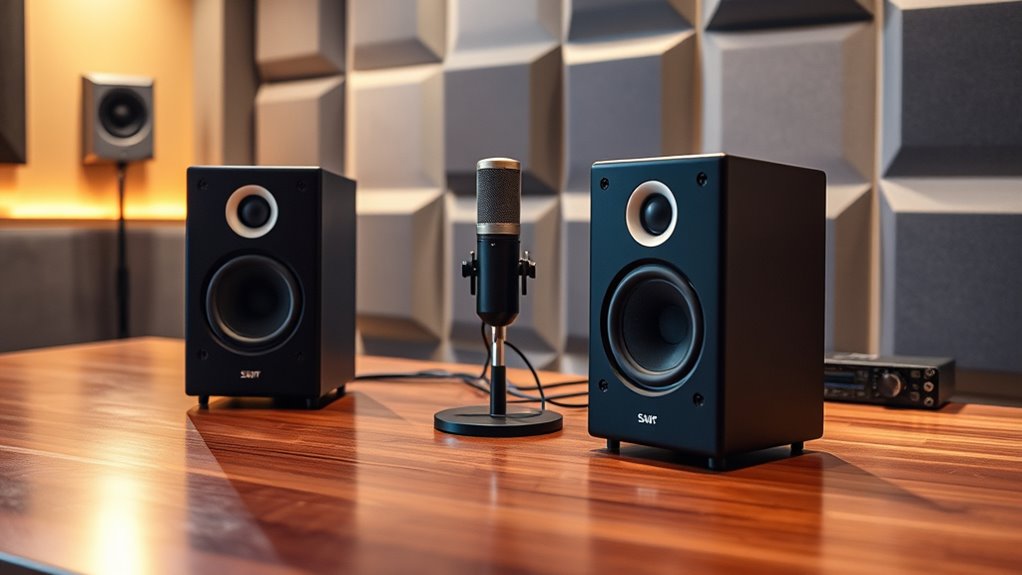

When selecting studio monitor speakers, balancing accuracy, budget, and usability can be challenging. The best monitors deliver flat frequency responses for true sound reproduction, but options vary widely in size, power, and price. The PreSonus Eris E4.5 stands out as the top overall pick for its balanced performance and affordability. Meanwhile, the JBL 305P MkII offers excellent clarity at a reasonable price, making it a favorite for many users. Buyers often face tradeoffs between size, sound fidelity, and budget, which can complicate decision-making. Continue reading for a detailed breakdown of the best studio monitor speakers and which models fit different needs.

Get business pricing on tech for your team
- Business-only prices and quantity discounts
- Tax-exempt purchasing
- Multiple users, one account, clear invoices
Key Takeaways
- The top-ranked monitors balance flat frequency response with ease of use for both beginners and professionals.
- Size and power vary significantly; larger speakers generally provide more bass but require more space and power.
- Price range reflects performance, but some budget options still deliver surprisingly accurate sound for their class.
- Build quality and connectivity features are key for long-term reliability and ease of integration into existing setups.
- Choosing the right monitor depends heavily on intended use, space constraints, and budget, with no one-size-fits-all solution.
| PreSonus Eris 3.5 Powered Studio Monitors (Pair) |  | Best Compact Desktop Monitor | Power: 50 watts | Woofer Size: 3.5 inches | Frequency Response: 80 Hz–20 kHz | VIEW ON AMAZON | See Our Full Breakdown |
| PreSonus Eris E4.5 2-Way 4.5-inch Near-Field Studio Monitors (Pair) |  | Best Versatile Near-Field Monitor | Speaker Type: 2-way near-field | Woofer: 4.5-inch woven-composite | Tweeter: 1-inch silk dome | VIEW ON AMAZON | See Our Full Breakdown |
| JBL 305P MkII 5″ 2-Way Active Powered Studio Reference Monitors (Pair) |  | Best for Precise Imaging and Wide Sweet Spot | Woofer Size: 5 inches | Tweeter Size: 1 inch | Amplifiers: 2x 41W Class-D | VIEW ON AMAZON | See Our Full Breakdown |
| Yamaha HS5 Powered Studio Monitor (Pair) |  | Best for Flat, Accurate Mixing | Woofer Size: 5 inches | Tweeter Size: 1 inch | Frequency Response: 54 Hz – 30 kHz | VIEW ON AMAZON | See Our Full Breakdown |
| Yamaha HS4 Powered Studio Monitor (Pair) in Black |  | Best for Space-Constrained Monitoring | Woofer Diameter: 4.5 inches | Frequency Response: 60 Hz – 22 kHz | Maximum Output Power: 26 W | VIEW ON AMAZON | See Our Full Breakdown |
| Edifier R1280T Powered Bookshelf Speakers – 2.0 Near Field Studio Monitor |  | Best for Versatile Home Use and High-Quality Stereo Sound | Speaker Type: Bookshelf | Power: 42 Watts RMS | Frequency Response: 80 Hz | VIEW ON AMAZON | See Our Full Breakdown |
| Yamaha HS3 Powered Studio Monitor, Pair |  | Best for Precise Monitoring in Small Studios | Type: 2-way bass-reflex powered speaker | Woofer: 3.5 inches | Tweeter: 0.75 inches | VIEW ON AMAZON | See Our Full Breakdown |
| Mackie CR3.5 Creative Reference Powered Studio Monitors (Pair) | 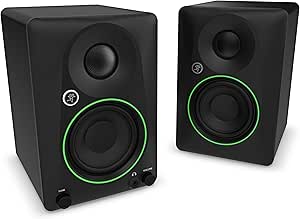 | Best for Desktop Mixing and Streaming on a Budget | Woofer Diameter: 3.5 inches | Tweeter Diameter: 1 inch | Audio Output Mode: Stereo | VIEW ON AMAZON | See Our Full Breakdown |
| M-Audio BX3 3.5″ Wired Studio Monitor Speakers (Pair) |  | Best for Versatile, Studio-Grade Monitoring with Software Bundle | Woofer Size: 3.5 inches (Kevlar) | Tweeter Type: Silk dome | Power: 120W | VIEW ON AMAZON | See Our Full Breakdown |
| studio monitor speaker | Inputs | Frequency Response |
|---|---|---|
| PreSonus Eris 3.5 Powered Stud | Balanced TRS, RCA, front-panel aux | 80 Hz–20 kHz |
| PreSonus Eris E4.5 2-Way 4.5-i | TRS, RCA, aux | — |
| JBL 305P MkII 5" 2-Way Active | XLR, TRS | — |
| Yamaha HS5 Powered Studio Moni | XLR, TRS | 54 Hz – 30 kHz |
| Yamaha HS4 Powered Studio Moni | — | 60 Hz – 22 kHz |
| Edifier R1280T Powered Bookshe | — | 80 Hz |
| Yamaha HS3 Powered Studio Moni | XLR/TRS combo, RCA, Stereo Mini | 70 Hz – 22 kHz |
| Mackie CR3.5 Creative Referenc | — | — |
| M-Audio BX3 3.5" Wired Studio | 1/4-inch, 1/8-inch, RCA | — |
More Details on Our Top Picks
PreSonus Eris 3.5 Powered Studio Monitors (Pair)
This pick stands out for its small footprint combined with surprisingly powerful sound, making it ideal for tight desktop setups. Compared with larger monitors like the Yamaha HS5, the Eris 3.5 offers less bass due to its 3.5-inch woofer, but its built-in tone controls and multiple inputs make it versatile for various applications. Its compact size is perfect for users who need clear, balanced audio without space constraints, though it isn’t suited for large rooms or professional mixing environments. The headphone output and adjustable controls add convenience, but setup for optimal sound can require some tweaking.
Best for: Desktop users with limited space seeking quality sound for music, gaming, or content creation.
Not ideal for: Large room environments or those needing deep bass or high-volume output.
- Compact size fits well on any desk
- Strong, distortion-free sound with tone controls
- Multiple input options for flexibility
- Built-in headphone amplifier for private listening
- Limited bass response due to small woofer
- Requires setup for optimal sound tuning
Verdict: A solid choice for desktop setups where space is at a premium but quality sound remains important.
Pros:- Compact size fits well on any desk
- Powerful, distortion-free sound with adjustable tone controls
- Multiple input options for versatile connectivity
Cons:- Limited bass response due to small woofer
- Designed primarily for desktop use, not for large rooms
Best for: Small home offices, gaming stations, or content creators needing compact, reliable monitors.
Not ideal for: Large studios or users requiring deep bass or high-volume sound for mixing.
- Power:50 watts
- Woofer Size:3.5 inches
- Frequency Response:80 Hz–20 kHz
- Inputs:Balanced TRS, RCA, front-panel aux
- Features:Built-in high- and low-frequency tuning controls, headphone output
Our verdict“Ideal for users with limited space who want studio-quality sound at their desktop.”
PreSonus Eris E4.5 2-Way 4.5-inch Near-Field Studio Monitors (Pair)
This model makes the most sense for those seeking accurate, near-field monitoring with a bit more bass than the smaller Eris 3.5. It offers a balanced sound profile thanks to its 4.5-inch woofer and 1-inch silk dome tweeter, making it suitable for music production, multimedia, and casual listening. Its room-tuning controls and headphone amplifier provide adaptability, but compared with the JBL 305P MkII, it may require some tuning to optimize low-end response, especially if you plan to use the optional Eris Sub 8BT. This monitor is ideal for users who want more accurate sound reproduction and room flexibility but are willing to invest time in setup.
Best for: Home producers or multimedia enthusiasts who want accurate sound with room tuning options.
Not ideal for: Large spaces or those expecting deep bass without additional subwoofers.
- Accurate, studio-quality sound with tight bass
- Flexible room-tuning controls for different environments
- Headphone output with built-in amp for private listening
- Compatibility with optional subwoofer for extended bass
- Deep low-end may require additional subwoofer
- Sound tuning and placement can demand some adjustment
Verdict: A versatile choice for those who prioritize accurate sound with room tuning capabilities, at the cost of some bass depth.
Pros:- Accurate, studio-quality sound for production and casual listening
- Room-tuning controls help adapt sound to space
- Flexible connections including balanced and unbalanced inputs
Cons:- Deep low-end might require additional subwoofer
- Placement and tuning may need some adjustment for best results
Best for: Home producers, multimedia creators, and audio engineers needing precise sound with flexible room adaptation.
Not ideal for: Large or untreated rooms where deep bass is essential without extra subwoofers.
- Speaker Type:2-way near-field
- Woofer:4.5-inch woven-composite
- Tweeter:1-inch silk dome
- Amplification:50W Class AB
- Inputs:TRS, RCA, aux
- Features:Room-tuning controls, headphone output
Our verdict“Perfect for users who want room-tuning flexibility and accurate sound, provided they are open to some setup effort.”
JBL 305P MkII 5″ 2-Way Active Powered Studio Reference Monitors (Pair)
The JBL 305P MkII is distinguished by its patented Image Control Waveguide, which delivers exceptional imaging and a broad sweet spot that benefits mixing and critical listening. Its dual 41-watt Class-D amps power the 5-inch woofer and 1-inch tweeter, producing deep bass and crisp highs. Compared with the Yamaha HS5, the JBL offers more room-tuning flexibility through Boundary EQ and HF Trim controls, making it adaptable to a variety of room setups. While the 5-inch woofer provides better low-end depth than smaller monitors like the Yamaha HS4, it still may fall short for those requiring extensive bass for large spaces. This monitor fits professionals and serious hobbyists who need precise imaging and reliable performance.
Best for: Mixing engineers and producers needing accurate imaging with room flexibility.
Not ideal for: Users who need substantial low-end for large spaces or those with budget constraints, as it lacks digital inputs and remote volume control.
- Exceptional imaging with a wide sweet spot
- Room-tuning via Boundary EQ and HF Trim controls
- Durable MDF enclosure tested for reliability
- Versatile XLR/TRS inputs for professional use
- No built-in digital inputs or remote volume control
- Limited low-end depth compared to larger monitors
Verdict: An excellent choice for those prioritizing imaging and room flexibility in a relatively compact form factor.
Pros:- Precise imaging with a wide sweet spot
- Room-tuning flexibility with Boundary EQ and HF Trim
- Reliable, tested MDF construction
Cons:- Limited low-end depth for larger space needs
- No digital input or remote volume control
Best for: Professional producers or mixing engineers focused on accurate stereo imaging in near-field environments.
Not ideal for: Large rooms or users needing deep bass without additional subwoofers.
- Woofer Size:5 inches
- Tweeter Size:1 inch
- Amplifiers:2x 41W Class-D
- Peak SPL:108 dB
- Inputs:XLR, TRS
- Features:Image Control Waveguide, Boundary EQ
Our verdict“Ideal for professionals who need detailed imaging and room adaptability in a compact monitor.”
Yamaha HS5 Powered Studio Monitor (Pair)
The Yamaha HS5 stands out for its reputation as a neutral, flat-response monitor, making it highly suitable for mixing and detailed audio work. Its 5-inch woofer and dedicated bi-amp configuration deliver a frequency response from 54 Hz to 30 kHz, ensuring clear reproduction across the spectrum. Compared with the smaller HS3, the HS5 offers a broader frequency range and more accurate sound, though it shares the same size limitations when it comes to deep bass. Its simple, durable design and trusted Yamaha build quality make it a reliable choice, but the lack of built-in digital features or remote control means it’s less adaptable for casual or multimedia use. It’s best suited for those who prioritize precise translation over added features.
Best for: Professional or serious hobbyist users focused on accurate monitoring for mixing and mastering.
Not ideal for: Large rooms or casual listeners who need more bass or wireless options.
- Flat, neutral sound ideal for mixing and editing
- Bi-amp design with dedicated power for clarity
- Reliable Yamaha build quality
- Accepts both balanced and unbalanced inputs
- Limited deep bass response with 5-inch woofer
- No wireless or digital input options
Verdict: The go-to monitor for professionals requiring precise, uncolored sound in small to medium spaces.
Pros:- Flat, accurate sound reproduction for mixing
- Bi-amped with dedicated LF and HF drivers
- Robust Yamaha construction and reliability
Cons:- Limited bass depth due to 5-inch woofer
- No wireless or digital connectivity options
Best for: Audio engineers and producers needing accurate translation and flat response for mixing.
Not ideal for: Large venues or users who require deep bass or wireless connectivity.
- Woofer Size:5 inches
- Tweeter Size:1 inch
- Frequency Response:54 Hz – 30 kHz
- Power Amplification:70W total
- Inputs:XLR, TRS
- Enclosure Material:MDF
Our verdict“A dependable, precise monitor ideal for critical listening and mixing environments.”
Yamaha HS4 Powered Studio Monitor (Pair) in Black
The Yamaha HS4 offers a smaller, more compact option with a 4.5-inch woofer, making it suitable for tight spaces like small studios or editing suites. While it shares the same flat response philosophy as the HS5, its reduced size limits its low-end output, with a frequency response down to 60 Hz. Its versatile connectivity, including XLR, TRS, and RCA, broadens compatibility, but its maximum power of 26W makes it less ideal for large or loud environments. Compared to the HS5, the HS4 sacrifices some bass extension but remains a strong choice for space-limited setups where accuracy and clarity matter. Its simple design and reliable Yamaha reputation make it a practical pick.
Best for: Compact studios or editing spaces needing accurate sound in a small footprint.
Not ideal for: Large rooms or users who need substantial low-end or high-volume output.
- Small size fits well in tight spaces
- Versatile connectivity options
- Accurate, flat response for editing and mixing
- Trusted Yamaha quality and durability
- Limited maximum output power; not suitable for large rooms
- No wireless or advanced digital features
Verdict: A practical, space-saving monitor for detailed sound work in small environments.
Pros:- Compact size ideal for limited spaces
- Versatile connectivity options
- Accurate, flat sound for critical listening
Cons:- Limited low-end output due to smaller woofer
- Lower maximum power making it less loud for large rooms
Best for: Small studio spaces or editing suites where space is limited but audio fidelity is a priority.
Not ideal for: Large, open spaces or environments requiring deep bass and high volume levels.
- Woofer Diameter:4.5 inches
- Frequency Response:60 Hz – 22 kHz
- Maximum Output Power:26 W
- Connectivity:XLR, TRS, RCA
- Color:Black
Our verdict“A smart choice for tight spaces needing accurate, reliable monitoring without deep bass demands.”
Edifier R1280T Powered Bookshelf Speakers – 2.0 Near Field Studio Monitor
The Edifier R1280T stands out for its natural sound reproduction and versatile input options, making it ideal for those who want a stylish, high-quality stereo system for their home studio or multimedia setup. Compared with the Mackie CR3.5, it offers richer audio and a more refined wood finish, though it lacks the built-in tone controls and wall placement features of the Mackie. Its 42W power and dual AUX inputs make it suitable for casual listening and light production, but it’s limited to stereo sound and isn’t designed for outdoor or high-volume professional use.
Pros:- Natural, high-fidelity sound reproduction
- Multiple input options including RCA and PC audio
- Remote control for easy adjustments
- Elegant wood finish complements home decor
Cons:- Limited to stereo sound with two speakers
- No waterproofing or outdoor durability
- Requires a power outlet for operation
Best for: Home users seeking high-quality stereo sound with simple connectivity and stylish design
Not ideal for: Professional producers who need extensive connectivity options or flat frequency response for mixing
- Speaker Type:Bookshelf
- Power:42 Watts RMS
- Frequency Response:80 Hz
- Impedance:4 ohm
- Woofer Diameter:4 inches
- Connectivity:Auxiliary, RCA, PC audio inputs
Our verdict“This speaker set is best for home enthusiasts who prioritize sound quality and style over professional monitoring features.”
Yamaha HS3 Powered Studio Monitor, Pair
The Yamaha HS3 delivers transparent, detailed sound with its 3.5-inch woofer and 0.75-inch dome tweeter, making it a solid choice for critical listening. Compared to the Mackie CR3.5, it offers a slightly flatter frequency response, but at only 26W, it’s less powerful and may struggle in larger rooms or for louder monitoring. Its compact size and professional-grade sound make it ideal for small studios or desktop setups where accuracy is more important than volume.
Pros:- Accurate, flat frequency response
- High-quality, detailed sound reproduction
- Includes useful accessories like speaker cables
- Compact form factor
Cons:- Limited to 26W output power, not suitable for large spaces
- Small size may limit bass response
- Price may be higher relative to power output
Best for: Small studio owners or home producers needing precise, uncolored sound for mixing and editing
Not ideal for: Large rooms or users requiring high volume levels, as it may lack sufficient power for bigger spaces
- Type:2-way bass-reflex powered speaker
- Woofer:3.5 inches
- Tweeter:0.75 inches
- Frequency Response:70 Hz – 22 kHz
- Power Output:26 W
- Inputs:XLR/TRS combo, RCA, Stereo Mini
Our verdict“Ideal for small spaces where detailed, professional monitoring takes priority over loudness or bass depth.”
Mackie CR3.5 Creative Reference Powered Studio Monitors (Pair)
The Mackie CR3.5 excels at providing accurate, uncolored sound in a compact form, making it perfect for desk setups and casual production. Its front-panel tone knob and bass response switch give users quick control over voicing, a feature that the Yamaha HS3 lacks. Compared to the M-Audio BX3, the CR3.5’s smaller 3.5-inch woofers naturally limit bass depth, but its included accessories and versatile placement options compensate for that in many small studio environments.
Pros:- Accurate, unflattering sound ideal for mixing and streaming
- Tone knob and bass switch for quick voicing adjustments
- Includes isolation pads and all necessary cables
- Compact and easy to place on desks
Cons:- Limited bass response due to small 3.5″ woofers
- RCA and TRS only, fewer connectivity options
- Wired connection only—no Bluetooth
Best for: Streamers, podcasters, and small studio users who need quick adjustments and accurate sound on a budget
Not ideal for: Producers needing deep bass or high-volume monitoring, or those working in large rooms
- Woofer Diameter:3.5 inches
- Tweeter Diameter:1 inch
- Audio Output Mode:Stereo
- Connectivity:RCA, TRS
- Additional Features:Tone knob, bass response switch
Our verdict“Best suited for content creators and small studios needing precise sound with simple controls without the need for deep bass or high power.”
M-Audio BX3 3.5″ Wired Studio Monitor Speakers (Pair)
The M-Audio BX3 offers a high 120W power output and premium components like Kevlar woofers and silk dome tweeters, making it a versatile choice for serious studio work, gaming, and content creation. Its wired-only setup ensures zero-latency response, unlike Bluetooth models, and the inclusion of MPC Beats software adds value. Compared with the Mackie CR3.5, the BX3 provides more power and better bass depth, but it’s larger and less portable, which might be a drawback for mobile setups.
Pros:- High-powered 120W output for loud, clear sound
- Premium components including Kevlar woofers
- Multiple input options plus front AUX and headphone jacks
- Includes MPC Beats software for music production
Cons:- Larger size and weight may be less suitable for mobile use
- Wired connection only, no Bluetooth
- 3.5-inch woofers may still lack deep bass for very large rooms
Best for: Producers, musicians, and streamers who need powerful, studio-grade sound with versatile connectivity and included software
Not ideal for: Users requiring wireless connectivity or those with limited desk space, as it’s bulkier than smaller monitors
- Woofer Size:3.5 inches (Kevlar)
- Tweeter Type:Silk dome
- Power:120W
- Inputs:1/4-inch, 1/8-inch, RCA
- Additional Features:EQ controls, included MPC Beats software
Our verdict“Best for advanced users needing powerful, studio-quality sound with flexible connectivity and software support.”

How We Picked
These studio monitor speakers were selected based on a combination of sound accuracy, build quality, usability, and value for money. We prioritized models that have been widely reviewed by professionals and consumers alike, ensuring reliable performance across different settings. Considerations such as frequency response flatness, power output, connectivity options, and size influenced the rankings. Monitors that deliver consistent, neutral sound without coloration were rated higher, as they better serve mixing and critical listening tasks. Price-to-performance ratio was also a key factor, helping to identify options suitable for various budgets without sacrificing core quality.Factors to Consider When Choosing Studio Monitor Speakers
Choosing the right studio monitor speakers involves weighing several important factors beyond just price. Proper selection can significantly impact your mixing accuracy, workflow, and overall enjoyment. Here are key considerations to help you make an informed decision and avoid common pitfalls.Sound Quality and Frequency Response
Sound accuracy is paramount in studio monitors, so look for speakers with a flat frequency response that reproduces audio without coloration. This ensures your mixes translate well across different playback systems. Beware of monitors that boost bass or treble excessively, as they can lead to unbalanced mixes. Inaccurate monitors might be tempting for their punch or brightness, but they compromise critical listening. Prioritize models with good reviews for neutral, detailed sound at your budget level.
Size and Power Handling
The physical size of monitors influences their bass response and overall clarity. Larger speakers tend to produce fuller sound but require more space and a suitable environment. Consider your room size and placement options — small spaces may benefit from compact monitors like the Yamaha HS3 or Edifier R1280T. Power handling capacity ensures the monitors can operate at desired volume levels without distortion. Overestimating power needs can lead to unnecessary expense, while underestimating results in poor sound at higher volumes.
Connectivity and Compatibility
Ensure your monitors feature compatible inputs—such as XLR, TRS, or RCA—matching your audio interface or mixer. Some models offer multiple connection options for flexibility, while others may be limited. Think about future upgrades or additional gear, and choose monitors with versatile connectivity to avoid needing adapters or additional equipment. Also, consider built-in features like volume controls or room calibration if you want streamlined setup and operation.
Build Quality and Durability
Studio monitors are a long-term investment, so pay attention to construction quality. Sturdy cabinets minimize unwanted vibrations and resonance, which can color the sound. Some budget models may feel less robust, risking damage over time or during transportation. Reliable monitors often include protective features like sturdy grills or rubber feet. Think about your environment and handling needs—if you plan to move or mount the speakers frequently, durability becomes even more critical.
Budget and Value
While high-end monitors can deliver exceptional accuracy, they often come with a hefty price tag. Budget-friendly options like the Yamaha HS4 or Edifier R1280T provide surprisingly good performance for small studios or beginners. However, investing a bit more can improve sound fidelity, durability, and features—beneficial for professional settings. Be wary of extremely cheap models that may lack clarity or durability, as these can undermine your mixing quality and long-term satisfaction.
Frequently Asked Questions
Can I use regular speakers as studio monitors?
Regular speakers are generally not suitable as studio monitors because they often color the sound, emphasizing certain frequencies over others. Studio monitors are designed for flat frequency response, providing a true representation of your audio. Using regular speakers may lead to mixes that sound different on other playback systems, causing issues down the line. For accurate mixing and critical listening, dedicated studio monitors are highly recommended.
Is size more important than sound quality?
Size can influence the sound, especially low-frequency response, but it isn’t the sole factor. Larger monitors often produce better bass and fuller sound, but quality and accuracy are more crucial for mixing. Smaller monitors like the Yamaha HS3 may still deliver precise sound if well-designed. Ultimately, choose a size that fits your space and workflow, but prioritize sound fidelity over mere dimensions.
How much should I spend on good studio monitors?
Entry-level monitors can start around $100-$200 per pair, suitable for hobbyists or beginners. Mid-range options in the $300-$600 range typically offer better accuracy and durability for semi-professional use. Professional-grade monitors often cost $1,000 or more per pair, with superior transparency and build quality. Your budget should reflect your needs—investing more generally results in more reliable and precise sound, especially for professional work.
Do I need studio monitors with room correction features?
Room correction features can help compensate for acoustic issues in your environment, providing a clearer sound. However, they are not essential if your room is well-treated acoustically. For small or untreated spaces, these features can significantly improve listening accuracy. Keep in mind that room correction tools are supplementary; proper placement and acoustic treatment are often more effective for achieving accurate sound.
Should I buy active or passive studio monitors?
Most studio monitors today are active, meaning they include built-in amplifiers, simplifying setup and wiring. Passive monitors require external amplification and are typically used in larger or more complex systems. For most home studios or small setups, active monitors like the JBL 305P MkII or Yamaha HS5 are more convenient and reliable. Passive monitors can offer flexibility but require additional equipment and technical know-how, making them less suitable for beginners.
Conclusion
For most users, the PreSonus Eris E4.5 offers a balanced combination of sound accuracy, build quality, and affordability, making it the best overall choice. Beginners or those on a tight budget should consider models like the Edifier R1280T for ease of use and value. Professionals seeking the highest fidelity and durability might prefer the JBL 305P MkII or Yamaha HS5. If space is limited, compact options like the Yamaha HS3 can deliver surprisingly precise sound. Ultimately, your ideal monitor depends on your specific needs, budget, and workspace—use this guide to identify the best fit for your setup.Fall Picks
fall essentials
As an affiliate, we earn on qualifying purchases.