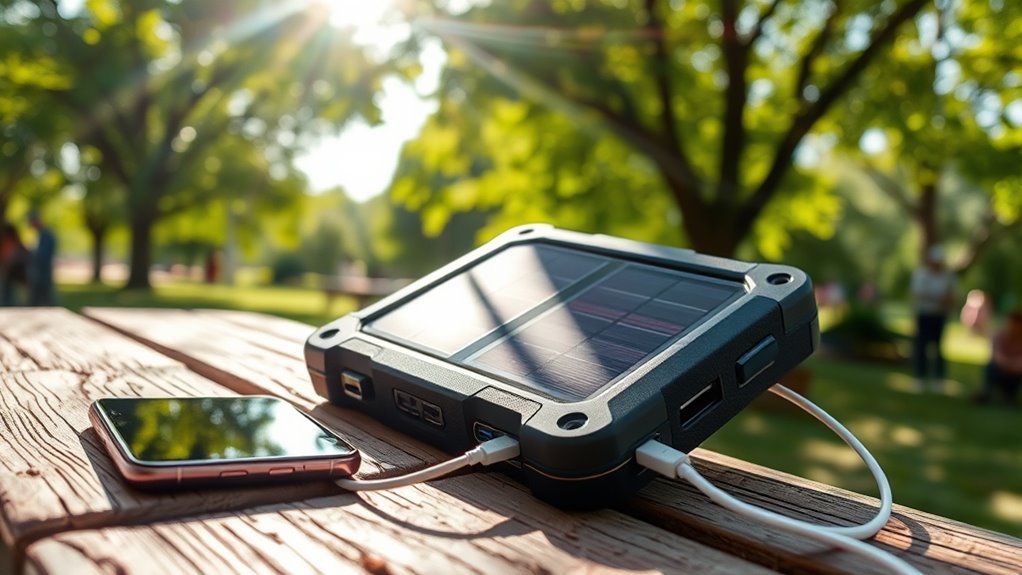

Solar phone chargers combine a battery bank with a small solar panel, but that panel is usually best for topping up during extended outings rather than quickly refilling a phone. My best overall pick is the MINRISE 40000mAh for its stated 20W USB-C power delivery, while the BLAVOR 10,000mAh models suit lighter carry and the BLAVOR hand-crank model adds emergency tools. The main tradeoff is between capacity and weight, with built-in cables and wireless charging adding convenience but not replacing a dependable outlet charge. Read on for how the 14 options differ and which features matter for your trips.

Get business pricing on tech for your team
- Business-only prices and quantity discounts
- Tax-exempt purchasing
- Multiple users, one account, clear invoices
Key Takeaways
- The MINRISE 40000mAh is the standout for wired charging speed because it specifies 20W USB-C PD, while many high-capacity alternatives emphasize wireless charging or built-in cables.
- The 10,000mAh BLAVOR models favor portability over long-term backup capacity; they make more sense for lighter everyday carry than for powering several devices across a long trip.
- Large capacity claims do not settle the choice: the 48,000–50,000mAh models may hold more charge, but their size and weight can make them less practical to carry.
- Built-in cables reduce packing friction on the SOARAISE, BLASOUL, Durecopow 20,000mAh, and BLAVOR 20,000mAh cable models, though buyers should check that the included connectors fit their devices.
- Emergency features serve different purposes: the FEELLE and BLAVOR hand-crank models add backup tools, while dual flashlights on several models offer a simpler camp or roadside convenience.
| 20000mAh Solar Power Bank with Wireless Charging and 15W Fast Charging |  | Best for Temperature Swings | Capacity: 20000mAh | Battery type: Solid-state | Wired charging: 15W fast charging | VIEW ON AMAZON | See Our Full Breakdown |
| SOARAISE 48000mAh Solar Power Bank with Wireless Charging and 4 Built-in Cables |  | Best for Shared Charging | Capacity: 48000mAh | Battery type: Lithium-polymer | Solar panels: 4 | VIEW ON AMAZON | See Our Full Breakdown |
| BLASOUL Solar Power Bank 49800mAh with Wireless Charging and Built-in Cables |  | Best for Fast Outdoor Charging | Capacity: 49800mAh | Battery type: Lithium polymer | Maximum wired output: 22.5W | VIEW ON AMAZON | See Our Full Breakdown |
| WongKuo 49800mAh Solar Power Bank with Wireless Charging |  | Best for Emergency Lighting | Capacity: 49800mAh | Battery type: Li-polymer | Fast charging: QC 3.0 | VIEW ON AMAZON | See Our Full Breakdown |
| MINRISE Solar Power Bank 40000mAh with PD 20W Fast Charging |  | Best Value for Wired Fast Charging | Capacity: 40000mAh | Output power: 20W PD | Solar panel: 1.8W | VIEW ON AMAZON | See Our Full Breakdown |
| Durecopow Solar Charger Power Bank 20,000mAh with Built-in Cables and Dual Flashlight |  | Best for Built-In Cables | Capacity: 20,000mAh | Ports: 1 USB-C (input/output), 2 USB-A (output) | Built-in cables: USB-C, Lightning, Micro USB; USB-A input cable | VIEW ON AMAZON | See Our Full Breakdown |
| YELOMIN 38800mAh Solar Power Bank with USB-C Fast Charging and Dual LED Flashlights |  | Best for High Stated Capacity | Capacity: 38,800mAh | Weight: 280g | Ports: 1 USB-C (input/output), 2 USB-A (5V/2.4A) | VIEW ON AMAZON | See Our Full Breakdown |
| FEELLE 50000mAh Solar Power Bank with Magnetic Wireless Charging, Hand Crank, and Compass |  | Best for Emergency Charging Options | Battery capacity: 50,000mAh | Battery type: Lithium polymer | Charging sources: Solar, hand crank, USB | VIEW ON AMAZON | See Our Full Breakdown |
| 20000mAh Solar Power Bank with Wireless Charging, Built-in Cables, and Dual LED Flashlights |  | Best Compact Multi-Device Pick | Battery capacity: 20,000mAh | Wireless charging: Qi compatible, up to 15W | Built-in cables: Lightning, USB Type-C, USB-A | VIEW ON AMAZON | See Our Full Breakdown |
| BLAVOR Solar Power Bank with Hand Crank, 20000mAh, Built-in 4 Cables, Wireless Charging, and Survival Tools |  | Best for a Feature-Rich Survival Kit | Capacity: 20,000mAh | Charging methods: Solar, hand crank, USB-C PD, wireless | USB-C PD: Up to 20W | VIEW ON AMAZON | See Our Full Breakdown |
| BLAVOR Solar Power Bank 10,000mAh Portable Wireless Charger |  | Best Rugged Compact Pick | Capacity: 10,000mAh | Battery type: Lithium-cobalt | USB-C output: 20W fast charging | VIEW ON AMAZON | See Our Full Breakdown |
| BLAVOR Solar Power Bank 10,000mAh Portable Wireless Charger |  | Best for Lightweight Day Trips | Capacity: 10,000mAh | Battery type: Lithium-cobalt | USB-C output: 20W | VIEW ON AMAZON | See Our Full Breakdown |
| Durecopow 49800mAh Solar Power Bank with 15W Fast Charging, LED Flashlight, and Carabiner |  | Best for High-Capacity Camp Charging | Battery capacity: 49,800mAh | Battery cell type: Lithium polymer | Charging: 15W QC3.0 fast charging | VIEW ON AMAZON | See Our Full Breakdown |
| BLAVOR Solar Power Bank 20000mAh with Wireless Charging and Built-in Cables |  | Best for Charging a Group | Battery capacity: 20,000mAh | USB-C fast charging: 20W | Wireless charging: Qi standard for phones and Apple Watch | VIEW ON AMAZON | See Our Full Breakdown |
| solar phone charger | Capacity | Wireless charging | Ports | Battery type |
|---|---|---|---|---|
| 20000mAh Solar Power Bank with | 20000mAh | Qi-compatible | 2 USB-A; 1 USB-C input/output | Solid-state |
| SOARAISE 48000mAh Solar Power | 48000mAh | Yes | 2 USB-A; 1 USB-C | Lithium-polymer |
| BLASOUL Solar Power Bank 49800 | 49800mAh | — | — | Lithium polymer |
| WongKuo 49800mAh Solar Power B | 49800mAh | Qi-enabled | — | Li-polymer |
| MINRISE Solar Power Bank 40000 | 40000mAh | — | — | — |
| Durecopow Solar Charger Power | 20,000mAh | — | 1 USB-C (input/output), 2 USB-A (output) | — |
| YELOMIN 38800mAh Solar Power B | 38,800mAh | — | 1 USB-C (input/output), 2 USB-A (5V/2.4A) | — |
| FEELLE 50000mAh Solar Power Ba | — | 15W magnetic | USB-C, USB-A, Micro USB | Lithium polymer |
| 20000mAh Solar Power Bank with | — | Qi compatible, up to 15W | 2 USB-A, 1 USB-C | — |
| BLAVOR Solar Power Bank with H | 20,000mAh | Up to 15W | 1 USB-C, 2 USB-A | — |
| BLAVOR Solar Power Bank 10,000 | 10,000mAh | Supported | — | Lithium-cobalt |
| BLAVOR Solar Power Bank 10,000 | 10,000mAh | Qi standard | 3 | Lithium-cobalt |
| Durecopow 49800mAh Solar Power | — | — | 1 USB-C input/output, 2 USB-A outputs | — |
| BLAVOR Solar Power Bank 20000m | — | Qi standard for phones and Apple Watch | — | — |
More Details on Our Top Picks
20000mAh Solar Power Bank with Wireless Charging and 15W Fast Charging
Its solid-state battery gives this 20,000mAh charger a distinct angle for campers and emergency kits exposed to changing temperatures. The capacity is more manageable to carry than the SOARAISE 48000mAh and BLASOUL 49800mAh, though it will provide fewer recharges for a group or a long trip. A 15W wired output and Qi charging offer flexible ways to top up a phone, while the listed ports and included cables reduce packing. The solar panel is best treated as backup power, since its charging is described as slow; it cannot replace wall charging before a trip. This pick suits buyers who value battery stability and several charging options over maximum capacity or rugged weather protection.
Pros:- Solid-state battery is described as more stable in extreme temperatures
- 15W fast charging supports quicker wired phone top-ups
- Qi wireless charging adds a cable-free option
- Includes USB-A, Lightning, and Type-C cables
Cons:- Solar charging is slow and intended for emergency use
- Still bulky compared with compact 10,000mAh options
- Listed ports may be limiting when charging several devices at once
Best for: Campers and emergency-kit owners who want a moderate-capacity charger with a solid-state battery and both wired and Qi charging.
Not ideal for: Groups on extended trips who need the highest capacity, or buyers relying on solar panels to recharge quickly.
- Capacity:20000mAh
- Battery type:Solid-state
- Wired charging:15W fast charging
- Wireless charging:Qi-compatible
- Ports:2 USB-A; 1 USB-C input/output
- Included cables:USB-A, Lightning, Type-C
- Solar panel:High-efficiency monocrystalline
- Lighting:Dual flashlights with SOS mode
Our verdict“Choose this for temperature-conscious camping and emergency use if you prefer a more manageable capacity to the SOARAISE or BLASOUL high-capacity models.”
SOARAISE 48000mAh Solar Power Bank with Wireless Charging and 4 Built-in Cables
Four solar panels and seven-device support make the SOARAISE the lineup’s most group-oriented option. Its 48,000mAh capacity can serve several phones over a long outing, while four built-in cables and a wireless pad cut down on loose accessories. That setup is more convenient for mixed-device groups than the MINRISE 40000mAh, which has fewer listed simultaneous connections, but the SOARAISE’s 5V/3A maximum output does not match MINRISE’s stated 20W PD charging. The four panels are described as faster than a single-panel design, yet weather still affects solar input, so I would treat them as a way to extend a charge rather than refill the bank. Its size and nonreplaceable built-in cables are the main costs of convenience.
Pros:- 48000mAh capacity suits long trips and shared use
- Four solar panels offer more collection area than single-panel designs
- Four built-in cable types and wireless charging reduce accessory packing
- Supports simultaneous charging of up to seven devices
Cons:- Large capacity is likely to make the unit heavy and bulky
- Maximum output is listed as 5V/3A, below the MINRISE 20W PD spec
- Built-in cables may be difficult to replace if damaged
Best for: Families or small groups on multi-day outings who want to share one high-capacity bank across different cable types and wireless devices.
Not ideal for: Solo hikers prioritizing low weight, or buyers who need high-output PD charging and replaceable charging cables.
- Capacity:48000mAh
- Battery type:Lithium-polymer
- Solar panels:4
- Ports:2 USB-A; 1 USB-C
- Built-in cables:USB-C, Lightning, USB-A, Micro
- Wireless charging:Yes
- Maximum output:5V/3A
- Simultaneous devices:Up to 7
Our verdict“Pick the SOARAISE for group charging and fewer loose cables, provided bulk and modest listed output are acceptable.”
BLASOUL Solar Power Bank 49800mAh with Wireless Charging and Built-in Cables
22.5W wired output and 15W wireless charging give the BLASOUL a speed advantage over the SOARAISE, whose listed maximum is 5V/3A. Its nearly 50,000mAh capacity and four built-in cable types also suit travelers carrying several devices. For outdoor use, the IP65 rating adds stated protection against water and dust, a practical distinction from the MINRISE, whose description calls the casing waterproof and dustproof but does not give an IP rating. The tradeoff is substantial capacity: this is a cumbersome choice for anyone counting pack weight. Solar charging remains a backup rather than a dependable way to replenish the bank quickly. Choose it when rugged protection and stronger stated wired output matter more than portability.
Pros:- 49800mAh capacity can support multiple device charges
- 22.5W maximum wired and 15W maximum wireless output
- Four built-in cable types reduce the need to pack separate cords
- IP65 rating is specified for water, dust, and shock resistance
Cons:- High capacity makes it bulky and heavy
- Solar charging is typically slow and best used as backup
- No solar panel wattage is provided in the product data
Best for: Outdoor travelers carrying several phones or device types who want a high-capacity bank with a stated IP65 rating and faster wired output.
Not ideal for: Light-pack hikers or buyers who expect the solar panel to quickly recharge the power bank.
- Capacity:49800mAh
- Battery type:Lithium polymer
- Maximum wired output:22.5W
- Maximum wireless output:15W
- Built-in cables:iOS, Type-C, Micro, USB-A
- Lighting:LED flashlight with steady, SOS, and strobe modes
- Protection feature:Intelligent protection IC
Our verdict“Choose the BLASOUL when faster stated charging and an IP65 rating outweigh the burden of carrying a large power bank.”
WongKuo 49800mAh Solar Power Bank with Wireless Charging
Dual flashlights with SOS and strobe modes make the WongKuo a useful choice for an emergency kit that needs both phone power and signaling light. Its 49,800mAh capacity, Qi pad, and four built-in cables provide broad charging options, much like the BLASOUL 49800mAh. BLASOUL is the clearer pick for buyers focused on output speed because it states 22.5W wired charging; WongKuo lists QC 3.0 but gives no wattage in the supplied specs. WongKuo does specify an IP65 rating and ABS/PC construction for outdoor use. As with the other large banks here, the solar panel is emergency backup, not a practical substitute for charging from an outlet, and the capacity adds considerable bulk.
Pros:- 49800mAh capacity supports extended use across multiple devices
- IP65 rating is specified for outdoor protection
- Four built-in cables, USB-A ports, and Qi charging offer connection flexibility
- Dual flashlights include steady, SOS, and strobe modes
Cons:- Large capacity is likely to add substantial weight and bulk
- Solar charging is slow and intended for emergency backup
- QC 3.0 is listed without a maximum wattage
Best for: Campers and emergency-kit owners who want a high-capacity phone bank with signaling lights and several built-in charging connections.
Not ideal for: Buyers who prioritize a clearly specified high-wattage output or a lightweight charger for everyday carry.
- Capacity:49800mAh
- Battery type:Li-polymer
- Fast charging:QC 3.0
- Wireless charging:Qi-enabled
- Outputs:4 built-in cables, 2 USB-A ports, wireless pad
- Inputs:Built-in USB-A cable, USB-C cable
- Material:ABS/PC
- Flashlight modes:Steady, SOS, strobe
Our verdict“Pick the WongKuo for emergency lighting and broad charging options if you do not need the BLASOUL’s stated 22.5W wired output.”
MINRISE Solar Power Bank 40000mAh with PD 20W Fast Charging
20W PD output and a stated weight of 1.1 lb give the MINRISE a more specific portability and charging case than the bulkier-feeling 49,800mAh options. Its 40,000mAh capacity is still ample for several phone top-ups, while four built-in cable types reduce what needs to go in a daypack. Compared with the BLASOUL 49800mAh, it gives up some capacity and the stated IP65 rating, but supplies a defined 20W PD output and dimensions. The 1.8W solar panel is best viewed as emergency assistance, not a fast way to refill a large battery. Buyers should also plan to recharge from an adapter rated at 5V/2A or higher. The ABS casing, silicone corners, and dual lights suit outdoor kits, though this remains a sizable charger.
Pros:- 20W PD output is clearly specified for wired charging
- 40000mAh capacity supports multiple device charges
- Four built-in cable types reduce extra cords
- Listed weight and dimensions help with packing decisions
Cons:- 1.8W solar panel is intended for emergency backup, not rapid recharging
- Still weighs 1.1 lb and takes substantial pack space
- Efficient wall recharging requires a 5V/2A or higher adapter
Best for: Campers and travelers who want a defined 20W PD output, multiple built-in cable types, and a documented weight for packing decisions.
Not ideal for: Buyers needing the largest possible capacity, IP65-rated protection, or meaningful solar recharging speed.
- Capacity:40000mAh
- Output power:20W PD
- Solar panel:1.8W
- Connector types:USB-C, USB-A, Micro USB, iOS
- Weight:1.1 lb
- Dimensions:6.67 × 3.35 × 1.22 in
- Material:ABS with silicone corners
- Lighting:Dual LED, 165 ft range
- Protection:Waterproof, dustproof, drop-proof
Our verdict“Choose the MINRISE for a documented, moderately lighter high-capacity option with 20W PD, while accepting slower solar backup and less capacity than BLASOUL.”
Durecopow Solar Charger Power Bank 20,000mAh with Built-in Cables and Dual Flashlight
Three built-in output cables make this Durecopow a practical pick for groups carrying a mix of phones: you can leave several loose cords behind and connect multiple devices at once. Compared with the YELOMIN 38800mAh, it offers less stated capacity but adds Lightning and Micro USB cables alongside USB-C, plus a USB-A input cable. Its dual flashlights, compass, carabiner, and described drop, dust, and water resistance suit a packed hiking kit. The tradeoff is its 20,000mAh capacity, which is more modest than the YELOMIN’s, and the rugged build may feel bulky for everyday pocket carry. Treat its solar panel as backup charging; USB charging is the more practical way to replenish it.
Pros:- Three built-in output cables cover USB-C, Lightning, and Micro USB devices
- USB-C input/output and two USB-A ports support several connection options
- Dual flashlights with SOS and strobe modes, a compass, and a carabiner add outdoor utility
- Described drop, dust, and water resistance suits outdoor packing
Cons:- Solar charging is better treated as an emergency top-up than the main recharge method
- Its 20,000mAh capacity is lower than the YELOMIN 38800mAh
- The rugged, cable-packed design may be bulky for pocket carry
Best for: Hiking groups with mixed USB-C, Lightning, and Micro USB devices who want to pack fewer loose cables
Not ideal for: Pocket-carry users or multi-day groups prioritizing the largest stated battery capacity
- Capacity:20,000mAh
- Ports:1 USB-C (input/output), 2 USB-A (output)
- Built-in cables:USB-C, Lightning, Micro USB; USB-A input cable
- Charging methods:Solar, USB outlet
- Materials:Silicone rubber, ABS, PC
- Emergency features:Dual LED flashlight with steady, SOS, and strobe modes; compass; carabiner
- Certifications:CE, FCC, RoHS
- Warranty:12 months
Our verdict“Choose this Durecopow if built-in cables for a mixed-device hiking group matter more than maximum battery capacity or pocketable size.”
YELOMIN 38800mAh Solar Power Bank with USB-C Fast Charging and Dual LED Flashlights
With a stated 38,800mAh capacity and a listed weight of 280g, this YELOMIN pairs substantial reserve power with a carry weight that could suit a backpacking kit. It has three outputs, waterproof port covers, and dual flashlights with SOS and strobe modes. Compared with the Durecopow 20,000mAh, it claims much more capacity and lists its weight, but gives up the Durecopow’s built-in output cables and compass. Its recharge setup is another tradeoff: USB-C handles input and output, yet the listed wall charging method uses Micro USB. The solar panel is described as an emergency top-up source, so buyers planning frequent recharges should factor in that older input connector and bring a wall adapter.
Pros:- 38,800mAh stated capacity offers a larger reserve than the Durecopow 20,000mAh
- Listed weight of 280g gives buyers a concrete carry-weight figure
- USB-C input/output and two USB-A outputs allow three wired output connections
- Port covers and dual SOS/strobe flashlights suit outdoor and emergency kits
Cons:- Solar charging is intended for emergency top-ups, not regular replenishment
- Wall charging uses Micro USB rather than USB-C
- No built-in output cables are listed
Best for: Backpackers who prioritize a large stated battery reserve and want port covers and emergency lighting
Not ideal for: Travelers who want built-in phone cables or prefer a USB-C wall input for recharging
- Capacity:38,800mAh
- Weight:280g
- Ports:1 USB-C (input/output), 2 USB-A (5V/2.4A)
- Wall charging:Micro USB
- Charging methods:Wall adapter, solar panel
- Emergency features:Dual LED flashlights with steady, SOS, and strobe modes
- Protection:Waterproof port covers; waterproof and dustproof design described
- Compatibility:iPhone, Samsung, Android, iPad
Our verdict“Pick the YELOMIN if you want its larger stated capacity and listed 280g weight, and can live with Micro USB wall charging.”
FEELLE 50000mAh Solar Power Bank with Magnetic Wireless Charging, Hand Crank, and Compass
The FEELLE stands out for its three charging routes: USB, solar, and a hand-crank generator, alongside 15W magnetic wireless charging and built-in cables. That range makes it a more emergency-focused kit than the YELOMIN 38800mAh, which lists wall and solar charging but no hand crank or wireless output. The FEELLE also claims a 50,000mAh capacity, giving it the largest stated reserve among these five picks. Those features come with practical limits: solar output depends on sunlight, and the hand crank is best understood as a contingency feature, not a routine way to refill a large battery. Magnetic charging may also be less convenient with phone cases thicker than 3mm. Its many functions favor preparedness over a simple, light phone charger.
Pros:- Three listed power sources: USB, solar, and hand crank
- 15W magnetic wireless charging adds a cable-free phone option
- 50,000mAh stated capacity exceeds the other four products in this batch
- Built-in cables, compass, flashlight, and described shock, dust, and water protection add kit versatility
Cons:- Solar charging depends on sunlight and is slower than USB charging
- Magnetic charging may lose efficiency with phone cases thicker than 3mm
- The hand crank is an emergency option rather than a practical way to refill the full battery
Best for: Emergency-kit owners who want wired, magnetic wireless, solar, and hand-crank charging options in one unit
Not ideal for: Minimalist hikers who want a simple, lightweight charger or users whose thick phone case interferes with magnetic alignment
- Battery capacity:50,000mAh
- Battery type:Lithium polymer
- Charging sources:Solar, hand crank, USB
- Wireless charging:15W magnetic
- Ports:USB-C, USB-A, Micro USB
- Built-in cables:USB-C, Lightning, Micro USB, USB-A
- Input/output:5V, 3A
- Protection and tools:Described as shockproof, dustproof, and waterproof; compass; three-mode LED flashlight
Our verdict“Choose the FEELLE for an emergency kit that values multiple ways to access power more than a simple, lightweight charger.”
20000mAh Solar Power Bank with Wireless Charging, Built-in Cables, and Dual LED Flashlights
This model combines built-in Lightning, USB-C, and USB-A cables with Qi wireless charging, so a group can connect different phones without packing as many leads. Its 15W wireless output and three listed ports make it more flexible for mixed-device charging than the Durecopow 20,000mAh, which lists built-in output cables but no wireless charging. The supplied dimensions and 80g listed weight suggest a compact form, although the product description also says its 20,000mAh capacity adds bulk; I would not assume it is pocket-friendly without checking how that figure applies to the unit. Rugged ABS protection and SOS lighting support outdoor use. As with the other solar picks, the panel is a backup source, while USB-C input is the more dependable recharge route.
Pros:- Built-in Lightning, USB-C, and USB-A cables reduce the number of separate leads to pack
- Qi-compatible 15W wireless charging adds a cable-free option
- Two USB-A ports and one USB-C port offer additional wired connections
- Shockproof, waterproof, and dustproof casing is paired with SOS-capable flashlights
Cons:- Solar charging is best treated as backup power
- The listed 80g weight and stated 20,000mAh capacity leave carry expectations unclear
- Wireless charging requires a compatible phone and can be less convenient than a direct cable connection
Best for: Small groups with mixed Lightning and USB-C phones who want wireless charging and multiple built-in cable options
Not ideal for: Buyers relying on solar as their regular charging method or those who need a clearly verified carry weight before choosing
- Battery capacity:20,000mAh
- Wireless charging:Qi compatible, up to 15W
- Built-in cables:Lightning, USB Type-C, USB-A
- Ports:2 USB-A, 1 USB-C
- Input/output:5V, 3A
- Dimensions:2.87 × 2.48 × 1.14 inches
- Listed weight:80g
- Protection and lighting:ABS plastic; described as shockproof, waterproof, and dustproof; dual LED flashlight with steady, strobe, and SOS modes
Our verdict“Choose this model for built-in mixed-device cables plus Qi wireless charging, but verify its carry weight if portability is your priority.”
BLAVOR Solar Power Bank with Hand Crank, 20000mAh, Built-in 4 Cables, Wireless Charging, and Survival Tools
BLAVOR packs a 20,000mAh battery, four built-in cables, USB-C PD up to 20W, wireless charging up to 15W, and listed capacity for up to seven devices into a survival-oriented package. Compared with the FEELLE 50000mAh, it claims less battery capacity but specifies USB-C PD and adds tools including a camping lantern and thermometer. The hand crank, compass, flashlight, and carabiner add emergency utility, yet the crank is a limited fallback: the provided data says one minute of cranking supplies only five minutes of light. It should not be treated as a meaningful way to recharge a phone. The solar panel shares that backup role; USB-C PD is the practical choice for replenishing the bank.
Pros:- USB-C PD up to 20W and wireless charging up to 15W provide distinct charging options
- Four built-in cables and listed support for up to seven devices reduce accessory needs
- Camping lantern, flashlight, compass, thermometer, and carabiner suit an emergency kit
- Shell is described as waterproof, shockproof, dustproof, and flame-retardant
Cons:- 20,000mAh capacity is lower than the FEELLE 50000mAh
- Hand-crank output is limited; the listed rate is five minutes of light per minute of cranking
- Solar and hand-crank charging are less practical for routine battery replenishment than USB-C PD
Best for: Preparedness-minded campers who want wired and wireless phone charging alongside a lantern, thermometer, and compass
Not ideal for: Buyers seeking the largest battery reserve or expecting the hand crank to recharge phones at a useful rate
- Capacity:20,000mAh
- Charging methods:Solar, hand crank, USB-C PD, wireless
- USB-C PD:Up to 20W
- Wireless charging:Up to 15W
- Ports:1 USB-C, 2 USB-A
- Built-in cables:2 USB-C, 1 iOS, 1 USB-A
- Listed simultaneous device capacity:Up to 7 devices
- Features and shell:Flashlight, camping lantern, compass, thermometer, carabiner; ABS+PC shell described as waterproof, shockproof, dustproof, and flame-retardant
Our verdict“Pick the BLAVOR if you want a multi-tool emergency charger with USB-C PD and lighting, and accept that its crank is mainly for light.”
BLAVOR Solar Power Bank 10,000mAh Portable Wireless Charger
I’d choose this BLAVOR when carrying a rugged 10,000mAh backup matters more than stretching power across a long trip. Its 20W USB-C output can top up a compatible phone faster by cable, while wireless charging and support for three devices add flexibility at camp. The IPX5-rated, dustproof and shockproof build, dual flashlights, and compass carabiner suit outdoor use better than a basic pocket bank. Compared with the 20,000mAh BLAVOR in this lineup, this one is easier to keep compact but offers less reserve for several devices or multiple days. Solar input is best treated as an emergency trickle source; relying on it to refill the bank can leave you short. Its 10,000mAh capacity also makes it a weaker fit for frequent tablet charging.
Pros:- 20W USB-C fast charging for compatible devices
- IPX5-rated rugged build with dust and shock resistance
- Wireless charging and support for up to three devices
- Dual flashlights and compass carabiner add practical outdoor utility
Cons:- 10,000mAh capacity limits the number of charges for larger devices
- Solar charging is slow compared with charging from a wall outlet
Best for: Day hikers and phone-first campers who want a durable backup with wired and wireless charging options
Not ideal for: Multi-day groups or tablet users who need enough stored energy for repeated charges
- Capacity:10,000mAh
- Battery type:Lithium-cobalt
- USB-C output:20W fast charging
- Wireless charging:Supported
- Simultaneous devices:Up to 3
- Water resistance:IPX5
- Other features:Dual flashlights, compass carabiner
- Casing:Flame-retardant ABS and PC
Our verdict“Pick this BLAVOR for a compact, weather-ready phone backup; choose the 20,000mAh BLAVOR if you need more stored power.”
BLAVOR Solar Power Bank 10,000mAh Portable Wireless Charger
At 9.3 ounces, this BLAVOR is the more clearly specified choice for hikers watching pack weight who still want wireless charging and a 20W USB-C port. It shares the 10,000mAh capacity and outdoor accessories of the other 10,000mAh BLAVOR here, so its distinction is portability rather than extra endurance. Qi charging can spare you a cable for a compatible phone, and three ports support charging several devices at once. The tradeoff is modest reserve: compared with the 20,000mAh BLAVOR, it gives you less breathing room for a group or repeated phone top-ups. A full wired recharge takes about seven hours, and sunlight is a slow way to replenish it, so I’d leave home with it charged rather than count on the solar panel during a short outing.
Pros:- Specified weight of 9.3 ounces suits lighter day packs
- 20W USB-C output supports fast charging on compatible devices
- Qi wireless charging and three ports offer flexible charging
- IPX5-rated build includes dual flashlights and a compass carabiner
Cons:- 10,000mAh capacity is limited for multi-day or group use
- Takes about seven hours to recharge by cable
- Solar charging is slow and weather-dependent
Best for: Weight-conscious day hikers who want a wireless-capable backup for one or two phones
Not ideal for: Backpackers or families who need several full charges or a fast turnaround between trips
- Capacity:10,000mAh
- Battery type:Lithium-cobalt
- USB-C output:20W
- Wireless charging:Qi standard
- Ports:3
- Weight:9.3 ounces
- Dimensions:5.91 x 3.07 x 0.87 inches
- Warranty:3 years
Our verdict“Choose this model for a lighter day-trip kit, while the 20,000mAh BLAVOR better fits longer outings.”
Durecopow 49800mAh Solar Power Bank with 15W Fast Charging, LED Flashlight, and Carabiner
The Durecopow is the capacity-first option here: its stated 49,800mAh battery is aimed at carrying substantial reserve for several devices, rather than minimizing pack weight. QC3.0 charging at up to 15W, two USB-A outputs, and one USB-C input/output make it useful for a campsite where phones need regular top-ups. Its rugged, weather-resistant design and strobe/SOS flashlight also suit emergency kits. Compared with either 10,000mAh BLAVOR, it offers far more stated capacity but gives up portability and the BLAVOR’s wireless charging. The listing provides no weight, so I’d check that detail before planning a long hike. Solar charging remains a slow backup method; for reliable use, recharge it from a corded source before leaving.
Pros:- 49,800mAh stated capacity for extended charging between outlets
- QC3.0 fast charging with USB-C and two USB-A outputs
- Rugged waterproof, shockproof, and dustproof design
- Multi-mode flashlight includes strobe and SOS
Cons:- Large capacity makes it bulkier to carry than the 10,000mAh BLAVOR models
- No wireless charging is listed
- Solar input is slow and depends on sun exposure
Best for: Car campers and emergency-kit owners who prioritize stored capacity for multiple devices over low carry weight
Not ideal for: Ultralight hikers or buyers who want wireless charging and a clearly specified compact form
- Battery capacity:49,800mAh
- Battery cell type:Lithium polymer
- Charging:15W QC3.0 fast charging
- Ports:1 USB-C input/output, 2 USB-A outputs
- Voltage:3.7V DC
- Amperage:3A
- Protection:Waterproof, shockproof, dustproof
- Other features:Strobe/SOS flashlight, carabiner
- Warranty:12 months
Our verdict“Pick the Durecopow for a high-capacity camp or emergency reserve, provided its bulk fits your kit.”
BLAVOR Solar Power Bank 20000mAh with Wireless Charging and Built-in Cables
For a shared campsite or family day outdoors, this BLAVOR combines 20,000mAh capacity with built-in cables and wireless charging, reducing the scramble for separate leads. It can charge up to six devices at once, including compatible phones and Apple Watches, and its 20W USB-C output is the fastest wired option among the higher-capacity picks here. The flashlight, camping light, compass, and thermometer add useful functions when you’re away from outlets. Compared with the 49,800mAh Durecopow, this one has less stated energy but adds wireless charging and built-in connectors for easier group use. The rugged shell and multiple accessories can make it cumbersome for pocket carry, and sunlight should be treated as backup input rather than a dependable way to refill it.
Pros:- 20,000mAh capacity offers more reserve than the 10,000mAh BLAVOR models
- Built-in cables, ports, and wireless charging reduce accessory needs
- Can charge up to six devices simultaneously
- Outdoor tools include a flashlight, camping light, compass, and thermometer
Cons:- Rugged construction and accessories make it bulky for pocket carry
- Solar charging is slow and best treated as a backup source
- Lower stated capacity than the 49,800mAh Durecopow
Best for: Families and small camping groups who want one bank with built-in cables and charging options for several devices
Not ideal for: Solo hikers who prioritize low weight, or buyers seeking the largest possible stored capacity
- Battery capacity:20,000mAh
- USB-C fast charging:20W
- Wireless charging:Qi standard for phones and Apple Watch
- Simultaneous devices:Up to 6
- Connectors:USB-C, USB-A, Lightning
- Durability:Waterproof, shockproof, dustproof
- Accessories:Flashlight, camping light, compass, thermometer, carabiner, rope
- Safety protections:Overcharge, over-discharge, over-current, short-circuit
Our verdict“Choose this BLAVOR when several people need convenient charging options from one outdoor power bank.”

How We Picked
I compared these 14 solar phone chargers by the factors that shape real buying decisions: stated battery capacity, wired charging speed, charging methods, built-in cables, portability cues, and practical extras such as lights, a compass, or a hand crank. I gave more weight to clear charging details and day-to-day usefulness than to a large capacity number or a long feature list. Because the product names alone do not establish real-world solar charging speed, I treat the panels as supplemental charging and do not rank a model higher just for calling itself solar.
The order should reflect distinct buyer needs rather than make every option seem equivalent. The MINRISE leads for its stated 20W PD charging; compact 10,000mAh BLAVOR models make a stronger case for light carry; and the high-capacity SOARAISE, BLASOUL, WongKuo, and Durecopow models are aimed at buyers willing to carry a larger bank. Built-in cables, wireless charging, lights, and hand-crank features affect convenience, but each adds tradeoffs in bulk, compatibility, or reliance on a slower backup method. Several listed names are similar or repeated, so buyers should confirm the exact model and included features before ordering.
| solar phone charger | Battery type |
|---|---|
| 20000mAh Solar Power Bank with | Solid-state |
| SOARAISE 48000mAh Solar Power | Lithium-polymer |
| BLASOUL Solar Power Bank 49800 | Lithium polymer |
| WongKuo 49800mAh Solar Power B | Li-polymer |
| MINRISE Solar Power Bank 40000 | — |
| Durecopow Solar Charger Power | — |
| YELOMIN 38800mAh Solar Power B | — |
| FEELLE 50000mAh Solar Power Ba | Lithium polymer |
| 20000mAh Solar Power Bank with | — |
| BLAVOR Solar Power Bank with H | — |
| BLAVOR Solar Power Bank 10,000 | Lithium-cobalt |
| BLAVOR Solar Power Bank 10,000 | Lithium-cobalt |
| Durecopow 49800mAh Solar Power | — |
| BLAVOR Solar Power Bank 20000m | — |
Factors to Consider When Choosing Solar Phone Chargers
Before choosing a solar phone charger, decide how you expect to use it: as a battery bank charged at home, as a backup that gets occasional sunlight, or as emergency gear. Those use cases call for different balances of capacity, portability, and charging options.
Treat the Solar Panel as a Backup Input
A small panel attached to a power bank has limited area, so sunlight may add charge slowly and unevenly. Clouds, shade, panel angle, and time of year all affect what it can collect. For reliable trip planning, charge the bank from a wall outlet before leaving and treat solar as a way to extend reserve power. A common mistake is assuming the word “solar” means the bank will recharge quickly while strapped to a backpack. If you need sustained off-grid charging, compare fold-out panels with larger surface areas as a separate category. The built-in panel is most useful when you can leave the bank in direct sun for long periods while keeping your phone out of the heat.
Choose Capacity Around Your Carry and Trip Length
Capacity labels help compare models, but they do not translate directly into a fixed number of phone charges. Conversion losses, phone battery size, and whether you charge by cable or wirelessly change the amount that reaches your device. Bigger banks can support more top-ups, yet they usually take up more space and add weight to a daypack. For a short outing, a lighter 10,000mAh unit may be easier to keep with you than a 40,000mAh or larger model. For a multi-day trip, consider how many devices need power and whether you can recharge the bank between days. Match the capacity to your actual load instead of choosing the largest number by default.
Check Output Speed and Port Compatibility
Battery capacity describes stored energy; output specifications describe how quickly a device can receive it. Look for a stated USB-C Power Delivery output if fast wired charging matters, and check whether your phone supports that charging standard. A USB-C port does not automatically mean high-speed charging, and bundled cables may support different speeds from the bank itself. Built-in cables simplify packing, but their connectors may not suit every phone or tablet. If the exact output ratings are unclear, plan around standard charging instead of assuming a fast-charge claim applies to every port. Buyers with several device types may prefer a bank that offers both a suitable USB-C output and a separate cable they can replace.
Compare Convenience Features With Their Tradeoffs
Wireless charging can reduce cable clutter, but it is generally less efficient than a direct cable connection and requires correct alignment. Built-in cables help when you want an all-in-one kit, though a damaged attached cable may be harder to replace than a separate one. Flashlights can be handy around camp or during a power outage, but they add little value if you already carry a headlamp. Compass and hand-crank features are emergency aids, not substitutes for a charged battery bank. Before paying attention to a long feature list, ask which one or two additions solve a problem you actually face. Extra functions are most useful when they let you leave another item at home without making charging less convenient.
Plan for Weather, Handling, and Heat
Outdoor use exposes a charger to drops, dust, rain, and temperature swings, so check the specific model’s protection claims rather than assuming every rugged-looking shell is waterproof. A water-resistant rating describes defined conditions and does not make a device safe to submerge. Direct sun can heat a phone and power bank, so place the panel where it receives light while the devices stay ventilated and out of extreme heat. A carabiner may help attach a bank to a pack, but it does not guarantee secure mounting or good panel exposure while walking. Think about where the charger will sit during use and how you will keep its ports clean and dry. For harsh conditions, a protective pouch and a separate cable can be more useful than extra built-in functions.
Pay for the Feature That Solves Your Main Problem
Spending more makes sense when a specific feature changes how you will use the charger, such as faster wired output, enough capacity for several devices, or emergency tools you would otherwise pack separately. It makes less sense to pay for a large capacity figure if the bank will stay at home because it is too bulky. Beginners often get better results from a straightforward model with clear output details and familiar ports than from a unit with multiple unusual charging methods. For emergency storage, check how the manufacturer recommends maintaining and periodically recharging the battery. Compare the exact model name and included accessories carefully when product listings use similar names. The best fit is the one you can keep charged, carry comfortably, and connect to your devices without guesswork.
Frequently Asked Questions
Can a built-in solar panel recharge my phone quickly while I hike?
Usually, a small built-in panel is better treated as a slow backup input than a fast phone charger. Its output depends on strong direct sunlight, panel angle, shade, and the time available. Walking can also keep the panel at an inconsistent angle, while heat may make it unwise to leave a phone exposed beside it. For a dependable charge during a hike, start with a fully charged power bank and use the solar panel to extend its reserve when conditions allow. A larger fold-out panel is a better fit if solar collection is a main part of your plan.
Is a 40,000mAh or larger charger a better choice for a long trip?
It can be, if you need to recharge multiple devices and are willing to carry the extra bulk. The printed capacity does not equal the amount delivered to your phone, since voltage conversion and charging losses reduce usable energy. A large bank also needs more time and power to recharge from an outlet. Estimate your devices’ needs for the trip and consider whether you can recharge at a campsite, vehicle, or lodging stop. If you mostly need one phone top-up, a smaller model may be easier to bring along.
Should I choose wireless charging or use a cable?
A cable is usually the better choice when you want a direct, predictable charge and the phone supports the bank’s output. Wireless charging can be convenient when you want fewer loose accessories, but it can lose more energy and requires the phone to stay aligned with the charging surface. Cases, placement, and movement may affect whether wireless charging starts reliably. If you are relying on the bank for several phone charges, wired charging is generally the more practical default. Wireless support is most useful as an extra option rather than the only way to connect.
What should I check before buying a power bank with built-in cables?
Confirm that the included connectors match every device you expect to charge and read the stated output for each cable. Built-in cables can save packing space, but their charging speed may differ from a USB-C port on the same bank. Check whether you can still use a replaceable cable if the built-in ones do not fit a new device. Also verify the exact model listing, since similar product names may describe different cable sets. If you travel with several device types, a bank with standard ports plus your own cable may be more adaptable.
Are hand-crank solar chargers dependable emergency power sources?
A hand crank can provide a backup charging method when sunlight and an outlet are unavailable, but it is typically a manual, labor-intensive way to generate power. It is better suited to emergency signaling or adding a small reserve than to quickly filling a phone battery. Solar input also depends on weather and exposure, so neither feature removes the need to keep the bank charged ahead of time. For emergency readiness, store the charger according to its maker’s guidance and check its charge periodically. Choose a crank model for redundancy and tools, not as your primary everyday charging plan.
Conclusion
For most buyers comparing these solar phone chargers, I would start with the MINRISE 40000mAh as the best overall pick because its stated 20W USB-C PD gives wired charging a clear role alongside its larger reserve. The best value depends on what you need: choose a 20,000mAh Durecopow or BLAVOR cable model for a more manageable mix of capacity and convenience, after confirming the exact listing. For a best premium, high-capacity fit, consider the SOARAISE, BLASOUL, WongKuo, or Durecopow 49,800–50,000mAh options if carrying a larger bank is acceptable. Beginners and everyday-carry buyers may prefer either BLAVOR 10,000mAh model for its simpler, lighter capacity class. For emergency-oriented gear, the BLAVOR hand-crank model adds survival tools, while the FEELLE combines a crank with a larger stated capacity; choose between them based on how much bulk you are willing to carry. In every case, plan to charge the bank from an outlet before relying on it outdoors.
Fall Picks
fall essentials
As an affiliate, we earn on qualifying purchases.