
A smart leak detector for frozen pipes should alert you to both water and the temperature drop that can precede a burst. My best overall pick is the Resideo WiFi Water Leak Detector with Freeze Alarm for its direct focus on leak and freeze warnings. The YoLink Water Leak Sensor 4 Alarm Kit with Hub stands out for a multi-room setup, while the SwitchBot Wi-Fi Water Leak Detector suits spots where a probe cable can reach beneath an appliance or pipe. The main tradeoffs are how much area each setup covers, whether it needs a hub, and whether it detects freezing conditions as well as water. Read on for the full comparison and help matching a detector to your home.

Get business pricing on tech for your team
- Business-only prices and quantity discounts
- Tax-exempt purchasing
- Multiple users, one account, clear invoices
Key Takeaways
- Freeze alerts separate the most relevant picks: Resideo and the Kidde Wi-Fi detector explicitly pair water detection with freeze warnings, a better match for pipe protection than a water-only sensor.
- Coverage depends on the whole system, not just sensor count: X-Sense, GoveeLife, and YoLink offer multi-sensor options, but hub requirements and alert paths affect how useful those sensors are across a home.
- YoLink is the lineup’s hub-centered option: Its sensor-and-hub kits suit buyers planning several monitored areas, while a standalone Wi-Fi detector may be simpler for one vulnerable location.
- Cable probes solve placement problems: The SwitchBot and GoveeLife cable models can reach beneath appliances or along hard-to-access areas where a sensor body cannot sit flat.
- Local sound and remote alerts serve different jobs: YoLink’s loud-alarm options can warn someone nearby, while app-connected detectors are more useful when the home is empty.
| X-Sense SWS54 Wi-Fi Water Leak Detector Kit with 3 Sensors and Base Station | 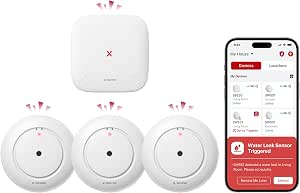 | Best for Shallow-Leak Coverage | Sensors: 3 | Base station: Included | Water detection depth: As shallow as 0.4 mm | VIEW ON AMAZON | See Our Full Breakdown |
| Resideo WiFi Water Leak Detector with Freeze Alarm |  | Best for Long Pipe Runs | Power: Battery powered | Batteries: 2 AA batteries, included | Sensor type: Cable sensor | VIEW ON AMAZON | See Our Full Breakdown |
| GoveeLife Smart Water Leak Detectors, 5-Pack |  | Best for Whole-Home Leak Coverage | Pack size: 5 sensors | Wireless technology: Sub-1G | Wireless range: Up to 1,804 ft | VIEW ON AMAZON | See Our Full Breakdown |
| YoLink Water Leak Sensor 4 with 105 dB Alarm |  | Best for Freeze Detection Beyond Wi-Fi | Model: YS7906 | Detection: Water leak and low temperature | Communication protocol: LoRa | VIEW ON AMAZON | See Our Full Breakdown |
| Kidde Wi-Fi Water Leak and Freeze Detector with App Alerts |  | Best Compact Freeze Alarm | Model: 60WLDR-W | Power: 2 AA batteries | Freeze detection: 37°F or rapid temperature drop | VIEW ON AMAZON | See Our Full Breakdown |
| GoveeLife Smart Water Leak Detector, 3-Pack |  | Best for Multi-Room Leak Coverage | Pack size: 3 sensors | Connectivity: 915 MHz Sub-1G; gateway requires 2.4 GHz Wi-Fi | Maximum range: 1,804 ft (550 m) | VIEW ON AMAZON | See Our Full Breakdown |
| X-Sense Wi-Fi Water Leak Detector and Freeze Alarm, 1-Pack |  | Best Hub-Free Freeze Warning | Pack quantity: 1 sensor | Connectivity: 2.4 GHz Wi-Fi; no hub required | Detection: Water leaks and temperatures below 39°F (4°C) | VIEW ON AMAZON | See Our Full Breakdown |
| YoLink Water Leak Sensor 4 Alarm Kit with Hub, 3-Pack |  | Best for Long-Range Freeze Monitoring | Included items: 1 hub and 3 sensors | Detection: Leaks and freezing temperatures | Wireless connectivity: LoRa | VIEW ON AMAZON | See Our Full Breakdown |
| GoveeLife Upgraded Smart Water Leak Detector with 4.92 ft Cable |  | Best for Hard-to-Reach Leak Points | Cable length: 4.92 ft | Monitoring modes: Leak alarm and water-level monitoring | Connectivity: 915 MHz Sub-1G; gateway supports 2.4 GHz Wi-Fi | VIEW ON AMAZON | See Our Full Breakdown |
| YoLink Water Leak Sensor 4 Alarm Kit with SpeakerHub, 3 Sensors |  | Best for a Loud Local Hub Alert | Included: 1 hub and 3 sensors | Detection: Water leaks and low temperatures | Wireless protocol: LoRa | VIEW ON AMAZON | See Our Full Breakdown |
| Ring Flood and Freeze Sensor |  | Best for Sidewalk Homes | Connectivity: Amazon Sidewalk | Freeze alert threshold: Below 40°F | Power: 2 AA alkaline batteries, included | VIEW ON AMAZON | See Our Full Breakdown |
| SwitchBot Wi-Fi Water Leak Detector with 1 m Probe Cable |  | Best for Remote Leak Alerts | Connectivity: 2.4 GHz Wi-Fi | Probe cable length: 1 m | Detection threshold: Water level as low as 0.5 mm | VIEW ON AMAZON | See Our Full Breakdown |
| smart leak detector for frozen pipe | Water resistance | Battery life | Alarm volume | Connectivity |
|---|---|---|---|---|
| X-Sense SWS54 Wi-Fi Water Leak | IP66 | — | — | — |
| Resideo WiFi Water Leak Detect | — | — | — | — |
| GoveeLife Smart Water Leak Det | IP67 | Up to 5 years | — | — |
| YoLink Water Leak Sensor 4 wit | — | — | 105 dB | — |
| Kidde Wi-Fi Water Leak and Fre | — | — | 85 dB | Wi-Fi |
| GoveeLife Smart Water Leak Det | IP67 | Up to 5 years | — | 915 MHz Sub-1G; gateway requires 2.4 GHz Wi-Fi |
| X-Sense Wi-Fi Water Leak Detec | — | — | — | 2.4 GHz Wi-Fi; no hub required |
| YoLink Water Leak Sensor 4 Ala | IP66 | — | 105 dB | — |
| GoveeLife Upgraded Smart Water | — | Up to 5 years (advertised) | 105 dB | 915 MHz Sub-1G; gateway supports 2.4 GHz Wi-Fi |
| YoLink Water Leak Sensor 4 Ala | IP66 | Over 5 years | 105 dB | — |
| Ring Flood and Freeze Sensor | IP66 | Up to 6 years | — | Amazon Sidewalk |
| SwitchBot Wi-Fi Water Leak Det | IP67 | Up to 2 years | 100 dB | 2.4 GHz Wi-Fi |
More Details on Our Top Picks
X-Sense SWS54 Wi-Fi Water Leak Detector Kit with 3 Sensors and Base Station
I’d choose the X-Sense SWS54 when catching a small leak early matters as much as sensing a frozen-pipe risk. Its upper and lower probes detect dripping or pooled water as shallow as 0.4 mm, and the kit gives you three sensors plus a base station for covering several vulnerable spots. App notifications add remote awareness, while the 120 dB alarms provide a local warning. Compared with the single-sensor Kidde Wi-Fi Water Leak and Freeze Detector, this kit covers more locations out of the box, but the supplied details do not specify freeze-temperature detection. Its long stated wireless range is also measured in open areas, so walls and a 2.4 GHz-only Wi-Fi requirement may shape placement. I’d pick it for leak monitoring, not as a stand-alone freeze alarm.
Pros:- Three sensors and a base station support monitoring multiple locations.
- Upper and lower probes detect dripping and water as shallow as 0.4 mm.
- 120 dB alarms and app notifications offer local and remote warnings.
- IP66-rated sensors suit damp placement areas.
Cons:- The supplied product information does not state that it detects freezing temperatures.
- Requires a 2.4 GHz Wi-Fi network; 5 GHz is not supported.
- The 1,804 ft wireless range is specified for open areas, not typical rooms with walls.
Best for: Homeowners who want to place leak sensors at several pipe-adjacent or appliance locations and value early detection of shallow water.
Not ideal for: Buyers who specifically need a confirmed low-temperature alert for frozen pipes, or who use only a 5 GHz Wi-Fi network.
- Sensors:3
- Base station:Included
- Water detection depth:As shallow as 0.4 mm
- Audible alarm:120 dB
- Wireless range:Up to 1,804 ft (550 m) in open areas
- Water resistance:IP66
- Wi-Fi:2.4 GHz; 5 GHz not supported
- Batteries:3 AAA batteries, included
Our verdict“Choose the SWS54 for multi-location, shallow-leak coverage, but choose a detector with stated freeze sensing if frozen-pipe alerts are your priority.”
Resideo WiFi Water Leak Detector with Freeze Alarm
The Resideo WiFi Water Leak Detector is the clearest fit here for monitoring a long, spread-out pipe route: its flexible cable sensor starts at 5 feet and can be extended up to 500 feet. It also directly addresses frozen-pipe concerns with temperature and humidity monitoring, alongside leak detection, app alerts, and a 100 dB alarm. Compared with the Kidde Wi-Fi Water Leak and Freeze Detector, Resideo offers much more cable coverage and can work with the L5 shutoff valve for automatic water cutoff. The tradeoff is installation: a long cable can be awkward in tight spaces, and the device relies on app alerts rather than a local display. I’d favor it when pipe coverage and a possible shutoff connection matter more than a compact, simple sensor.
Pros:- Monitors leaks, freezing temperatures, and humidity.
- Flexible cable sensor extends from 5 feet up to 500 feet for long runs.
- Push and email alerts pair with a 100 dB audible alarm.
- Can integrate with the Resideo L5 shutoff valve for automatic water cutoff.
Cons:- A long cable can be cumbersome to route through tight or cluttered spaces.
- Requires two AA batteries and has no built-in rechargeable battery.
- No local display; remote status depends on app notifications.
Best for: Owners of larger homes who need to trace a cable sensor along exposed or hard-to-reach pipes and want the option of L5 shutoff integration.
Not ideal for: People who need a compact wireless contact sensor for a cramped cabinet or want a local display instead of app-based monitoring.
- Power:Battery powered
- Batteries:2 AA batteries, included
- Sensor type:Cable sensor
- Cable coverage:5 ft sensor; extendable up to 500 ft
- Audible alarm:100 dB
- Alerts:Push and email
- Shutoff compatibility:Resideo L5 shutoff valve
- Dimensions:2 x 1.1 x 3.9 in
Our verdict“Pick Resideo when a long cable run and potential automatic shutoff matter more than the compact placement offered by Kidde.”
GoveeLife Smart Water Leak Detectors, 5-Pack
For a home with many possible leak points, the GoveeLife 5-Pack puts five sensors into one system and offers app, SMS, and email alerts through a compatible gateway. Its IP67 rating and adjustable alarm up to 105 dB suit damp areas where a sensor may be splashed, while the stated range of up to 1,804 feet can help when sensors sit far from the gateway. Compared with the three-sensor X-Sense SWS54, GoveeLife supplies two more sensors and more alert channels, but it requires a compatible gateway and the supplied details do not list freeze detection. That distinction matters for this roundup: it is a strong way to watch for water from a thawing pipe, not a specified early warning for falling pipe temperatures. I’d choose it for broad leak coverage, not temperature monitoring.
Pros:- Five sensors cover more locations than the three-sensor X-Sense kit.
- App, SMS, and email alerts provide several ways to hear about a leak.
- IP67-rated sensors offer strong water resistance.
- Adjustable alarm reaches up to 105 dB, with a claimed battery life of up to five years.
Cons:- Requires a compatible gateway for connected alerts.
- Gateway Wi-Fi supports 2.4 GHz only.
- The supplied product details do not specify freeze-temperature detection.
Best for: Homeowners who want to monitor five leak-prone locations and receive alerts through multiple channels.
Not ideal for: Buyers seeking a stated freeze-temperature alert or anyone who does not want to add and configure a compatible gateway.
- Pack size:5 sensors
- Wireless technology:Sub-1G
- Wireless range:Up to 1,804 ft
- Alarm:Up to 105 dB; 4 adjustable levels
- Battery life:Up to 5 years
- Batteries:10 AAA batteries, included
- Alerts:App, SMS, and email through a compatible gateway
- Water resistance:IP67
Our verdict“Choose this pack for multi-room leak monitoring and varied notifications, but not as your only frozen-pipe temperature alarm.”
YoLink Water Leak Sensor 4 with 105 dB Alarm
The YoLink Water Leak Sensor 4 earns its place by sensing both water and low temperatures, a more direct match for frozen-pipe monitoring than the leak-only details supplied for the X-Sense SWS54 and GoveeLife 5-Pack. It uses LoRa rather than relying on Wi-Fi for the sensor-to-hub link, with a stated open-air range of up to 2,034 feet and a 105 dB alarm. That combination suits remote areas such as a detached utility space, provided you add the required YoLink Hub. Unlike Resideo’s long cable sensor, this is a battery-powered contact-style unit rather than a cable run that can follow pipes. I’d weigh the extra hub cost and the conflicting battery-life claims before choosing it; the provided details also do not give an IP rating.
Pros:- Detects both water leaks and low temperatures.
- LoRa communication offers a stated open-air range of up to 2,034 feet without relying on Wi-Fi for the sensor link.
- 105 dB alarm provides a strong local warning.
- Includes two replaceable AAA batteries.
Cons:- Requires a YoLink Hub, sold separately.
- Battery-life claims conflict: the description says over two years while an item highlight says up to five years.
- The supplied product details do not state an IP rating.
Best for: Homeowners who need both leak and low-temperature sensing in a remote area and are willing to use a YoLink Hub.
Not ideal for: Buyers who want a complete out-of-box connected system, need a stated water-resistance rating, or prefer a cable sensor for tracing a long pipe run.
- Model:YS7906
- Detection:Water leak and low temperature
- Communication protocol:LoRa
- Maximum open-air range:2,034 ft
- Alarm volume:105 dB
- Power:2 AAA alkaline batteries, included
- Hub:Required; sold separately
- Battery-life claims:Over 2 years in description; up to 5 years in item highlight
Our verdict“Choose YoLink for combined freeze and leak sensing in a remote spot if you already have, or plan to add, its required hub.”
Kidde Wi-Fi Water Leak and Freeze Detector with App Alerts
The Kidde Wi-Fi Water Leak and Freeze Detector is the straightforward choice for a cramped spot where you want both water and cold-temperature alerts without routing a sensor cable. It detects freezing conditions at 37°F or after a rapid temperature drop, sends smartphone alerts, and can notify friends or family. Its compact form and Alexa and Google Home compatibility make it easier to fit into an existing connected home than the hub-dependent YoLink Water Leak Sensor 4. The tradeoff is a less forceful 85 dB alarm than YoLink’s 105 dB or Resideo’s 100 dB, and it needs Wi-Fi and the Kidde app for smart alerts. I’d choose Kidde for simple placement near a sink or appliance, but not for the broad cable coverage Resideo provides.
Pros:- Detects both leaks and freezing conditions at 37°F or after a rapid temperature drop.
- Compact design fits near appliances and in tight under-sink spaces.
- Can send smartphone alerts and notify friends or family.
- Works with Amazon Alexa and Google Home; two AA batteries are included.
Cons:- Its 85 dB alarm is quieter than the 100 dB Resideo and 105 dB YoLink alarms.
- Smart alerts require Wi-Fi and the Kidde app.
- The one-year limited warranty applies to the alarm only.
Best for: Apartment residents and homeowners who want a compact, app-connected freeze and leak alarm near a sink, appliance, basement, or garage.
Not ideal for: People who need a loud local alarm, long cable coverage, or connected monitoring that does not depend on Wi-Fi and the Kidde app.
- Model:60WLDR-W
- Power:2 AA batteries
- Freeze detection:37°F or rapid temperature drop
- Alarm volume:85 dB
- Connectivity:Wi-Fi
- Smart home compatibility:Amazon Alexa and Google Home
- Warranty:1-year limited manufacturer warranty; alarm only
Our verdict“Pick Kidde for compact, direct freeze-and-leak alerts in a Wi-Fi-connected home, and choose Resideo when you need extended cable coverage.”
GoveeLife Smart Water Leak Detector, 3-Pack
For covering several vulnerable spots at once, I’d choose this three-sensor GoveeLife kit over the single-location X-Sense Wi-Fi Water Leak Detector and Freeze Alarm. Its app, SMS, and email alerts offer multiple ways to hear about a leak, while the 105 dB adjustable alarm can be set to suit a utility room or a quieter living area. The long stated battery life and IP67 rating also make the sensors practical for damp locations near pipes. The tradeoff is that this kit does not detect freezing temperatures, so it cannot warn of a cold pipe before water escapes. It also needs a compatible GoveeLife gateway and 2.4 GHz Wi-Fi, and the gateway only supports H5059 or H5830 sensors. I’d pick it for leak coverage, not freeze prevention.
Pros:- Three sensors cover multiple locations from one kit.
- App, SMS, and email notifications provide several alert routes.
- Adjustable alarm reaches up to 105 dB.
- IP67 rating and stated battery life of up to five years suit damp, low-maintenance placements.
Cons:- Does not detect low temperatures or freezing conditions.
- Requires a compatible gateway and 2.4 GHz Wi-Fi.
- Gateway supports only GoveeLife H5059 or H5830 sensors.
Best for: Homeowners who want to monitor several leak-prone locations and receive alerts through multiple channels.
Not ideal for: Anyone seeking an early warning for temperatures below freezing, or buyers who do not already have a compatible GoveeLife gateway.
- Pack size:3 sensors
- Connectivity:915 MHz Sub-1G; gateway requires 2.4 GHz Wi-Fi
- Maximum range:1,804 ft (550 m)
- Alarm:Up to 105 dB; 4 volume levels
- Notifications:App, SMS, and email
- Battery life:Up to 5 years
- Water resistance:IP67
- Compatible sensors:GoveeLife H5059 and H5830
Our verdict“Choose this kit for broad leak coverage and flexible alerts, but choose a freeze-detecting option such as the YoLink Water Leak Sensor 4 Alarm Kit if cold-pipe warnings are a priority.”
X-Sense Wi-Fi Water Leak Detector and Freeze Alarm, 1-Pack
This is the clearest fit for buyers who want leak and low-temperature detection without adding a hub. Unlike the GoveeLife Smart Water Leak Detector 3-Pack, the X-Sense can alert when temperatures fall below 39°F (4°C), giving it a direct role in a frozen-pipe setup rather than only warning after water reaches the floor. Its six probes pick up both drips and pooled water, and a 110 dB local alarm adds a warning even when a phone is out of reach. The compromise is coverage: this is a one-location sensor, so monitoring several pipe runs means buying separate units. It also connects only to 2.4 GHz Wi-Fi, and its battery is rated for up to two years—shorter than the stated lifespan of the YoLink Water Leak Sensor 4 Alarm Kit.
Pros:- Detects both water leaks and temperatures below 39°F (4°C).
- Connects directly to 2.4 GHz Wi-Fi without a hub.
- Six probes detect drips and pooling water.
- 110 dB alarm and app notifications provide local and remote alerts.
Cons:- One sensor covers only one location.
- Does not support 5 GHz Wi-Fi.
- Battery life is rated for up to two years under normal operating conditions.
Best for: Homeowners who need a simple, single-location sensor near a vulnerable pipe and want freeze alerts without a separate hub.
Not ideal for: People monitoring several rooms or remote outbuildings who want multiple sensors and long-range hub connectivity in one kit.
- Pack quantity:1 sensor
- Connectivity:2.4 GHz Wi-Fi; no hub required
- Detection:Water leaks and temperatures below 39°F (4°C)
- Probe configuration:Two upper probes and four bottom probes
- Minimum water detection depth:0.4 mm
- Local alarm:110 dB
- Ingress protection:IP66
- Battery:Replaceable CR123A; up to 2 years under normal operating conditions
Our verdict“Pick the X-Sense for direct, hub-free freeze and leak alerts at one vulnerable spot; choose a multi-sensor YoLink kit for broader coverage.”
YoLink Water Leak Sensor 4 Alarm Kit with Hub, 3-Pack
For cold pipes in locations that are far from the home router, this YoLink bundle has a stronger case than the hub-free X-Sense SWS0B: LoRa communication reaches up to 2,034 feet, and the three sensors monitor both leaks and freezing temperatures. That combination makes it suited to spreading coverage across a basement, garage, or detached area, provided the hub can connect to the internet by Ethernet or 2.4 GHz Wi-Fi. Each sensor also has an IP66 rating, a 105 dB alarm, and replaceable AAA batteries rated for up to five years. The tradeoff is the hub: setup depends on another device and an internet connection, unlike the direct Wi-Fi X-Sense. Additional SMS options may also carry a monthly charge, so I’d check the alert plan that fits the household before relying on it.
Pros:- Three sensors detect both leaks and freezing temperatures.
- LoRa range is stated at up to 2,034 feet.
- 105 dB alarms and mobile app alerts support local and remote warnings.
- IP66 sensors use replaceable AAA batteries rated for up to five years.
Cons:- Requires the included hub and an internet connection.
- Hub connects through Ethernet or 2.4 GHz Wi-Fi, not 5 GHz Wi-Fi.
- Additional SMS options may involve a monthly charge.
Best for: Owners of larger homes or outbuildings who need several freeze-and-leak sensors with long-range communication to a hub.
Not ideal for: Buyers who want a single sensor that connects straight to Wi-Fi, or who prefer not to depend on a hub and internet connection.
- Included items:1 hub and 3 sensors
- Detection:Leaks and freezing temperatures
- Wireless connectivity:LoRa
- Maximum range:Up to 2,034 ft
- Hub connection:Ethernet or 2.4 GHz Wi-Fi
- Alarm volume:105 dB
- Water resistance:IP66
- Battery:Replaceable AAA; rated for up to 5 years
Our verdict“Choose this kit when long-range, multi-location freeze monitoring matters more than avoiding a hub.”
GoveeLife Upgraded Smart Water Leak Detector with 4.92 ft Cable
The long probe cable gives this GoveeLife a more specific use than the three-sensor GoveeLife kit: it can place the sensing end near a hard-to-reach leak point while the main unit stays accessible. Its 4.92 ft cable and selectable leak-alarm or water-level monitoring modes suit spots where water needs to be watched at a particular height or in a narrow recess. App, SMS, and email alerts plus a 105 dB alarm cover remote and nearby warnings. But for frozen pipes, there’s a key limitation: the listed detection is for water, not low temperature. Compared with the YoLink Water Leak Sensor 4, it also lacks stated freeze detection and depends on a compatible GoveeLife gateway. The listing’s water-resistance information is inconsistent, so I would not choose it for a placement that may be submerged.
Pros:- 4.92 ft cable reaches leak points that are difficult to access with a compact sensor.
- App offers leak-alarm and water-level monitoring modes.
- App, SMS, and email alerts accompany a 105 dB alarm.
- Advertised battery life is up to five years.
Cons:- Listed detection covers water, not freezing temperatures.
- Requires a compatible GoveeLife H5059 or H5830 gateway and 2.4 GHz Wi-Fi.
- Water-resistance information is inconsistent in the listing.
Best for: Homeowners who need to position a water-sensing probe in a tight or recessed spot and already use a compatible GoveeLife gateway.
Not ideal for: Buyers seeking freeze-temperature alerts or a sensor for a location where dependable submersion protection is required.
- Cable length:4.92 ft
- Monitoring modes:Leak alarm and water-level monitoring
- Connectivity:915 MHz Sub-1G; gateway supports 2.4 GHz Wi-Fi
- Wireless range:550 m
- Alarm volume:105 dB
- Notifications:App, SMS, and email
- Battery life:Up to 5 years (advertised)
- Gateway compatibility:GoveeLife H5059 and H5830
Our verdict“Choose this cable-probe model for awkward leak locations, but select a freeze-detecting YoLink or X-Sense sensor for cold-pipe warnings.”
YoLink Water Leak Sensor 4 Alarm Kit with SpeakerHub, 3 Sensors
This three-sensor YoLink kit is a good match for households that want freeze and leak detection across several locations, plus a loud local alert through the included SpeakerHub. Like the YoLink Water Leak Sensor 4 Alarm Kit with Hub, it uses LoRa and lists a range of up to 2,034 feet; that gives it an advantage over the cable-based GoveeLife detector when sensors need to reach across a property. Its sensors have IP66 protection, 105 dB alarms, and replaceable AAA batteries rated for over five years. The practical distinction is the SpeakerHub, which adds an audible alerting route beyond phone notifications. It still requires 2.4 GHz Wi-Fi and a hub, so it is not as straightforward as the hub-free X-Sense. Optional SMS services may also add recurring costs.
Pros:- Three sensors detect leaks and low temperatures.
- Included SpeakerHub adds a local audible alerting option.
- LoRa range is stated at up to 2,034 feet.
- Replaceable AAA batteries are rated for over five years.
Cons:- Requires a hub and 2.4 GHz Wi-Fi.
- Additional SMS options may carry a monthly charge.
- Three-sensor coverage may be more than needed for a single vulnerable pipe.
Best for: Households that want several freeze-and-leak sensors and a dedicated hub with audible alerts, including homes where phones may not be nearby.
Not ideal for: Buyers who want direct Wi-Fi setup without a hub or who only need one sensor at a single pipe.
- Included:1 hub and 3 sensors
- Detection:Water leaks and low temperatures
- Wireless protocol:LoRa
- Maximum range:Up to 2,034 ft
- Alarm volume:105 dB
- Water resistance:IP66
- Battery:Replaceable AAA
- Battery life:Over 5 years
Our verdict“Choose this kit for multi-point freeze monitoring with a dedicated audible hub alert; choose the hub-free X-Sense for a simpler single-location setup.”
Ring Flood and Freeze Sensor
The Ring Flood and Freeze Sensor stands out for combining water detection with a low-temperature warning: it alerts when water is detected and when temperatures fall below 40°F. That freeze threshold makes it a more direct fit for pipe protection than the SwitchBot Wi-Fi Water Leak Detector, which focuses on water detection rather than cold warnings. It also skips a dedicated base station, keeping the setup simpler for homes with Amazon Sidewalk coverage.
The tradeoff is that Sidewalk availability can vary by location, so it is less predictable than a detector that connects directly to home Wi-Fi. Its stated battery life of up to six years is a plus, though actual life depends on use and gateway proximity. I’d choose it for a Ring-oriented home with reliable Sidewalk reach, but not as a standalone answer where that network is unavailable.
Pros:- Detects both water and temperatures below 40°F, addressing two risks to pipes.
- Connects over Amazon Sidewalk without a separate base station.
- Battery life is rated for up to six years.
- IP66 water resistance suits placement near potential leak sources.
Cons:- Alerts depend on Amazon Sidewalk coverage, which varies by location.
- Battery life can change with usage and proximity to a Sidewalk gateway.
- Operating temperature starts at 32°F, so the listed range does not cover below-freezing conditions.
Best for: Ring households with Amazon Sidewalk coverage that want one sensor to warn about both leaks and temperatures below 40°F.
Not ideal for: People in areas with weak or unavailable Amazon Sidewalk coverage, or buyers who need a detector that connects directly to Wi-Fi.
- Connectivity:Amazon Sidewalk
- Freeze alert threshold:Below 40°F
- Power:2 AA alkaline batteries, included
- Battery life:Up to 6 years
- Water resistance:IP66
- Operating temperature:32°F to 120°F (0°C to 49°C)
- Dimensions:2.76 × 1.02 in (70 × 25.9 mm)
- Warranty:One-year limited warranty
Our verdict“Choose this Ring sensor if your home has dependable Sidewalk coverage and you want a dedicated warning below 40°F alongside water detection.”
SwitchBot Wi-Fi Water Leak Detector with 1 m Probe Cable
The SwitchBot Wi-Fi Water Leak Detector is a strong choice when remote leak notification and flexible probe placement matter more than a built-in freeze warning. Its 1 m cable can reach beneath appliances or along a pipe run, while detection down to 0.5 mm helps catch shallow water. The detector sends app and email alerts over 2.4 GHz Wi-Fi without a hub, unlike the Ring Flood and Freeze Sensor, which relies on Amazon Sidewalk and adds a specific cold-temperature alert.
SwitchBot also brings a 100 dB local alarm and an IP67 housing, useful if someone is home to hear a leak or the sensor may get wet. The main limitation for frozen-pipe protection is clear: the supplied product information describes water detection, not a temperature threshold. Its two-year battery-life claim is shorter than Ring’s up-to-six-year rating, and Wi-Fi availability is required for remote alerts.
Pros:- Sends app and email notifications over Wi-Fi without a hub.
- The 1 m probe cable makes it easier to position detection points in tight or hard-to-reach areas.
- Detects water levels as low as 0.5 mm and has a 100 dB alarm.
- IP67 waterproof housing supports wet-area placement.
Cons:- No freeze-temperature alert is specified, unlike the Ring Flood and Freeze Sensor.
- Requires 2.4 GHz Wi-Fi for network connectivity.
- Battery life is rated for up to two years, shorter than Ring’s stated maximum.
Best for: Homeowners who want app and email leak alerts from under appliances or along a pipe, and already have 2.4 GHz Wi-Fi.
Not ideal for: Buyers seeking an explicit low-temperature warning for freeze risk, or homes without reliable 2.4 GHz Wi-Fi.
- Connectivity:2.4 GHz Wi-Fi
- Probe cable length:1 m
- Detection threshold:Water level as low as 0.5 mm
- Alarm volume:100 dB
- Power:2 AAA batteries, included; 3 V
- Battery life:Up to 2 years
- Water resistance:IP67
- Smart home compatibility:Alexa, Google Assistant, Siri, IFTTT, SmartThings
Our verdict“Pick SwitchBot for hub-free remote water alerts and cable-based placement, but choose a detector with a stated temperature warning if freeze alerts are your priority.”

How We Picked
I ranked these detectors around the specific risk of frozen pipes, rather than treating every water sensor as interchangeable. I gave more weight to products that identify both leaks and low temperatures, then compared the practical reach of their sensors, the need for a hub, alert options, and the ease of placing sensors near vulnerable plumbing. Multi-sensor kits earned credit when they could cover several risk points without making setup unnecessarily complicated.
The order also reflects tradeoffs between focused protection and flexible coverage. A product with a freeze alarm ranks ahead of a water-only option for this use case, while hub-based systems make more sense for homes with multiple monitoring locations than for someone watching one sink. Cable probes and audible alarms add value for specific placements or nearby occupants, but they do not replace checking connectivity, temperature thresholds, and alert delivery before relying on a setup.
| smart leak detector for frozen pipe | Water resistance | Battery life |
|---|---|---|
| X-Sense SWS54 Wi-Fi Water Leak | IP66 | — |
| Resideo WiFi Water Leak Detect | — | — |
| GoveeLife Smart Water Leak Det | IP67 | Up to 5 years |
| YoLink Water Leak Sensor 4 wit | — | — |
| Kidde Wi-Fi Water Leak and Fre | — | — |
| GoveeLife Smart Water Leak Det | IP67 | Up to 5 years |
| X-Sense Wi-Fi Water Leak Detec | — | — |
| YoLink Water Leak Sensor 4 Ala | IP66 | — |
| GoveeLife Upgraded Smart Water | — | Up to 5 years (advertised) |
| YoLink Water Leak Sensor 4 Ala | IP66 | Over 5 years |
| Ring Flood and Freeze Sensor | IP66 | Up to 6 years |
| SwitchBot Wi-Fi Water Leak Det | IP67 | Up to 2 years |
Factors to Consider When Choosing Smart Leak Detector For Frozen Pipes
Choosing a detector for frozen pipes means planning around where cold air reaches plumbing and how you will hear about a problem. I would start with the home’s vulnerable locations and the type of warning each one needs, then match sensor count, connectivity, and installation style to that plan.
Prioritize temperature alerts where pipes can freeze
A water-only sensor can warn you after a leak reaches the floor, but it may not alert you while a pipe is simply getting dangerously cold. For exposed plumbing, garages, crawlspaces, or rooms that lose heat, check whether the detector supports a low-temperature or freeze alert and how that warning is delivered. Do not assume that every connected leak sensor measures temperature just because it has an app. If you are monitoring a warm kitchen cabinet, water detection may be the main need; at a cold exterior wall, temperature monitoring matters more. A detector is an alerting tool, not a substitute for insulation, heat, or pipe maintenance.
Map sensor locations before choosing a kit size
Count the places where a leak could start and where freezing is most plausible, rather than buying by sensor count alone. Common targets include pipe runs near exterior walls, water heaters, washing machines, and sinks, but one sensor may not cover a large room or multiple disconnected plumbing points. Put sensors where water will collect or where the probe can reach the likely leak path, while keeping the device accessible for battery changes. A multi-pack can lower setup friction across several rooms, though unused sensors do not add protection. Avoid placing a detector where routine condensation or cleaning water could cause repeated alerts.
Check connectivity and hub dependence
Remote alerts rely on a working path from the sensor to your phone, which may involve Wi-Fi, a dedicated hub, and an internet connection. A direct Wi-Fi model can be appealing for a small setup, while hub-based systems may be a better fit when you want several sensors managed together. Check whether the hub must sit near the router or the sensors, and whether its power and network connection are reliable during the conditions you are trying to monitor. A phone notification is not guaranteed if Wi-Fi or internet service is down. For a high-risk area, favor a setup that also provides a local audible alert or another dependable way for someone at home to hear it.
Choose between a sensor body and a probe cable
A compact sensor body works well when it can sit directly on the floor beneath plumbing. A cable probe gives more placement flexibility for tight gaps under appliances, along a pipe run, or around an awkward corner. The tradeoff is that the cable must be routed without snagging, and its sensing section needs to lie where water can reach it. Before buying, measure the distance from the practical device location to the likely leak point; a cable that falls short can leave the vulnerable area unmonitored. Do not assume a probe cable detects freezing unless the product also specifies temperature sensing.
Plan for alert fatigue and maintenance
Repeated false alarms can lead people to mute notifications, which defeats the point of a connected detector. Choose a sensor location that avoids splashes and routine dampness, and check the manufacturer’s guidance for cleaning and battery replacement. Make sure the app can send the alert types you care about, and review phone notification permissions after setup. A brief test after installation can confirm that both the local alarm and remote notification work, but it cannot prove the system will stay connected indefinitely. Add periodic checks to your home-maintenance routine, especially before cold weather.
Pay for coverage or features you will actually use
A larger kit or dedicated hub can make sense when several rooms, outbuildings, or plumbing zones need monitoring. For one sink or appliance, a simpler detector may be easier to install and maintain than a system with extra components. Pay more attention to the coverage plan and alert method than to a long feature list that does not address your specific risk. If you need an audible warning while away, confirm what can sound locally and what depends on a phone connection. For a cold, rarely visited area, prioritize reliable temperature alerts and a practical way to receive them over add-ons that do not improve warning time.
Frequently Asked Questions
Do I need a detector with a freeze alarm, or is leak detection enough?
For pipes that may freeze, a freeze alarm can give warning before water escapes, while a basic leak sensor usually reacts only after water reaches its sensing points. That earlier warning is most useful in unheated or drafty spaces and near plumbing along exterior walls. In a heated room where the main concern is an appliance hose failure, water detection may address the more likely problem. Check that the product specifically supports temperature alerts; a connected app alone does not imply freeze sensing. For a high-risk pipe location, pairing a freeze-capable detector with sound insulation and appropriate heating provides a more complete plan.
Can a phone alert reach me if my home Wi-Fi or internet goes down?
Remote notifications generally depend on the sensor’s connection path and an available internet connection, so a Wi-Fi outage can interrupt alerts to your phone. Some systems use a hub, but that does not automatically mean they have cellular backup or can send messages without internet. A local siren may still sound if the detector or hub has power, which can help someone who is home. Before choosing, check what happens during a router, internet, or power failure and whether the system offers backup power. If the property is often empty, treat connectivity limits as part of the protection plan rather than assuming every alert will arrive.
Should I buy one multi-sensor kit or separate detectors for each room?
A multi-sensor kit can simplify setup when several likely leak points need coverage, but it is only useful if each sensor can be placed where water or cold conditions are likely. Separate detectors may suit a home with different needs in different rooms, such as freeze monitoring in a garage and water-only monitoring beneath a sink. Compare the total monitored area, hub needs, and alert behavior before deciding by package size. Also check whether sensors in one kit can be positioned far enough apart for your layout. A modest, well-placed setup is more useful than extra sensors left in a drawer.
Where should I place a detector to catch a frozen-pipe problem early?
Start near plumbing exposed to cold, including pipes along exterior walls, in garages, crawlspaces, and under sinks beside drafty areas. A temperature-capable unit should be positioned where it can register the local conditions around the pipe, while a leak sensor needs to sit where escaping water will reach it. Those goals may call for more than one sensor in a large or compartmentalized area. Keep devices accessible for maintenance and follow the manufacturer’s placement guidance rather than enclosing them behind insulation or stored items. Check the location during cold weather, since airflow and room conditions can vary across a space.
Is a probe cable better than a flat leak sensor under an appliance?
A probe cable is useful when the detector body cannot fit beneath an appliance or when the likely leak point sits farther away from an accessible surface. A flat sensor is simpler when it can lie directly on the floor at the point where water would collect. Measure the route and sensing reach before choosing a cable model, and make sure its probe will not be pinched, pulled, or blocked during routine appliance movement. A cable probe does not automatically provide freeze alerts, so check the temperature features separately. For frozen-pipe protection, placement flexibility and temperature sensing are distinct needs.
Conclusion
For most buyers focused on both leaks and cold-weather warnings, I would start with the Resideo WiFi Water Leak Detector with Freeze Alarm as the best overall fit. The GoveeLife Smart Water Leak Detectors, 5-Pack is my best value-style choice for spreading sensors across several spots, while the YoLink Water Leak Sensor 4 Alarm Kit with SpeakerHub is the best premium-style pick for buyers who want a hub-based setup with a strong local warning. Beginners monitoring one location may prefer the X-Sense Wi-Fi Water Leak Detector and Freeze Alarm, 1-Pack over a multi-sensor system. For awkward spaces beneath appliances, choose the SwitchBot Wi-Fi Water Leak Detector with 1 m Probe Cable; for a home already centered on Ring, the Ring Flood and Freeze Sensor may suit that specific setup. Match the detector to the coldest, most vulnerable plumbing area, and confirm its alert method and connectivity before relying on it.