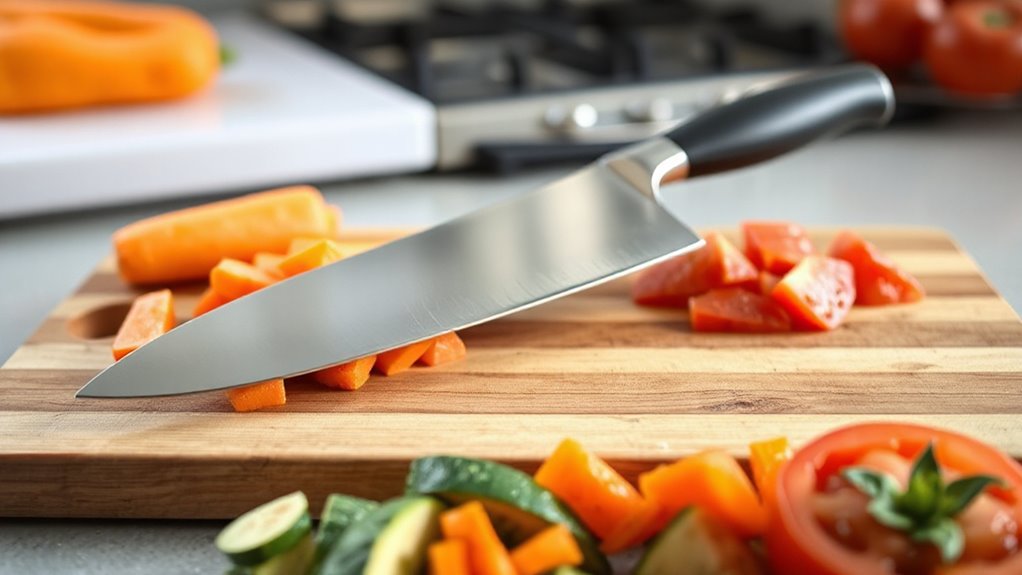

For a versatile first pick, I recommend the Imarku 7-inch Santoku: its all-purpose blade shape suits slicing, dicing, and everyday vegetable prep. The Cuisinart 7-inch Nakiri stands out as a dedicated vegetable knife and comes with a blade guard, while the Cuisinart Advantage color-coded set gives beginners several knife types in one purchase. The main tradeoffs are flexibility versus a specialized straight-edge blade, a single knife versus a set, and easy storage versus more blade length. Smaller paring knives are handy for detailed work, but they are less comfortable for preparing a whole pile of vegetables. Read on for the full comparison and help matching a knife to your kitchen habits.

Get tech for your team delivered free — and shop member deals
- Fast, free delivery on millions of items
- Access to Prime Big Deal Days deals on October 6–7
- Prime Video, Amazon Music and more included
Key Takeaways
- The Imarku Santoku is the most versatile single-knife choice in this lineup; a dedicated nakiri makes more sense if most of your prep involves vegetables.
- The Cuisinart Nakiri pairs a focused blade shape with a blade guard, while the Sunnecko, PAUDIN, and HOSHANHO offer other 7-inch nakiri options with different stated features.
- Sets solve different problems: Cuisinart’s color-coded set suits buyers starting from scratch, while the VITUER and Gourmetop sets focus on covered paring knives.
- Compact knives have a narrower job. The OAKSWARE 5.5-inch utility knife and Farberware 5-inch Santoku can feel less cumbersome than a 7-inch blade, but they offer less reach for large vegetables.
- Storage and upkeep are part of the choice. Blade guards and self-sharpening covers add convenience, while a standalone knife keeps the purchase focused on one task.
| Imarku 7-inch Santoku Knife with Japanese High-Carbon Stainless Steel |  | Best Overall Santoku | Blade material: Japanese high-carbon stainless steel | Blade length: 7 inches | Blade thickness: 2.5 mm | VIEW ON AMAZON | See Our Full Breakdown |
| OAKSWARE Chinese Chef’s Knife 7″ – Vegetable Cleaver & Meat Slicing Knife |  | Best Wide-Blade Prep Knife | Blade length: 7 inches | Blade material: German 1.4116 high-carbon stainless steel | Hardness: Rockwell 57+ | VIEW ON AMAZON | See Our Full Breakdown |
| Cuisinart Advantage 12-Piece Color-Coded Knife Set |  | Best Starter Set | Pieces: 12 total: 6 knives and 6 blade guards | Material: Stainless steel | Included knives: 8-inch chef, 8-inch slicing, 8-inch serrated bread, 7-inch santoku, 6.5-inch utility, and 3.5-inch paring | VIEW ON AMAZON | See Our Full Breakdown |
| Cuisinart 7″ Nakiri Knife with Blade Guard |  | Best Dedicated Vegetable Knife | Blade length: 7 inches | Material: Stainless steel | Knife type: Nakiri, or vegetable cleaver | VIEW ON AMAZON | See Our Full Breakdown |
| Henckels Solution 4-Inch Paring Knife |  | Best for Detailed Vegetable Prep | Blade length: 4 inches | Material: Stainless steel | Construction: Single-piece, precision-stamped | VIEW ON AMAZON | See Our Full Breakdown |
| VITUER 4-Piece Paring Knife Set with Sheaths – 4-inch German Stainless Steel Blades, PP Handles |  | Best Multi-Prep Paring Set | Blade material: German stainless steel (3Cr13MoV) | Blade length: 4 inches | Hardness: Rockwell 56 ± 2 HRC | VIEW ON AMAZON | See Our Full Breakdown |
| Cuisinart C77TR-3PR Triple Rivet 3.5-Inch Paring Knife, Black |  | Best for Controlled Detail Work | Blade material: High-carbon stainless steel | Blade length: 3.5 inches | Construction: Full tang | VIEW ON AMAZON | See Our Full Breakdown |
| Cokuma 3-Piece Kitchen Knife Set with Sheaths |  | Best Starter Knife Trio | Set includes: 8-inch chef knife, 4.5-inch utility knife, 4-inch paring knife | Blade material: High-carbon German 3Cr13MoV steel | Rockwell hardness: 56 ± 2 HRC | VIEW ON AMAZON | See Our Full Breakdown |
| OAKSWARE 5.5-Inch Forged Kitchen Utility Knife |  | Best All-Purpose Utility Knife | Model: 6236 | Blade length: 5.5 inches (14 cm) | Blade material: German 1.4116 X50CrMoV15 stainless steel | VIEW ON AMAZON | See Our Full Breakdown |
| Sunnecko 7-inch Nakiri Knife – High-Carbon Stainless Steel Chef Knife |  | Best Dedicated Vegetable Slicer | Blade length: 7 inches | Blade material: High-carbon stainless steel | Edge angle: 12-degree double bevel | VIEW ON AMAZON | See Our Full Breakdown |
| Gourmetop Paring Knife Set of 4, 3.8″ with Colorful Covers – Dishwasher Safe |  | Best Color-Coded Paring Set | Brand: Gourmetop | Model number: GMTKT26 | Number of knives: 4 | VIEW ON AMAZON | See Our Full Breakdown |
| Farberware EdgeKeeper 3.5″ Paring Knife with Self-Sharpening Blade Cover, High-Carbon Stainless Steel, Ergonomic Handle – Black |  | Best Self-Sharpening Paring Knife | Blade length: 3.5 inches | Blade material: High-carbon stainless steel | Cover: Self-sharpening EdgeKeeper blade cover | VIEW ON AMAZON | See Our Full Breakdown |
| PAUDIN 7-Inch Nakiri Knife – High Carbon Stainless Steel Vegetable Cleaver |  | Best Everyday Nakiri | Knife type: Nakiri / vegetable cleaver | Blade length: 7 inches | Blade material: 5Cr15MoV stainless steel | VIEW ON AMAZON | See Our Full Breakdown |
| HOSHANHO 7-Inch Nakiri Chef Knife |  | Best for Fine-Cut Vegetable Prep | Knife type: Nakiri | Blade length: 7 inches | Blade material: 10Cr15CoMoV high-carbon stainless steel | VIEW ON AMAZON | See Our Full Breakdown |
| Farberware EdgeKeeper 5-Inch Santoku Knife with Sharpening Cover |  | Best Compact Santoku | Blade length: 5 inches | Blade material: High-carbon stainless steel | Blade type: Santoku | VIEW ON AMAZON | See Our Full Breakdown |
| knives for vegetable prep | Blade length | Blade material | Handle material |
|---|---|---|---|
| Imarku 7-inch Santoku Knife wi | 7 inches | Japanese high-carbon stainless steel | Pakkawood |
| OAKSWARE Chinese Chef’s Knife | 7 inches | German 1.4116 high-carbon stainless steel | ABS |
| Cuisinart Advantage 12-Piece C | — | — | — |
| Cuisinart 7" Nakiri Knife with | 7 inches | — | — |
| Henckels Solution 4-Inch Parin | 4 inches | — | — |
| VITUER 4-Piece Paring Knife Se | 4 inches | German stainless steel (3Cr13MoV) | BPA-free PP plastic |
| Cuisinart C77TR-3PR Triple Riv | 3.5 inches | High-carbon stainless steel | — |
| Cokuma 3-Piece Kitchen Knife S | — | High-carbon German 3Cr13MoV steel | ABS |
| OAKSWARE 5.5-Inch Forged Kitch | 5.5 inches (14 cm) | German 1.4116 X50CrMoV15 stainless steel | — |
| Sunnecko 7-inch Nakiri Knife | 7 inches | High-carbon stainless steel | Pakkawood |
| Gourmetop Paring Knife Set of | 3.8 inches | Heat-treated 3Cr13MoV stainless steel | Polypropylene |
| Farberware EdgeKeeper 3.5" Par | 3.5 inches | High-carbon stainless steel | — |
| PAUDIN 7-Inch Nakiri Knife | 7 inches | 5Cr15MoV stainless steel | Pakkawood |
| HOSHANHO 7-Inch Nakiri Chef Kn | 7 inches | 10Cr15CoMoV high-carbon stainless steel | Pakkawood |
| Farberware EdgeKeeper 5-Inch S | 5 inches | High-carbon stainless steel | — |
More Details on Our Top Picks
Imarku 7-inch Santoku Knife with Japanese High-Carbon Stainless Steel
I rank the Imarku 7-inch Santoku as the most balanced single-knife choice here for slicing, dicing, and chopping vegetables. Its 15–18° edge and hollow scallops are suited to clean cuts, while the indentations can help reduce sticking as you work through moist ingredients. Compared with the OAKSWARE Chinese Chef’s Knife, it has a less expansive blade for scooping piles of chopped vegetables, but its santoku shape makes it a straightforward fit for everyday board work. The Pakkawood handle adds a stable, comfortable grip. The tradeoff is that this is one knife, without a blade guard, so it offers less task coverage and storage protection than the Cuisinart set. I would reserve it for vegetable prep rather than heavy-duty cutting.
Pros:- 15–18° edge angle suits precise slicing and dicing
- Hollow edge is designed to reduce food sticking
- Pakkawood handle offers a stable grip
- 7-inch santoku profile is useful for everyday vegetable prep
Cons:- Only one knife is included, limiting coverage for other kitchen tasks
- No blade guard is listed for protected storage
- Less blade width for scooping than the OAKSWARE Chinese Chef’s Knife
Best for: Home cooks who want one comfortable, sharp-edged knife for regular vegetable slicing and dicing.
Not ideal for: Cooks who want a wide blade for scooping ingredients or a multi-knife set with guards for storage.
- Blade material:Japanese high-carbon stainless steel
- Blade length:7 inches
- Blade thickness:2.5 mm
- Edge angle:15–18 degrees per side
- Edge type:Hollow, scalloped edge
- Handle material:Pakkawood
- Warranty:3-month free refund and 1-year free exchange
Our verdict“Choose the Imarku if you want a comfortable, versatile santoku for daily vegetable prep and do not need a set or storage guard.”
OAKSWARE Chinese Chef’s Knife 7″ – Vegetable Cleaver & Meat Slicing Knife
The OAKSWARE Chinese Chef’s Knife earns its place for cooks who value blade width as much as cutting ability. That broad 7-inch profile can handle vegetable slicing, then help crush garlic or move chopped ingredients from board to pan. Its 14–16° edge and full-tang construction make it a sturdier-feeling alternative to the Imarku Santoku, whose narrower profile is easier to maneuver for many routine cuts. This OAKSWARE is the better match for larger batches and scoop-and-transfer prep; its ABS handle and triple rivets favor a practical, durable setup over the Imarku’s Pakkawood finish. The tradeoffs are real: it is not for bones, and it requires hand washing and drying. I would skip it if you want a low-maintenance knife or mostly do delicate, small-scale prep.
Pros:- Wide blade can crush garlic and scoop chopped vegetables
- 14–16° edge is suited to slicing vegetables and boneless meat
- Full-tang, triple-riveted construction
- ABS handle is designed for comfortable use during longer prep
Cons:- Not designed for cutting bones
- Requires hand washing and drying
- Wider blade may feel less nimble than the Imarku Santoku for small, precise cuts
Best for: Cooks who regularly chop large quantities of vegetables and want a broad blade for crushing and transferring ingredients.
Not ideal for: People seeking a knife for bone cutting or a low-maintenance option that can go in the dishwasher.
- Blade length:7 inches
- Blade material:German 1.4116 high-carbon stainless steel
- Hardness:Rockwell 57+
- Edge angle:14–16 degrees per side
- Handle material:ABS
- Construction:Full tang, triple riveted
- Model number:6817
Our verdict“Pick the OAKSWARE if broad-blade chopping and scooping matter more to you than compact handling or easy cleanup.”
Cuisinart Advantage 12-Piece Color-Coded Knife Set
I recommend the Cuisinart Advantage set to new cooks who want several blade shapes ready for different ingredients, rather than one dedicated vegetable knife. Its six knives include an 8-inch chef knife and 7-inch santoku for most vegetable chopping, plus a paring knife for smaller jobs. Color coding can help separate knives during prep, and each has a matching guard. Compared with the Imarku Santoku, this set provides more task coverage and protected storage, but it does not give you the same focused pick if your main goal is a single everyday vegetable knife. The nonstick coating is another distinction, though the product details do not say how it holds up over time. You will also need room to store six knives, and the limited warranty details are unspecified.
Pros:- Includes chef, santoku, utility, paring, slicing, and bread knives
- Color-coded blades help distinguish knives during food preparation
- Matching blade guards are included
- Ergonomic handles and nonstick coating are listed
Cons:- Six knives take more storage space than a single santoku or nakiri
- Limited warranty details are not specified
- Less focused on vegetable prep than the dedicated Cuisinart Nakiri
Best for: New cooks setting up a kitchen who want several knife types and individual blade guards in one purchase.
Not ideal for: Vegetable-prep-focused cooks who want one dedicated, higher-spec knife or have little room to store a six-knife set.
- Pieces:12 total: 6 knives and 6 blade guards
- Material:Stainless steel
- Included knives:8-inch chef, 8-inch slicing, 8-inch serrated bread, 7-inch santoku, 6.5-inch utility, and 3.5-inch paring
- Blade features:Color-coded with nonstick coating
- Handles:Ergonomic
- Storage:Six matching blade guards
- Warranty:Limited warranty
Our verdict“Choose this set if you want a guarded assortment for a new kitchen, not if you only need a dedicated vegetable knife.”
Cuisinart 7″ Nakiri Knife with Blade Guard
For a knife chosen specifically for vegetables, the Cuisinart 7-inch Nakiri has a clear purpose: its rectangular blade is designed for chopping, slicing, and dicing, and the included guard protects it in storage. Compared with the OAKSWARE Chinese Chef’s Knife, it is the more focused vegetable-prep pick, while the OAKSWARE adds details for crushing garlic and transferring ingredients. That narrower role is also the Cuisinart’s main compromise: the listing describes it as primarily for vegetables, so it is a less flexible choice if you want one blade for meat and bread as well. The stainless steel blade and 7-inch length suit regular board work, but the product details provide no edge angle or handle material for buyers comparing fine specifications. I would choose it for a dedicated vegetable station, not an all-purpose kit.
Pros:- Nakiri shape is designed for chopping, slicing, and dicing vegetables
- 7-inch blade provides room for regular board work
- Stainless steel blade
- Blade guard supports safer storage and edge protection
Cons:- Primarily intended for vegetable prep, limiting its all-purpose usefulness
- Product details do not specify the edge angle
- Product details do not specify the handle material
Best for: Cooks who mostly prepare vegetables and want a dedicated 7-inch nakiri with a storage guard.
Not ideal for: Buyers who need one knife for vegetables, meat, and bread or want detailed information about edge angle and handle material.
- Blade length:7 inches
- Material:Stainless steel
- Knife type:Nakiri, or vegetable cleaver
- Included accessory:Blade guard
- Primary use:Vegetable chopping, slicing, and dicing
- Blade shape:Rectangular
Our verdict“Choose this Cuisinart if vegetable chopping is your priority and you want a guard, but not as your only knife for varied kitchen tasks.”
Henckels Solution 4-Inch Paring Knife
The Henckels Solution 4-inch Paring Knife fills a different role from the larger Imarku Santoku: it is for trimming, peeling, and precise cuts that are awkward on a full-size blade. Its lightweight, stamped construction favors maneuverability, while the triple-rivet handle gives a secure place to grip during detailed work. It is also dishwasher safe, a convenience not listed for the Imarku or OAKSWARE knives. The short blade is the tradeoff: it will be slower for chopping a large pile of vegetables, where either 7-inch option offers more cutting length. This is a useful companion knife, not a replacement for a main prep blade. I would choose it for fruit and vegetable detail work, and skip it if you want one knife to handle most board tasks.
Pros:- 4-inch blade offers control for detailed prep
- Lightweight construction favors maneuverability
- Triple-rivet ergonomic handle
- Dishwasher safe, according to the product details
Cons:- Short blade is inefficient for chopping large batches
- Lightweight feel may not suit cooks who prefer more heft
- Works best as a companion to a larger knife such as the Imarku Santoku
Best for: Cooks who often peel, trim, and make precise cuts on small vegetables or fruit and want a maneuverable secondary knife.
Not ideal for: Anyone looking for a primary knife to chop large quantities of vegetables or who prefers a heavier blade.
- Blade length:4 inches
- Material:Stainless steel
- Construction:Single-piece, precision-stamped
- Handle:Ergonomic, triple-rivet
- Care:Dishwasher safe
- Warranty:Lifetime against manufacturer’s defects
- Model number:17540-093
Our verdict“Choose the Henckels for precise small-scale vegetable prep, but pair it with a larger knife for routine chopping.”
VITUER 4-Piece Paring Knife Set with Sheaths – 4-inch German Stainless Steel Blades, PP Handles
I rank the VITUER set for households that want several small prep knives ready for fruit, herbs, and trimming vegetables. Its four matching 4-inch blades make it more useful for batch prep or shared kitchens than the single Cuisinart C77TR-3PR, though neither is a substitute for a full-size chopping knife. The German 3Cr13MoV steel has a stated hardness of 56 ± 2 HRC, and the BPA-free PP handles are designed for a balanced grip during detail work. Individual sheaths help protect the edges in a drawer. The tradeoff is the narrow role: four paring knives add little variety, and their short blades are awkward for larger vegetables. Hand washing is required, and the plastic covers may wear with repeated use.
Pros:- Four 4-inch knives suit small, precise vegetable-prep tasks
- German 3Cr13MoV stainless steel with stated 56 ± 2 HRC hardness
- BPA-free PP handles are designed for a balanced grip
- Four sheaths support safer drawer storage
Cons:- Short blades are limiting for larger vegetables and broad chopping
- Hand washing is required
- Plastic sheaths may wear over time
Best for: Cooks who regularly prep small vegetables, herbs, and fruit, or households that want several matching paring knives for shared use
Not ideal for: Anyone seeking one versatile knife for chopping whole vegetables or a set with different blade shapes
- Blade material:German stainless steel (3Cr13MoV)
- Blade length:4 inches
- Hardness:Rockwell 56 ± 2 HRC
- Handle material:BPA-free PP plastic
- Knives included:4
- Sheaths included:4
- Total pieces:8
Our verdict“Choose this set for repeated small-scale prep and spare paring knives, not as your main vegetable-chopping tool.”
Cuisinart C77TR-3PR Triple Rivet 3.5-Inch Paring Knife, Black
The Cuisinart C77TR-3PR is the focused pick here for cooks who want one compact knife for peeling, trimming, and careful cuts around small vegetables. Its 3.5-inch blade is shorter than the VITUER’s 4-inch blades, favoring nimble control over a little extra reach. Full-tang construction, a wide safety bolster, and an ergonomic handle give it a stability-minded design, while the included guard offers a simple storage solution. I place it ahead of multi-knife sets for someone who needs just one paring knife, but below the OAKSWARE 5.5-inch utility knife for cooks who also want to slice larger produce. The main compromise is its narrow scope: a short blade cannot handle broad chopping, and the listing does not provide a specific steel grade or edge angle.
Pros:- Compact 3.5-inch blade is suited to controlled detail cuts
- Full-tang construction with stainless steel rivets
- Extra-wide safety bolster supports hand positioning
- Blade guard and lifetime warranty are included
Cons:- Short blade is not well suited to chopping larger vegetables
- Only one knife is included, with no broader blade-size range
- Specific steel grade and edge angle are not provided
Best for: Cooks who want a single, compact knife for peeling and precise trimming of small vegetables
Not ideal for: Buyers who want one knife to handle larger vegetables, or a set with multiple blade sizes
- Blade material:High-carbon stainless steel
- Blade length:3.5 inches
- Construction:Full tang
- Handle:Ergonomically designed
- Bolster:Extra-wide safety bolster
- Included accessory:Blade guard
- Warranty:Lifetime
- Color:Black
Our verdict“Pick this Cuisinart for controlled small-vegetable prep if you do not need a longer slicing or chopping blade.”
Cokuma 3-Piece Kitchen Knife Set with Sheaths
For a new kitchen that needs more than a paring knife, the Cokuma trio makes a practical starting point: an 8-inch chef knife, 4.5-inch utility knife, and 4-inch paring knife cover different vegetable sizes and prep styles. That range gives it more flexibility than the VITUER set, whose four blades all serve small-detail tasks. German 3Cr13MoV steel and a stated 56 ± 2 HRC hardness are shared across the set, while ABS handles keep the design straightforward. Matching sheaths for all three knives are useful when drawer storage is the only option. The tradeoff is care and specialization: hand washing is recommended, and none of the blades is a dedicated nakiri-style vegetable slicer like the Sunnecko. Choose this set for basic coverage, not a refined single-purpose vegetable blade.
Pros:- Three blade sizes cover small, medium, and larger prep tasks
- German 3Cr13MoV steel with stated 56 ± 2 HRC hardness
- Matching sheaths are supplied for all three knives
- Ergonomic ABS handles are designed for a comfortable grip
Cons:- Hand washing is recommended
- No dedicated nakiri or other specialized vegetable blade is included
- The set uses ABS handles rather than a stated premium handle material
Best for: First-time cooks or small households that need a few blade sizes for everyday vegetable preparation
Not ideal for: Cooks who want a dedicated vegetable knife or dishwasher-friendly cleanup
- Set includes:8-inch chef knife, 4.5-inch utility knife, 4-inch paring knife
- Blade material:High-carbon German 3Cr13MoV steel
- Rockwell hardness:56 ± 2 HRC
- Handle material:ABS
- Sheaths:Three matching covers
- Care:Hand washing recommended
- Material status:Knives and sheaths are BPA-free and lead-free
Our verdict“Choose the Cokuma set for broad everyday coverage in one purchase, but pick a nakiri if vegetable slicing is your main priority.”
OAKSWARE 5.5-Inch Forged Kitchen Utility Knife
The OAKSWARE earns its place as the middle ground between a short paring knife and a broad vegetable blade. Its 5.5-inch forged blade has enough length for many everyday slicing jobs while staying slimmer and easier to guide than the Sunnecko 7-inch nakiri. The German 1.4116 X50CrMoV15 steel, hand-polished edge, and 14–16-degree edge angle point to a design aimed at precise cuts; the full tang and three rivets add a sturdy handle construction. I would choose it for mixed prep—vegetables, herbs, and other ingredients—rather than repetitive high-volume chopping, where a nakiri’s taller blade may feel more suited. Its clear upkeep tradeoff is that the blade should be rinsed and dried after use. It offers versatility, but not the specialized vegetable-first shape of the Sunnecko.
Pros:- 5.5-inch blade balances reach with control
- Forged German 1.4116 X50CrMoV15 stainless steel
- Hand-polished edge with a stated 14–16-degree angle per side
- Full-tang construction with a triple-riveted handle
Cons:- Requires prompt rinsing and drying after use
- Slim utility profile is less specialized for broad vegetable chopping than a nakiri
- No sheath or storage accessory is listed
Best for: Cooks who want a mid-length knife for mixed vegetable prep, herbs, and occasional slicing of other foods
Not ideal for: Shoppers focused on high-volume vegetable chopping or those who prefer a knife that needs less prompt post-use care
- Model:6236
- Blade length:5.5 inches (14 cm)
- Blade material:German 1.4116 X50CrMoV15 stainless steel
- Blade edge:Plain
- Construction:Forged, full tang
- Edge angle:14–16 degrees per side
- Rockwell hardness:57+
- Handle:Triple-riveted
Our verdict“Pick the OAKSWARE if you want one mid-sized knife for varied prep rather than a dedicated vegetable slicer.”
Sunnecko 7-inch Nakiri Knife – High-Carbon Stainless Steel Chef Knife
Among these five, the Sunnecko is the most specifically shaped for vegetable prep: its 7-inch nakiri blade and hand-polished 12-degree double bevel are aimed at smooth, straight slicing. The wavy blade pattern is described as reducing friction, which may help cut ingredients cleanly without the broader, more general-purpose feel of the OAKSWARE 5.5-inch utility knife. At 0.48 pounds, it is listed as lightweight, and the Pakkawood handle plus included sheath make it appealing for cooks who want a dedicated blade they can store safely. That specialization is also its limit: this is not a cleaver for bones or heavy-duty chopping, and its high-carbon stainless steel calls for more rust-prevention care than a lower-maintenance option. I’d rank it above the utility knife for vegetable-focused slicing, not for all kitchen jobs.
Pros:- 7-inch nakiri profile is tailored to vegetable slicing
- Hand-polished 12-degree double-bevel edge
- Lightweight listed weight of 0.48 pounds
- Pakkawood handle and protective sheath are included
Cons:- High-carbon steel requires more care to help prevent rust
- Not suited to bones or heavy-duty cleaving
- Specialized blade shape is less versatile than the OAKSWARE utility knife
Best for: Vegetable-focused cooks who regularly slice and prep produce and want a dedicated nakiri with a storage sheath
Not ideal for: Anyone needing a heavy-duty cleaver for bones or a single knife for every kitchen task
- Blade length:7 inches
- Blade material:High-carbon stainless steel
- Edge angle:12-degree double bevel
- Handle material:Pakkawood
- Weight:0.48 pounds
- Included accessory:Protective blade sheath
- Blade pattern:Wavy pattern
Our verdict“Choose the Sunnecko for frequent vegetable slicing, provided you are comfortable caring for a specialized high-carbon stainless blade.”
Gourmetop Paring Knife Set of 4, 3.8″ with Colorful Covers – Dishwasher Safe
I’d choose the Gourmetop set for a kitchen that needs several small knives ready for peeling, trimming, and detail work. Its four color-coded covers make it easier to keep blades protected and distinguish knives in a shared drawer, while the 3.8-inch size suits close control better than broad chopping. Compared with the VITUER 4-Piece Paring Knife Set, Gourmetop specifies a heat-treated 55–57 HRC blade and dishwasher-safe care, making cleanup simpler. The tradeoff is reach: these short blades are less suited to slicing a large squash or handling a full board of vegetables. I see this as a practical set for small prep jobs, not a replacement for a chef’s knife or nakiri.
Pros:- Four color-coded covers help protect blades and distinguish knives in storage
- 3.8-inch blades offer control for peeling and trimming
- Dishwasher-safe construction simplifies cleanup
- Heat-treated 3Cr13MoV stainless steel is specified at 55–57 HRC
Cons:- Short blades are limiting for larger vegetables and sustained board chopping
- A four-knife set may be unnecessary for cooks who need only one paring knife
Best for: Cooks who regularly peel and trim vegetables and want several covered paring knives for a shared or busy kitchen
Not ideal for: Anyone who wants one knife for chopping larger vegetables or prefers a longer blade for board work
- Brand:Gourmetop
- Model number:GMTKT26
- Number of knives:4
- Blade length:3.8 inches
- Blade material:Heat-treated 3Cr13MoV stainless steel
- Hardness:55–57 HRC
- Handle material:Polypropylene
- Care:Dishwasher safe
Our verdict“Choose this set for covered, easy-clean paring knives, but pair it with a longer knife for substantial vegetable prep.”
Farberware EdgeKeeper 3.5″ Paring Knife with Self-Sharpening Blade Cover, High-Carbon Stainless Steel, Ergonomic Handle – Black
The Farberware EdgeKeeper makes the most sense for cooks who want a compact knife for peeling, trimming, and garnishing without having to arrange separate sharpening as often. Its self-sharpening cover is the main distinction from the Gourmetop set: instead of supplying several covered knives, this is a single precision tool with a sharpener built into its sheath. The ergonomic handle and 3.5-inch blade suit controlled hand work, though that shorter reach is a real limit when vegetable prep moves to the cutting board. Unlike the dishwasher-safe Gourmetop knives, this model needs hand washing and cover care. I’d favor it for occasional detail tasks and regular storage; cooks seeking a versatile vegetable chopper should choose a longer knife.
Pros:- Self-sharpening cover helps maintain the edge during regular use
- Compact 3.5-inch blade suits precision tasks
- Ergonomic handle is designed for a comfortable grip
- Protective cover keeps the blade enclosed during storage
Cons:- Short blade limits usefulness for chopping larger vegetables
- Requires hand washing and separate attention to cleaning the cover
Best for: Cooks who mainly peel, trim, and garnish vegetables and prefer a paring knife with a sharpener built into its cover
Not ideal for: People who want a dishwasher-safe knife or need one blade for both detail work and larger chopping tasks
- Blade length:3.5 inches
- Blade material:High-carbon stainless steel
- Cover:Self-sharpening EdgeKeeper blade cover
- Handle design:Ergonomic
- Color:Black
- Care:Hand wash
Our verdict“Pick this for frequent small, precise cuts and built-in edge upkeep, not as your main vegetable knife.”
PAUDIN 7-Inch Nakiri Knife – High Carbon Stainless Steel Vegetable Cleaver
For cooks who want a dedicated blade for a board full of vegetables, the PAUDIN 7-inch nakiri is a more natural fit than either paring knife here. Its wide, straight-edged profile is suited to repeated slicing, dicing, and chopping, while the pakkawood handle offers a balanced grip for longer prep sessions. The wave pattern is described as reducing food friction, a useful feature when slicing ingredients that tend to cling. Compared with the HOSHANHO 7-Inch Nakiri, PAUDIN lists 56+ HRC rather than 60 HRC; I’d position it as the less demanding choice for everyday vegetable work, not the sharper-spec option. The pattern is not Damascus steel, despite its appearance, and this vegetable-focused blade is not meant for chopping through bones.
Pros:- Seven-inch nakiri profile suits repeated vegetable slicing and chopping
- Pakkawood handle is described as comfortable and balanced
- Wave pattern is intended to reduce food friction
- Stainless steel blade is specified at 56+ HRC
Cons:- Vegetable-focused design is not suited to chopping through bones
- Wave pattern may suggest Damascus construction, but the blade is not real Damascus steel
Best for: Home cooks who prepare vegetables in quantity and want a dedicated nakiri for slicing, dicing, and chopping
Not ideal for: Cooks looking for a multipurpose knife for bones or heavy meat work, or a blade with true Damascus construction
- Knife type:Nakiri / vegetable cleaver
- Blade length:7 inches
- Blade material:5Cr15MoV stainless steel
- Hardness:56+ HRC
- Handle material:Pakkawood
- Blade pattern:Wave pattern
- Stated use:Slicing, dicing, and chopping vegetables
Our verdict“Choose the PAUDIN for straightforward, dedicated vegetable prep if you do not need a bone-capable all-purpose knife.”
HOSHANHO 7-Inch Nakiri Chef Knife
I rank the HOSHANHO above the PAUDIN for cooks who put a premium on a fine, keen cutting edge. Its 15-degree hand-polished edge and 60 HRC steel are specified more precisely than the PAUDIN’s 56+ HRC blade, which gives this nakiri a clearer appeal for controlled, clean vegetable cuts. Scalloped hollows are intended to reduce sticking as you slice, while the pakkawood handle is shaped for balanced control. Both knives share a seven-inch vegetable-focused format, so this is not a size upgrade over PAUDIN; the difference is the stated edge and steel specification. The drawback is sparse care guidance: product information does not say how to wash or sharpen it. I’d choose it for attentive prep, not for buyers who want explicit maintenance instructions.
Pros:- Hand-polished 15-degree edge is suited to precise cuts
- 10Cr15CoMoV steel is specified at 60 HRC
- Scalloped hollows are designed to reduce food sticking
- Pakkawood handle is shaped for balanced, comfortable control
Cons:- Product information does not specify washing or sharpening instructions
- The seven-inch nakiri format is specialized for slicing rather than heavy-duty tasks
Best for: Vegetable-focused cooks who prioritize a finely angled edge and precise slicing over an all-purpose blade
Not ideal for: Buyers who want clear care and sharpening instructions or need a knife for heavy-duty tasks such as bone chopping
- Knife type:Nakiri
- Blade length:7 inches
- Blade material:10Cr15CoMoV high-carbon stainless steel
- Hardness:60 HRC
- Edge angle:15 degrees
- Handle material:Pakkawood
- Blade feature:Scalloped hollows
Our verdict“Choose the HOSHANHO for precise vegetable slicing and its specified fine edge, provided you are comfortable finding care guidance elsewhere.”
Farberware EdgeKeeper 5-Inch Santoku Knife with Sharpening Cover
The 5-inch Farberware EdgeKeeper sits between a paring knife and a full-size vegetable knife, making it a useful pick for cooks who want board control without a long blade. Its short santoku profile handles slicing, dicing, chopping, and mincing, while oval indentations are designed to help food release. The built-in sharpener in the cover adds an edge-maintenance feature that the PAUDIN and HOSHANHO nakiris do not list. Still, its compact blade offers less cutting length for large vegetables than either seven-inch nakiri. It also requires hand washing and immediate drying, unlike the dishwasher-safe Gourmetop set. I’d choose this for a small kitchen or modest prep loads; cooks who routinely chop big quantities will benefit more from a full-size blade.
Pros:- Five-inch blade offers a compact option for board work
- Oval indentations are designed to reduce food sticking
- Built-in sharpener is included in the protective cover
- Ergonomically contoured handle is designed for comfortable control
Cons:- Shorter blade has less reach than the seven-inch PAUDIN and HOSHANHO nakiris
- Requires hand washing and immediate drying
Best for: Cooks with limited counter or storage space who want a compact knife for everyday vegetable slicing, dicing, and mincing
Not ideal for: People who prepare large quantities of vegetables or want dishwasher-safe cleanup
- Blade length:5 inches
- Blade material:High-carbon stainless steel
- Blade type:Santoku
- Blade feature:Oval indentations
- Cover:Protective EdgeKeeper sheath with built-in sharpener
- Handle:Ergonomically contoured
- Care:Hand wash, rinse, and dry immediately
Our verdict“Choose this compact santoku for smaller prep jobs and limited storage, but go with a seven-inch nakiri for large-volume chopping.”

How We Picked
I compared the 15 options by how well their blade type and size suit common vegetable tasks, from chopping a cabbage to trimming a pepper. I gave the strongest position to a knife with a broad range of everyday uses, which puts the Imarku 7-inch Santoku ahead of narrower specialty picks. Dedicated nakiri knives were judged on their fit for repeated vegetable slicing, with the Cuisinart model’s blade guard counting as a practical storage advantage. I also weighed whether a product’s form made sense for its intended role: compact knives for detail work, utility blades for in-between tasks, and sets for buyers who need more than one knife. Materials, handle construction, and included covers mattered as stated features, not as proof of performance I could not verify.
The ranking favors useful vegetable-prep coverage over the number of pieces in a box. The Cuisinart Advantage set is placed for beginners who want color-coded options; the OAKSWARE Chinese chef’s knife for shoppers drawn to a broad cleaver-style blade; and the OAKSWARE utility knife for smaller, mixed tasks. The Sunnecko, PAUDIN, and HOSHANHO nakiri knives sit alongside the Cuisinart Nakiri as dedicated alternatives, while the Henckels, Cuisinart, VITUER, Cokuma, Gourmetop, and Farberware paring or small-knife options serve detail work or compact-kitchen needs. I distinguish the Farberware EdgeKeeper models by their self-sharpening covers, not by assuming that they replace attentive knife care. This approach puts versatility, task fit, storage, and the buyer’s need for a single knife or a set ahead of feature counts alone.
| knives for vegetable prep | Handle material |
|---|---|
| Imarku 7-inch Santoku Knife wi | Pakkawood |
| OAKSWARE Chinese Chef’s Knife | ABS |
| Cuisinart Advantage 12-Piece C | — |
| Cuisinart 7" Nakiri Knife with | — |
| Henckels Solution 4-Inch Parin | — |
| VITUER 4-Piece Paring Knife Se | BPA-free PP plastic |
| Cuisinart C77TR-3PR Triple Riv | — |
| Cokuma 3-Piece Kitchen Knife S | ABS |
| OAKSWARE 5.5-Inch Forged Kitch | — |
| Sunnecko 7-inch Nakiri Knife | Pakkawood |
| Gourmetop Paring Knife Set of | Polypropylene |
| Farberware EdgeKeeper 3.5" Par | — |
| PAUDIN 7-Inch Nakiri Knife | Pakkawood |
| HOSHANHO 7-Inch Nakiri Chef Kn | Pakkawood |
| Farberware EdgeKeeper 5-Inch S | — |
Factors to Consider When Choosing Knives For Vegetable Prep
I’d start with the jobs you do most, then choose the blade shape and size that make those jobs feel natural. A knife aimed at vegetable prep still needs to fit your storage, maintenance habits, and comfort with sharpening.
Choose a blade shape for your cutting motion
A santoku or chef-style blade is a flexible starting point if you move between vegetables and other ingredients. A nakiri’s straight cutting edge is designed for a more direct up-and-down chopping motion, which can suit repetitive vegetable slicing. A Chinese chef’s knife brings a broader cleaver-like profile, but its size may feel like more blade than you want for small tasks. Don’t choose by the word “vegetable” on the packaging alone; picture how you actually lift and guide a knife. If you rock the blade through herbs or smaller ingredients, a shape that supports that motion may feel more natural than a straight-edged specialist.
Match blade length to your counter space and ingredients
A 7-inch blade gives room to work across larger vegetables, though it needs space on the board and in storage. A 5- to 5.5-inch knife can be easier to manage in a small kitchen or for quick, mixed jobs, but it may require extra cuts through a large squash or cabbage. Paring knives are useful for peeling, trimming, and fine cuts held close to the hand; they are not a comfortable substitute for a full-size prep knife. One common mistake is buying a short blade for every task just because it feels less intimidating. If you often prep large quantities, choose a manageable full-size knife and keep a small paring knife for detail work.
Decide whether you need one knife or a set
A single-purpose purchase can be the clearer choice if you already own a reliable general kitchen knife and want a dedicated vegetable blade. A set makes more sense when you are filling several gaps at once, but piece count alone does not tell you whether its knives match your routine. Color-coded handles or blade covers may help with organization, yet they also add storage pieces to keep track of. Check which knife shapes are included and whether you will use each one before choosing a set. For vegetable prep, a useful pairing is often one full-size knife for board work and one paring knife for small, controlled tasks.
Treat covers as a storage feature, not a care plan
A blade guard or sheath can protect an edge in a drawer and reduce the chance of an exposed blade catching a hand. A self-sharpening cover adds convenience, but it does not remove the need to follow the maker’s care instructions. Covers also need to be dry and clean before storage, especially after washing. Avoid assuming that a covered knife is automatically safe to toss into a crowded drawer; loose utensils can still shift around it. If you have a knife block or magnetic strip with a safe spot, a cover may matter less than it does in a drawer.
Think through sharpening and washing before buying
Edge upkeep affects daily usefulness as much as the knife’s stated steel type. A knife that suits your cutting style but stays dull between sharpenings can make vegetable prep slower and less controlled. Read care directions before treating a knife as dishwasher-safe, since handles and edges may call for different handling than a quick wash cycle. If you are new to knife care, a protected storage option and a simple sharpening routine may be more useful than chasing technical material claims. Pay more attention to clear care guidance and a comfortable grip than to a feature label you cannot connect to your habits.
Frequently Asked Questions
Is a nakiri better than a santoku for vegetable prep?
A nakiri is more specialized for straight, repeated vegetable cuts, while a santoku is usually the more flexible choice across different kitchen tasks. Your cutting motion matters: a nakiri favors a direct chopping action, and a santoku can suit buyers who want one knife for varied prep. Neither shape makes up for a dull edge or an uncomfortable grip. If vegetables make up most of your knife work, a nakiri is worth a closer look. If you want one main knife, the santoku is the easier all-round fit.
Can I use a paring knife as my main vegetable knife?
A paring knife works best for small, controlled jobs such as trimming, peeling, and detail cuts. Its shorter blade can become tiring when you use it to chop a large amount of vegetables on a board. It may still be a practical main knife if your kitchen tasks are light and your ingredients are usually small. For regular meal prep, pairing it with a full-size santoku, nakiri, or chef-style knife gives you a better range. Choose based on how much you prep, not just which blade feels easiest to hold at first.
Should I buy a knife set or one dedicated vegetable knife?
Choose a single knife if you already have the other tools you need and want to improve one part of your prep. A set can be useful when you are starting with few knives, though extra pieces may go unused if their shapes do not match your cooking. Look at the actual knives included rather than relying on the set’s piece count. Color coding and covers can help with organization, but they should support a useful selection, not stand in for one. For many kitchens, one full-size prep knife and a paring knife cover more routine vegetable work than a larger set of mismatched tools.
Are blade guards or self-sharpening covers worth choosing?
A guard is useful when a knife lives in a drawer because it separates the edge from other utensils and gives the blade a protected place. A self-sharpening cover may appeal if you want a built-in upkeep aid, but it should not be treated as a substitute for proper care. Check that the cover fits securely and can be cleaned and dried easily. If you store knives in a block or on a safe magnetic strip, a guard may add little day-to-day value. Pick the storage feature that addresses a real problem in your kitchen.
What should a beginner prioritize when choosing a first vegetable knife?
A beginner should prioritize a comfortable grip, manageable blade length, and useful all-round shape over a highly specialized knife. A 7-inch santoku can cover a wide range of prep, while a color-coded set can help if you need several knife types from the start. Think about where the knife will be stored and whether you are ready to maintain its edge. A blade that is too large for your board or too small for your usual ingredients can make learning less comfortable. Choose the tool that fits your real kitchen routine, then add a specialist knife only if a repeated task calls for one.
Conclusion
For the best overall, I’d choose the Imarku 7-inch Santoku for its broad fit across everyday vegetable tasks. The best value is the Cuisinart 7-inch Nakiri if you want a dedicated vegetable blade with a guard, while the HOSHANHO Nakiri is my pick for buyers seeking a focused, premium-leaning single knife. Beginners who need several options can start with the Cuisinart Advantage color-coded set. For specific needs, choose the OAKSWARE 5.5-inch utility knife for a smaller all-purpose blade, or the VITUER paring set for covered detail knives. If you are unsure, start with one full-size knife that matches your cutting motion and add a paring knife only when your prep calls for it.
Halloween Picks
halloween
As an affiliate, we earn on qualifying purchases.