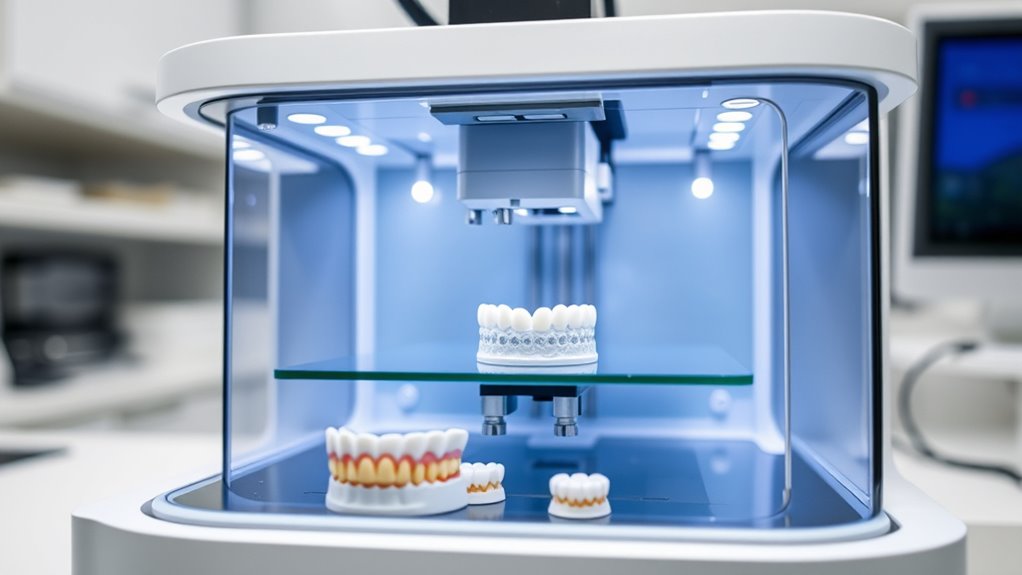
Dental 3D printers have become essential tools for creating accurate dental models, crowns, and bridges. The ANYCUBIC Photon Mono 4 stands out as the best overall choice thanks to its high-resolution LCD and fast printing speeds. For those prioritizing detail, the ELEGOO Saturn 4 Ultra offers 16K clarity, while the Large Format Resin Sonic XL appeals to practices needing bigger build volumes. Buyers face tradeoffs between resolution, build size, speed, and cost, making it vital to choose a model aligned with specific needs. Continue reading for a detailed comparison to help you make an informed decision.
Get ready for Prime Big Deal Days — try Prime free
Exclusive member deals on October 6–7, plus fast free delivery. Cancel anytime.
Start your free trialAs an affiliate, we earn on qualifying purchases.
Complete the kit


Key Takeaways
- High-resolution LCDs, like 16K, significantly improve the detail in dental models, but they often come at a higher cost.
- Build volume varies widely; larger printers are better for labs producing multiple models simultaneously but tend to be more expensive and slower.
- Speed is crucial for busy practices, with some models offering faster layer curing thanks to mono LCD technology.
- Ease of use and connectivity features, such as app control and auto-heating, streamline workflows but may add to the price.
- Choosing between resin types depends on the application—some resins are designed specifically for temporary models, impacting material costs and performance.
| ANYCUBIC Photon Mono 4 Resin 3D Printer with 7” 10K Mono LCD Screen |  | Best Overall for High-Resolution Detail and User-Friendly Operation | Resolution: 9024×5120 | Build Volume: 6.04” x 3.42” x 6.49” | Screen Size: 7” | VIEW ON AMAZON | See Our Full Breakdown |
| Antinsky Temporary Dental Model Resin A2, 500g for DLP LCD 3D Printers |  | Best Value for Precise Dental Models with Fast Curing | Color: A2 | Volume: 500g | Cure Time: 3 seconds per layer | VIEW ON AMAZON | See Our Full Breakdown |
| ANYCUBIC Photon P1 Resin 3D Printer, 14K Precision, Large Build Size 8.78×4.96×9.05in |  | Best for Professional-Grade Large-Scale Detailed Models | Build Size: 8.78 x 4.96 x 9.05 inches | Resolution: 13,312 x 5,120 pixels | XY Pixel Size: 16.8 x 24.8 micrometers | VIEW ON AMAZON | See Our Full Breakdown |
| Uniformation GK3 Pro Resin 3D Printer 16K High-Transparency LCD with Auto Heating and APP Control |  | Best for Ultra-Detail and Consistent Results in Cold Environments | Light Source: 385nm COB | Resolution: 16K (15120 × 6230) | XY Resolution: 14 × 19 μm | VIEW ON AMAZON | See Our Full Breakdown |
| Antinsky Temporary Dental Model Resin for 3D Printing, 500g |  | Best for Fast, Precise Dental Models with Low Shrinkage | Color: A1 | Volume: 500g | Cure Time: 3 seconds per layer | VIEW ON AMAZON | See Our Full Breakdown |
| ANYCUBIC Photon P1 Resin 3D Printer with Dual-Color/Material Printing and Large Build Size |  | Best for Creative Flexibility and Large Projects | Product Dimensions: 28 x 14 x 13 inches | Item Weight: 39 pounds | Build Volume: 8.78 x 4.96 x 9.05 inches | VIEW ON AMAZON | See Our Full Breakdown |
| Large Format Resin 3D Printer Sonic XL 4K (2022) with 190x120x200mm Build Volume, MSLA LCD, Wi-Fi |  | Best for High-Resolution Batch Dental Printing | Build Volume: 190 x 120 x 200 mm | Display: 8.9-inch monochrome 4K LCD | Layer Height: 10 microns | VIEW ON AMAZON | See Our Full Breakdown |
| ELEGOO Saturn 4 Ultra 16K Resin 3D Printer with 10″ Mono LCD and Smart Tank Heating |  | Best for Ultra-High-Resolution Dental Models | Display Size: 10 inches | Resolution: 16K Mono LCD | Build Volume: 8.33 × 4.66 × 8.66 inches | VIEW ON AMAZON | See Our Full Breakdown |
| dental 3d printer | Build Volume | Resolution |
|---|---|---|
| ANYCUBIC Photon Mono 4 Resin 3 | 6.04” x 3.42” x 6.49” | 9024×5120 |
| Antinsky Temporary Dental Mode | — | — |
| ANYCUBIC Photon P1 Resin 3D Pr | — | 13,312 x 5,120 pixels |
| Uniformation GK3 Pro Resin 3D | 8.3 x 4.7 x 9.5 inches | 16K (15120 × 6230) |
| Antinsky Temporary Dental Mode | — | — |
| ANYCUBIC Photon P1 Resin 3D Pr | 8.78 x 4.96 x 9.05 inches | — |
| Large Format Resin 3D Printer | 190 x 120 x 200 mm | — |
| ELEGOO Saturn 4 Ultra 16K Resi | 8.33 × 4.66 × 8.66 inches | 16K Mono LCD |
More Details on Our Top Picks
ANYCUBIC Photon Mono 4 Resin 3D Printer with 7” 10K Mono LCD Screen
The ANYCUBIC Photon Mono 4 stands out for its exceptional 10K resolution, delivering stunningly detailed models that rival the clarity of more expensive units like the Uniformation GK3 Pro. Its large build volume caters to more ambitious projects, making it ideal for professional workflows that demand both precision and size. Compared to the Photon P1, it offers simpler operation with a straightforward leveling system, though it lacks app connectivity, which some advanced users might miss. While the high resolution and stable lighting are major advantages, the absence of app support could frustrate those seeking remote control. Overall, this printer balances quality and ease of use, perfect for users who want detailed prints without complex features.
Pros:- Exceptional 10K resolution for detailed models
- Large build volume accommodates bigger projects
- User-friendly 4-point leveling system
- Stable, uniform lighting for smooth surface finishes
Cons:- No app support limits remote operation
- Requires familiarity with resin printing processes
Best for: Beginners and hobbyists seeking high-resolution results with straightforward setup
Not ideal for: Experienced users who need advanced remote monitoring or app integration
- Resolution:9024×5120
- Build Volume:6.04” x 3.42” x 6.49”
- Screen Size:7”
- Light Source:LighTurbo matrix
- Print Speed:70mm/h
Our verdict“This model is best suited for users who prioritize high detail and ease of use over advanced connectivity features.”
Antinsky Temporary Dental Model Resin A2, 500g for DLP LCD 3D Printers
Designed specifically for dental applications, Antinsky A2 resin offers high precision and a natural A2 shade that enhances realism in temporary teeth. Its fast 3-second curing per layer speeds up production, especially when compared to slower dental resins. This resin’s high hardness and scratch resistance make it durable enough for functional dental models, though it’s primarily suited to most 405nm DLP LCD printers. Unlike general-purpose resins, it excels in creating sharp, accurate features, but may require post-curing polishing for the best surface finish. Compared with the Antinsky Temporary Dental Model Resin, it offers similar performance but emphasizes a slightly different color tone. It’s an excellent choice for dental labs focusing on efficiency and detail.
Pros:- High precision with sharp, detailed features
- Fast curing of 3 seconds per layer
- Excellent mechanical strength and scratch resistance
- Reduces volume shrinkage for dimensional stability
Cons:- Requires specific 405nm DLP LCD printers
- Surface may need polishing for a smooth finish
Best for: Dental professionals producing temporary models with high detail and quick turnaround
Not ideal for: General hobbyists or those using non-405nm printers, due to limited compatibility
- Color:A2
- Volume:500g
- Cure Time:3 seconds per layer
- Surface Hardness:80-90D
- Compatibility:Most 405nm DLP LCD printers
Our verdict“This resin is ideal for dental applications where precision and speed are critical, but it’s less flexible for non-dental uses.”
ANYCUBIC Photon P1 Resin 3D Printer, 14K Precision, Large Build Size 8.78×4.96×9.05in
The ANYCUBIC Photon P1 combines ultra-high resolution with a sizable build volume, making it suitable for professional applications that require large, intricate models. Its 14K LCD offers unmatched detail, surpassing many mid-range printers like the Photon Mono 4. The advanced features, including automatic leveling and AI monitoring, ease operation but might be overwhelming for newcomers. The large build size means it needs ample space and potentially more setup time. Compared to smaller models, the P1 is a better choice for high-volume production, but its complexity and size could be drawbacks for casual users. It’s a robust option for those prioritizing both scale and precision.
Pros:- High-precision 14K LCD for detailed output
- Large build volume supports bigger projects
- Automatic leveling with AI monitoring for consistency
- Supports high-viscosity resins for advanced applications
Cons:- Requires ample space for operation
- Steep learning curve for beginners
Best for: Professional users or advanced hobbyists needing large, detailed models
Not ideal for: Beginners or users with limited space due to its size and complexity
- Build Size:8.78 x 4.96 x 9.05 inches
- Resolution:13,312 x 5,120 pixels
- XY Pixel Size:16.8 x 24.8 micrometers
- Resin Compatibility:Up to 8,000 cps viscosity
- Display:10.1-inch 14K mono LCD
Our verdict“This printer suits experienced users demanding large-scale, detailed models with high precision, though it requires more space and setup time.”
Uniformation GK3 Pro Resin 3D Printer 16K High-Transparency LCD with Auto Heating and APP Control
The Uniformation GK3 Pro pushes resin 3D printing boundaries with a remarkable 16K resolution, delivering exquisitely detailed models. Its smart auto-heating feature ensures consistent results even in colder conditions, a notable advantage over less advanced systems like the Photon Mono 4. The 10.1-inch display and app control allow for remote operation, ideal for professional workflows. However, the complex setup and higher price point may deter casual users or beginners. While the high resolution is its main strength, the limited build volume means larger projects require multiple prints or compromises. For users seeking ultimate detail and automation, this model offers an impressive package, but it’s less suited for those on a budget or with space constraints.
Pros:- Exceptional 16K resolution for ultra-detailed models
- Automatic resin heating maintains quality in cold environments
- App control for remote operation and monitoring
- High-rigidity frame with linear guides for stability
Cons:- Complex setup process requiring technical skill
- Higher cost compared to standard resin printers
- Limited build volume for larger models
Best for: Proprietary workflows requiring ultra-fine detail and remote management
Not ideal for: Hobbyists or small-scale users who don’t need extreme resolution or remote features
- Light Source:385nm COB
- Resolution:16K (15120 × 6230)
- XY Resolution:14 × 19 μm
- Build Volume:8.3 x 4.7 x 9.5 inches
- Connectivity:APP control
Our verdict“This printer is best for professionals demanding the highest detail and remote control, but it may be overkill for casual users or small projects.”
Antinsky Temporary Dental Model Resin for 3D Printing, 500g
The Antinsky Temporary Dental Model Resin provides a reliable option for producing natural-looking temporary teeth with sharp detail and high stability. Its quick 3-second layer cure time boosts workflow efficiency, especially compared to slower resins. The low shrinkage helps maintain dimensional accuracy, making it suitable for detailed dental applications. While surface finishing requires polishing, this resin’s durability and scratch resistance after polishing make it a favorite in dental labs aiming for consistent results. Compared with the Antinsky A2 resin, this variant emphasizes a natural appearance over specific color matching, catering to a slightly different aesthetic need. It’s an effective choice for rapid, precise dental model production.
Pros:- High precision with fine detail
- Low shrinkage for stable dimensions
- Fast curing of approximately 3 seconds per layer
- Durable and scratch-resistant post-polishing
Cons:- Requires surface treatments and polishing
- Limited to 405nm DLP LCD printers
Best for: Dental professionals focused on quick turnaround models with high accuracy
Not ideal for: Users needing large or non-dental prints, or those without compatible 405nm printers
- Color:A1
- Volume:500g
- Cure Time:3 seconds per layer
- Hardness:80-90D
- Compatibility:405nm DLP LCD printers
Our verdict“This resin delivers rapid, precise dental models suitable for busy dental labs, but it’s less versatile outside dental applications.”
ANYCUBIC Photon P1 Resin 3D Printer with Dual-Color/Material Printing and Large Build Size
The ANYCUBIC Photon P1 stands out for its dual-color and dual-material capabilities, allowing for more complex and vibrant dental models compared to the single-material options like the ELEGOO Saturn 4 Ultra 16K. Its large build volume makes it ideal for producing multiple crowns or complex dental appliances in a single batch. However, handling high-viscosity resins up to 8,000 cps demands careful management and specific resin choices, which can be a challenge for users unfamiliar with resin chemistry. The automatic leveling and AI monitoring enhance reliability, but the advanced features come with a learning curve. Compared with the Sonic XL 4K, it offers more creative options at the expense of slightly more complex operation. This pick makes the most sense for experienced dental labs or professionals wanting flexibility and size without sacrificing precision, but less so for beginners due to its complexity.
Pros:- Dual-color and dual-material printing for complex dental models
- Large build volume supports multiple or large projects
- Automatic leveling and AI monitoring improve consistency
- Compatible with high-viscosity resins for professional results
Cons:- Handling high-viscosity resins can be tricky and requires specific resins
- Complex features may have a steep learning curve for newcomers
Best for: Pro dental laboratories or experienced dental technicians needing multi-material, large-scale prints
Not ideal for: Dental practices or hobbyists new to 3D printing, due to complex setup and resin requirements
- Product Dimensions:28 x 14 x 13 inches
- Item Weight:39 pounds
- Build Volume:8.78 x 4.96 x 9.05 inches
- Resin Compatibility:Engineering-grade, high-viscosity resins up to 8,000 cps
Our verdict“This printer is best suited for experienced dental professionals needing large, multi-material prints with advanced features.”
Large Format Resin 3D Printer Sonic XL 4K (2022) with 190x120x200mm Build Volume, MSLA LCD, Wi-Fi
The Sonic XL 4K offers a significant advantage over the ELEGOO Saturn 4 Ultra 16K with its expansive 190x120x200mm build volume, making it ideal for batch production of dental models or crowns. Its 4K monochrome LCD ensures sharp detail with 50-micron XY accuracy, crucial for precise dental work. While its large size and high resolution make it appealing for clinics needing fast, detailed output, the manual bed leveling process can slow down setup and adjustment. The LCD’s lifespan of around 2000 hours is a consideration for high-volume use, but multiple connectivity options streamline workflow. Compared to the ELEGOO Saturn 4 Ultra, it sacrifices some compactness and ease of use for larger batch capacity and speed. This model is best for dental labs or clinics with space and volume needs, less so for individual practitioners or small setups.
Pros:- Large build volume supports batch printing
- High-resolution 4K LCD for detailed dental models
- Multiple connectivity options facilitate workflow
- Fast print speeds of 90 mm/hr
Cons:- Manual bed leveling can be time-consuming
- Larger footprint requires ample space
Best for: Dental labs or clinics focused on high-volume, detailed production
Not ideal for: Small dental practices or hobbyists with limited space, due to size and setup complexity
- Build Volume:190 x 120 x 200 mm
- Display:8.9-inch monochrome 4K LCD
- Layer Height:10 microns
- XY Accuracy:50 microns
- Print Speed:90 mm/hr
- Connectivity:Wi-Fi, USB, Ethernet, microSD
Our verdict“This printer is ideal for high-volume dental production where size and detail are priorities over ease of setup.”
ELEGOO Saturn 4 Ultra 16K Resin 3D Printer with 10″ Mono LCD and Smart Tank Heating
The ELEGOO Saturn 4 Ultra 16K excels in delivering ultra-fine detail with its 16K mono LCD, making it highly suitable for detailed dental models like crowns or surgical guides. Its smart tank heating maintains a stable resin temperature, which improves layer consistency and reduces print failures. Compared to the Sonic XL 4K, it offers higher resolution but with a smaller build volume, making it better suited for highly detailed individual models rather than batch production. Its automatic leveling simplifies setup, but the complexity of features and higher price point may challenge less experienced users. The AI monitoring adds convenience, yet accuracy can vary depending on user setup. This model is perfect for practitioners or labs demanding exceptional detail and ease of use in smaller batches, but less so for large-scale production.
Pros:- 16K ultra-high resolution delivers exceptional detail
- Smart tank heating enhances print consistency
- Automatic leveling simplifies initial setup
- AI camera for real-time monitoring
Cons:- Complex features may require some learning curve
- Higher price point compared to less detailed models
- Size limits batch capacity
Best for: Dental professionals requiring ultra-high resolution for detailed, small batch models
Not ideal for: High-volume manufacturing or users needing larger build volumes, due to size and cost
- Display Size:10 inches
- Resolution:16K Mono LCD
- Build Volume:8.33 × 4.66 × 8.66 inches
- Tank Heating:30 °C
- Printing Speed:up to 150 mm/h
Our verdict“This printer is best for professionals prioritizing ultra-fine detail in small batches over volume or size.”

How We Picked
I evaluated these dental 3D printers based on key factors that matter most to dental professionals: print resolution, build volume, speed, ease of use, and cost of maintenance. I prioritized models that deliver consistent, high-precision results suitable for dental applications, while also considering user-friendly features like touchscreen interfaces and app connectivity. The ranking reflects a balance between performance and value, favoring options that suit both small clinics and larger labs. Models with proven reliability, good support, and compatibility with dental resins earned higher scores in this lineup.Factors to Consider When Choosing Dental 3d Printers
Choosing the right dental 3D printer involves understanding several critical factors that impact your workflow, cost, and output quality. Beyond basic specs, it’s important to consider how the printer integrates into your existing setup and whether its features align with your specific needs, such as model size or resin compatibility. This guide highlights the most important considerations to help you avoid common pitfalls and make a smarter investment.Resolution and Print Quality
For dental applications, high resolution is non-negotiable. A printer with a 4K or higher mono LCD can capture fine details essential for accurate crowns and bridges. Lower resolutions may save money but risk producing less precise models, which can affect patient outcomes. Always check the XY resolution and layer thickness capabilities to ensure the printer meets your quality standards.
Build Volume
Build size determines how many models or larger dental prosthetics you can print simultaneously. Larger volumes are advantageous for busy labs, but they often come with increased costs and longer print times. Consider your typical workflow and whether a smaller, more affordable unit can meet your current needs or if an investment in a bigger model is justified for future growth.
Printing Speed
Speed affects how quickly you can turn around patient models and prosthetics. Mono LCD printers tend to cure layers faster, resulting in shorter production times. However, faster speeds can sometimes compromise detail if not balanced with resolution. Evaluate your throughput requirements and whether faster printers justify their higher price tags.
Ease of Use and Workflow Integration
User-friendly features like touchscreen controls, app connectivity, and auto-heating can streamline daily operations, especially for smaller teams or less experienced users. Compatibility with dental-specific resins and software also reduces setup time and potential errors. Keep in mind that advanced features often come with a learning curve and added costs.
Cost of Materials and Maintenance
Material costs can vary significantly depending on resin type and supplier. Some printers are compatible with a broad range of dental resins, providing flexibility and potentially lowering ongoing expenses. Maintenance requirements, such as replacing screens or filters, should also factor into your long-term budget. Higher initial investments may be offset by lower operational costs if the machine is reliable and efficient.
Frequently Asked Questions
How does resolution impact dental model accuracy?
Higher resolution directly correlates with finer detail and better surface finish, which are critical for dental restorations. A 16K or 14K LCD provides the precision needed for complex dental work, reducing the need for post-processing. Cheaper models with lower resolution may produce models that lack the detail necessary for clinical use, leading to potential reprints and delays.
Is a larger build volume always better?
Not necessarily. While a larger build volume allows for printing multiple models or bigger prosthetics, it also means higher costs and potentially slower print times. If your work mainly involves small crowns or individual models, a smaller, more affordable printer might be more efficient. Consider your typical workload before opting for a larger volume model.
What resin type should I choose for temporary dental models?
Temporary dental model resins are formulated for quick setting and easy removal, making them ideal for short-term applications like trial fittings. They tend to be less durable than permanent resins but are more cost-effective for interim models. Always check compatibility with your printer and ensure the resin’s properties meet your specific clinical needs.
How important is printing speed in a busy dental lab?
Speed is a significant factor if turnaround times are tight. Mono LCD printers with high-resolution screens tend to cure layers faster, boosting productivity. However, sacrificing resolution for speed may compromise quality. Balance your throughput needs with the precision required for your dental work to choose the right model.
What maintenance tasks are common with dental 3D printers?
Regular maintenance includes cleaning resin tanks, replacing screens or filters, and calibrating the build platform. Proper upkeep ensures consistent print quality and extends the lifespan of the machine. Some models offer automated cleaning and calibration features, reducing downtime and user effort. Budgeting for ongoing maintenance is essential when evaluating total cost of ownership.
Conclusion
For those who need the highest precision and are willing to invest in advanced features, the ELEGOO Saturn 4 Ultra makes a compelling choice. Small practices or startups seeking a reliable, affordable option will find the ANYCUBIC Photon Mono 4 suits their needs perfectly. Large labs or clinics prioritizing bigger models and faster throughput should consider the Sonic XL. Beginners or those new to resin printing will benefit from models with simpler interfaces and lower costs, like the Antinsky Resin A2. Ultimately, your choice depends on balancing budget, workflow, and desired quality—clarity comes from knowing what matters most to your practice.
As an affiliate, we earn on qualifying purchases.Fall yard work Picks
leaf blowers