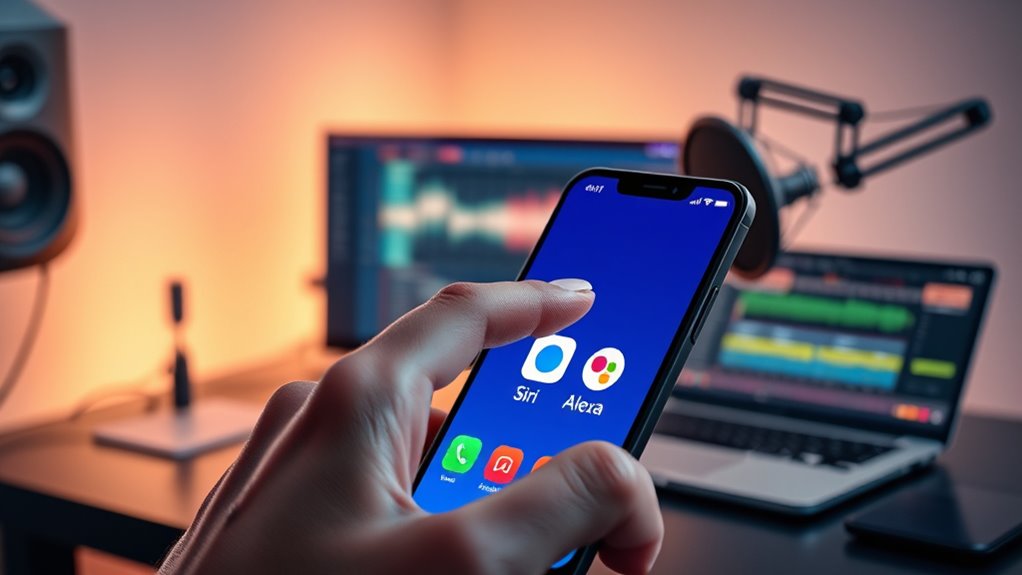

To train Siri, Alexa, and Google for perfect recognition, developers gather vast amounts of voice data from diverse speakers, accents, and environments. They use advanced AI techniques like machine learning and natural language processing to teach these assistants to understand speech patterns, improve accuracy, and handle complex commands. Constant updates and real-world testing refine their abilities further. If you keep exploring, you’ll discover how these methods make voice recognition more natural and reliable.

Get business pricing on tech for your team
- Business-only prices and quantity discounts
- Tax-exempt purchasing
- Multiple users, one account, clear invoices
Key Takeaways
- Collect diverse voice data from various speakers, accents, and environments to improve recognition accuracy.
- Use machine learning algorithms and natural language processing to enhance understanding and response quality.
- Regularly update and retrain voice models with new data to adapt to evolving speech patterns and slang.
- Implement context-aware and personalized training to enable assistants to handle complex and multi-language requests.
- Test in real-world scenarios to identify errors and refine models for seamless, natural interactions.
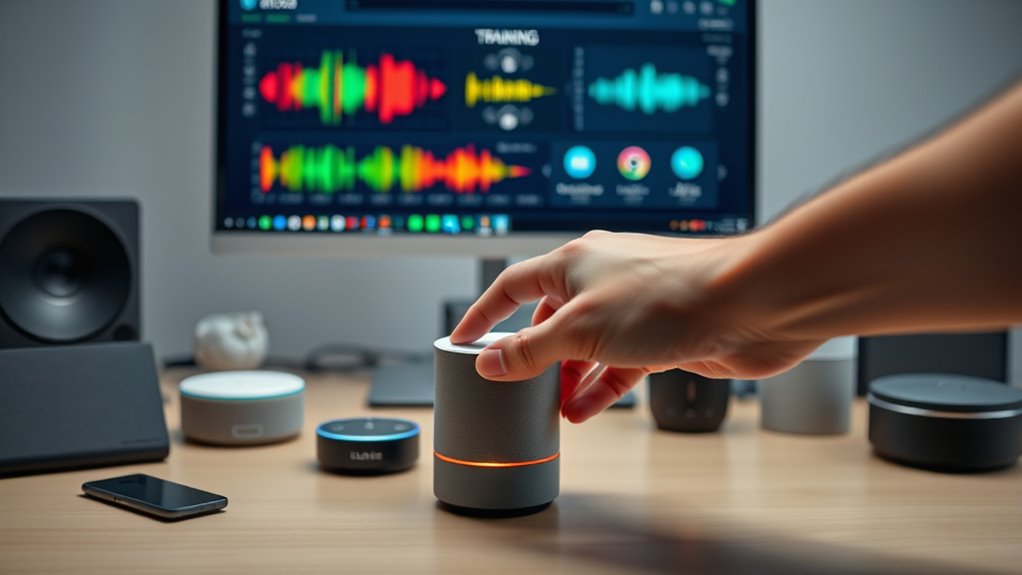
Have you ever wondered how voice assistants have become such a vital part of our daily lives? These AI-powered tools like Siri, Alexa, and Google Assistant now help us manage schedules, control smart home devices, and even answer questions in real-time. Their rapid growth reflects the increasing adoption of smart devices and the expansion of interconnected home systems. In 2024, the global voice assistant market is valued at over USD 7.35 billion and is projected to skyrocket to USD 33.74 billion by 2030, with a compound annual growth rate of 26.5%. This surge is driven by more people integrating voice technology into their routines, especially through smartphones, smart speakers, and wearables. In the US alone, nearly 150 million people use voice assistants as of 2024, and that number continues to grow steadily. Worldwide, voice search adoption is also on the rise, contributing considerably to the overall increase in usage.
Voice assistants are rapidly growing, with a market valued at over USD 7.35 billion in 2024 and expanding across the globe.
To guarantee voice assistants recognize and respond accurately, developers focus heavily on machine learning and natural language processing (NLP). These advanced AI techniques allow assistants to better understand speech patterns, accents, and dialects, making interactions more natural and intuitive. Companies like Google, Apple, and Amazon continuously improve their systems, expanding voice app ecosystems and enhancing device responsiveness. For instance, Google Assistant, holding nearly 46% of the global market share, has seen its app ecosystem grow from just 165 in 2017 to over 1,700 in early 2018, demonstrating rapid expansion. Meanwhile, Apple’s Siri and Amazon Alexa maintain strong user bases, with millions of active users worldwide.
Training these assistants involves feeding them vast amounts of voice data from diverse speakers, languages, and contexts. This extensive dataset helps improve recognition accuracy, especially in noisy environments or with different accents. Continual updates and AI training refine their ability to distinguish between commands and respond promptly. Developers also incorporate context-awareness features, enabling assistants to understand complex requests and provide personalized responses. As the AI behind voice assistants evolves, it becomes better at handling multiple languages and dialects, making these tools more inclusive. Additionally, advances in voice recognition algorithms are crucial for enhancing their ability to accurately interpret diverse speech inputs across various environments.
Despite regulatory and compliance challenges, advancements in AI technology keep pushing voice assistants forward. Their ability to understand nuanced speech, handle multiple languages, and deliver personalized experiences positions them as essential tools across industries, from home automation to customer service. As these systems improve, you’ll notice even more seamless, accurate, and natural interactions, transforming how you connect with technology daily. Voice assistants aren’t just about convenience—they’re becoming smarter, more adaptable, and more integral to your digital life.
Products Worth Considering

Samsung 27-inch Odyssey OLED G6 QD-OLED QHD Gaming Monitor

Samsung 27-Inch Odyssey QD-OLED G8 4K 240Hz Gaming Monitor

Apple iPad Air 11-inch (M2), 512GB, Wi-Fi, Space Gray
As an affiliate, we earn on qualifying purchases.
Frequently Asked Questions
How Do Voice Assistants Handle Multiple Languages Simultaneously?
You might wonder how voice assistants handle multiple languages at once. They recognize bilingual or multilingual speakers and respond seamlessly without manual switching. Advanced platforms detect code-switching—mixing languages in a single utterance—though accuracy varies. Continuous learning helps them adapt to new language patterns, dialects, and accents. While some assistants perform well with common languages, less common pairs can cause latency or recognition issues, but ongoing improvements aim to reduce these challenges.
Can Voice Assistants Recognize Different Voices of the Same Person?
You wonder if voice assistants can recognize different voices of the same person. They use voice recognition models that adapt to your vocal traits, but variations due to illness, emotion, or environment can challenge accuracy. While systems like Google Assistant’s Voice Match aim to differentiate your voice, they might struggle with significant changes. Consistent voice samples improve recognition, but perfect accuracy isn’t guaranteed, especially during vocal changes.
What Privacy Settings Are Available for Voice Assistant Training?
Ever wonder how much control you have over your voice data? You can opt-in or out of human review, delete recordings, and disable sharing with third parties. Apple, Google, and Amazon provide privacy settings to manage this, and you can review or revoke permissions anytime. Isn’t it reassuring to know you’re in charge of your privacy? Regularly update your preferences to stay protected and ensure your voice assistant respects your choices.
How Do Voice Assistants Improve Understanding Over Time?
You might wonder how voice assistants get better at understanding you. They improve over time by constantly collecting your interaction data and analyzing patterns. Your corrections help retrain their models, making recognition more accurate. They adapt to your speech, slang, and preferences through ongoing use. Plus, they leverage contextual clues from conversations and external data, refining their responses and becoming more personalized and reliable with each interaction.
Are There Differences in Training Methods Among Siri, Alexa, and Google?
Think of training voice assistants like tuning musical instruments; each has a different method. You’ll find Siri responds broadly without personalization, like a well-tuned piano ready to play any note. Alexa and Google, however, undergo voice training, like fine-tuning strings for accuracy. Google focuses on understanding conversations deeply, while Alexa emphasizes expanding skills. These varied approaches shape how each assistant learns and improves, tailoring their performance to different user needs.
Conclusion
Now that you understand how to train Siri, Alexa, and Google, you’re like a conductor guiding a symphony, ensuring each note hits perfectly. With patience and consistent practice, your voice assistants will recognize you effortlessly, making your daily routines smoother. Think of this process as nurturing a friendship—building trust and understanding over time. Soon, your voice assistants will respond with the precision of a well-trained orchestra, transforming your tech experience into pure harmony.