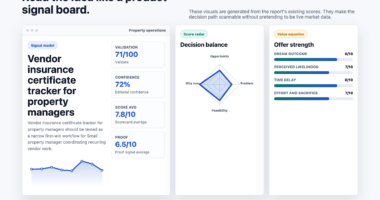
📊 Full opportunity report: Automate The Handoff From Real Estate Deal To Checklist on IdeaNavigator AI — validation score, market gap, and execution plan.

Get business pricing on tech for your team
- Business-only prices and quantity discounts
- Tax-exempt purchasing
- Multiple users, one account, clear invoices
TL;DR

IdeaNavigator AI’s proposal describes an automation for residential brokerages: when a CRM records a new deal, a hosted workflow would create a transaction-management checklist and prefill an e-signature packet. The concept remains an MVP proposal, not a reported launch; IdeaNavigator AI recommends testing the workflow with one brokerage across 30 deals and measuring staff time and data-entry errors.
IdeaNavigator AI has outlined a proposed deal-to-checklist automation for residential real estate brokerages, designed to turn a new deal entered in a customer relationship management system into a transaction checklist and a prefilled e-signature packet. In the proposal, an employee must approve the packet before it is sent. IdeaNavigator AI has not identified the concept as a launched product or a completed pilot.
In its proposal, IdeaNavigator AI suggests a first version that would monitor one brokerage’s CRM for a new deal. The proposed workflow would then create a corresponding record or checklist in the brokerage’s transaction-management system and use listing fields to prefill an e-signature packet. IdeaNavigator AI describes this as a hosted automation service, rather than a new CRM or a replacement for the brokerage’s existing software.
IdeaNavigator AI identifies operations managers at residential brokerages or teams as the intended users. The proposal says coordinators may move deal and listing information among a CRM, MLS feed, e-signature service, transaction-management platform and email, and characterizes manual transfer as a source of repeated data entry and updates that can fall out of sync. IdeaNavigator AI provides no measured error rates or time savings and does not identify a brokerage that has adopted the workflow.
For an initial test, IdeaNavigator AI recommends selecting one brokerage and running the automation across 30 deals. Its proposed measures are coordinator hours saved and data-entry errors compared with the brokerage’s current manual process. The proposal also suggests a possible monthly subscription priced by the number of active transactions automated; it specifies no prices or commercial terms.
Reducing Repeated Deal Data Entry
If the workflow works as intended, it could reduce the time coordinators spend copying deal details between separate systems and help make the checklist and signing packet more consistent with the listing record. IdeaNavigator AI’s proposal frames the practical test as whether the workflow saves staff time without introducing new mistakes or slowing transactions.
The proposal’s human approval step is relevant because automated records and documents can carry incorrect or incomplete information forward. Requiring review before a packet is sent leaves a person responsible for checking it, while allowing the software to prepare routine fields. IdeaNavigator AI does not specify what data would be checked or how exceptions would be handled.
IdeaNavigator AI recommends a 30-deal trial to compare the workflow with the existing process. That test would not by itself establish performance across different brokerages, software configurations or transaction types. For operations teams, a useful result would need to include both time saved and error counts, rather than relying on automation volume alone.
Products Worth Considering

Amazon Kindle Paperwhite Signature Edition (12th Generation, 2024), 32 GB, Metallic Black

Bose QuietComfort Wireless Noise-Cancelling Over-Ear Headphones, Black

Sonos Era 100 SL Compact Microphone-Free Speaker, Black
As an affiliate, we earn on qualifying purchases.
Disconnected Brokerage Software Workflows
IdeaNavigator AI’s proposal describes brokerages as relying on several separate tools: CRM platforms, MLS feeds, e-signature services, transaction-management systems and email. It says that when those tools do not share data cleanly, coordinators may have to re-enter listing and deal information, and changes made in one place may not be reflected elsewhere.
IdeaNavigator AI says real estate CRMs increasingly expose APIs and webhooks, while general-purpose automation tools may lack real-estate-specific connectors and MLS field mappings. The proposal presents that mismatch as an opportunity for a specialized layer that understands listings and transactions. It does not name particular software vendors or provide independent market data to quantify the gap.
IdeaNavigator AI recommends a deliberately narrow scope: begin with one new-deal trigger and one checklist-and-packet workflow, rather than attempting to connect every brokerage system at once. The source describes a product concept and validation plan, not a dated product announcement or a report of completed testing.
Pilot Results and Product Status
IdeaNavigator AI reports no completed pilot results in its proposal. The material does not say whether a brokerage has agreed to test the workflow, which CRM or transaction-management platforms would be connected, or whether the proposed service is being built. It gives no figures for implementation costs, coordinator hours saved, data-entry errors, reliability or subscription pricing.
The proposal also does not explain how the system would handle missing or conflicting listing fields, changes after a checklist is created, failed integrations, access controls or records that need manual exceptions. Those details would affect whether the automation can be used reliably in day-to-day brokerage operations. Until a trial is reported, the expected benefits remain hypotheses to be measured, not demonstrated outcomes.
Measure the 30-Deal Trial
IdeaNavigator AI’s proposed validation plan is to choose one residential brokerage, connect its CRM to the relevant transaction-management and e-signature tools, and run the new-deal workflow for 30 transactions. The plan calls for comparing coordinator time and data-entry errors with the brokerage’s existing manual process, while retaining human review before any packet is sent.
IdeaNavigator AI does not announce a trial start date, participating brokerage or follow-up report. If testing proceeds, results on time saved, error rates and exceptions could help determine whether the automation is useful enough to expand or support a subscription service. Until those results are available, the concept’s operating and commercial viability remains unverified.
Source: IdeaNavigator AI proposal
Key Questions
What would the proposed automation do?
According to IdeaNavigator AI’s proposal, it would detect a new deal in a brokerage CRM, create a matching transaction-management checklist and prefill an e-signature packet using listing fields. A person would approve the packet before it is sent.
Is the workflow already available?
IdeaNavigator AI describes a product proposal and validation plan. The information does not confirm a launch, a working product or a completed brokerage pilot.
How is the proposal meant to be tested?
IdeaNavigator AI recommends testing the workflow at one brokerage across 30 deals, measuring coordinator hours saved and data-entry errors against the current manual process.
How might the service make money?
IdeaNavigator AI suggests a monthly subscription with pricing tiers based on the number of active transactions automated. The proposal gives no subscription prices.
What has not been established yet?
IdeaNavigator AI’s proposal reports no pilot results, confirmed customers, named software integrations, pricing details or measured savings. How the workflow would handle conflicting data and exceptions is also unspecified.
Source: IdeaNavigator AI