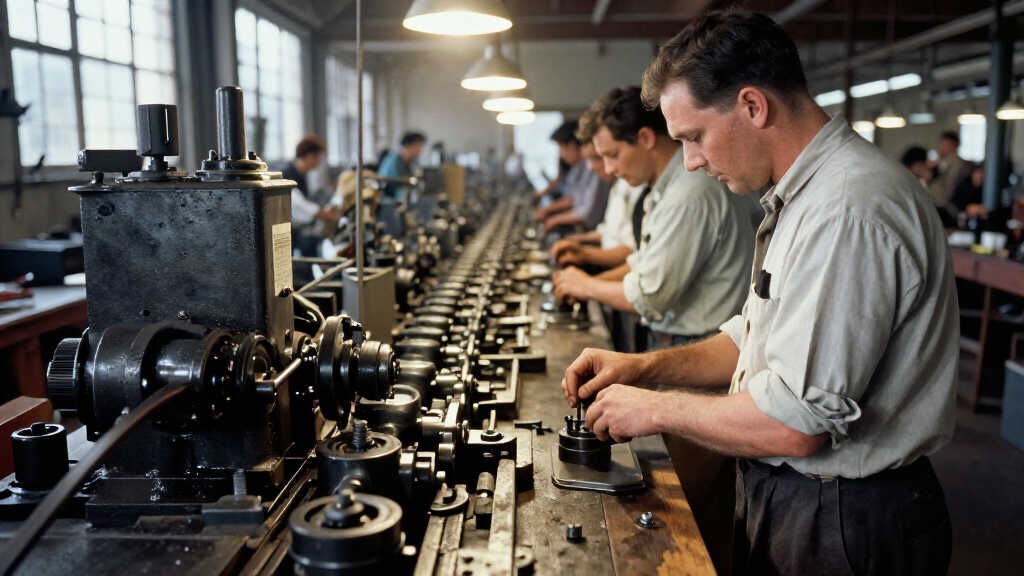
🔍 Read the full analysis: The Assembly Line And The Push For Better Worker Pay on ThorstenMeyerAI.com

Get business pricing on tech for your team
- Business-only prices and quantity discounts
- Tax-exempt purchasing
- Multiple users, one account, clear invoices
TL;DR
Ford raised minimum daily pay to $5 and shortened the workday in January 1914, after turnover at its Detroit plant reached 370% the previous year. The account links the change to the challenge of keeping workers on a faster assembly line; the figures rely partly on Ford’s own 1922 memoir and later historical research.
A November 6, 2026, account of Ford Motor Co.’s early assembly line says the company’s 1914 decision to raise minimum daily pay to $5 and cut the workday to eight hours was a response to extreme worker turnover, rather than a plan to make workers able to buy Ford cars. The development matters as a case study in how industrial efficiency gains collided with the challenge of retaining workers.
The account, published by ThorstenMeyerAI.com as the fifth episode of its “Work After Work” series, reports that Ford’s annual labor turnover reached 370% in 1913. The company hired 50,448 people to maintain an average workforce of 13,623, according to figures cited from economists Daniel Raff and Lawrence Summers’ 1987 study. The Henry Ford museum gives a slightly higher estimate of about 380%, the account says.
Ford announced the new pay arrangement on January 5, 1914. It set minimum daily pay at $5, paid under a conditional “profit sharing” plan, and reduced the workday from nine hours to eight. The account says turnover fell to 54% in 1914. The available material does not spell out all eligibility conditions for the payments, so the $5 figure should not be read as an unconditional wage available to every worker.
The production figures show the scale of the change. Ford’s own account put labor time for assembling a Model T chassis at 12 hours and 28 minutes before the moving line, compared with one hour and 33 minutes by early 1914 — a reduction of about 88%. The source attributes those figures to Henry Ford’s 1922 book, written with journalist Samuel Crowther, and presents them as the company’s account rather than independent measurements.
Pay and the Cost of Turnover
The episode challenges a familiar explanation for Ford’s wage policy: that he raised pay mainly so workers could afford the cars they built. The account says Ford had about 14,000 workers and produced roughly 250,000 cars a year around 1914; it identifies worker retention, not a shortage of customers, as the company’s immediate problem. That interpretation is supported by the turnover figures, though the source does not establish that retention was the only motive behind the policy.
The case also shows why productivity alone does not explain how industrial change affected workers. Assembly-line methods sharply reduced the time needed for some tasks, while breaking work into smaller, repeated movements. Ford described the goal as reducing workers’ thought and movements to a minimum. For the company, the faster system made staffing a central operating issue; for workers, the account describes an environment in which many left or stopped attending.
For readers considering modern factory work, the history offers a grounded example of a continuing tension: employers may adopt technology to raise output, but keeping workers can carry its own costs. The source says factory employment in the United States rose by about a third between 1910 and 1920, and that robots now perform more tasks on assembly lines. Those broad points do not establish a direct comparison between Ford’s era and present-day workplaces.
Products Worth Considering

Kindle Paperwhite Signature Edition 32GB (2024) – Auto-adjusting front light, wireless charging, weeks of battery life – Metallic Black

Kindle Paperwhite 16GB (2024) – 7 Glare-Free Display, Weeks Battery Life – Black

DJI Mic 3 Wireless Microphone Kit (2 Transmitters, 1 Receiver, Charging Case)
As an affiliate, we earn on qualifying purchases.
From Stationary Chassis to Moving Line
Before Ford’s experiments, workers assembled a car around a chassis that stayed in one place, bringing parts to it. Ford’s account says the company began testing a moving line in about April 1913, first on the flywheel magneto, a small generator used in the ignition system. The task was split into 29 operations, and the part moved between workers. Ford reported that assembly time fell from about 20 minutes to 13 minutes and 10 seconds, then to seven minutes and eventually five as the line was adjusted.
The method was then applied to the chassis. An early setup pulled it along a 250-foot line with a rope and windlass; later, the line was raised and the work divided further. Ford reported that chassis assembly time fell first to five hours and 50 minutes, then to one hour and 33 minutes in early 1914. The account also cites a decline in labor time for assembling an engine, from nine hours and 54 minutes in October 1913 to five hours and 56 minutes six months later.
The production history comes chiefly from My Life and Work, Ford’s 1922 memoir with Crowther. The turnover figures draw on Raff and Summers’ 1987 study, which in turn used earlier work by labor economist Sumner Slichter and company surveys. Those sources are not identical in their estimates, and the memoir reflects Ford’s own perspective.
““The reduction of the necessity for thought on the part of the worker and the reduction of his movements to a minimum.””
— Henry Ford, as quoted in My Life and Work
Limits of the Historical Record
The figures are historical estimates assembled from sources with different methods. The account identifies 370% turnover from Raff and Summers’ study, while the Henry Ford museum’s figure is about 380%; Ford’s own later recollection described hiring about 53,000 people annually to maintain a workforce of 14,000. These differences are reported rather than reconciled in the material provided.
The exact terms of the conditional profit-sharing plan are not detailed here, nor does the account establish how many workers qualified for the full $5 daily amount. It also presents turnover and retention as the central explanation for the change, but does not rule out other business or policy considerations. Ford’s production-time numbers come from the company owner’s memoir, not a separate independent audit.
The Series’ Next Historical Question
The source is an episode in an ongoing series, not a report of a new company policy or a current labor dispute. It does not announce a publication date for the next episode or identify a new historical finding. Readers can expect the series to continue examining how production systems shape work, but the material provided does not specify its next subject.
For this episode, the central next step for readers is to compare the account’s claims with the cited historical record: Ford’s memoir for production details, and Raff and Summers’ study and the underlying labor surveys for turnover and pay. No further evidence or response from Ford Motor Co. is included in the source material.
Key Questions
Why did Ford raise minimum daily pay to $5 in 1914?
The account says the pay increase and shorter workday were a response to severe worker turnover. It reports 370% turnover in 1913 and says turnover fell to 54% in 1914. It does not establish that retention was the policy’s only motive.
What changed in the 1914 policy?
On January 5, Ford raised minimum daily pay to $5 under a conditional profit-sharing plan and shortened the workday from nine hours to eight. The source does not provide the full eligibility rules.
How much faster did the assembly line make chassis assembly?
Ford’s 1922 account put labor time at 12 hours and 28 minutes per chassis before the moving line and one hour and 33 minutes by early 1914, a reported reduction of about 88%. Those are company-reported figures.
Are the turnover numbers consistent across sources?
No. The episode cites 370% for 1913 from a study by Daniel Raff and Lawrence Summers, while the Henry Ford museum gives an estimate of about 380%. The material does not explain the difference.
Source: ThorstenMeyerAI.com