
TL;DR

Get business pricing on tech for your team
- Business-only prices and quantity discounts
- Tax-exempt purchasing
- Multiple users, one account, clear invoices
Siemens announced a strategic partnership with NVIDIA to build an Industrial AI Operating System aimed at integrating AI across manufacturing processes. The focus is on physical AI models trained on proprietary industrial data, with initial implementations planned for 2026. This signals a shift toward AI solutions tailored for factory environments, emphasizing domain expertise and physical data.
Siemens has announced a major strategic initiative to develop an Industrial AI Operating System in partnership with NVIDIA, aiming to embed AI across the entire manufacturing lifecycle. This move emphasizes physical AI models trained on proprietary industrial data, marking a significant shift from conventional chat-based AI applications and highlighting Siemens’ focus on factory productivity and automation.
The core of Siemens’ approach is the Industrial Foundation Model (IFM), designed to process and contextualize data from 3D models, 2D drawings, sensor telemetry, and automation logic. Siemens first announced the IFM at Hannover Messe 2025, positioning it as a domain-specific alternative to general-purpose language models.
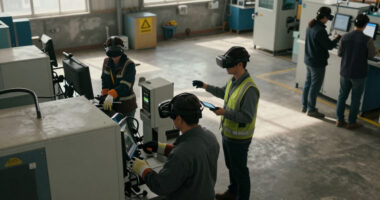
The partnership with NVIDIA aims to create a comprehensive platform that integrates GPU-accelerated simulation, generative digital twins, and real-time optimization tools. Siemens plans to launch its first fully AI-driven, adaptive manufacturing site at its Erlangen factory in Germany in 2026, with subsequent tools like Digital Twin Composer and industrial copilots to follow.
Implications of Siemens’ Physical AI Focus for Manufacturing
This initiative signals a shift toward AI solutions that leverage proprietary, physical-world data and domain expertise, potentially transforming factory automation and digital twin applications. It underscores Siemens’ strategy to leverage its industrial data advantage, which could redefine productivity standards in manufacturing. However, reliance on NVIDIA infrastructure raises questions about technological sovereignty and the pace of adoption in conservative industrial markets.As an affiliate, we earn on qualifying purchases.
Background on Siemens’ Industrial AI Investments
Siemens has long been a leader in industrial automation, with a century of experience in factory systems and digitalization. Its recent investments focus on integrating AI into these legacy systems, moving beyond traditional automation toward intelligent, adaptive manufacturing processes. The announcement at Hannover Messe 2025 about the Industrial Foundation Model marked a significant step in this direction, emphasizing physical AI tailored for industrial data.
The collaboration with NVIDIA, announced at CES 2026, builds on this foundation, aiming to accelerate simulation, digital twins, and autonomous operations. Prior to this, Siemens had already established relationships with key industry players, positioning itself as a domain expert capable of deploying AI solutions at scale.
“Industrial AI is no longer a feature; it’s a force that will reshape the next century.”
— Roland Busch, Siemens CEO
digital twin software for manufacturing
As an affiliate, we earn on qualifying purchases.
As an affiliate, we earn on qualifying purchases.
Unresolved Questions About Deployment and Performance
While Siemens has outlined its strategic vision, specific performance metrics, hardware configurations, and deployment timelines remain undisclosed. The Erlangen factory is targeted for 2026, but detailed validation of the platform’s effectiveness and scalability are still pending. Additionally, the dependence on NVIDIA’s infrastructure raises concerns about technological sovereignty and potential vendor lock-in.
As an affiliate, we earn on qualifying purchases.
Next Steps for Siemens’ Industrial AI Rollout
Siemens is expected to begin pilot projects at its Erlangen factory in 2026, with broader deployment of AI tools like Digital Twin Composer and industrial copilots planned subsequently. Industry observers will monitor performance results and integration challenges, while competitors may accelerate their own physical AI initiatives. Siemens’ ongoing collaboration with NVIDIA will also evolve, potentially influencing hardware and software standards in industrial AI.
As an affiliate, we earn on qualifying purchases.
Key Questions
What is the Industrial Foundation Model?
The Industrial Foundation Model (IFM) is Siemens’ domain-specific AI designed to process industrial data such as 3D models, drawings, and sensor telemetry to optimize manufacturing and automation processes.
How does Siemens’ approach differ from general-purpose AI?
Siemens emphasizes physical, domain-specific AI trained on proprietary industrial data, unlike general-purpose models focused on language or broad internet data. This enables more accurate, relevant automation and simulation in manufacturing settings.
What are the main benefits of Siemens’ industrial AI platform?
The platform aims to improve factory efficiency through real-time digital twins, generative simulation, and autonomous operations, potentially reducing downtime and increasing productivity.
Are there risks associated with Siemens’ reliance on NVIDIA technology?
Yes, dependence on NVIDIA’s infrastructure and libraries could raise concerns about vendor lock-in and technological sovereignty, especially for European customers seeking more control over their AI solutions.
When will the first AI-driven factory be operational?
Siemens plans to launch its fully AI-driven manufacturing site at the Erlangen factory in 2026, with subsequent tools and pilots expected to follow shortly thereafter.
Source: ThorstenMeyerAI.com
Fall Picks
fall essentials
As an affiliate, we earn on qualifying purchases.