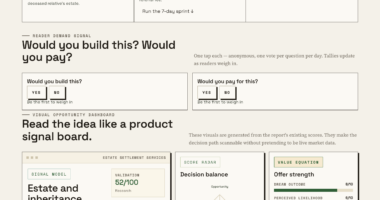
📊 Full opportunity report: Build A Repeatable Process For Made-in-USA Claim Compliance on IdeaNavigator AI — validation score, market gap, and execution plan.

Get business pricing on tech for your team
- Business-only prices and quantity discounts
- Tax-exempt purchasing
- Multiple users, one account, clear invoices
TL;DR

IdeaNavigator AI has proposed a compliance workflow that links each product SKU making a Made-in-USA claim to its materials, supplier records and assembly location. The proposal is an unvalidated product concept; the supplied information does not establish that a tool has launched or that the FTC opened an enforcement sweep in April 2026.
IdeaNavigator AI has outlined a proposed Made-in-USA claim compliance workflow that would connect product records to supplier and assembly information, then alert a brand when a supplier change could affect an origin claim. The concept targets compliance and operations teams at consumer brands, but the supplied information describes an idea to validate—not a launched product or confirmed regulatory development.
The proposed system would maintain a record for each SKU, linking its bill of materials, supplier affidavits and assembly location. A red-yellow-green status would show the current state of substantiation by product line, while supplier-change notifications would flag affected claims before revised packaging or marketing materials are released. The proposal does not specify how records would be verified or how the status colors would be assigned.
IdeaNavigator AI frames the problem as fragmented documentation: a brand may continue printing an origin claim after a supplier changes, while supporting documents remain dispersed across email and receipts. The product is intended to bring those records together so staff can retrieve them if the claim is questioned. That description identifies a potential operational risk; it does not establish how often such failures occur or that any particular brand has experienced one.
The suggested commercial model is an annual subscription priced by brand or SKU count, with a separately priced audit-response module. For initial validation, the proposal recommends offering a fixed-fee substantiation audit to 15 brands that currently make origin claims, then measuring how many convert to ongoing monitoring. No customer commitments, conversion results, pricing figures or operating software are reported.
Build a repeatable process for Made-in-USA claim compliance
IdeaNavigator AI proposes linking each product’s origin claim to its materials, suppliers and assembly location. It remains an unvalidated concept, not a launched product or confirmed regulatory development.
What the workflow would track
A product-level record could help teams find evidence and spot changes that may require claim review.
Evidence by SKU
Link each product to its bill of materials, supplier affidavits and assembly location.
Color-coded view
Show substantiation status by product line. The proposal does not explain how colors would be assigned.
Review before reuse
Alert teams when supplier changes could affect claims before packaging or marketing is released.
From records to review
The proposed process connects operational changes with compliance checks.
Gather product, materials, supplier and assembly records for each SKU.
Notify staff when supplier information may affect an origin claim.
Have the brand assess whether its evidence still supports the claim.
What is known—and unverified
| Question | What the material says |
|---|---|
| Product launch | Proposed workflow; no launch reported |
| FTC sweep in April 2026 | Asserted in the proposal; no agency citation supplied |
| Brand validation | 15-brand audit test proposed; no results reported |
How the idea would be tested
The proposal suggests checking whether brands pay for substantiation support and ongoing monitoring.
Keeping Product Claims Tied to Records
For a consumer brand, an origin statement on packaging is tied to facts about how a product is made and where its components come from. If supplier or production details change, existing documentation may no longer support the claim as presented. A maintained, product-level record could help compliance staff identify which claims need review before packaging is printed or marketing is distributed.
The proposal also speaks to the cost of answering a regulator or other reviewer: teams may need to find and organize records across suppliers, products and time periods. A centralized file could make that work more manageable, although the concept alone does not show that it would prevent violations, satisfy legal requirements or reduce penalties. Brands would still need to assess whether the evidence supports each claim.
Products Worth Considering

Apple AirPods Pro (2nd Generation) Wireless Earbuds with USB-C MagSafe Charging Case

Bose Lifestyle Ultra Wireless Home Speaker, White Smoke

Samsung 27-Inch Odyssey G5 QHD Gaming Monitor (G51F)
As an affiliate, we earn on qualifying purchases.
The Proposed Product and Its Test
The concept is aimed specifically at consumer brands that print U.S.-origin claims on packaging, rather than compliance software across all industries. Its central workflow is to associate evidence with individual products and monitor changes that might make the evidence stale. Supplier-change alerts are intended to connect procurement activity with compliance review before a claim is reused.
IdeaNavigator AI says the opportunity has become more urgent because it describes an FTC enforcement sweep on origin claims in April 2026, with named penalties. However, the supplied material does not cite an FTC announcement, identify the penalties, or provide documentation for that characterization. The enforcement-sweep statement should therefore be treated as an attributed assertion in the proposal, not as an independently established event here. The suggested audit offer to 15 brands is a validation plan, not evidence that the test has taken place.
Product Status and FTC Details
The supplied information does not say whether a software product is being built, who would operate it, when it might be available, or whether any brands have agreed to test it. It also gives no technical details about integrations, access controls, evidence retention, or how supplier notifications would be triggered and checked.
The claimed April 2026 FTC sweep is not supported here with a link to an agency release, case list or penalty details. The material also does not describe the legal standard for a Made-in-USA claim or explain how the proposed color-coded status would account for differences among products and their evidence. Those points would need verification before readers could treat the enforcement claim or the proposed workflow as authoritative guidance.
Evidence Needed to Validate the Idea
The next step described is to conduct fixed-fee substantiation audits with 15 consumer brands that currently make origin claims and track whether they subscribe to ongoing monitoring. Results would help test whether brands will pay for record organization and supplier-change alerts, but no timetable or outcome is stated.
Before the enforcement rationale can be relied on, the April 2026 FTC assertion needs confirmation against agency records. Any eventual product would also need to show how it handles changing supplier data, preserves supporting documents and distinguishes an administrative warning from a legal assessment. Until those details and validation results are available, the proposal remains a business concept rather than evidence of a new compliance requirement or established solution.
Source: IdeaNavigator AI
Key Questions
Has a Made-in-USA compliance product launched?
The material describes a proposed workflow. It does not report a launch, availability date or operating company.
What would the proposed system track?
It would link each SKU to its bill of materials, supplier affidavits and assembly location, with a status for the associated claim and alerts for supplier changes.
Did the FTC open an enforcement sweep in April 2026?
IdeaNavigator AI’s proposal says it did, but the supplied information includes no agency citation or details to verify that assertion.
How would the idea be tested?
The proposal recommends offering fixed-fee substantiation audits to 15 brands and measuring conversion to a recurring monitoring subscription. No results are reported.
Source: IdeaNavigator AI