
🔍 Read the full analysis: Which Mesh Wi-Fi System Should You Pick For Whole-Home Coverage In 2027? on ThorstenMeyerAI.com

Get business pricing on tech for your team
- Business-only prices and quantity discounts
- Tax-exempt purchasing
- Multiple users, one account, clear invoices
TL;DR
A buyer guide from ThorstenMeyerAI.com compares 10 mesh Wi-Fi systems for different home layouts, budgets and device needs. It ranks the TP-Link Deco X55 as its balanced starting point, while describing the Deco XE75 and Netgear Orbi 770 as options for buyers seeking tri-band capacity or Wi-Fi 7. These are editorial assessments, not independent test results, and coverage depends on placement, walls and backhaul.
ThorstenMeyerAI.com has published a comparison of 10 mesh Wi-Fi systems for households seeking coverage across multiple rooms, recommending the TP-Link Deco X55 as its balanced starting point. The guide also points to tri-band and Wi-Fi 7 models for homes that may benefit from more wireless capacity, while cautioning that a newer standard alone cannot overcome poor node placement or a slow broadband plan.
The comparison weighs Wi-Fi generation, band configuration, kit size, setup and management rather than ranking systems by the newest standard alone. Its top choice, the Deco X55, is a Wi-Fi 6 three-node kit. The guide favors it as a practical middle ground over older Wi-Fi 5 equipment without assuming every household needs Wi-Fi 7.
For buyers considering other tiers, the guide describes the Deco XE75 as a tri-band option with a 6 GHz band and the Netgear Orbi 770 as a more capable Wi-Fi 7 choice. It also names the Deco 7 Pro and Deco 7 BE5000 among Wi-Fi 7 alternatives, and the Eero 6+ as an option for buyers who value guided setup. These are the source’s product assessments, not reported results from a standardized performance test.
The guide includes simpler or older systems too: its Deco S4 two-pack may suit a smaller home with modest needs. Its central recommendation is to match the kit to the home’s layout, devices, broadband connection and backhaul options. A three-pack is not automatically better for every house, and advertised coverage should be treated as an estimate.
The 10 picks
- 1
 NETGEAR Orbi 770 Series WiFi 7 Mesh System, 3-PackView on Amazon →
 - 2
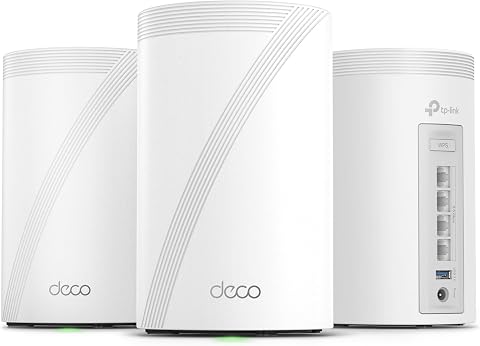 TP-Link Deco 7 Pro BE10000 Tri-Band Wi-Fi 7 Whole-Home Mesh System, 3-PackView on Amazon →
 - 3
 Amazon eero 6+ Wi-Fi 6 Mesh System, 3-PackView on Amazon →
 - 4
 NETGEAR Orbi 370 Series WiFi 7 Mesh System for Home (RBE373) – Wireless Route…View on Amazon →
 - 5
 TP-Link Deco 7 BE5000 Dual-Band Wi-Fi 7 Mesh SystemView on Amazon →
 - 6
 TP-Link Deco XE75 AXE5400 Tri-Band Wi-Fi 6E Mesh System, 3-PackView on Amazon →
 - 7
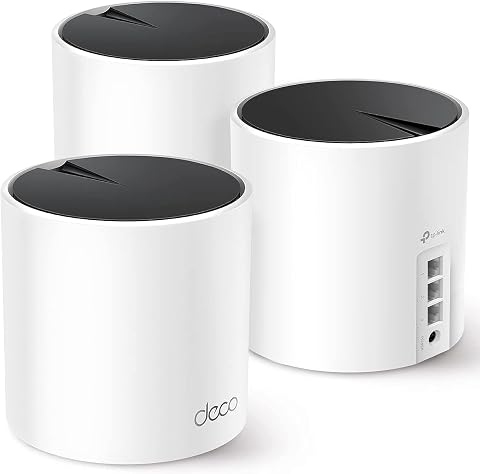 TP-Link Deco X55 AX3000 Wi-Fi 6 Mesh System, 3-PackView on Amazon →
 - 8
 TP-Link Deco S4 AC1900 Mesh Wi-Fi System, 3-PackView on Amazon →
 - 9
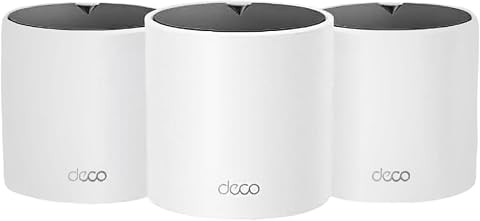 TP-Link Deco X15 AX1500 Dual-Band Wi-Fi 6 Mesh System, 3-PackView on Amazon →
 - 10
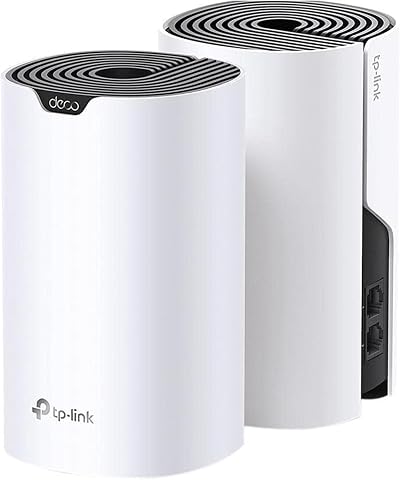 TP-Link Deco S4 Whole Home Mesh WiFi System (2-Pack)View on Amazon →
Choosing Capacity for Your Home
The choice affects more than peak wireless speed: a mesh system’s node placement and connection between nodes can determine whether distant rooms get a stable signal. A household with older devices and ordinary broadband may not gain much from paying for Wi-Fi 7, while a busy network with compatible devices and fast service could make better use of newer capacity.
Understanding backhaul can also prevent a costly mismatch. Wireless satellites relay traffic to the main unit, and that link may limit performance. Tri-band systems can provide additional radio capacity, but they do not guarantee stronger coverage in a difficult layout. Where Ethernet can be run between nodes, wired backhaul may address the bottleneck more directly.
The practical takeaway is to identify where the signal is weak and which devices need connectivity before choosing a kit. More nodes, extra bands and newer Wi-Fi labels each solve different problems; none automatically fixes every dead zone.
How the Guide Ranks Its Picks
The source says it gives greater weight to balanced capability than to the newest Wi-Fi generation. Its criteria include the number of nodes, potential wireless backhaul capacity, setup and management, and whether a household can use the system’s features. That approach explains why a Wi-Fi 6 kit can rank ahead of more expensive Wi-Fi 7 models in a general-purpose comparison.
The guide also distinguishes homes by layout and equipment. Walls, floors and long distances can weaken links between nodes, while older phones and laptops cannot make use of features they do not support. Coverage figures are planning guides, not guarantees, and placement in open areas may matter more than adding a node or upgrading a standard.
The material supplied for this comparison names several options but does not provide individual prices, controlled test measurements or a complete product-by-product results table. Its rankings should be read as editorial guidance based on stated selection criteria, rather than a verified finding that one system will outperform another in every home.
“The Deco X55 is the most balanced starting point.”
— ThorstenMeyerAI.com buying guide
What the Comparison Cannot Establish
The supplied source material does not include independent benchmark data, measured coverage results or current prices for the 10 systems. It is therefore not possible to verify from this material how the models perform against one another under the same conditions, or which represents the best value at a given retailer.
Actual results also depend on a home’s construction, interference, node locations, connected devices and broadband speed. The guide does not establish that any one kit will eliminate dead zones in every layout. Availability and product pricing can change, and the source provides no retailer-specific or date-stamped price information.
Checks Before You Buy
Readers should check the current price and availability of the models they are considering, then compare those costs with their household’s devices and internet plan. A practical next step is to map the rooms needing coverage, identify likely node locations and check for Ethernet options. That can clarify whether a two-pack is adequate, a third node is useful, or wired backhaul is the better investment.
Buyers should also confirm the system’s ports and management features against their needs, including whether they want to connect a television, desktop or other equipment by cable. As product details and prices change, any purchase decision should be based on current specifications and the home’s actual constraints, not this ranking alone.
Key Questions
Which mesh system does the guide recommend as its general-purpose pick?
The guide ranks the TP-Link Deco X55 first, describing its Wi-Fi 6 platform and three-node kit as a balanced choice. That is the guide’s editorial assessment, not a guarantee of the best performance in every home.
When might a tri-band mesh system be useful?
A tri-band system such as the Deco XE75 or Deco 7 Pro may help when wireless nodes need additional capacity for traffic between them. The benefit depends on placement, local conditions and the system’s design; Ethernet backhaul may be a better option where wiring is available.
Do most households need Wi-Fi 7?
Not necessarily. The guide presents Wi-Fi 7 as an option for households with compatible devices, higher capacity needs or plans to keep the system for several years. Older devices cannot use features they do not support, so a Wi-Fi 6 system may better fit some budgets and needs.
Is a three-pack always better than a two-pack?
No. The guide says a two-pack may suit a compact home, while larger or divided layouts may benefit from additional placement options. Walls, floors and node locations affect coverage, so the right number depends on the home rather than the pack size alone.
Are the guide’s rankings based on independent testing?
The supplied source material does not give controlled benchmark results or measured head-to-head coverage tests. Its rankings are presented as editorial recommendations based on stated selection factors, so readers should check current specifications and independent testing before buying.
Source: ThorstenMeyerAI.com
Halloween Picks
halloween
As an affiliate, we earn on qualifying purchases.