
📊 Full opportunity report: Quiet GPUs for Local AI: Acoustic and Thermal Roundup on ThorstenMeyerAI.com — validation score, market gap, and execution plan.
Listen free for 30 days with Audible
Thousands of audiobooks and originals — cancel anytime.
Start your free trialAs an affiliate, we earn on qualifying purchases.
TL;DR
This article reviews the quietest GPUs for local AI in 2026, emphasizing thermal and acoustic performance. Power-capping and cooler design are key to quiet operation. The RTX 5090 leads for high VRAM needs, with other options for budget and efficiency.
In 2026, the most effective GPUs for local AI are those that combine high VRAM with low noise and heat output, achieved through power-capping and superior cooling solutions, not just raw performance.
This roundup evaluates GPUs based on their thermal and acoustic characteristics, emphasizing that cooler, quieter operation depends heavily on cooler design and power management, rather than chip architecture alone.
The RTX 5090 (32GB) is identified as the top choice for high-end local AI rigs, offering the best performance-to-noise ratio when properly cooled and power-capped, despite its high TDP of 575W. For budget-conscious users, the RTX 4090 (24GB) and used RTX 3090 are highlighted as reliable, cost-effective options that can be optimized for quieter operation. The RTX 5080 and RTX 4060 Ti (16GB) are recommended for efficiency-focused setups handling smaller models, thanks to their lower power draw and heat output. For professional, dense model workloads, the RTX PRO 6000 Blackwell with 96GB VRAM is suitable, though details on its acoustic profile are still emerging.
Quiet GPUs
for local AI.
The GPU makes ~70% of your heat and most of your noise. But here’s the secret: the chip doesn’t decide how loud your card is — the cooler design and your power settings do. Match your VRAM tier in Part 2, then make it quiet.
Capping to 70–80% sheds a huge amount of heat for almost no inference loss — because inference is memory-bound. A capped 5090 is dramatically cooler & quieter than stock. Do this first.
Within one GPU model, partner cards differ enormously. For a single card, a large triple-fan open-air with zero-RPM idle runs slow & quiet. For multi-GPU, the calculus flips →
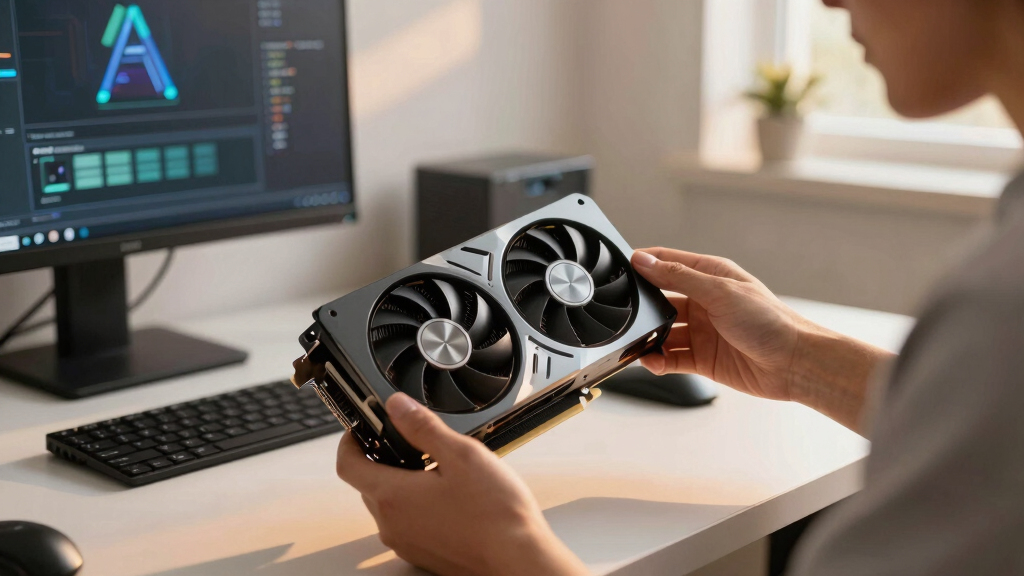
With room to breathe, a large triple-fan open-air cooler spreads heat across a big fin stack and runs its fans slowly. The quietest choice — what most people should buy.
Impact of Cooler Design and Power Management on GPU Quietness
The choice of GPU in local AI setups is heavily influenced by thermal and acoustic performance, which directly affects user comfort and system reliability. Power-capping and high-quality cooling can transform high-performance cards into near-silent operation, making advanced AI hardware more accessible for everyday use.
As an affiliate, we earn on qualifying purchases.
2026 GPU Landscape for Local AI Workstations
As of 2026, the GPU market for local AI has shifted focus from pure speed benchmarks to thermal and acoustic efficiency. The emphasis on VRAM tiers remains critical, with 16GB to 96GB options catering to different model sizes and workloads. Proper cooling solutions are essential for maintaining performance and quiet operation. Previous years saw a trend toward high-performance cards like the RTX 4090 and 5090, but now, how these cards are cooled and managed power-wise determines their suitability for continuous operation.
Undervolting and power-capping are widely adopted techniques to reduce heat and noise, with partner cards offering varied cooling solutions. The importance of cooler design—favoring large triple-fan open-air models—has become central in selecting GPUs for quiet, high-performance AI workstations.
"Power-capping a GPU to 70–80% is the most effective way to drastically reduce heat and noise without sacrificing inference speed."
— Thorsten Meyer, AI hardware expert
low noise GPU cooler for AI workstation
As an affiliate, we earn on qualifying purchases.
As an affiliate, we earn on qualifying purchases.
Unresolved Aspects of GPU Acoustic Performance
While power-capping and cooler design are proven methods to reduce noise, the precise acoustic performance of newer professional cards like the RTX PRO 6000 Blackwell under sustained loads remains under evaluation. Details about their cooling solutions and noise levels are still emerging, and real-world testing is ongoing.
thermal optimized GPU for local AI
As an affiliate, we earn on qualifying purchases.
As an affiliate, we earn on qualifying purchases.
Next Steps for Quiet GPU Development and Testing
In the coming months, further testing of high-end professional cards and multi-GPU configurations will clarify their acoustic profiles. Manufacturers are expected to release new cooler variants and firmware updates to improve noise performance, while users are advised to prioritize power management and cooling options when building AI workstations.
power-capped GPU for quiet operation
As an affiliate, we earn on qualifying purchases.
As an affiliate, we earn on qualifying purchases.
Key Questions
How does power-capping improve GPU noise levels?
Power-capping reduces the GPU's power draw, which lowers heat output and allows fans to run at lower speeds, significantly decreasing noise during operation.
Can I make a high-performance GPU run quietly without specialized cooling?
While some cooling improvements can be achieved with aftermarket coolers or undervolting, optimal quiet operation typically requires high-quality cooling solutions and power management, especially for high-TDP cards like the RTX 5090.
Are professional GPUs like the RTX PRO 6000 Blackwell noisy?
Details about their noise levels are still emerging, but their large cooling solutions suggest they can be optimized for quiet operation, including the use of thermal management, although they may inherently produce more noise under full load without proper cooling.
What VRAM size should I prioritize for quiet local AI setups?
VRAM size depends on your model size and workload. Generally, larger VRAM (e.g., 32GB or 96GB) supports bigger models but may require more cooling. For moderate workloads, 16GB or 24GB cards are easier to keep quiet.
Source: ThorstenMeyerAI.com
Fall Picks
fall essentials
As an affiliate, we earn on qualifying purchases.