
TL;DR
Diffusion image models are trained to predict noise added to real images, then generate pictures by reversing that process, starting from random noise. Public research explains the core method; prompt guidance, compressed image representations and the training process also help explain common errors and questions about memorized images.
A November 23 explainer from Thorsten Meyer AI describes how diffusion models make images by starting with random noise and removing it in stages, guided by a text prompt. The method, set out in published research, helps explain both how image generation works and why models can struggle with lettering, object counts and spatial relationships.

Get business pricing on tech for your team
- Business-only prices and quantity discounts
- Tax-exempt purchasing
- Multiple users, one account, clear invoices
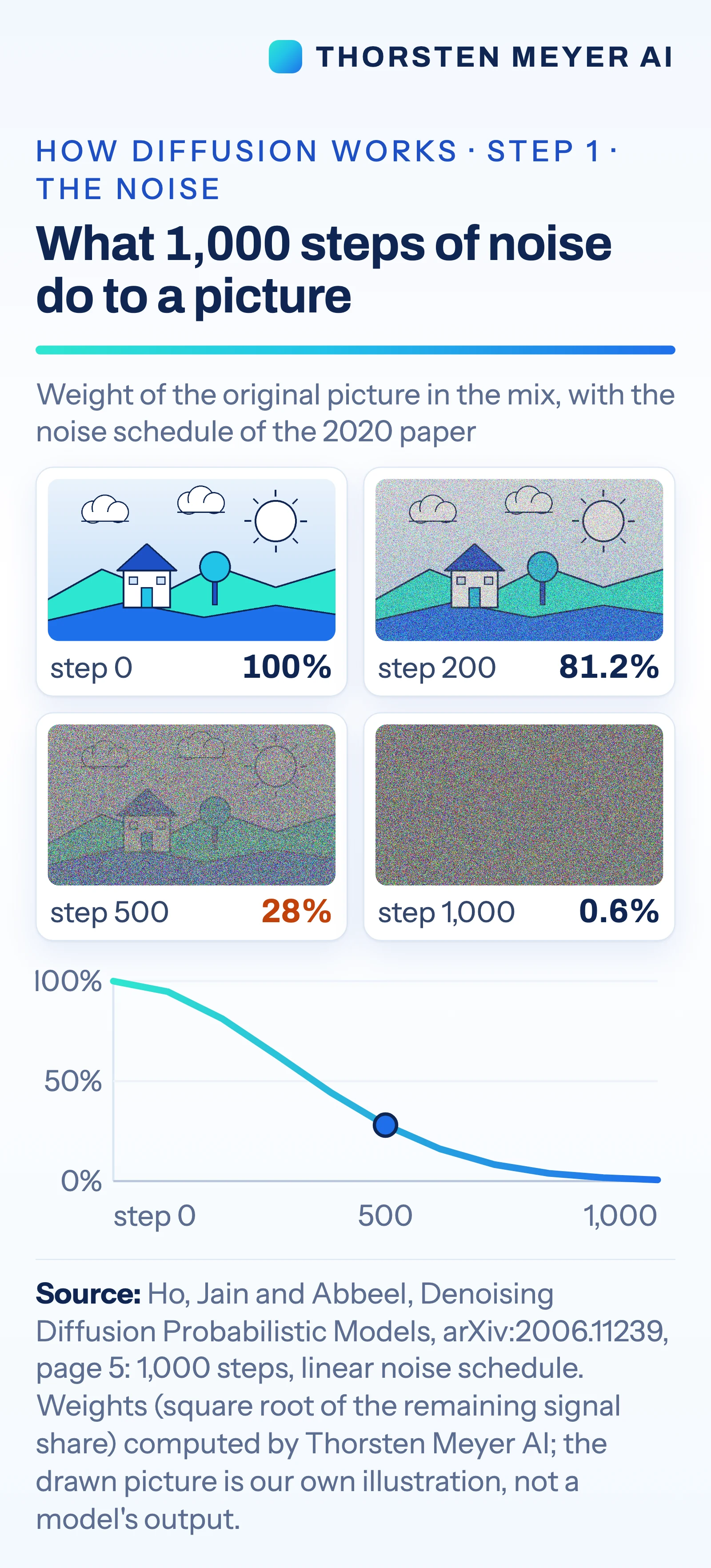
Training begins with real images. A diffusion process adds noise over many small steps until the original image is nearly indistinguishable from random static. Because the added noise is known, a neural network can be trained to estimate it from each noisy image. The explainer points to a 2020 paper by Jonathan Ho, Ajay Jain and Pieter Abbeel, which used 1,000 steps in its experiments.
Generation runs the learned process in reverse: the model starts with noise and repeatedly estimates what to remove. Broad shapes tend to emerge before finer details. The explainer says a widely used open-source pipeline has a 50-step default; that setting is an example, not a universal requirement for all image models.
Many systems do not perform this work directly on every pixel. The explainer describes latent diffusion, which compresses an image into a smaller representation before denoising. In Stable Diffusion v1, it says, a 512-by-512 image is represented with 48 times fewer numbers. A text encoder converts the prompt into numerical information, and guidance steers the denoising steps toward it. Stronger guidance can make the output adhere more closely to the prompt, while the source notes a potential cost in image quality.
Why Image Models Misplace Details
The step-by-step process clarifies why a model can produce a convincing overall scene but mishandle a specific instruction. A prompt influences the image throughout generation, but the model is not following a symbolic checklist of objects and their positions. The explainer identifies lettering, counting and spatial placement as persistent challenges, including errors such as putting a cube beside a sphere when asked to place it on top.
The training process also informs concerns about resemblance to source material. The explainer says researchers have extracted near-copies of training images from models. That observation raises questions about memorization and copyright, but it does not by itself settle whether a particular output infringes a right. Those questions depend on evidence and legal standards beyond the model’s basic mechanics.
Products Worth Considering

Sony WH-1000XM4C (M4 2nd Gen) Wireless Noise-Cancelling Headphones, Black

LG UltraGear 32-inch 4K UHD OLED Gaming Monitor, 165Hz

Logitech MX Mechanical Wireless Illuminated Performance Keyboard, Clicky
As an affiliate, we earn on qualifying purchases.
From Diffusion Theory to Image Tools
The idea predates today’s image generators. In 2015, Jascha Sohl-Dickstein and colleagues described gradually destroying structure in data and learning a reverse process to restore it. The 2020 paper Denoising Diffusion Probabilistic Models by Ho, Jain and Abbeel developed a practical approach that helped make diffusion methods useful for image generation.
The explainer reports that, under the 2020 paper’s noise schedule, the original image carries 81.2% of its weight after 200 steps, 28% after 500 and 0.6% after 1,000. Those figures describe that paper’s setup, not every current model. The article also references Hugging Face diffusers documentation for an example of a 50-step generation setting.
Text guidance draws on components familiar from language processing, including a text encoder and attention. The explainer treats those as parts of the image-generation pipeline, while pointing readers to separate material for broader explanations of neural networks and language models.
““systematically and slowly destroy structure in a data distribution through an iterative forward diffusion process””
— Jascha Sohl-Dickstein and colleagues, in a 2015 research paper
Open Questions on Copies and Quality
The explainer reports that researchers have recovered near-copies of training images from diffusion models, but it does not provide details about the studies, their scope or how often such reproduction occurs. The risk for a particular model or prompt therefore cannot be established from the article alone.
It also says a UK court found in 2025 that Stable Diffusion itself is not an “infringing copy,” while other questions remain open. The source does not set out the full ruling or identify every unresolved issue, so the statement should be read narrowly. Model-specific differences in step counts, compression and prompt guidance also mean the cited settings do not describe all systems.
What Research and Courts May Clarify
The explainer does not announce a new model, experiment or court decision. Further research could clarify when models reproduce training images and how reliably generation settings affect fidelity, detail and prompt adherence. Legal outcomes may clarify how copyright rules apply to training and generated images; the source does not specify a next hearing or decision date.
For readers assessing a particular image model, the practical next step is to check its technical documentation and the evidence behind claims about its outputs. The general process—learn to predict noise, then remove it under prompt guidance—provides a useful framework, but it does not establish how any individual system was trained or what it will generate.
Key Questions
Does a diffusion model start with a blank canvas?
In the process described by the explainer, generation starts with random noise, not a blank canvas or a searched photograph. The model removes noise in stages to form an image.
How does training teach the model to make images?
Training adds known noise to real images. A neural network learns to estimate that noise, which lets it progressively remove noise during generation.
Why do generated images get words or object positions wrong?
The explainer identifies lettering, counting and spatial placement as challenges. Prompt guidance steers the process, but does not guarantee exact text or relationships between objects.
Do all diffusion models use 1,000 or 50 steps?
No. The 1,000-step figure comes from the experiments in the 2020 paper cited by the source. Its 50-step figure describes a common default in an open-source pipeline, not a universal setting.
Does the UK court ruling settle copyright questions about AI images?
The source reports a 2025 finding that Stable Diffusion itself was not an “infringing copy,” while saying other questions remain open. It does not provide enough detail to treat that statement as a resolution of all copyright issues involving model training or generated images.
Source: Thorsten Meyer AI