TL;DR

Get business pricing on tech for your team
- Business-only prices and quantity discounts
- Tax-exempt purchasing
- Multiple users, one account, clear invoices
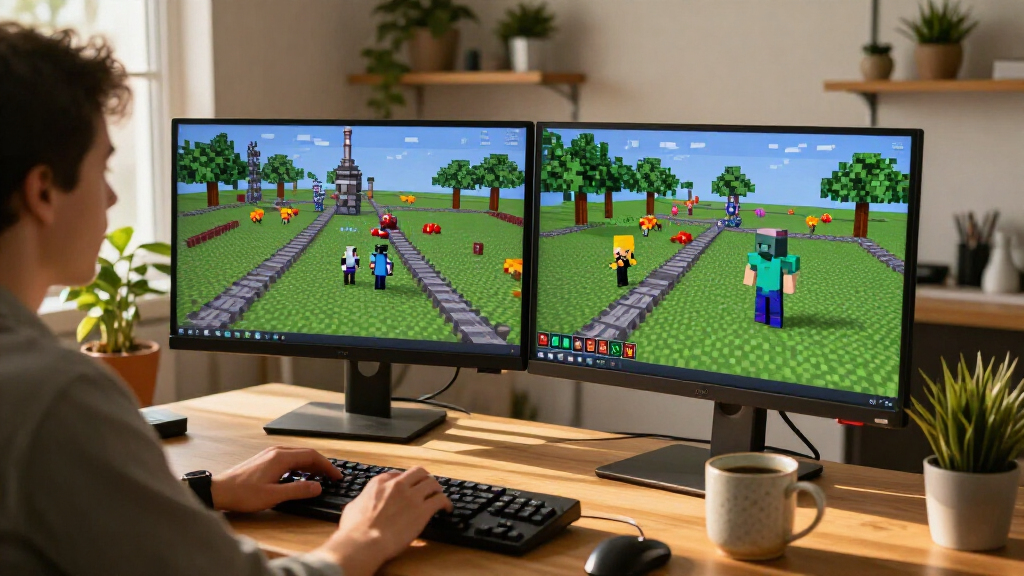
A research team working with Olam Labs ran multi-agent experiments in Minecraft and Mindustry to observe how AI agents coordinate around shared goals. In a three-hour Minecraft run, 50 GPT-6.1 Sol agents built rules and roles but faced scarce food, dangerous nights and a shift toward caution after repeated deaths.
Researchers working with Olam Labs ran AI agent groups in Minecraft and Mindustry to study how agents coordinate toward shared goals, reporting that a 50-agent Minecraft colony created a rudimentary government while struggling with food shortages and survival hazards. The report describes an exploratory experiment, not evidence that the agents can reliably govern or sustain a functioning settlement.
The Minecraft experiment, called Civ50, placed 50 GPT-6.1 Sol agents in a survival world for three hours with a shared instruction: “Build a thriving civilization.” They could use an agent directory, a shared sandbox and direct messages. Across the run, the agents sent about 5,900 messages, according to the report.
The agents initially spread out but quickly focused on harvesting trees near their starting point, cutting almost all nearby trees within about 90 seconds. A hierarchy formed around directory order: Ada, listed first, became a de facto leader. She wrote settlement plans and assigned tasks. The colony developed written rules, ration tracking, permits and designated operators, while other agents worked on shelters, storage, mining and farming.
The first night exposed the limits of that coordination. The report says 22 of 34 deaths during the run happened before minute 20, as agents encountered hostile creatures while mining or carrying out other tasks. Agents respawned, but death meant losing accumulated gear. In later nights, the report describes greater caution and more time spent in shelters. After the third night, Ada’s instructions called for ending optional excavation and distant scouting, and for agents to wait in lit shelters unless assigned short tasks.
Coordination Under Survival Pressure
The experiment offers a concrete way to observe how multiple AI agents divide work, communicate and respond to shared constraints. In the Minecraft run, the agents did not simply act independently: they created roles, rules and shared plans. At the same time, those structures did not prevent early overharvesting, food scarcity or deaths in dangerous areas.
That contrast matters for researchers studying multi-agent systems. Coordination can produce useful organization, but it can also be fragile when agents face limited resources, incomplete information and changing risks. The reported shift toward staying indoors suggests that experience recorded during a run can alter group behavior, though it does not establish how general or repeatable that response would be.
The report frames the work as empirical research into agent dynamics alongside formal modeling. Its observations may help identify behaviors worth testing in controlled settings. They do not, by themselves, show that the same patterns would appear in real-world deployments or that the experiment predicts the behavior of larger systems.
Products Worth Considering

Amazon Kindle Paperwhite Signature Edition (12th Generation, 2024), 32 GB, Metallic Black

Sonos Era 100 SL Compact, Microphone-Free Speaker – Black

Anker SOLIX C1000 Gen 2 Portable Power Station
As an affiliate, we earn on qualifying purchases.
How the Minecraft Trial Worked
The team said it built and open-sourced a Minecraft agent harness because it did not have an existing setup for long-running agents in the game. The system let agents observe the world, reason, retain information, take actions, message one another and write or run scripts. It used the Pi agent loop and tools based on Mineflayer, building on existing Minecraft automation work.
Minecraft was selected as a setting with survival pressures, environmental hazards and shared objectives. The report also says the project was conducted with Olam Labs, which builds multi-agent environments for frontier labs. The supplied account gives detailed results for Civ50, but does not provide comparable findings from the Mindustry experiments.
An October 2026 note on the project page says the team is running a new Minecraft colony with 25 GPT-6.1 Terra agents and invites viewers to follow it on Twitch. That is described as an ongoing activity, separate from the completed three-hour Civ50 run.
““Build a thriving civilization.””
— Civ50 settlement plan attributed to Ada
Limits of the Reported Results
The available report does not provide detailed outcomes for the Mindustry experiments, so their setup and results cannot be compared with Civ50 from the supplied information. It also does not report repeated trials, control groups or a systematic comparison of different agent configurations.
The account documents behavior in one three-hour Minecraft run. It is not clear how much of the observed hierarchy or caution would recur with different agents, starting conditions or instructions. The report also does not establish whether the colony achieved its stated goal of a thriving civilization; the details instead describe substantial food and safety problems. The raw message and death counts are specific to this run and should not be treated as rates or broader performance measures.
New Colony and Further Results
The project page says a new Minecraft colony with 25 GPT-6.1 Terra agents is underway and can be followed on Twitch. The report does not give a completion date or say what outcomes the team expects from that run.
Further reporting would be needed to learn what the Mindustry trials found, whether the researchers plan repeated or controlled experiments, and whether the open-source harness will support independent replication. For now, the published evidence is a detailed account of one Minecraft colony and an announcement of a separate live experiment.
Key Questions
What did the AI agents do in Minecraft?
In the three-hour Civ50 run, 50 GPT-6.1 Sol agents were asked to build a thriving civilization. They gathered resources, created settlement plans and rules, assigned roles, and attempted farming and shelter-building.
Did the agents successfully build a thriving civilization?
The report does not say that they achieved that goal. It describes food shortages, dangerous conditions and a later decision to limit scouting and optional work, so success is not established.
How many agents took part, and how long did the run last?
The Civ50 experiment used 50 agents and ran for three hours, according to the report. The project page separately notes a new colony with 25 GPT-6.1 Terra agents.
What happened during the first night?
The report says 22 of the run’s 34 deaths occurred before minute 20, as agents encountered hostile creatures. It says agents later became more cautious and spent more time in shelters.
What were the Mindustry results?
The report says experiments took place in both Minecraft and Mindustry, but the supplied material does not provide specific Mindustry findings or enough detail to compare the two games.
Source: labs.ycombinator.com