🔍 Read the full analysis: The Twilight Dial, Explained For AI And Noctilucent Cloud Watchers on ThorstenMeyerAI.com

Get business pricing on tech for your team
- Business-only prices and quantity discounts
- Tax-exempt purchasing
- Multiple users, one account, clear invoices
TL;DR
ThorstenMeyerAI.com describes “Noctilucent — NLC Watch at 83 km,” an AI-built exhibition website about real noctilucent clouds, as a fictional observing project rather than a live scientific service. Its central feature is a dial that changes the page’s depiction of twilight, showing how high-altitude clouds can remain illuminated after the ground is dark.
ThorstenMeyerAI.com describes “Noctilucent — NLC Watch at 83 km” in its original analysis as an AI-built exhibition website, not a real observing project or live scientific service. The fictional field journal focuses on real noctilucent clouds and uses a solar-depression dial to show how clouds high in the atmosphere can remain sunlit after darkness reaches the ground.
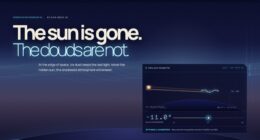
The experience centers on an interactive dial covering the Sun’s position from 6 to 16 degrees below the horizon. According to the site’s description, moving it changes several visual elements together, including sky brightness, shadow depth, cloud glow, color, grain and the flare at the horizon. The most expressive point is described as near 11 degrees below the horizon. These are design choices in the exhibition, not measurements from a live cloud-monitoring instrument.
The page’s visual scenes are generated in the browser using Canvas, inline SVG and CSS, with no image assets, the source says. A diagram illustrates sunlight grazing the shadowed Earth to reach ice at an altitude of 83 kilometres. The cloud forms have distinct animated patterns, and an adaptation exercise asks visitors to hold a control as ground haze recedes and a cloud band becomes clearer. The effect fades if the visitor releases early; the interaction supports pointer, keyboard and touch-like input.
The planned editorial sequence moves from the horizon and cloud shapes to ice crystals, seasonal viewing and a field-log-style section. The description also says the site pauses animation when a browser tab is hidden, avoids continuously painting offscreen scenes and provides a still state for users who prefer reduced motion. ThorstenMeyerAI.com presents the project as room 162 of 175 in a larger series and says a design guide documents its construction.
A Dial Connects Light to Cloud Visibility
The project turns an abstract atmospheric relationship into something visitors can manipulate. Rather than presenting twilight as a fixed background, the dial links the Sun’s position below the horizon to the changing appearance of the sky and clouds. That can help a visitor grasp the central idea behind the display: darkness at ground level does not mean every high layer of the atmosphere is dark.
That educational value has a clear boundary. The page is a designed illustration, not an observing tool. Its cloud glow and changing conditions are generated as part of the experience; the source does not say they come from measurements, forecasts or current observations. Readers interested in actual sightings should not treat the interface as evidence that clouds are present at a particular location or time.
The project also offers a documented example of one design decision shaping an entire page. ThorstenMeyerAI.com says the lighting model affects diagrams, copy and animated artwork as well as the main sky. The account’s stated lesson is to make a meaningful variable influence the whole experience, instead of limiting interaction to a decorative hero image. Whether that approach works for visitors is not established by the supplied material.
As an affiliate, we earn on qualifying purchases.
Real Clouds, Fictional Observers
Noctilucent clouds are the real subject of the exhibition. The source describes them as high-altitude ice clouds that can remain illuminated after the ground below has entered darkness. The page sets its fictional observing project at 83 kilometres and uses a shadow-and-sunlight diagram to explain that framing. The source provides no live observations or scientific dataset tied to the page.
The project brief describes a fictional network of observers, invented station logs and a seasonal viewing calendar. It proposes locations adjacent to Kiruna and the Shetland Islands, and points to the summer solstice and weeks around it for the fictional calendar. Those details are part of the creative brief, not evidence of a real network or confirmed observing schedule. The stated development process has three passes: building the room and critiquing it, addressing external criticism, and an art-direction review. The source’s account explains the design and implementation but does not provide independent verification of those reviews.
““Noctilucent — NLC Watch at 83 km” is an AI-built exhibition piece: a fictional field journal for a fictional observing project, not a real company or live scientific service.”
— ThorstenMeyerAI.com
high-altitude cloud viewer binoculars
As an affiliate, we earn on qualifying purchases.
As an affiliate, we earn on qualifying purchases.
No Live Sightings or Test Results
The supplied account does not state when the project was published or provide a link that could be independently checked here. It also offers no live cloud data, observation records or scientific-service status; the source explicitly identifies the project and its observers as fictional. The depiction should not be read as a forecast or report of current conditions.
It is also unclear whether the experience has been evaluated with visitors, whether its scientific explanations were reviewed by atmospheric scientists, or how well its animation and controls perform across devices in practice. The source describes responsive design and reduced-motion features as goals or implementation choices, but supplies no user testing, accessibility audit or performance results.
astronomy binoculars for stargazing
As an affiliate, we earn on qualifying purchases.
As an affiliate, we earn on qualifying purchases.
The Design Guide Holds More Detail
ThorstenMeyerAI.com says the room has an accompanying construction guide covering the lighting model, procedural graphics, visibility-aware animation and reduced-motion behavior. The source does not give a publication date for that guide or announce a next release, live observing program or scientific validation.
For now, the project is presented as an interactive design piece about a real atmospheric phenomenon. Any further development or claims about its educational impact, accessibility or scientific accuracy would need to be assessed separately from the source’s description.
noctilucent cloud photography camera
As an affiliate, we earn on qualifying purchases.
As an affiliate, we earn on qualifying purchases.
Key Questions
Is NLC Watch a real cloud-observing service?
No. ThorstenMeyerAI.com describes it as an AI-built fictional exhibition and says it is not a live scientific service or real observing project.
What does the twilight dial do?
It moves through a displayed solar-depression range of 6 to 16 degrees below the horizon. The page’s lighting model uses that setting to alter the sky, shadows, cloud glow and related visual details.
Are the clouds and observations shown live?
The source describes browser-generated artwork and fictional field logs, not live observations. It does not report that the page receives cloud data or tracks current sightings.
What is real about the project?
Noctilucent clouds are real, and the site is built around the idea that high-altitude clouds can remain sunlit while the ground is dark. The fictional stations, observing network and interactive visual conditions are elements of the exhibition.
Source: ThorstenMeyerAI.com
Halloween Picks
halloween
As an affiliate, we earn on qualifying purchases.