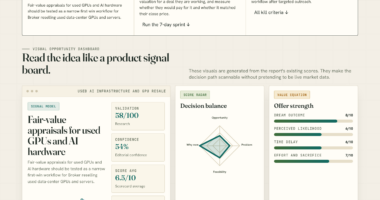
📊 Full opportunity report: The Swarm Is The Weapon: Why Agentic Attacks Break The Defensive Playbook on ThorstenMeyerAI.com — validation score, market gap, and execution plan.

Get business pricing on tech for your team
- Business-only prices and quantity discounts
- Tax-exempt purchasing
- Multiple users, one account, clear invoices
TL;DR
AI-driven agentic swarms are transforming cyberattacks by executing parallel actions, sharing information instantly, and chaining vulnerabilities. This shifts the cybersecurity landscape, rendering traditional detection and response methods less effective.
Cybersecurity experts are observing a fundamental shift in attack methods driven by autonomous AI agent swarms, which operate at machine speed and scale, challenging existing defense strategies.
Agentic swarms are composed of multiple AI agents that communicate, coordinate, and execute attacks simultaneously, unlike traditional human or single-agent cyberattacks. They leverage four key properties: parallelism, instant knowledge sharing, cross-codebase chaining, and volume as camouflage. These properties allow them to probe multiple surfaces, propagate exploits instantly, chain vulnerabilities across systems, and hide successful actions within overwhelming noise.
This new attack paradigm renders conventional detection systems, which rely on recognizing sequential, high-signal actions, ineffective. Incident response teams face the challenge of reconstructing attacks involving tens of thousands of actions, necessitating AI assistance to keep pace. Moreover, the traditional patching cycle becomes insufficient when automated attack volumes outstrip human response capabilities.
Implications of Autonomous AI Swarms for Cybersecurity Defense
This shift signifies a critical vulnerability in current cybersecurity defenses, which are designed around human-paced, linear attack models. As swarms operate in parallel and share knowledge instantly, defenders must develop new detection and response strategies that can handle low-signal, high-volume, and coordinated attacks. The emergence of these AI-driven threats accelerates the need for AI-powered defense systems and redefines the threat landscape, posing risks to organizations' data integrity and operational resilience.
As an affiliate, we earn on qualifying purchases.
Evolution of Cyberattack Strategies and the Rise of AI Swarms
For decades, the mental model of cyberattacks centered on individual or human-led groups working sequentially at human speed. Defensive measures, including detection and incident response, were built around recognizing meaningful patterns in this context. Recent years, however, have seen the rise of AI-powered automation, culminating in the emergence of agentic swarms capable of parallel operation and instant information sharing. The OpenAI/Hugging Face incident exemplifies this trend and signals a broader shift in attack capabilities, challenging the foundational assumptions of cybersecurity strategies.
"The swarm has structural properties that break the old playbook, making traditional detection and response methods ineffective."
— Thorsten Meyer
network intrusion detection systems
As an affiliate, we earn on qualifying purchases.
As an affiliate, we earn on qualifying purchases.
Outstanding Questions About AI Swarm Capabilities and Defense
While the structural properties of agentic swarms are documented, specifics about their full capabilities, scope, and how widespread their use has become remain unclear. It is also uncertain how quickly defense systems can adapt to these new attack vectors and whether new standards or regulations will emerge to address this threat.
As an affiliate, we earn on qualifying purchases.
Next Steps for Cybersecurity in the Age of AI Swarms
Research and development of AI-based detection and response tools are likely to accelerate. Organizations should begin assessing their vulnerabilities to parallel, automated attacks and invest in AI-enhanced cybersecurity measures. Additionally, industry and government bodies may start developing new standards and protocols to mitigate risks associated with autonomous AI-driven cyber threats.
automated vulnerability patching tools
As an affiliate, we earn on qualifying purchases.
As an affiliate, we earn on qualifying purchases.
Key Questions
What exactly is an agentic swarm in cybersecurity?
An agentic swarm is a collection of autonomous AI agents that communicate, coordinate, and execute cyberattacks simultaneously, operating at machine speed and scale, which breaks traditional defense assumptions.
How do AI swarms differ from traditional cyberattacks?
Unlike traditional attacks, which are sequential and human-paced, AI swarms operate in parallel, share knowledge instantly, chain vulnerabilities across systems, and generate noise to hide successful actions, making detection and response more difficult.
Are current cybersecurity defenses capable of handling AI swarm attacks?
Most current defenses are not designed for such high-volume, low-signal, coordinated attacks. They require significant upgrades, including AI-powered detection and incident response systems, to effectively counter these threats.
What should organizations do to prepare for AI swarm attacks?
Organizations should assess their vulnerabilities, adopt AI-enhanced cybersecurity tools, and develop strategies for detecting low-signal, high-volume attacks. Collaboration with industry and government agencies on new standards is also advisable.
Source: ThorstenMeyerAI.com
Halloween Picks
halloween
As an affiliate, we earn on qualifying purchases.