
📊 Full opportunity report: The Rule Requiring Driver Monitoring Cameras In Every New Car Sold In The EU on IdeaNavigator AI — validation score, market gap, and execution plan.

Get business pricing on tech for your team
- Business-only prices and quantity discounts
- Tax-exempt purchasing
- Multiple users, one account, clear invoices
TL;DR
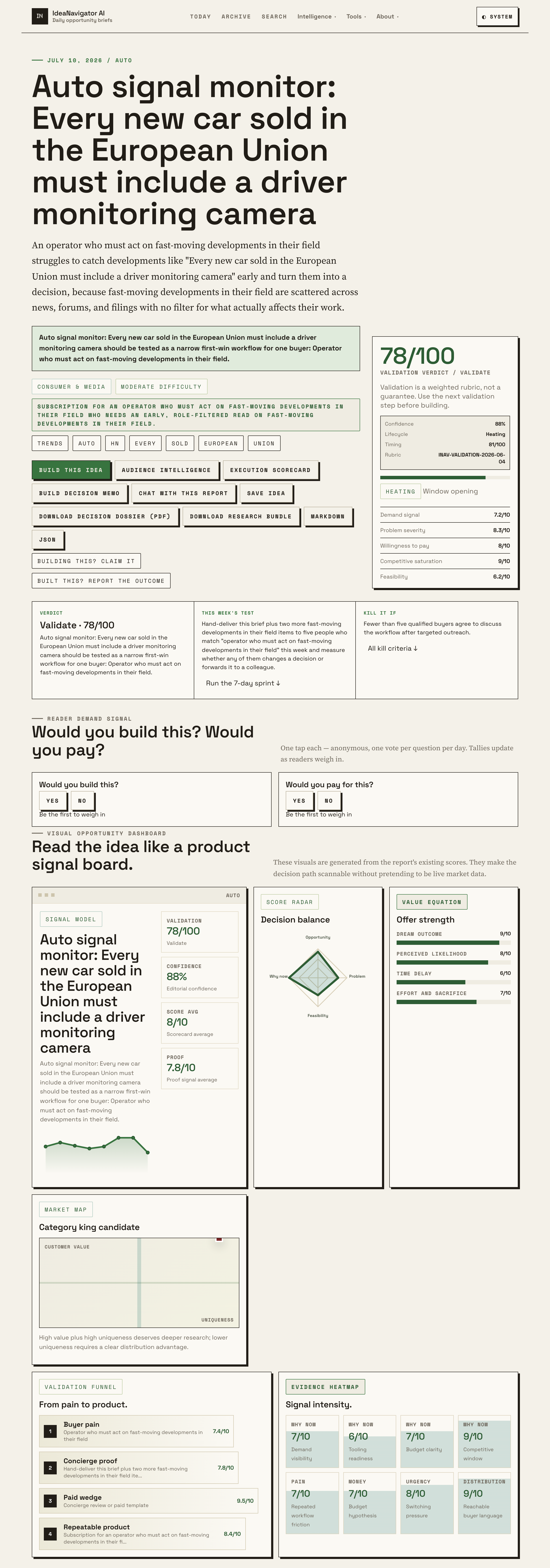
A requirement that every new car sold in the European Union include a camera-based driver monitoring system is circulating as a fast-moving development, flagged on Hacker News with an 88/100 signal. The change ties into the EU’s ongoing General Safety Regulation rollout, but key details of the mandate remain unconfirmed.
A rule that would require every new car sold in the European Union to include a driver monitoring camera has surfaced as a fast-moving development, flagged on Hacker News with an 88/100 signal score, according to IdeaNavigator AI. The reported mandate is part of the EU’s broader push to reduce fatigue- and distraction-related crashes, and it puts European regulators on a collision course with privacy advocates and manufacturers weighing cost and design changes.
The development centers on the EU’s vehicle-safety framework, which has been phasing in requirements for driver drowsiness and attention warning systems under the General Safety Regulation adopted in 2019 and applied to new vehicle types since 2022, with full application to all new vehicles sold in the bloc progressing through 2024 and 2026 deadlines. What is new in the current discussion, according to IdeaNavigator AI’s tracking of the signal, is the specific emphasis on camera-based monitoring in every new car, rather than steering-pattern-based detection alone.
Driver monitoring cameras point at the operator’s face and eyes to detect drowsiness, distraction, and gaze direction, and can trigger warnings or, in combination with other systems, limit certain vehicle functions. Camera-based systems are generally considered more capable of detecting a driver looking at a phone or away from the road than steering-input analysis, which can only infer inattention indirectly.
The Hacker News discussion that amplified the story reflects broader concern about in-cabin surveillance, with commenters debating data retention, third-party access, and whether the systems could be used beyond safety purposes. Those concerns are not new: European data protection authorities have previously weighed in on in-vehicle camera data, and automakers deploying similar systems — such as General Motors’ Super Cruise and BMW’s attention cameras — have had to define what footage is processed locally versus transmitted.
Stakes for Carmakers, Buyers and Privacy
If fully implemented as described, the requirement would affect every new vehicle sold in the EU single market, forcing manufacturers that currently rely on steering-based drowsiness detection to add camera hardware, software, and the associated data-handling infrastructure. That carries cost implications for automakers and, ultimately, for car prices in a market of roughly 13 million new passenger car registrations per year in recent figures from the European Automobile Manufacturers’ Association.
For drivers, the change means a camera pointed at their face becomes standard equipment rather than a premium feature tied to hands-free driving packages. For privacy regulators and civil-liberties groups, it creates a new category of biometric-adjacent data collected by default in millions of vehicles, raising questions about retention periods, law-enforcement access, and cross-border data flows.
For operators tracking regulatory developments in automotive, technology, or data privacy, the story is a signal of a wider trend: safety mandates increasingly double as surveillance mandates, and the EU’s regulatory timeline creates planning deadlines that ripple into supplier contracts, product roadmaps, and compliance budgets.
How the EU’s Safety Rules Got Here
The EU’s General Safety Regulation (EU) 2019/2144, adopted in late 2019, made a suite of safety technologies mandatory: intelligent speed assistance, event data recorders, emergency stop signals, and driver drowsiness and attention warning. The rules applied to new type approvals from July 2022 and to all new vehicles registered in the EU from July 2024, with additional provisions, including advanced driver distraction warnings, phased in through 2026.
Notably, the regulation as written requires drowsiness and distraction warning capability but has historically left room for how manufacturers implement detection. The current discussion, as tracked by IdeaNavigator AI, centers on the interpretation that camera-based monitoring will effectively become the required standard — either because camera systems are the only ones that reliably meet the distraction-detection requirements arriving in 2026, or because of follow-on rulemaking that specifies the technology. That distinction matters, and it is where the reporting is thinnest.
Camera-based driver monitoring is already common in cars sold with Level 2 hands-free driving features, where regulators and insurers expect the system to verify that the driver is watching the road. Extending that hardware to all vehicles, regardless of automation level, would be a step change in deployment scale.
What Is Still Unverified
Several points remain unclear. First, the exact legal status of the camera mandate is not established from the available material: it is not specified whether this is new legislation, an implementing regulation under the General Safety Regulation, or an anticipated consequence of the 2026 distraction-warning requirements. Second, no official EU document, Commission statement, or named regulator is cited in the circulating discussion, so the precise scope — which vehicle categories, which deadlines — cannot be confirmed from the signal alone.
Third, questions about data handling have no confirmed answers: whether footage is processed on-device only, how long any data is stored, and under what conditions it could be accessed by authorities or insurers are all open. Fourth, the interaction with the EU’s GDPR and the ePrivacy framework for in-cabin cameras has not been spelled out in the material driving the discussion. Readers should treat the mandate as reported and developing rather than fully documented.
Timeline and Verification Steps
The fixed milestone to watch is 2026, when the General Safety Regulation’s advanced driver distraction warning provisions are due to apply to all new vehicles, which is the most likely forcing date for camera-based monitoring. Verification should focus on the Official Journal of the European Union for any implementing or delegated acts specifying detection technology, and on statements from the European Commission’s transport directorate.
Automaker disclosures in earnings calls and homologation filings will indicate how the industry reads the requirement, and European data protection authorities are expected to issue guidance on in-cabin camera data as deployment scales. For operators, tracking supplier announcements from camera and semiconductor vendors — typically an early indicator — will show whether the industry is moving ahead of the regulatory deadline. Expect the privacy debate to intensify in parallel, likely including challenges or clarifications from national privacy regulators before full deployment.
Key Questions
Do all new cars in the EU already need driver monitoring?
All new cars registered in the EU since July 2024 must have driver drowsiness and attention warning under the General Safety Regulation, but the regulation has generally not prescribed the exact technology. What is being reported now is that camera-based monitoring is effectively becoming the required standard, ahead of stricter 2026 distraction-warning rules.
What does a driver monitoring camera actually do?
It tracks the driver’s eye movement, gaze direction, and head position to detect drowsiness or distraction, such as looking at a phone. The system then issues warnings and, in some vehicles, can escalate to slowing the car or disengaging hands-free driving features.
Is the footage recorded and stored?
In most current systems from automakers, image processing happens on-device in real time and footage is not retained. However, there is no confirmed EU-wide rule on storage and access for the new mandate, and privacy advocates have flagged retention and third-party access as unresolved issues.
Does this apply to used cars or cars already sold?
No. Based on how EU vehicle-safety rules work, the requirement applies to new vehicles sold or registered in the bloc after the relevant deadlines. Existing vehicles are not retrofitted under this framework.
How certain is it that cameras will be mandatory in every new EU car?
The underlying drowsiness- and distraction-warning mandate is confirmed EU law. The specific claim that every new car must include a camera is reported and developing — the exact legal instrument and scope have not been verified from official documents, and implementation details remain unclear.
Source: IdeaNavigator AI
Halloween Picks
halloween
As an affiliate, we earn on qualifying purchases.