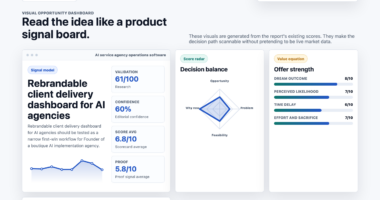

📊 Full opportunity report: Singapore: Engineer the Transition on ThorstenMeyerAI.com — validation score, market gap, and execution plan.

Get tech for your team delivered free — and shop member deals
- Fast, free delivery on millions of items
- Access to Prime Big Deal Days deals on October 6–7
- Prime Video, Amazon Music and more included
TL;DR
Singapore is implementing a multi-faceted, state-driven strategy to manage economic transition, focusing on continuous reskilling and AI development. This approach aims to pre-empt displacement and maintain competitiveness.
Singapore has unveiled a comprehensive policy framework aimed at engineering the economic and technological transition driven by automation and AI. This multi-program approach emphasizes continuous worker reskilling, targeted AI development, and leveraging its strong state capacity to manage change proactively. The strategy underscores Singapore’s distinct model of calibrated, well-funded interventions designed to stay ahead of technological disruption.
Singapore’s government has committed significant resources to a suite of programs that collectively aim to prepare the workforce for a rapidly evolving economy. Learn more about the economics of forward-deployed engineers. Central to this effort is SkillsFuture, which provides citizens with credits and heavily subsidized training, coupled with mid-career allowances and job placement schemes. These initiatives are designed to enable workers to upgrade skills continuously, thus pre-empting displacement by automation. Concurrently, Singapore’s National AI Strategy, refreshed in 2026 and overseen by an AI Council chaired by the Prime Minister, allocates over a billion Singapore dollars to AI research, development, and governance. The country is also innovating around its infrastructure constraints by promoting efficient, home-grown AI models and selectively investing through sovereign funds to support its AI ecosystem. The government’s approach is characterized by a high level of precision, with targeted programs addressing specific needs rather than relying on broad universal policies. This strategy reflects Singapore’s broader belief in a capable, meritocratic state that can design and execute policies at a granular level, ensuring that both human capital and technological infrastructure evolve in tandem.Engineer the Transition
Where others pick one lever, Singapore engineers all of them — a calibrated, well-funded instrument for each — and bets hardest that a high-capacity state can keep workers perpetually ahead of the machine.
Independent commentary, produced with AI assistance under human editorial oversight. The views are the author’s own and may change. This is analysis, not policy, economic, investment, or legal advice. Descriptions of SkillsFuture, Workfare, the CPF, the Progressive Wage Model, Singapore’s National AI Strategy and AI Council, and Temasek/GIC reflect publicly reported information as of mid-2026 and may change; figures are indicative. This phase maps differing approaches and endorses none; characterizations of contested arrangements present competing views, not a verdict. Country, program, and company names are referenced for analysis and imply no affiliation.
Why Singapore’s Transition Strategy Matters for Global Policy
Singapore’s approach demonstrates a highly calibrated, state-led model of managing economic and technological change. Its emphasis on continuous reskilling and targeted AI development could serve as a blueprint for other small, resource-constrained economies facing similar disruptions. The country’s success in integrating AI into its economy while maintaining high levels of workforce adaptability underscores the importance of state capacity and precision policy in navigating complex transitions. As automation accelerates worldwide, Singapore’s model offers insights into how governments can engineer change proactively rather than reactively, potentially influencing global policy frameworks.
AI training courses for professionals
As an affiliate, we earn on qualifying purchases.
As an affiliate, we earn on qualifying purchases.
Singapore’s Unique Approach to Economic Transition and AI Development
Unlike many jurisdictions that rely on broad regulations or social safety nets, Singapore’s strategy is rooted in a highly capable state that leverages specific instruments for each challenge. Its focus on skills development through SkillsFuture, income support via Workfare, and asset accumulation through the Central Provident Fund exemplifies a comprehensive, multi-layered approach. The country’s AI strategy, refreshed in 2026, reflects an integrated effort to develop home-grown AI models, foster regional AI hubs, and ensure that technological progress aligns with workforce resilience. For more insights, see our analysis on AI unit economics. This approach is shaped by Singapore’s constraints—limited land and energy—leading it to engineer innovative solutions rather than accept limitations as insurmountable.
“Our strategy is to stay ahead of the curve through continuous reskilling and targeted innovation, ensuring no one is left behind.”
— Singapore government spokesperson
reskilling and upskilling online programs
As an affiliate, we earn on qualifying purchases.
As an affiliate, we earn on qualifying purchases.
Unanswered Questions About Implementation and Outcomes
While Singapore’s strategy is clearly articulated, it remains uncertain how effectively these programs will scale and adapt over time, especially given global economic shifts and technological uncertainties. The long-term impact of the AI models and the actual employment outcomes for displaced workers are still to be observed. Additionally, the precise coordination among various programs and their ability to maintain momentum in a changing political or economic environment are still developing issues.
government-funded workforce training kits
As an affiliate, we earn on qualifying purchases.
As an affiliate, we earn on qualifying purchases.
Next Steps and Monitoring of Singapore’s Transition Efforts
Singapore is expected to continue refining its programs through ongoing evaluation and adjustments. The government will likely release periodic reports on workforce reskilling outcomes and AI deployment success. Monitoring will focus on employment stability, AI innovation metrics, and the integration of new technologies into the economy. You can explore related topics in this detailed analysis. International observers will watch how effectively Singapore’s model can serve as a scalable blueprint for managing technological transitions in other small, open economies.
As an affiliate, we earn on qualifying purchases.
Key Questions
How does Singapore’s SkillsFuture program support workers?
SkillsFuture provides citizens with credits for training, subsidized courses, and allowances for mid-career retraining, enabling continuous skill upgrades to stay ahead of automation.
What is the role of the AI Council in Singapore’s strategy?
The AI Council, chaired by the Prime Minister, oversees the national AI strategy, guiding research funding, development, and governance to ensure AI benefits the economy and society.
How does Singapore address its infrastructure constraints in AI development?
The country invests in efficient, home-grown AI models, manages data center development with high standards, and channels investments through sovereign funds to support its AI ecosystem.
What are the potential risks of Singapore’s approach?
Potential risks include over-reliance on state capacity, challenges in scaling programs, and uncertainties about long-term employment and technological outcomes amid global shifts.
Source: ThorstenMeyerAI.com
Halloween Picks
halloween
As an affiliate, we earn on qualifying purchases.