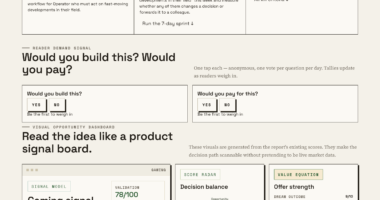

📊 Full opportunity report: IdeaClyst: The Validation Council on ThorstenMeyerAI.com — validation score, market gap, and execution plan.

Get business pricing on tech for your team
- Business-only prices and quantity discounts
- Tax-exempt purchasing
- Multiple users, one account, clear invoices
TL;DR
IdeaClyst introduces a new AI-driven idea validation process that uses opposing models to rigorously stress-test ideas before they reach roadmaps. It aims to reduce costly failures and improve decision-making efficiency.
IdeaClyst has launched a new AI-driven idea validation system called the Validation Council, designed to rigorously stress-test ideas through opposing model analysis before they are added to roadmaps. This development aims to improve decision quality and reduce costly failures in product development and strategic planning.
The Validation Council employs two distinct AI models, Claude and Codex, which analyze each idea from opposing perspectives. Before deliberation, a research pre-step gathers relevant context, evidence, and prior art, ensuring that the subsequent debate is grounded in facts rather than impressions.
Following the research phase, the council runs through five structured steps: framing the idea, steel-manning it, red-teaming it, evidence-checking, and synthesizing a verdict. This process produces an auditable recommendation, highlighting strengths, weaknesses, and assumptions, with the goal of killing weak ideas early and cheaply.
IdeaClyst is developed privately and is not publicly available, running locally on owned compute hardware, which minimizes operational costs and encourages widespread adoption. It is positioned as the first decision node in a broader decision-making layer, helping operators prioritize what to pursue and what to discard.
IdeaClyst — the validation council
Most ideas don’t die from being bad — they die from being plausible and untested. A research pre-step, then two models cross-examining the idea before it earns a roadmap slot.
Independent commentary, produced with AI assistance under human editorial oversight. The views are the author’s own and may change. IdeaClyst is developed privately and is not publicly available; it is provided “as is” without warranty. The council’s research, deliberation and verdicts are produced by automated models and may contain errors or shared blind spots — a verdict is auditable reasoning, not validated demand; verify independently before committing. Product and company names are trademarks of their respective owners; mention does not imply endorsement.
Why Structured Disagreement Enhances Decision-Making
By employing opposing AI models and a transparent, step-by-step process, IdeaClyst aims to reduce the risk of costly product failures caused by unchallenged or overly plausible ideas. This approach enhances the rigor of early-stage decision-making, offering a repeatable and nearly cost-free method to vet ideas before committing resources.
While the system cannot produce absolute truth—since models share blind spots—it significantly raises the bar for idea validation, making disagreements explicit and reviewable, thus improving overall strategic quality.
As an affiliate, we earn on qualifying purchases.
The Evolution of Idea Validation Tools
Traditional idea vetting often relies on single models or subjective judgment, which can lead to confirmation bias and overlooked flaws. You can learn more about IdeaClyst’s approach to decision-making. Recent developments have seen the rise of AI-assisted decision tools, but these typically lack structured disagreement or transparency.
IdeaClyst builds on this landscape by integrating multiple models in an adversarial setup, emphasizing local deployment to democratize rigorous idea testing. Its approach reflects a broader industry trend toward more accountable, evidence-based AI decision support systems.
“IdeaClyst’s council model replaces the comfort of agreement with the rigor of disagreement, making decision processes more transparent and trustworthy.”
— Thorsten Meyer, founder of ThorstenMeyerAI.com
decision analysis tools for product development
As an affiliate, we earn on qualifying purchases.
As an affiliate, we earn on qualifying purchases.
Limitations of Model-Based Idea Validation
While IdeaClyst’s approach introduces a more rigorous vetting process, it remains uncertain how well the models’ blind spots align or how effectively it prevents all types of flawed ideas from slipping through. For more context, see inside IdeaClyst’s decision process. The process cannot verify market validity or user acceptance, which depend on external factors.
Additionally, the potential for process-theater—where the structured steps lend an illusion of rigor—raises questions about how much the system influences actual decision quality versus perceived thoroughness.
As an affiliate, we earn on qualifying purchases.
Next Steps for Adoption and Development
Following its launch, the developers plan to gather user feedback and real-world case studies to refine the council’s effectiveness. They aim to encourage integrations with existing decision workflows and further testing in diverse industry contexts. Broader adoption will help assess its impact on reducing failed initiatives and improving strategic alignment.
strategic planning decision support
As an affiliate, we earn on qualifying purchases.
As an affiliate, we earn on qualifying purchases.
Key Questions
How does IdeaClyst differ from traditional idea evaluation methods?
Unlike single-model or subjective assessments, IdeaClyst employs two AI models in opposition, structured research, and transparent steps to rigorously stress-test ideas, reducing confirmation bias and unchallenged assumptions.
Can IdeaClyst guarantee that an idea is market-ready?
No. The system evaluates internal consistency and evidence, but it cannot verify market demand or user acceptance, which require external validation.
Is IdeaClyst open source, and how does that benefit users?
No, it is developed privately and is not publicly available.
What are the main limitations of the Validation Council approach?
The models can share blind spots, and the process may create an illusion of rigor. It cannot replace external market validation or eliminate all flawed ideas, but it significantly improves early-stage vetting.
Source: ThorstenMeyerAI.com
Columbus Day / Indigenous Peoples' Day Picks
long weekend sales
As an affiliate, we earn on qualifying purchases.