
TL;DR

Get business pricing on tech for your team
- Business-only prices and quantity discounts
- Tax-exempt purchasing
- Multiple users, one account, clear invoices
IdeaClyst is a local-first, AI-powered war room that helps founders quickly validate ideas by simulating a council of dissenting advisors. It turns scattered thinking into structured plans, reducing costly market mistakes and boosting confidence.
Ever sat with three promising ideas, feeling that knot tighten in your stomach? The build part is easy now, thanks to rapid prototyping and AI coding tools.
But the real challenge? Deciding which idea deserves your next six months. That’s where a war room—digital or physical—shines. And with IdeaClyst, that war room is a smart, local-first space that helps you cut through doubt and build conviction fast.
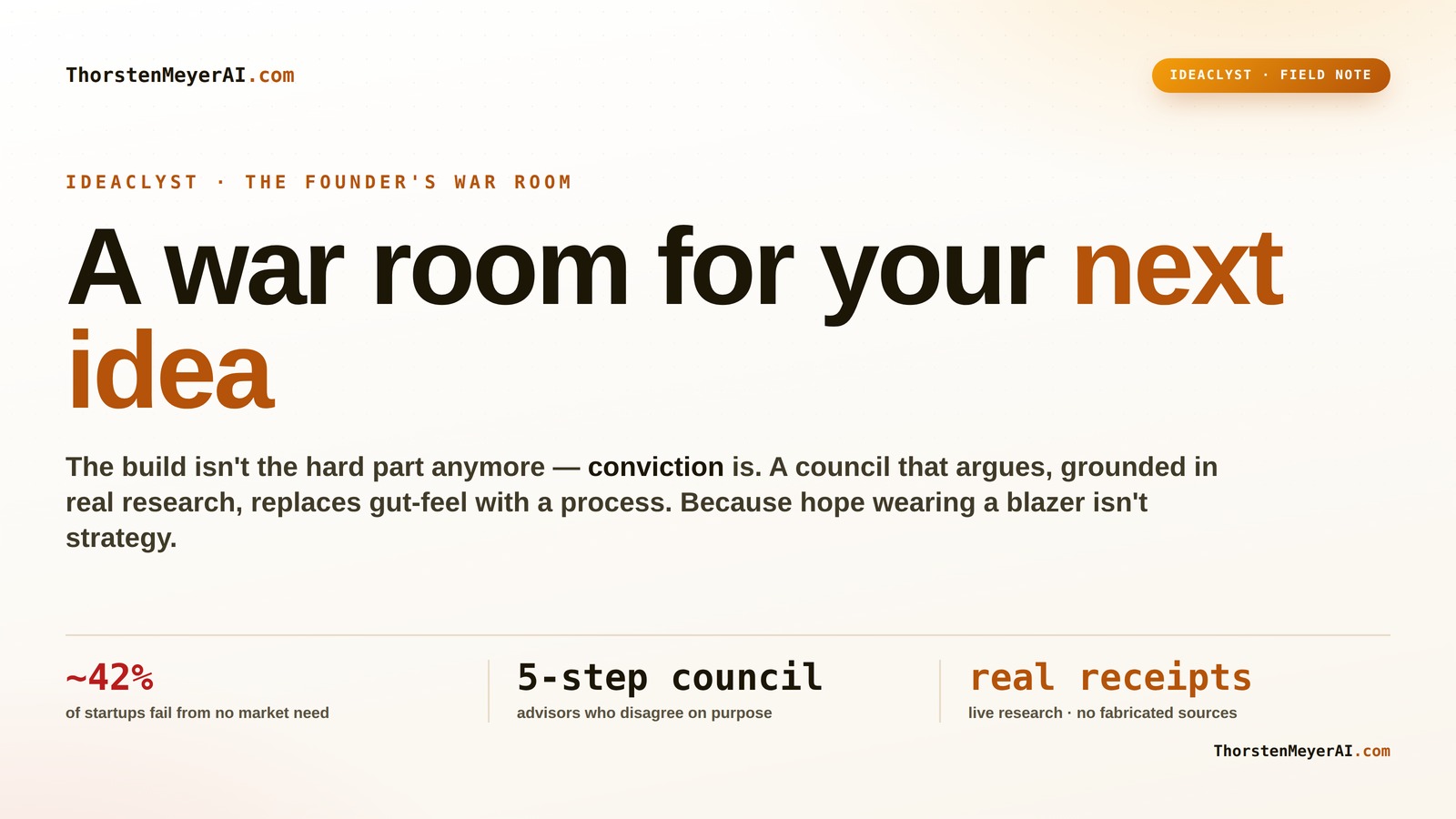
A war room for your next idea
The build isn’t the hard part anymore — conviction is. Knowing which idea deserves the next six months, and being able to defend it. Most founders answer with gut feel and optimistic math. That’s hope wearing a blazer. IdeaClyst replaces it with a process.
The most expensive decision is what to build
The single most valuable thing a tool can do is talk you out of the wrong six months. The numbers make the case better than any pitch.
Three tools in one — on your own machine
Strip away the framing and IdeaClyst is three things at once, all running locally with nothing leaving your laptop.
An AI council
Pressure-tests an idea you bring it — advisors who argue on purpose.
A discovery engine
Finds ideas you didn’t know to look for by hunting real demand signals.
A founder’s workspace
Carries winners from “interesting” all the way to “ready to build.”
Advisors who disagree on purpose
Not one confident, agreeable answer — a structured five-step deliberation where models play different roles and turn on their own work. The disagreement is the feature.
The five-step deliberation
A council that leads with the bad news surfaces the objections you’d otherwise find the expensive way, on month five.
Product strategy
Who’s it for, what’s the wedge, why now, what’s the business model.
Technical architecture
What would it actually take to build — and where’s the risk.
Critique pass
The council turns on its own work. Where’s the hand-waving? What kills this?
Second, independent critique
A different voice, a different angle — so blind spots don’t survive.
Final synthesis
Everything into one coherent founder packet: strategy, architecture, validation, plan.
When IdeaClyst cites a source, it actually fetched it
The hard departure from “ask an AI what it thinks of my startup.” It runs in a strict, real-data-only mode — if it can’t gather genuine evidence, it says so plainly rather than inventing a plausible paragraph.
Confidence with receipts
No fabricated statistics, no imaginary competitors, no made-up citations. The packet survives a skeptical co-founder or a sharp investor because the reasoning has receipts.
Market research first
Scouts the landscape before the council reasons about anything.
Competitor read
Real positioning, pricing signals, feature claims — differentiation vs. reality.
Validation with links
Not “talk to customers” — concrete signals & sources you can click.
From the blank page to build-ready
Evaluation is half the problem; the blank page is the other half. And a plan is worthless if it dies in a tab you never reopen.
Bring a space, not an idea
“AI for accountants,” “tools for indie game studios” — plus your goal and real capacity. It hunts demand signals across HN, Reddit, Product Hunt, GitHub, pricing pages.
- An honest market read — leads with the bad news when a space is hard
- An opportunity map — high pain, thin competition
- Ranked candidates — wedge, who pays, effort, risk, confidence
- each with KILL CRITERIA — when to walk away
A home and a forward path
Every promising idea gets carried forward, with every artifact in plain files on your disk.
- Validation tooling — sprint board, interview list, evidence browser
- Founder profile — a personal-fit lens; same discovery, different advice
- Build workspaces — funnel, personas, landing draft, version history
- “Build this idea” → a PRD + task queue, ready for a coding agent
Key Takeaways
- A digital war room like IdeaClyst offers a structured, private space for founders to validate and refine ideas quickly, avoiding costly market mistakes.
- Grounded in real-time web research, it reduces the guesswork and overconfidence often seen with generic AI tools.
- Multiple AI models, intentionally disagreeing, create a more robust validation process—like consulting a diverse panel of advisors.
- Setting up a local-first, open-source war room ensures your ideas stay private and under your control, with full ownership.
- Regularly revisiting and challenging your ideas keeps your war room active, preventing stagnation and fostering continuous innovation.
AI-powered startup idea validation tools
As an affiliate, we earn on qualifying purchases.
As an affiliate, we earn on qualifying purchases.
Why a War Room Is Your Secret Weapon for Smart Decision-Making
A war room acts as your command center for big ideas, helping you visualize, organize, and challenge your thinking. Instead of a cluttered brain or endless scattered notes, it creates a clear, visual landscape of your digital war room.
Imagine a whiteboard filled with sketches, sticky notes, and data points—everything you need to see at a glance. That’s the power of a dedicated space, whether physical or digital. It keeps your team aligned and ensures everyone understands the project’s true status.
Having such a space matters because it externalizes complex thinking, reducing cognitive overload. It encourages transparency and accountability, fostering a culture where assumptions are challenged openly. The tradeoff is that it requires discipline to keep the space updated and focused. Without regular maintenance, it can become cluttered or outdated, undermining its usefulness. The key is to view it as a living tool that evolves with your project, not just a static repository.
digital war room for entrepreneurs
As an affiliate, we earn on qualifying purchases.
As an affiliate, we earn on qualifying purchases.
How IdeaClyst Turns Your Idea into a Conviction Factory
IdeaClyst is more than just a brainstorming tool; it’s a digital war room that simulates a debate among multiple AI advisors. You bring an idea, and it stages a structured five-step council: strategy, architecture, critique, second critique, and synthesis.
Picture this: your idea faces a product strategist, a technical architect, and two critics—each playing different roles to poke holes and find strengths. The final report? A well-rounded plan, written in Markdown, ready to share or build upon.
This multi-model debate process is crucial because it exposes blind spots that a single perspective might miss. Each AI model, with its distinct training data and algorithms, offers unique insights and potential biases. When they disagree, it forces you to reconcile conflicting viewpoints, leading to a more nuanced understanding. The tradeoff is that this process can be more time-consuming and complex than a single-model approach, but the payoff is a decision basis rooted in diverse, evidence-backed critiques, reducing the risk of oversight and overconfidence.
local AI research tools for startups
As an affiliate, we earn on qualifying purchases.
As an affiliate, we earn on qualifying purchases.
The Real Power of IdeaClyst: Grounded in Live Web Research
Many AI tools give vague predictions or overconfident hype. IdeaClyst breaks that mold by anchoring every critique and strategy in real-time web research. It searches the internet for fresh data, trends, and facts, so your decisions aren’t based on model vibes but on current market realities.
This approach matters because markets are dynamic; what was true yesterday might be outdated today. By integrating live web research, IdeaClyst ensures your validation process reflects the latest information, reducing the risk of building for a market that has already shifted. For example, if you’re exploring a new SaaS feature, IdeaClyst pulls the latest user reviews, competitor updates, and industry reports—giving your idea a solid factual backbone. This real-time grounding means your decisions are more relevant and less prone to overconfidence based on stale data, ultimately leading to smarter, more adaptable strategies.
As an affiliate, we earn on qualifying purchases.
Local-First: Why Your Ideas Stay Yours
Unlike cloud-based tools that store your secrets on someone else’s server, IdeaClyst runs entirely on your machine. Your ideas, reports, and plans stay local—safe, private, and under your control. Learn more about technology trends.
This local-first approach isn’t just a tech detail. It’s about trust. You own your raw ideas and final plans—no data leaks, no subscription traps. It is developed privately and is not publicly available.
Having full control over your data is especially important because startup ideas are sensitive and competitive. Cloud storage introduces risks of breaches or unauthorized access, which can compromise your strategic advantage. By keeping everything local, you eliminate these vulnerabilities and retain ownership. Because it runs entirely on your machine, you can also adapt the tool to fit your specific workflows, adding features or integrations as your needs evolve. This approach empowers founders to innovate securely and confidently, knowing their intellectual property remains protected.
Building Your Own Digital War Room—Step-by-Step Setup
- Install IdeaClyst on your laptop; it’s a lightweight app that runs locally.
- Create a dedicated folder for your project ideas and reports.
- Bring your idea—write a sentence or paragraph—and feed it into the system.
- Let IdeaClyst’s council stage discussions, critiques, and syntheses.
- Review the final report and refine your idea based on the recommendations.
This process is designed to be straightforward but powerful. By organizing your ideas into a dedicated folder, you create a centralized hub that simplifies iterative testing. Feeding in new ideas or updates allows your war room to evolve naturally, fostering continuous refinement. The key is to visit regularly and keep your reports and critiques up to date, ensuring your decisions stay aligned with current market conditions and internal priorities.
Why Multiple AI Models Disagreeing Is Better Than One
Most AI tools give you an answer—sometimes overly optimistic or just plain wrong. IdeaClyst’s council approach involves multiple models, each with different “opinions,” intentionally disagreeing to surface blind spots. This mimics a diverse board of advisors, making your validation more nuanced.
Why does disagreement matter? Because in real-world decision-making, relying on a single perspective can blind you to risks or opportunities. When models disagree, it compels you to analyze why, forcing you to consider alternative explanations or overlooked data points. This process encourages critical thinking and helps identify hidden flaws that a single, consensus-driven model might miss. The tradeoff is that managing multiple models can be more complex and resource-intensive, but it ultimately results in a more resilient validation process that mirrors real-world diversity of thought and reduces overconfidence, which often leads to costly mistakes.
Practical Tips for Making Your War Room Work Better
- Dedicate a specific folder or space for your project files—keep everything together.
- Use Markdown for reports, so you can version control and update easily.
- Regularly revisit the critiques and syntheses; don’t let the discussions go stale.
- Integrate real-time web research to keep your data fresh and relevant.
- Encourage dissent within your AI council—challenge every assumption.
By maintaining an active, disciplined approach, you turn your war room into a reliable decision-making hub. Regular reviews prevent stagnation and promote continuous learning. When critiques are revisited and updated, your understanding deepens, and your strategies become more resilient. Incorporating web research ensures your discussions are grounded in current realities, not outdated assumptions. Promoting dissent within your AI council keeps the process rigorous, pushing you to question your biases and assumptions. Over time, this disciplined engagement transforms your war room from a static repository into a dynamic engine of strategic clarity and confidence.
When a War Room Saves You From Costly Mistakes
Imagine spending six months building a feature that no one needs. Now picture catching that flaw early, thanks to a structured debate with your AI council. The savings? Up to $150,000 in engineering, design, and opportunity costs—just by validating smarter.
This early validation isn’t just about saving money; it’s about avoiding strategic missteps that can derail your startup’s growth. By simulating a thorough debate, your war room encourages you to surface assumptions, identify risks, and pivot before the investment becomes sunk costs. This disciplined approach forces founders to confront assumptions head-on, reducing the likelihood of costly misjudgments. The tradeoff is that it requires upfront effort and discipline, but the payoff is a leaner, more confident product development process that minimizes waste and maximizes strategic alignment.
Keep Your War Room Active: Tips for Long-Term Success
Don’t let your war room become a dusty corner. Keep ideas flowing, critiques ongoing, and plans updated. Schedule regular reviews—weekly or biweekly—to refine and challenge your assumptions.
This ongoing engagement is vital because markets and technologies evolve rapidly. Regularly revisiting your war room ensures your strategies stay relevant, and your team remains aligned. For example, a startup that used IdeaClyst weekly was able to pivot quickly in response to new industry data, saving months of wasted effort. The discipline of continuous review fosters a mindset of agility and critical thinking, preventing complacency. Over time, this sustained effort transforms your war room into a living, breathing strategic tool that adapts to changing realities and keeps your decision-making sharp and confident.
Frequently Asked Questions
What exactly is a digital war room like IdeaClyst?
A digital war room is a dedicated space—virtual or physical—that helps teams visualize, challenge, and refine ideas. IdeaClyst takes this concept further by using AI to simulate a council of advisors, making your decision process more structured and evidence-based.How does IdeaClyst compare to regular brainstorming tools?
Unlike basic brainstorming apps, IdeaClyst provides a multi-model AI council that critiques your ideas from different angles. It also anchors its analysis in real-time web data, making validation more grounded and reliable.Can I use IdeaClyst if I’m on a tight budget or working solo?
Absolutely. IdeaClyst runs locally on your machine, with no subscriptions or cloud dependencies. It’s developed privately, so you control your data, and it’s designed to help solo founders validate ideas without costly research or consulting fees.What kinds of projects benefit most from a war room setup?
Projects involving innovation, new features, or market expansion benefit greatly. If you need to quickly test assumptions, identify risks, and prioritize ideas, a war room like IdeaClyst can save you months and hundreds of thousands of dollars.How often should I revisit my war room discussions?
Regularly—ideally weekly or biweekly. Keeping the conversation active ensures your ideas stay relevant, and you can quickly pivot based on new data or market shifts.Conclusion
Your next big idea needs more than hope—it needs a structured, honest debate. IdeaClyst provides founders with a local, AI-powered war room that acts as both critic and champion, helping you make confident, evidence-backed decisions.
Think of it as your personal command center—where scattered thoughts turn into clear plans, and risky bets become calculated moves. The future of startup decision-making is here. Are you ready to lead with conviction?
Columbus Day / Indigenous Peoples' Day Picks
long weekend sales
As an affiliate, we earn on qualifying purchases.