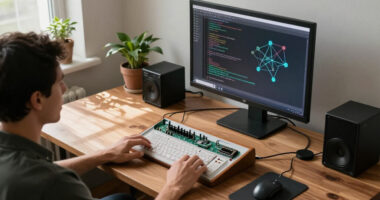

📊 Full opportunity report: Forezai · Polybot: When the AI Disagrees With the Odds on ThorstenMeyerAI.com — validation score, market gap, and execution plan.

Get business pricing on tech for your team
- Business-only prices and quantity discounts
- Tax-exempt purchasing
- Multiple users, one account, clear invoices
TL;DR
Polybot is an experimental AI designed to compare its probability estimates against market prices on Polymarket. It aims to identify when the AI’s view disagrees significantly with the market, testing the potential for AI to challenge crowd-based odds. Its performance and behavior are still under evaluation, highlighting the challenges of beating prediction markets with AI.
Polybot, an AI trading bot on Polymarket, is actively testing whether it can independently estimate probabilities that diverge from the market prices. This experiment aims to understand if AI can identify genuine mispricings and act on them, challenging the assumption that prediction markets are always correct. The project, led by Forezai, emphasizes risk management and transparency, making it a significant step in AI-driven market analysis.
Polybot is designed to research market questions by analyzing public information, formulating its own probability estimates, and comparing these to the market’s implied odds. The core idea is to identify when the AI’s estimate significantly differs from the market price, which could indicate a potential trading opportunity or insight. However, the system is built with strict discipline: it only trades when the disagreement surpasses a threshold that accounts for transaction costs, slippage, and model uncertainty, thus minimizing unnecessary trades.
According to Forezai, Polybot records its reasoning behind each estimate, enabling post-trade analysis and calibration over time. This feature aims to distinguish between mere luck and genuine predictive skill, emphasizing that the system’s value lies in its ability to produce calibrated probabilities across many estimates. The project explicitly states it is an experimental tool, not a money-making system, and warns of the risks involved in automated trading, especially in prediction markets where liquidity and market dynamics can quickly erode small edges.
Polybot — when the AI disagrees with the odds
A prediction market puts a price on the future. Polybot asks: can an AI’s own estimate diverge from that price for real — and should it ever act on the gap?
Not financial, investment, legal or tax advice; not a recommendation or solicitation to trade, invest or use any software. Forezai · Polybot is experimental software developed privately and is not publicly available, provided “as is” without warranty of accuracy or profitability. Trading and automated trading carry a substantial risk of loss including total loss of capital; past or backtested performance does not indicate future results. Prediction-market participation is restricted or prohibited in some jurisdictions (including for US persons) — you are solely responsible for compliance with applicable law. Consult a licensed professional before any financial decision. Produced with AI assistance under human editorial oversight; independent commentary, the author’s own views. Product and company names are trademarks of their respective owners; mention does not imply endorsement.
Implications for AI and Prediction Markets
This experiment demonstrates a cautious approach to using AI for market prediction, highlighting both the potential and limitations of independent AI estimates. If successful, it could pave the way for more transparent, calibrated AI tools that challenge crowd-sourced odds. However, it also underscores the difficulty of outperforming markets, especially after accounting for costs, slippage, and adversarial behavior. The project’s emphasis on auditability and risk discipline reflects a broader need for responsible AI deployment in financial decision-making, making this development relevant for traders, AI researchers, and regulators alike.
AI trading bot for prediction markets
As an affiliate, we earn on qualifying purchases.
As an affiliate, we earn on qualifying purchases.
Background on Prediction Markets and AI Challenges
Prediction markets like Polymarket aggregate public opinion and information into prices that reflect the collective probability of future events. These markets are generally efficient but not infallible. Historically, attempts by AI systems to beat markets have faced significant hurdles due to market efficiency, costs, and adversarial responses. Polybot builds on prior research into AI-based forecasting, emphasizing transparency, calibration, and risk management. The project’s focus on auditability distinguishes it from traditional trading bots, aligning with ongoing efforts to develop responsible AI tools for financial analysis.
“Polybot is an experiment to see if an AI can reliably identify when its probability estimate diverges from the market price in a meaningful way.”
— Forezai (via project documentation)
automated market analysis software
As an affiliate, we earn on qualifying purchases.
As an affiliate, we earn on qualifying purchases.
Uncertainties in AI Market Disagreement Detection
It remains unclear how often Polybot’s estimates will meaningfully diverge from market prices in live conditions, given market noise, liquidity, and adversarial responses. The long-term calibration and real-world profitability of such a system are still unproven. Additionally, the impact of costs, slippage, and market reactions on the AI’s effectiveness is not yet fully understood, and the system’s ability to avoid false positives or overfitting remains an open question.
probability estimation tools for trading
As an affiliate, we earn on qualifying purchases.
As an affiliate, we earn on qualifying purchases.
Next Steps in Polybot’s Development and Evaluation
Forezai plans to continue testing Polybot across multiple markets and conditions, focusing on its calibration and decision-making transparency. The project will analyze the frequency and quality of its disagreements with market prices, refine thresholds to balance risk and opportunity, and publish ongoing results. Further, the team aims to explore how the system performs over extended periods and whether it can develop a reliably calibrated probability estimate that can challenge market consensus without excessive risk.
prediction market trading algorithms
As an affiliate, we earn on qualifying purchases.
As an affiliate, we earn on qualifying purchases.
Key Questions
Can Polybot reliably beat prediction markets?
Currently, Polybot is an experimental system designed to test whether AI can identify meaningful disagreements with market prices. Its effectiveness in beating prediction markets has not yet been demonstrated and remains under evaluation.
Is Polybot a commercial trading tool?
No, Polybot is a research project developed privately and not publicly available intended to explore AI’s ability to challenge crowd-sourced odds. It is explicitly not a recommendation for trading or investment.
What risks are involved with using Polybot?
As an experimental system, Polybot carries significant risks, including potential losses due to market costs, slippage, and model inaccuracies. Users should treat it as a research tool and not rely on it for financial decisions.
How does Polybot record its reasoning?
Polybot logs its probability estimates and the reasoning behind each decision, enabling post-hoc analysis and calibration checks to assess its predictive reliability over time.
Source: ThorstenMeyerAI.com
Evergreen bestsellers Picks
bestsellers
As an affiliate, we earn on qualifying purchases.