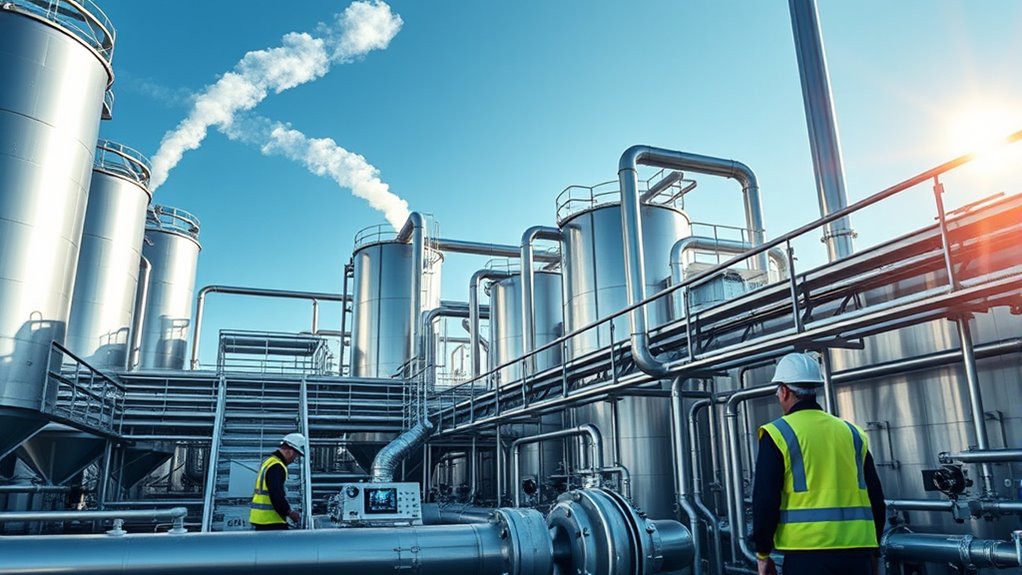

Carbon Capture and Utilization (CCU) technologies help you reduce greenhouse gases by capturing CO₂ from sources like power plants or even the atmosphere. These methods include direct air capture, which pulls CO₂ directly from the air, and mineralization, which converts CO₂ into stable minerals for safe storage or reuse. These innovative approaches support a circular carbon economy and contribute to fighting climate change. Keep exploring to discover how these advanced solutions can make a real difference.
Key Takeaways
- Carbon Capture and Utilization (CCU) technologies aim to reduce greenhouse gas emissions by capturing CO₂ and converting it into valuable products.
- Direct Air Capture (DAC) employs large fans and chemical filters to extract CO₂ directly from the atmosphere.
- Mineralization transforms captured CO₂ into stable mineral carbonates, providing permanent and environmentally safe sequestration.
- Mineralized carbonates can be reused in construction materials like cement, supporting a circular carbon economy.
- These technologies contribute to negative emission strategies, helping to achieve climate change mitigation goals.

As the world seeks ways to reduce greenhouse gas emissions, carbon capture and utilization (CCU) technologies emerge as promising solutions. These innovative methods aim to trap CO₂ from various sources and transform it into useful products, helping lessen our environmental impact. One intriguing approach within CCU is capturing carbon directly from the air, known as direct air capture. Unlike traditional capture methods that focus on industrial emissions, direct air capture actively pulls CO₂ from the atmosphere, where concentrations are relatively low. This process involves large fans drawing air through chemical filters that bind with CO₂, effectively removing it from the environment. Once captured, the CO₂ can be stored or converted into valuable materials, reducing the overall greenhouse effect.
Direct air capture pulls CO₂ from the atmosphere, offering a promising solution for reducing greenhouse gases.
Mineralization is another powerful technique that complements direct air capture. It involves transforming CO₂ into stable mineral forms through chemical reactions with naturally occurring minerals, such as silicates and oxides. When CO₂ is injected into these mineral-rich substrates, it reacts and forms solid carbonates, which are highly stable and environmentally benign. This process offers a permanent form of sequestration, preventing CO₂ from re-entering the atmosphere. Mineralization can be integrated with direct air capture systems by utilizing the captured CO₂ to react with minerals on-site or nearby, creating a closed-loop system that both removes and safely stores carbon.
You might find the concept of mineralization fascinating because it mimics natural processes like rock weathering but accelerates them considerably. It’s a way to lock away carbon safely and permanently, addressing one of the key challenges of climate mitigation. Moreover, mineralized carbonates can be used in construction materials, such as cement or concrete, turning waste into resource. This synergy between capture, conversion, and utilization exemplifies how CCU technologies can foster a circular carbon economy. Additionally, advances in capture efficiency are making these processes more feasible and cost-effective for large-scale deployment.
Implementing direct air capture combined with mineralization requires advanced engineering and resource management, but the benefits are substantial. These technologies can operate independently of emission sources, making them versatile tools in reducing global CO₂ levels. They also align with the growing emphasis on negative emission technologies, which are essential to meet ambitious climate targets. As you explore solutions for a sustainable future, understanding the role of direct air capture and mineralization offers insight into how cutting-edge science is transforming carbon management. Together, these strategies could help turn the tide against climate change and create a cleaner, healthier planet.
Frequently Asked Questions
What Are the Main Economic Barriers to Widespread Adoption?
You face economic barriers like high upfront costs, making it hard to see cost effectiveness in the short term. Market incentives are often lacking, so there’s little motivation for companies to invest in these technologies. Without strong policies or financial support, it’s challenging to justify the expense, even though long-term benefits could outweigh initial costs. Overcoming these barriers requires better incentives and cost reduction strategies.
How Does CCU Technology Impact Overall Carbon Lifecycle Emissions?
CCU technology reduces overall carbon lifecycle emissions by capturing CO2 emissions from sources like industrial processes and reusing it in products or fuels. This process prevents CO2 from entering the atmosphere, leading to significant emission reduction. By actively intercepting emissions at various stages, you lower the carbon footprint associated with production, transportation, and use, making CCU a crucial tool for achieving sustainable practices and combating climate change.
Are There Any Safety Concerns Associated With CO2 Storage?
You might wonder if storing CO2 is safe—there’s always some risk. But with diligent monitoring safety measures and leak prevention strategies in place, the chances of accidents decrease markedly. Regular inspections detect potential leaks early, preventing disaster. While no method is foolproof, advancements in safety protocols make CO2 storage increasingly secure, giving you peace of mind that careful oversight minimizes dangers and protects the environment effectively.
What Are the Regulatory Hurdles for CCU Implementation?
You’ll face regulatory hurdles like establishing clear legal frameworks for CO2 storage, which can be complex and vary by region. Policy incentives are often limited or inconsistent, making it harder to justify investments. Managing permitting processes, ensuring compliance with environmental standards, and gaining public acceptance also pose challenges. Overcoming these hurdles requires coordinated efforts to streamline regulations and create supportive policies that encourage CCU technology adoption.
How Scalable Are Current CCU Technologies for Global Use?
Sure, your grand plans for CCU’s global reach are as limitless as the universe—if only scalability challenges didn’t hold them back. Currently, technological advancements have made strides, but widespread implementation still faces hurdles like costs and infrastructure. While you dream of a world powered by CCU, remember that scaling these solutions globally requires overcoming significant barriers. So, don’t hold your breath; progress is steady but far from universal.
Conclusion
As you explore carbon capture and utilization, remember the story of Prometheus stealing fire—your efforts ignite hope for a cleaner future. By harnessing these technologies, you play a crucial role in turning the dark smoke of today into the bright promise of tomorrow. Every action, like a spark, contributes to a larger transformation, illustrating that even in the face of challenge, innovation can illuminate the path toward sustainability and a healthier planet.