Connecting AI glasses to your phone can slow it down because they constantly share data, which increases energy use and strains your device’s hardware. This extra workload causes your phone to work harder, leading to slower app launches and delays. The high processing demands of AR features can also bog down your CPU and GPU. If you want to understand how these factors come together to impact performance, keep exploring how interconnected devices affect your phone’s speed.

Get business pricing on tech for your team
- Business-only prices and quantity discounts
- Tax-exempt purchasing
- Multiple users, one account, clear invoices
Key Takeaways
- Continuous data sharing between AI glasses and phones increases processing load, slowing device responsiveness.
- High energy consumption from glasses strains phone batteries, causing throttling and sluggish performance.
- AR features demand intensive CPU and GPU resources, reducing available capacity for other tasks.
- Increased hardware workload from AR and data processing leads to lag and delayed app responses.
- Background data exchange by glasses consumes resources, impacting overall phone speed and user experience.
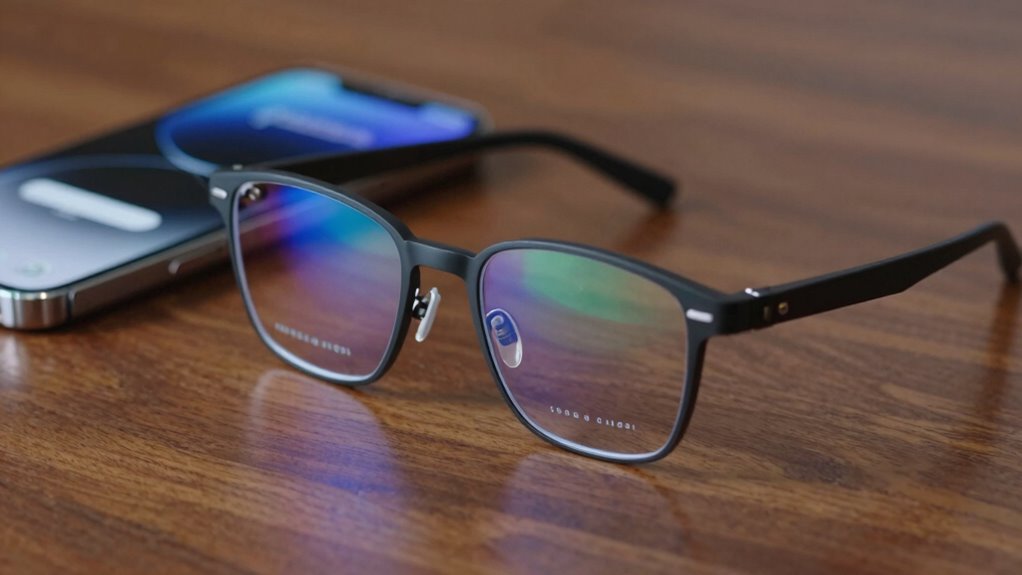
As AI glasses become more advanced, they’re starting to influence how quickly your phone responds and processes information. These smart glasses, often equipped with augmented reality capabilities, aim to enhance your daily interactions by overlaying digital information onto the real world. But as impressive as they are, they also introduce a new challenge: they can make your phone feel slower. This happens because the devices are increasingly interconnected, constantly sharing data and processing tasks in real-time. When your AI glasses are actively analyzing your environment or overlaying augmented reality visuals, they demand a lot of processing power. This, in turn, can lead your phone to struggle with its usual speed, especially if it’s trying to sync or communicate with the glasses simultaneously.
One key factor here is battery consumption. These glasses need significant energy to run their sensors, display AR content, and process data for a seamless experience. As a result, your phone often has to work harder to keep up with this energy drain, especially if it’s tethered through Bluetooth or Wi-Fi. When your phone is constantly exchanging data with AI glasses, it consumes more power, which can slow down system performance. The increased battery consumption means your phone might throttle its performance to conserve energy, making everything from app launches to page loads feel sluggish. Additionally, power management becomes crucial in maintaining overall device responsiveness during heavy usage of interconnected devices. Improving device efficiency could help mitigate some of these issues as technology advances. Moreover, the integration of wearable technology requires increased coordination between devices, further impacting phone responsiveness.
AI glasses’ high energy use can slow your phone and cause sluggish app performance over time.
Furthermore, augmented reality features require continuous data processing and rendering, which can strain your phone’s CPU and GPU. When your device is busy handling AR overlays from the glasses, it might allocate resources away from other tasks. This can lead to noticeable lag or delays in your phone’s usual operations. The more complex and integrated the AR experience becomes, the more your phone has to juggle multiple processes simultaneously, often leading to a perception of slower performance. Additionally, the processing capabilities of your device can become a limiting factor, especially if the hardware isn’t optimized for such demanding tasks. Upgrading hardware components like the graphics processor could help better handle these augmented reality workloads.
In essence, while AI glasses add a futuristic layer to your daily tech, their demanding features—like augmented reality—can inadvertently cause your phone to feel sluggish. They stretch your device’s processing capabilities and drain its battery faster, which can slow down your overall experience. Until phones optimize better for this new wave of interconnected smart devices, you might find yourself waiting a little longer for apps to load or pages to refresh, all because your AI glasses are working in the background, pushing the limits of your phone’s performance.
As an affiliate, we earn on qualifying purchases.
Frequently Asked Questions
Will AI Glasses Replace Smartphones Entirely in the Future?
AI glasses probably won’t replace smartphones entirely anytime soon. They’ll likely complement your device, offering augmented reality experiences and a more seamless user interface. You’ll still rely on your phone for certain tasks, but AI glasses will enhance how you interact with digital content, providing quick access and real-time info. This integration will make your overall experience more intuitive, rather than replacing your phone completely.
How Do AI Glasses Impact Battery Life of Phones?
AI glasses can cause your phone’s battery drain to deepen, as constant data exchange and real-time processing require significant power. However, smart power optimization strategies can help reduce this drain, balancing between performance and longevity. When you use AI glasses, you’re indirectly impacting your phone’s battery life, so keeping an eye on power consumption and enabling energy-saving features becomes essential for prolonging device life and maintaining seamless connectivity.
Can AI Glasses Improve Phone Processing Speeds?
AI glasses can improve your phone’s processing speeds by offloading tasks through Augmented Reality (AR) features. When you use AR, the glasses handle some computations, reducing the load on your phone. This enhances your overall User Experience, making interactions smoother and faster. As a result, your phone doesn’t have to work as hard, leading to quicker responses and a more seamless, immersive experience with less lag.
Are AI Glasses Compatible With All Smartphone Models?
No, AI glasses aren’t compatible with all smartphone models. While they shine in augmented reality and hands-free communication, compatibility varies by device. You might find some glasses work seamlessly with your phone, but others require specific operating systems or apps. Ironically, even with these high-tech gadgets, you could end up juggling different devices, making your experience feel more complex than just using your phone alone.
What Privacy Concerns Arise With AI Glasses and Phone Data?
With AI glasses, you face privacy concerns around data security and surveillance risks. These devices often collect and transmit personal information, increasing the chance of data breaches or unauthorized access. Surveillance risks also rise if your AI glasses record or monitor your environment without consent. You should stay cautious about how your data is stored, shared, and protected to prevent misuse or privacy violations.
As an affiliate, we earn on qualifying purchases.
Conclusion
As you slip on AI glasses, it’s like opening a new chapter where your phone’s speed becomes a distant echo, a fading rhythm that struggles to keep pace. The glasses symbolize a bridge, a new horizon where hands-free clarity shifts your focus, leaving the old world behind. In this dance of innovation, your phone may slow, but your perspective sharpens—embracing a future where vision leads and technology follows, quietly transforming how you see and move through your day.
As an affiliate, we earn on qualifying purchases.
wearable augmented reality device
As an affiliate, we earn on qualifying purchases.
As an affiliate, we earn on qualifying purchases.
Fall Picks
fall essentials
As an affiliate, we earn on qualifying purchases.