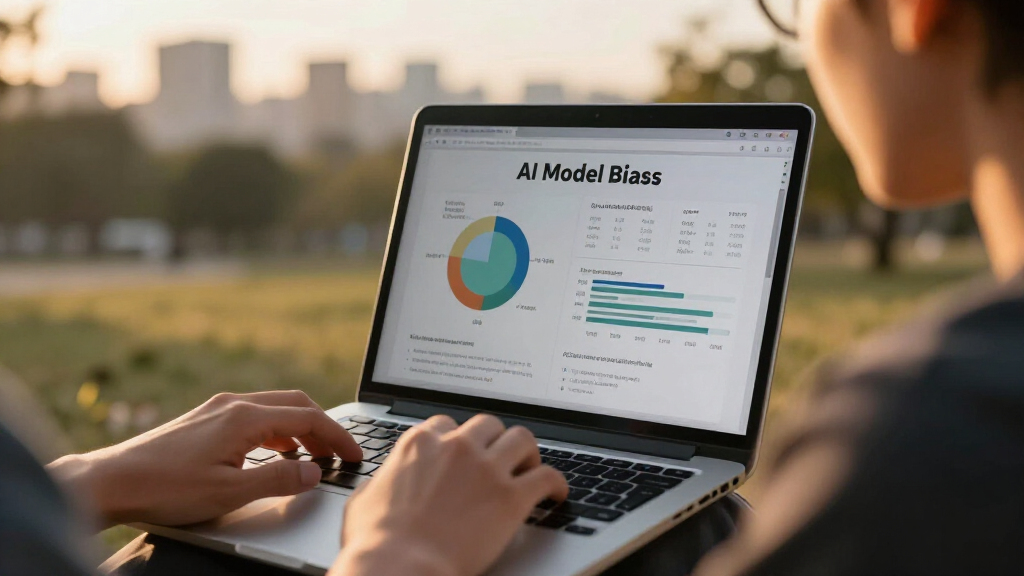

📊 Full opportunity report: The Three-Model Bias In AI: A Modern Media Analogy on ThorstenMeyerAI.com — validation score, market gap, and execution plan.

Get business pricing on tech for your team
- Business-only prices and quantity discounts
- Tax-exempt purchasing
- Multiple users, one account, clear invoices
TL;DR
A growing reliance on a small number of AI models for interpreting complex events is creating a shared perspective, which may lead to societal and market risks. This article examines the analogy with media bias and its implications.
Recent developments reveal that an increasing number of institutions and individuals are relying on a small set of AI models to interpret complex information, creating a shared perspective that could pose societal risks. This phenomenon parallels the historical role of a single trusted news anchor, which once unified public perception but also represented a single point of failure.
The core issue is that many organizations now feed similar data into the same AI models, which produce nearly identical outputs. This homogenization reduces interpretive diversity, a key component of healthy collective decision-making. Experts, including Thorsten Meyer, warn that this trend risks creating societal and market brittleness, as the absence of disagreement makes systems more vulnerable to collective errors.
Specifically, markets are experiencing faster cycles of boom and bust, not because fundamentals change more rapidly, but because the shared AI interpretation accelerates consensus. When everyone acts on the same probabilistic read, market movements become more synchronized and less resilient. This pattern is observed across other sectors where collective sense-making influences risk assessment and crisis reading.
A failure mode is building quietly under the AI economy, and it has nothing to do with the models getting too smart. It’s the opposite: they’re becoming a single shared lens — one anchor through which vast numbers of people read the same events the same way at the same moment.
▲ Opinion & analysis · not investment adviceInterpreting the world is a Bayesian problem — the kind where diversity of prior isn’t a nicety but the mechanism. Feed the same input to the same model and you get the same read, delivered to millions as if it were the answer.
A market works because buyers and sellers disagree about what news means; the price is that disagreement, resolved. Collapse the diversity and you don’t get a smarter market — you get a violently compressed one.
Each person routing their thinking through the best model behaves rationally. The aggregate is a monoculture — efficient until one shared blind spot takes the whole field at once.
Not worse tools or fewer of them — many genuinely different ones. This is where an abstract worry meets a case I’ve made from a completely different starting point.
Keep the interpreters plural — that is the whole defense.
Impacts of Reduced Interpretive Diversity in Society
This trend matters because it can lead to more fragile markets and societal systems. When interpretive diversity diminishes, errors become magnified, and collective responses can overshoot or undershoot reality. The homogenization driven by AI models risks creating a society where disagreement and debate are replaced by uniformity, increasing the potential for rapid, destabilizing shifts.
AI model interpretive diversity tools
As an affiliate, we earn on qualifying purchases.
As an affiliate, we earn on qualifying purchases.
Historical and Current Trends in Media and AI Usage
Historically, a single trusted news figure provided a unified lens on reality, fostering shared understanding but also creating a single point of failure. Media fragmentation later introduced diverse perspectives, which helped prevent uniform interpretation. Today, AI models are replacing that role, with a handful of frontier models shaping perceptions across sectors. This shift is driven by the efficiency and capability of these models but introduces new risks associated with interpretive uniformity.
"The homogenization is the product of more institutions feeding the same raw material through the same models, producing near-identical outputs."
— Thorsten Meyer
As an affiliate, we earn on qualifying purchases.
Uncertainties Around Long-term Societal Impact
It remains unclear how widespread or persistent this bias will become as AI models evolve and diversify. The extent to which industries and societies will develop safeguards or alternative interpretive methods is still uncertain. Additionally, the long-term impact on societal resilience and democratic debate is not yet fully understood.
AI interpretability and explanation tools
As an affiliate, we earn on qualifying purchases.
As an affiliate, we earn on qualifying purchases.
Monitoring and Mitigating the Effects of AI Homogeneity
Future steps include increased awareness of interpretive homogeneity risks, development of diverse AI models, and policies encouraging interpretive plurality. Researchers and regulators may focus on fostering interpretive diversity to prevent societal brittleness. Ongoing analysis of market behaviors and societal responses will inform these efforts.
As an affiliate, we earn on qualifying purchases.
Key Questions
What is the 'Three-Model Bias' in AI?
The 'Three-Model Bias' refers to the tendency of many institutions to rely on a small set of AI models, leading to homogenized interpretations of complex information, similar to media consensus.
Why does this homogenization pose a risk?
Homogenization reduces interpretive diversity, making markets and societal systems more fragile, prone to rapid errors, and less resilient to shocks.
Can this trend be reversed?
Reversing this trend involves developing more diverse AI models, encouraging multiple perspectives, and fostering debate and disagreement in decision-making processes.
How does this compare to historical media influence?
It is analogous to the era when a single news anchor shaped public perception, which fostered unity but also created a single point of failure. AI models now serve a similar role at scale.
What should institutions do to mitigate these risks?
Institutions should diversify their sources of interpretation, support multiple AI models, and promote critical engagement with AI-generated outputs.
Source: ThorstenMeyerAI.com
Halloween Picks
halloween
As an affiliate, we earn on qualifying purchases.