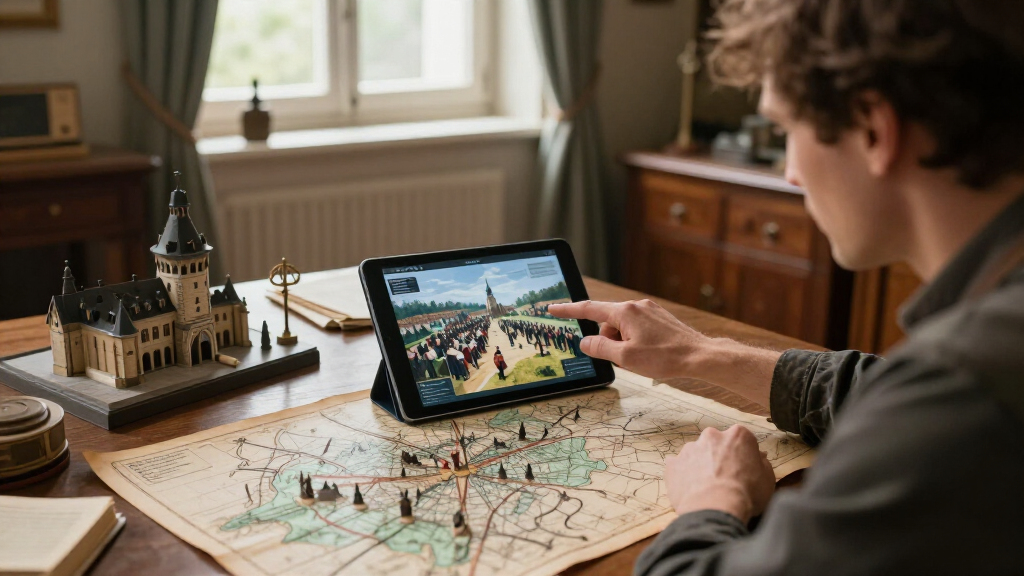

🔍 Read the full analysis: The Power Of AI In Recreating 1693 La Citadelle’s Historic Siege on ThorstenMeyerAI.com

Get business pricing on tech for your team
- Business-only prices and quantity discounts
- Tax-exempt purchasing
- Multiple users, one account, clear invoices
TL;DR
An AI-driven digital exhibition has recreated the 1693 siege of La Citadelle, offering an immersive, scroll-driven experience. This showcases AI’s potential in historical visualization and education.
AI has been employed to create a highly detailed, interactive digital reconstruction of the 1693 siege of La Citadelle, offering viewers a cinematic experience rooted in historical accuracy. This innovative project, developed through a rigorous AI-guided workflow, transforms traditional historical storytelling into an immersive visual journey. The exhibition is now accessible online, providing a new way to explore and understand this pivotal event in military history.
The project, hosted on a dedicated site, uses layered SVGs, CSS, and canvas elements to simulate the siege’s terrain, troop movements, and artillery fire without relying on static images. For more details, see the original analysis. It features a dynamic, scroll-driven diagram that visually narrates the siege over time, with animations depicting earthworks, battalion movements, and shell trajectories. The entire experience is orchestrated by AI-powered site logic, ensuring high fidelity to historical details and artistic coherence.
According to the creators, the process involved three main stages: initial construction using layered digital elements, iterative critique driven by AI analysis for visual and historical plausibility, and final approval by an art director. The site employs a restrained color palette and carefully selected typography to evoke the atmosphere of the period. The project aims to balance educational content with aesthetic storytelling, making it accessible and engaging for diverse audiences.
Developers emphasize that no static images or external assets are used; every visual element is generated through code, ensuring scalability and responsiveness across devices. The exhibition also includes detailed explanations of fortification geometry, siege tactics, and historical context, presented through interactive diagrams and cinematic overlays. Learn more in the internal link to Glimpse. The goal is to provide a comprehensive, immersive experience of the 1693 siege that appeals to both historians and digital art enthusiasts.
Potential of AI in Historical Visualization
This project demonstrates how AI can revolutionize historical education and visualization by creating immersive, accurate reconstructions of past events. It offers a new method for museums, educators, and historians to present complex military sieges and other historical phenomena in engaging formats. The use of AI-driven critique and layered digital storytelling could set a precedent for future virtual exhibits, expanding access to cultural heritage and enhancing learning experiences.
interactive historical simulation software
As an affiliate, we earn on qualifying purchases.
As an affiliate, we earn on qualifying purchases.
Historical and Technological Background of La Citadelle Siege
The siege of La Citadelle in 1693 was a significant military event during the late 17th century, involving complex fortification tactics and troop movements typical of Vauban-style star forts. Traditionally documented through engravings and written accounts, the event’s detailed visualization has been limited by static images and textual descriptions. Recent advances in AI and web technologies have now enabled the creation of dynamic, interactive reconstructions that bring history to life in unprecedented ways.
This project builds on prior efforts to digitize military history, but distinguishes itself through its use of layered SVGs, CSS animations, and AI-guided critique to achieve a high level of fidelity and artistic expression. It reflects a broader trend of integrating AI into cultural heritage preservation and digital storytelling, allowing for more nuanced and immersive experiences than traditional methods.
“By combining layered digital architecture with AI critique, this project achieves a balance of historical accuracy and artistic storytelling that was previously impossible.”
— Thorsten Meyer
AI-powered digital museum exhibits
As an affiliate, we earn on qualifying purchases.
As an affiliate, we earn on qualifying purchases.
Extent of Historical Accuracy and AI Limitations
While the project claims high fidelity to the 1693 siege, it is not yet clear how comprehensive or verified the historical details are. The AI critique process aims for plausibility, but some elements may be interpretative or reconstructed based on available sources. The accuracy of troop movements, fortification layouts, and tactical details remains subject to ongoing review and expert validation.
Additionally, as the exhibit is a digital simulation, it cannot fully replicate the sensory and contextual nuances of the actual event, such as sounds, smells, and the chaos of battle. The extent to which this visualization accurately reflects the real historical experience is still under discussion among historians and technologists.
As an affiliate, we earn on qualifying purchases.
Future Developments and Broader Applications of AI Reconstructions
Developers plan to expand the platform by integrating more detailed source material and collaborating with military historians for validation. There is also potential to adapt the technology for other historical events, periods, and cultural sites, making immersive history accessible worldwide.
Further enhancements may include augmented reality versions, interactive quizzes, and multi-language support to broaden educational reach. As AI technology advances, expect more nuanced and precise reconstructions that could redefine digital heritage preservation and public history engagement.
virtual reality historical reenactments
As an affiliate, we earn on qualifying purchases.
As an affiliate, we earn on qualifying purchases.
Key Questions
How accurate is the AI reconstruction of the 1693 siege?
The reconstruction aims for high fidelity based on available historical sources, but some details are interpretative and subject to ongoing expert review. It balances accuracy with artistic storytelling.
Can I explore the siege interactively online?
Yes, the exhibit is accessible via a dedicated website that allows users to scroll through the siege timeline, view animations, and explore interactive diagrams.
What technologies are used in creating this digital exhibit?
The project employs layered SVGs, CSS animations, and HTML5 canvas elements, all orchestrated by AI-guided critique processes, without reliance on static images or external assets.
Will this AI reconstruction replace traditional historical research?
Not replace, but complement. It offers an immersive visualization tool that enhances understanding and engagement, while traditional research provides the foundational accuracy and context.
Source: ThorstenMeyerAI.com
Fall Picks
fall essentials
As an affiliate, we earn on qualifying purchases.