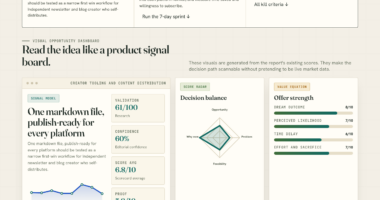
📊 Full opportunity report: Spatial Focus Room: Make Distraction Impossible on ThorstenMeyerAI.com — validation score, market gap, and execution plan.

Get business pricing on tech for your team
- Business-only prices and quantity discounts
- Tax-exempt purchasing
- Multiple users, one account, clear invoices
TL;DR
Spatial Focus Room, a deep-work app for Apple Vision Pro, creates immersive environments to eliminate distractions and enhance focus. It logs sessions and allows task-specific deep work, aiming to change focus habits.
Apple’s new Spatial Focus Room app for Vision Pro is designed to eliminate distractions during deep work sessions by immersing users in virtual environments that remove visual and auditory interruptions. This approach aims to address the fundamental flaw of traditional focus tools, which rely on willpower and internal resistance, by physically removing distractions through immersive technology. The app’s launch marks a significant shift in how focus and productivity tools are conceived, leveraging the capabilities of the Vision Pro headset to create distraction-free zones.
The Spatial Focus Room offers three distinct environments — CalmBeach, Rainforest, and DeepSpace — each designed to foster concentration through visual and auditory cues. Users can choose between fully immersive sessions, where the environment completely replaces their physical surroundings, or passthrough mode, which overlays ambient audio and visuals onto their real desk. These environments are generated procedurally, ensuring consistency and cost-effectiveness.
The app tracks each session, recording metrics such as focus streaks, total focus hours, and session details like location and duration. Users can attach specific tasks to each session, making deep work intentional and accountable. This combination of immersive environments, session tracking, and task management aims to turn focus into a habit rather than a fleeting attempt.
Make Distraction Impossible
We protect deep work with a timer that lives on the same glowing rectangle holding every feed and notification engineered to pull us out. Spatial Focus Room’s premise: the most reliable way to remove a distraction is to make it physically unavailable — and a headset is the first device that can.
A phone can tell you that you got distracted. A headset can make distraction impossible.
Each is a seamless 360° skybox + a 60-second ambient loop that masks your real room and becomes a cue: “focus starts now.” None of it is licensed stock — every skybox and soundscape is generated procedurally, so the catalog is cheap to expand.
Intent, attached to every session: name one concrete task and it floats in view inside the immersive space. Twenty-five minutes against one named thing — checked off and logged when the session ends. A calm environment becomes accountable deep work.
and becomes a place you go.
Independent commentary, produced with AI assistance under human editorial oversight. The views are the author’s own and may change. This describes a product’s design, features, and business rationale — not business, financial, legal, technical, or medical advice; cost and retention figures are the product’s own framing, not independently verified. Spatial Focus Room is a forthcoming app for Apple Vision Pro (visionOS 26); described features, pricing, and availability are stated by the product and may change. Names are trademarks of their respective owners; mention does not imply endorsement.
Transforming Focus Through Physical Distraction Removal
This development matters because it shifts the focus from resisting distractions to physically eliminating them, leveraging the capabilities of mixed reality hardware. By creating environments that users can enter and leave at will, the Spatial Focus Room could significantly improve productivity and concentration, especially for remote workers and knowledge professionals. Its emphasis on measurable progress and task-specific sessions also encourages sustained deep work habits, potentially transforming how individuals approach focus in their daily routines.
Apple Vision Pro virtual reality headset
As an affiliate, we earn on qualifying purchases.
As an affiliate, we earn on qualifying purchases.
Limitations of Traditional Focus Tools and the Rise of Immersive Tech
Conventional focus tools, such as timers and apps on smartphones, have long struggled with the inherent flaw of asking users to resist distractions from within the very device designed to distract. Studies show that interruptions cause minutes of lost focus, and repeated shifts can severely impair productivity. The advent of immersive headsets like Apple Vision Pro introduces a new paradigm: physically removing distractions rather than trying to resist them. Prior efforts to improve focus have relied on software interventions, but the hardware capabilities of mixed reality devices enable a more fundamental change by creating distraction-free zones.
While the app is a new offering, it builds on existing research indicating that environment design and sensory cues can enhance focus. The use of procedurally generated environments ensures consistency and scalability, making it feasible to expand the offering without licensing costs associated with stock footage or sound clips.
“The core idea behind Spatial Focus Room is simple: if you physically remove distractions, focus becomes the default state. The headset creates a dedicated environment for concentration, not just a temporary pause.”
— Thorsten Meyer, AI-focused product developer
As an affiliate, we earn on qualifying purchases.
Unclear Aspects of Long-Term Effectiveness and Adoption
It is not yet clear how widely the Spatial Focus Room will be adopted or how effective it will be over the long term in improving productivity. While initial design and concept are promising, empirical data on sustained use and real-world impact are still forthcoming. Additionally, how users will integrate this technology into their daily routines remains to be seen, especially considering hardware costs and accessibility issues. Further studies and user feedback are needed to validate its effectiveness and scalability.
As an affiliate, we earn on qualifying purchases.
Next Steps for Deployment and User Feedback
Following its announcement, the company plans to release the app for beta testing with select users, gathering data on usage patterns and effectiveness. Future updates may include additional environments, improved task integration, and analytics features. Broader rollout is expected once initial feedback confirms usability and benefits. Monitoring user engagement and productivity metrics will determine whether this approach becomes a standard tool for deep work.
As an affiliate, we earn on qualifying purchases.
Key Questions
How does the Spatial Focus Room eliminate distractions?
It creates immersive virtual environments that replace or overlay the physical surroundings, removing visual and auditory distractions during focus sessions.
Can users still see their physical workspace while using the app?
Yes, in passthrough mode, users can see their real desk with ambient audio and visuals layered over it, allowing for some physical interaction while maintaining focus.
Will this app work without the Apple Vision Pro headset?
No, the app is specifically designed for the Vision Pro’s immersive mixed reality capabilities and cannot operate on other devices.
What are the potential limitations of this approach?
High hardware costs, limited accessibility, and uncertain long-term effectiveness are potential barriers. Additionally, some users may find immersive environments distracting or uncomfortable over extended periods.
Source: ThorstenMeyerAI.com
Fall Picks
fall essentials
As an affiliate, we earn on qualifying purchases.