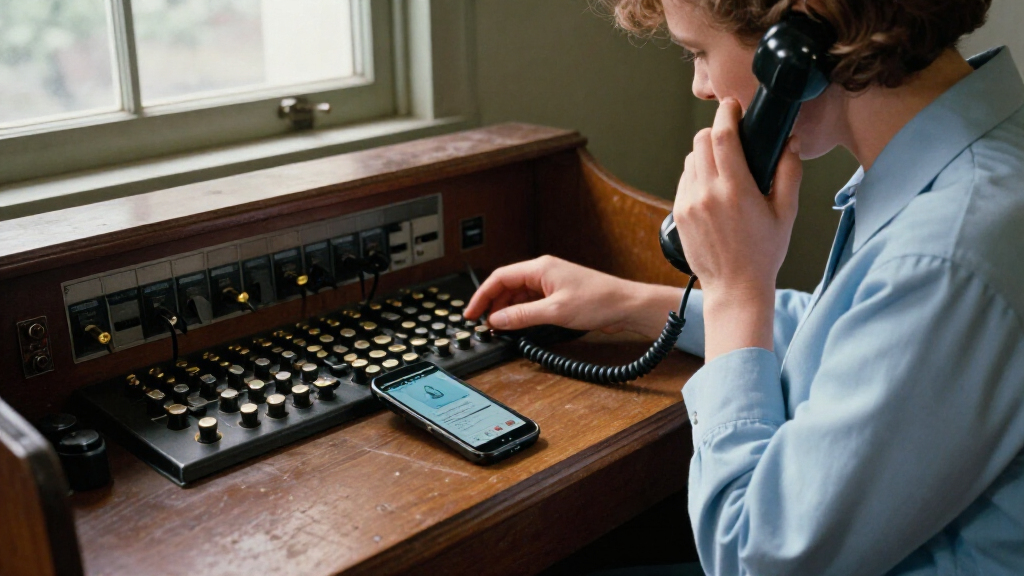
🔍 Read the full analysis: How Switchboard Operators Paved The Way For AI-Powered Calls on ThorstenMeyerAI.com

Get business pricing on tech for your team
- Business-only prices and quantity discounts
- Tax-exempt purchasing
- Multiple users, one account, clear invoices
TL;DR
Automatic telephone exchanges gradually replaced human switchboard operators across the Bell System, with dial service reaching the full network in 1978. A source article, citing economists James Feigenbaum and Daniel Gross, estimates that about one in seven white, American-born women born around 1900 worked as an operator at some point. The historical account draws parallels with current concerns about generative AI and women’s employment, while the scale of any future job losses remains uncertain.
In the early telephone system, callers relied on operators to connect them manually. An operator plugged a cord into the correct switchboard jack, linking one subscriber to another. The source says that by 1910 operators were almost all women, after telephone companies shifted from hiring mostly boys and young men. The work could be demanding, but former operators described it as relatively well paid and more social than factory work.
Telephone operation became a mass occupation as the network expanded. In 1920, operators accounted for roughly 2% of working women in the United States, according to the source. The 1930 census counted about 182,000 operators in the telephone industry, with another 23,000 working at private switchboards in hotels, hospitals and large companies. The article says AT&T was the country’s largest employer of women in the 1910s and the largest employer overall by the early 1920s.
Automatic switching developed over decades rather than in a single overnight change. Almon B. Strowger received a U.S. patent for an automatic telephone exchange in 1891. The Bell System began converting exchanges in 1919, after earlier experiments. According to the article, 32% of Bell telephones had dial service by 1930 and 60% by 1940. The source says the final Bell conversions were completed in 1978. Preparing a city could take two to three years, even though the physical cutover from switchboard wires to machinery took only a few minutes.
Infographic 01 · Rise and fall
The switchboard job: 70 years up, half a century down
The dial arrived city by city from 1919. Yet the number of telephone operators kept growing until 1970, because calls, long distance and office switchboards grew too.
All telephone operators in the US census · thousands
Share of Bell System telephones on dial
Census counts: persons 14 and over, economically active (1950 in the 1950 classification); they include operators at private switchboards. After 1970: −75,000 telephone operator jobs in 1972-1980 (BLS), all of them held by women. 2025: wage and salary jobs (BLS survey), split into telephone operators (3,430) and switchboard operators incl. answering services (34,280). Definitions differ: compare orders of magnitude only.
Sources: US Census Bureau, Historical Statistics of the United States (1975), series D 351; J. Feigenbaum & D. P. Gross, Quarterly Journal of Economics 139(3), 2024 (AT&T archive data, 1930 count, 1 in 7 estimate); C. B. Leon, Monthly Labor Review (June 1982); BLS, Occupational Employment and Wage Statistics, May 2025.
Powered by Thorsten Meyer AI
What Operator History Reveals About Automation
The account distinguishes the effects on workers already in the occupation from the experience of later generations. It cites research by Feigenbaum and Gross indicating that after a city changed to dial service, the number of young operators fell by 50% to 80%. Incumbent operators were less likely to be employed ten years later, and those who remained employed more often held lower-paid jobs, the article says.
At the same time, the source reports that young women’s overall employment did not fall in the same way: later cohorts found work as typists, secretaries and food-service workers, including in industries that had not previously employed many women in those roles. That shift does not mean the affected operators avoided disruption. It shows why the effects of automation need to be assessed by worker group and career stage, not only by whether total employment rose or fell.
The comparison matters as employers adopt AI tools that can perform or assist with clerical tasks. The article points to the International Labour Organization’s ranking of clerical jobs as the occupations most exposed to generative AI, and says that in rich countries this exposure falls more heavily on women’s jobs than men’s. Exposure, however, is not the same as a confirmed job loss: the historical case offers questions to examine, not a precise forecast of AI’s effects.
Products Worth Considering

Bose QuietComfort Ultra Earbuds (2nd Gen), Wireless Noise-Cancelling Earbuds, Black

Apple AirPods Pro 3 Wireless Earbuds with Active Noise Cancellation

Samsung 27-Inch Odyssey G5 QHD Gaming Monitor (G50F)
As an affiliate, we earn on qualifying purchases.
From Manual Calls to Dial Exchanges
The Bell telephone company was founded in 1877, and its first telephone exchange opened in New Haven, Connecticut, in 1878. Early calls required a person to connect lines by hand. As the number of subscribers grew, so did the need for operators; manual switching became harder to scale. The article says operators made up about half of AT&T’s workforce in the early 1920s, while annual turnover in internal company records reached as high as 40%.
The move to automatic exchanges was gradual and varied by location. The source says AT&T engineers recommended mechanical switching for large cities in 1917, and that the Bell System began conversions two years later. Wartime copper rationing halted conversions during World War II. The article also cautions against treating a familiar story about Strowger—an undertaker who supposedly believed an operator was diverting his customers—as fact: its author says no primary source confirming that account was found.
The estimate of one in seven has a defined population and time frame. Feigenbaum and Gross used census counts, operator ages and turnover estimates to calculate that about 13.7% of white, American-born women born around 1900 worked as telephone operators at some point from 1910 to 1940. The article stresses that the estimate refers to white women; it says AT&T did not hire Black operators until after 1940.
Limits of the Historical Comparison
The source is a historical analysis, not a new employment study of AI. It does not establish how many workers generative AI will displace, how quickly that could happen, or whether new roles will offset losses. The ILO exposure finding cited in the article describes which jobs may be affected by the technology; it does not by itself show that those jobs will disappear.
The telephone figures also depend on the populations and estimates used. The one-in-seven calculation applies to white, American-born women born around 1900, not to all women or all workers. The article’s account of local employment changes does not provide city-by-city figures or detailed evidence about the outcomes of every operator. Its Strowger anecdote is explicitly unconfirmed, and should not be treated as an established explanation for the invention.
Questions for Today’s AI Workforce
The historical account leaves current outcomes open. To determine whether AI is producing comparable employment changes, readers would need updated evidence on hiring, layoffs, wages, job duties and the creation of new work, broken down by occupation, gender and age. Measures of technological exposure should be tracked separately from measured changes in employment.
For workers and employers, the central issue is how tasks and opportunities change as tools enter the workplace. The telephone transition took place over many decades, with substantial differences between incumbent workers and younger people entering the labor market. Whether AI follows a similar path—and who bears the costs—will depend on adoption, workplace decisions and the availability of other jobs. The article presents that comparison as a reason to watch those outcomes, not as a prediction.
Key Questions
What is the news development in this article?
A November 19, 2026, article reviews the history of automatic telephone exchanges and uses the displacement of switchboard operators to examine current concerns about AI and work. It is a historical report, not an announcement of a new AI employment finding.
How many women worked as telephone operators?
Economists James Feigenbaum and Daniel Gross estimated that about 13.7%—roughly one in seven—of white, American-born women born around 1900 worked as operators at some point between 1910 and 1940. The estimate does not cover all women.
When did automatic switching replace manual operators?
The change took place gradually. The Bell System began converting exchanges in 1919; the source reports that 32% of Bell telephones had dial service by 1930 and 60% by 1940. It says the last Bell conversions were completed in 1978.
Does the operator history prove AI will eliminate clerical jobs?
No. The article uses the telephone transition as historical context. The ILO exposure finding it cites concerns jobs that may be affected by generative AI, not a confirmed number of jobs that will be lost.
Source: ThorstenMeyerAI.com