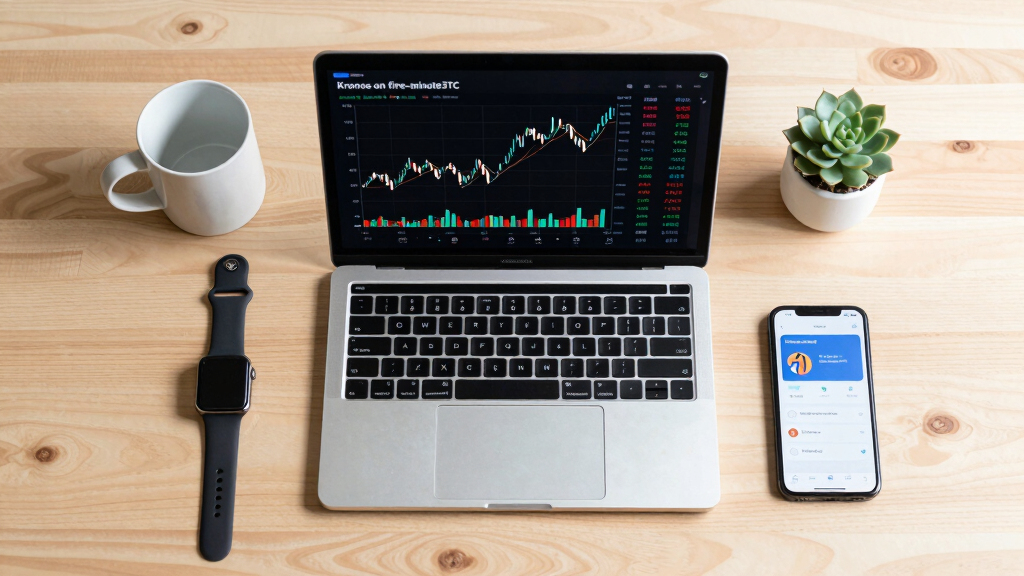

📊 Full opportunity report: Week Three — Foundation model vs Brownian motion. Kronos on five-minute BTC. on ThorstenMeyerAI.com — validation score, market gap, and execution plan.

Get business pricing on tech for your team
- Business-only prices and quantity discounts
- Tax-exempt purchasing
- Multiple users, one account, clear invoices
TL;DR
A recent test comparing Kronos, a foundation model, against Brownian motion for 5-minute Bitcoin prediction found no significant advantage. Brownian motion remains competitive in this context, challenging assumptions about AI-based trading models.
Recent testing of Kronos, an open-source foundation model for financial time series, found it does not outperform the traditional Brownian motion model in predicting 5-minute Bitcoin price movements, challenging expectations that advanced AI models would have a trading edge in this domain.
Over the past two weeks, a researcher ran a comprehensive offline comparison between Kronos-small, a state-of-the-art foundation model, and a geometric Brownian motion baseline, using historical data from a custom paper-trading bot focused on Polymarket’s 5-minute BTC markets. The test involved 497 trades, reconstructing market context and evaluating each model’s predicted probabilities against actual outcomes.
The results showed that Kronos’s predictive performance, measured by Brier score and log-loss, was statistically indistinguishable from Brownian motion on both the full sample and a strictly out-of-sample subset of 249 trades. Specifically, Brownian’s Brier score was marginally better, and Kronos’s confidence in tail predictions was notably overconfident, as indicated by higher log-loss values. Despite expectations, the foundation model did not demonstrate a meaningful edge over the simple, classical assumption of market behavior.
Implications for AI in Short-Term Crypto Trading
This finding questions the assumption that large, learned models inherently provide better predictive power in highly efficient, short-term crypto markets. The result suggests that, at least for 5-minute horizons, traditional models like Brownian motion remain competitive, and the added complexity of foundation models may not translate into practical trading advantages. For traders and developers, this underscores the importance of rigorous testing and skepticism when deploying AI-based strategies in real markets.
As an affiliate, we earn on qualifying purchases.
Background on Model Testing and Market Assumptions
Prior to this test, the author had been experimenting with a paper-trading bot that used a geometric Brownian motion model to estimate probabilities of BTC closing above certain thresholds within five minutes. Despite the model’s mathematical simplicity and long-standing use in finance, there was speculation that more sophisticated, data-driven models like Kronos could outperform it. Kronos, trained on millions of candles from global exchanges and backed by academic research, represents a new class of AI models designed for financial time series prediction. Previous expectations were that such models might capture complex market dynamics better than traditional assumptions.
The current test was motivated by the need to empirically verify if these models could deliver a real edge in short-term trading, given the market’s apparent efficiency and the historical dominance of simple stochastic models in finance.
“Kronos does not outperform Brownian motion in predicting 5-minute BTC movements, at least in this out-of-sample test.”
— Thorsten Meyer, researcher
cryptocurrency trading prediction tools
As an affiliate, we earn on qualifying purchases.
As an affiliate, we earn on qualifying purchases.
Unresolved Questions About Model Performance and Market Conditions
It remains unclear whether different configurations, training data, or market conditions might allow Kronos or similar models to outperform Brownian motion in other contexts or timeframes. Additionally, the test was conducted offline and does not account for live trading factors such as slippage, market impact, or real-time data quality. Whether the models could perform better with real-time adaptation or in different market regimes is still an open question.
financial time series analysis software
As an affiliate, we earn on qualifying purchases.
As an affiliate, we earn on qualifying purchases.
Future Testing and Potential Model Improvements
Further research could involve live testing of Kronos in real-time trading environments, exploring different model architectures, or combining traditional stochastic models with machine learning techniques. Continuous evaluation in varying market conditions will be essential to determine if foundation models can eventually deliver a genuine edge in short-term crypto trading. Additionally, researchers may investigate other asset classes or longer time horizons for potential advantages.
As an affiliate, we earn on qualifying purchases.
Key Questions
Does this mean AI models are useless for crypto trading?
No, this specific test shows that Kronos did not outperform a simple Brownian motion model in predicting 5-minute BTC moves. AI models may still be useful in other contexts or longer timeframes, but their advantage is not guaranteed.
Could model performance improve with different training data?
Potentially, yes. The current results are based on a specific dataset and model configuration. Different data or training methods might yield different outcomes.
Is this test applicable to live trading?
This test was conducted offline and does not account for real-time trading factors such as slippage and market impact. Live testing could produce different results.
Why did Kronos not outperform Brownian motion?
The data suggests that, for short-term BTC price movements, market behavior aligns closely with the assumptions of Brownian motion, making more complex models unnecessary or ineffective in this context.
Source: ThorstenMeyerAI.com
Halloween Picks
halloween
As an affiliate, we earn on qualifying purchases.