

TL;DR
Thorsten Meyer says his analytics, project tracking, PDF and video tools are now software he built with Claude and Codex coding agents. He reports paying for those AI subscriptions and per-use media models, while taking on maintenance, security and review himself. His account describes a personal workflow, not an independently verified cost comparison.
Thorsten Meyer says he has replaced subscriptions for web analytics, project tracking, PDF work and video recording with tools he built using Claude and Codex, AI coding agents from Anthropic and OpenAI. The account, published Nov. 25, describes one person’s approach to reducing software rentals by building and connecting custom tools, while taking responsibility for their maintenance, security and review.

Get business pricing on tech for your team
- Business-only prices and quantity discounts
- Tax-exempt purchasing
- Multiple users, one account, clear invoices
Meyer says his remaining software bill is for subscriptions to Claude and Codex; he also pays per use for AI models that generate voices, images and video clips. He does not provide a before-and-after breakdown of subscription costs, development time or total operating expenses, so the article does not establish whether the approach saves money overall.
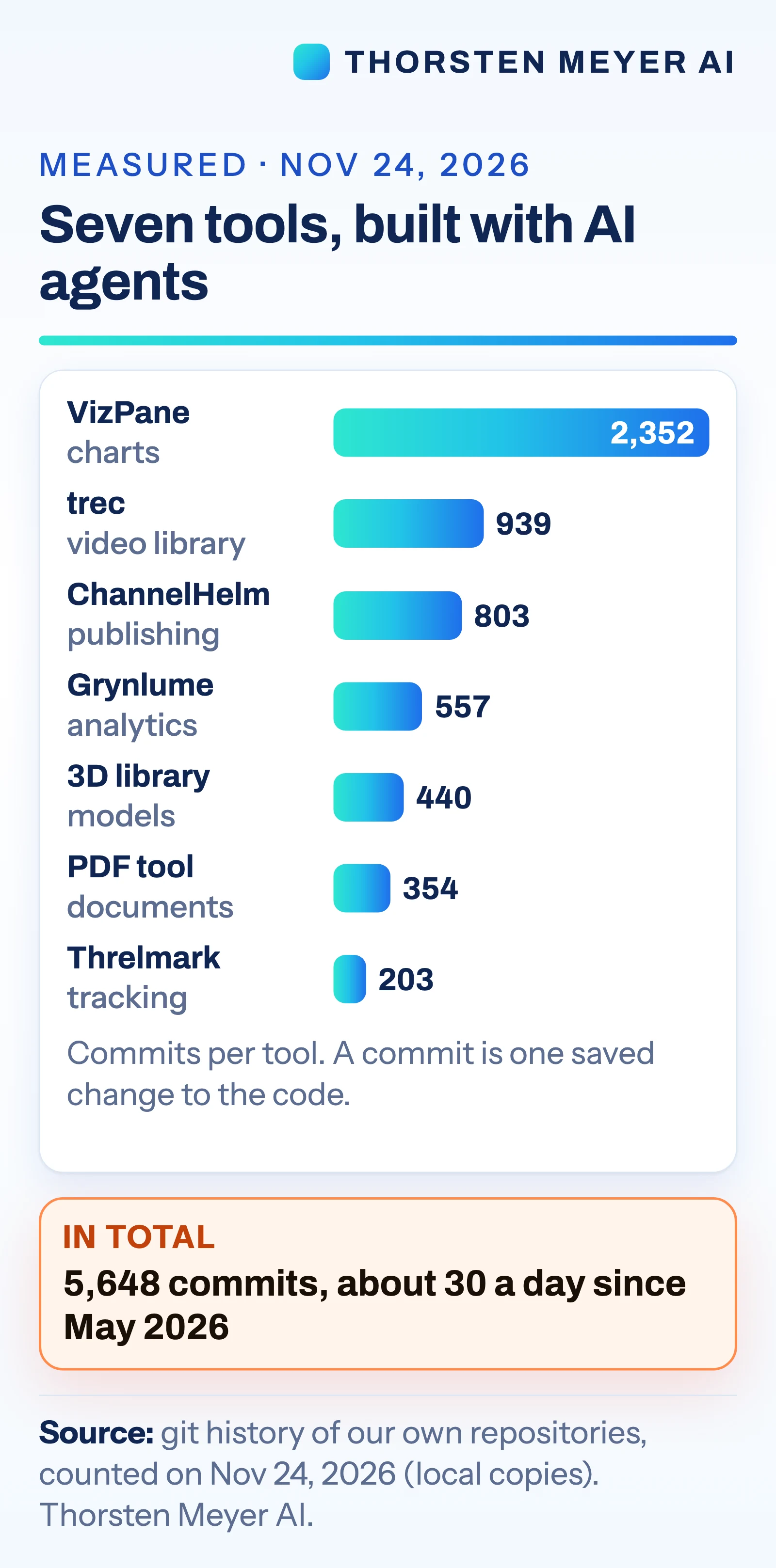
He describes coding agents as systems that work inside a software project: they read and write code, run tests and report results. Meyer sets the goals and checks the output. He says seven tools in his own repositories had 5,648 commits and 2,128 test files as of Nov. 24, 2026. Those figures come from his repositories and are not an independent measure of quality or reliability.
For the article and accompanying video, Meyer says a job moved through seven of his tools, from a project tracker to analytics. Each tool supplies a guide and a way for software agents to use it, allowing the steps to run without a person clicking through each application. He says people still set the goal and check the result.
Custom Tools Shift Work to Owners
Meyer’s account illustrates how AI coding agents may make narrowly tailored software more accessible to people who know their own workflows. A small business or solo worker can attempt to build a tool for a specific task instead of adapting to a general product. The trade-off in his description is a shift in responsibility: the builder must determine what the tool should do, inspect the result and maintain it over time.
That shift also matters to software vendors. Meyer argues that customers may build simple versions of products themselves, putting more weight on vendor reliability, support, security and compatibility with agents. This is his view of a possible market effect; the article offers no customer survey or market data establishing how widespread the change is.
The approach concentrates dependence, too. Meyer says he relies heavily on Anthropic and OpenAI for the coding agents behind his tools. The article does not detail what happens to his workflow if either service changes its terms, becomes unavailable or no longer meets his needs.
Products Worth Considering

DJI Mic 3 Wireless Microphone Kit (2 Transmitters, 1 Receiver, Charging Case)

LG UltraGear 27G640A-B 27-Inch QHD IPS Gaming Monitor, 300Hz, 1ms, G-SYNC Compatible, FreeSync Premium, DisplayHDR 400, HDMI 2.1, USB-C, Adj

Samsung Galaxy Tab A11+ 11-Inch Wi-Fi Tablet, 128GB, 6GB RAM, Silver
As an affiliate, we earn on qualifying purchases.
From Software Rental to Ownership
Many businesses use software as a service, or SaaS: applications run on a provider’s cloud infrastructure and are accessed by customers. Meyer cites the U.S. National Institute of Standards and Technology’s definition in Special Publication 800-145, which describes users as accessing a provider’s applications while the provider manages the underlying infrastructure and most application capabilities.
He compares this model to renting space in an office building: it is ready to use and someone else handles the building, but the tenant has limited control over its layout. In his view, businesses that use separate services for analytics, tasks, documents and video also manage separate logins, rules and bills. His alternative is to build tools around his own work and connect them so agents can pass tasks between them.
Meyer says he uses project notes, plans and activity logs to give coding agents information about a business and its software. He describes an agent-ready tool as having a readable guide and a standard way for software to interact with it. These practices are part of his workflow; the article does not report a controlled comparison with conventional software development.
“The scarce part is no longer the code. It is knowing exactly what you need, and checking that you got it.”
— Thorsten Meyer
Costs and Reliability Remain Unmeasured
The article does not disclose the full cost of building and running Meyer’s tools, including his time, AI subscriptions, per-use media charges, hosting or upkeep. It therefore remains unclear whether his setup is cheaper than the services it replaced. The repository commit and test-file counts are self-reported measures and do not show how often the tools fail or how well they protect data.
Meyer acknowledges that maintenance, security and review are now his responsibility. He does not provide details about security testing, backups, incident response or how the tools handle sensitive business information. He also says coding agents may start each session without remembering the business unless relevant details are written down, and that their output still needs review.
More Detail on the Tool Fleet
Meyer presents the article as a written companion to a video explaining his tool fleet and workflow. The account does not announce a product launch or provide a public roadmap for the tools. Further details about costs, reliability and security would be needed to assess how well this approach works beyond his own setup.
Key Questions
Which software subscriptions does Meyer say he replaced?
He says his web analytics, project tracking, PDF and video recording tools now run on tools he built. He does not name the subscription products he replaced.
Which AI coding agents does he use?
Meyer says he uses Claude Code from Anthropic and Codex from OpenAI to build his tools.
Does his account show that AI-built tools are cheaper?
No. Meyer says his software bill now covers Claude and Codex subscriptions, with additional per-use charges for media models, but provides no complete cost comparison with his former subscriptions.
What responsibilities come with building the tools?
Meyer says he is responsible for maintaining and securing the tools and reviewing the agents’ work. The article does not describe his specific security or backup practices.
Source: Thorsten Meyer AI