
TL;DR
Large language models generate text by turning a prompt into tokens and predicting one token at a time. Training and feedback help them follow instructions, but fluent answers can still be wrong; the source guide says verification remains necessary.
The guide describes a five-stage process: a prompt is split into tokens; each token is represented as numbers called embeddings; transformer layers process relationships among tokens; the model assigns probabilities to possible next tokens; and a sampling step selects one to append. The model repeats the process until it finishes its answer. Token splits and diagram proportions in the source are described as illustrative.

Get business pricing on tech for your team
- Business-only prices and quantity discounts
- Tax-exempt purchasing
- Multiple users, one account, clear invoices
Token counts vary by model and text. The guide cites OpenAI’s rule of thumb that one token represents about four English characters or roughly three-quarters of a word, while emphasizing that these are estimates. It also cites Anthropic’s statement that newer Claude tokenizers can produce about 30 percent more tokens for the same text than earlier models. The guide says tokens matter for usage costs and input limits, and can help explain difficulties with tasks such as counting letters.
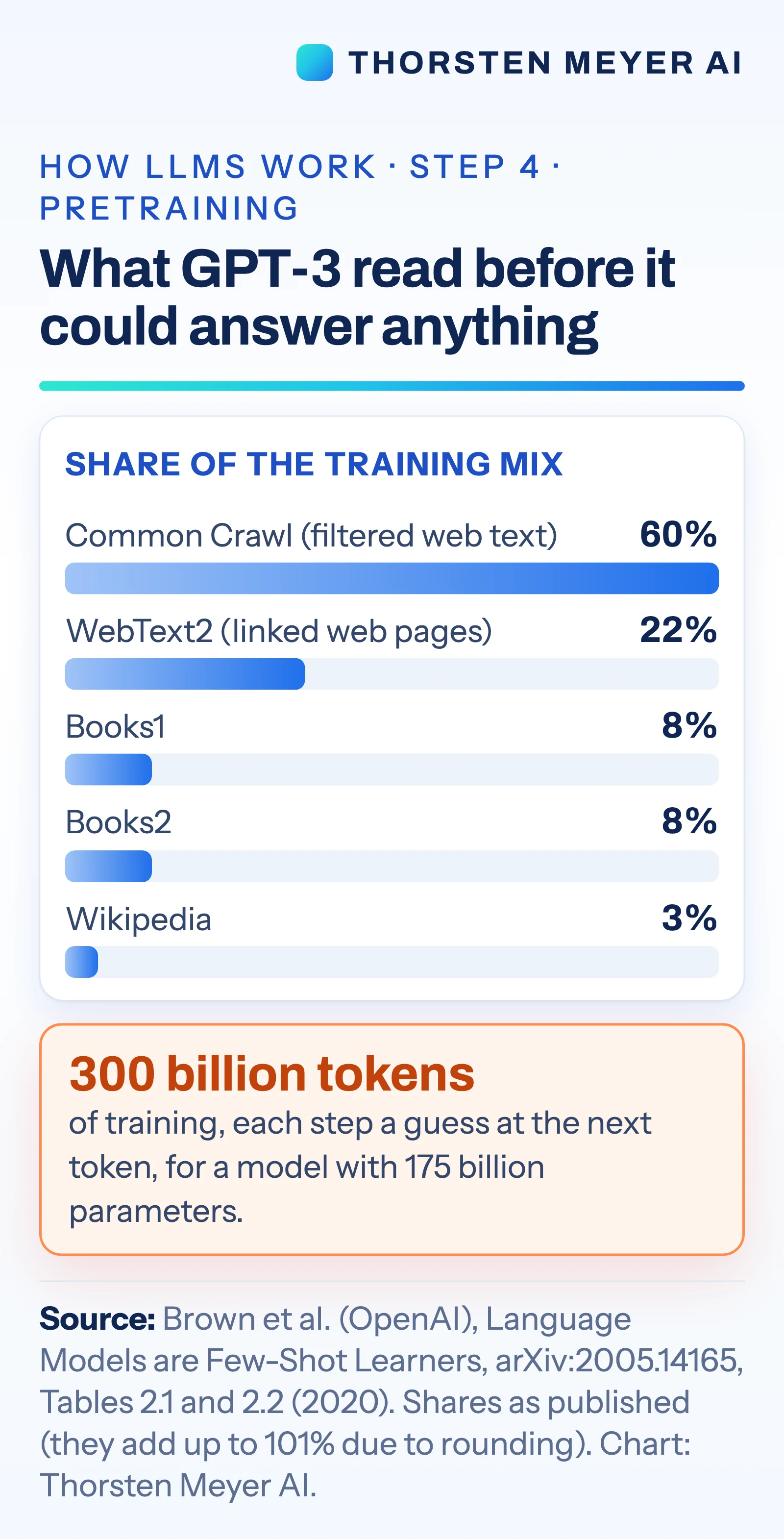
The article distinguishes pretraining, where a model learns to continue text from a large corpus, from post-training, which uses human or AI feedback to encourage instruction-following. It says some reasoning models generate hidden reasoning tokens before their visible answer, using more computation; those tokens may count as output for billing. Temperature affects how adventurous token selection is, so the same prompt can produce different answers.
Why Token Prediction Shapes Trust
Knowing that a model predicts likely continuations helps explain why a polished answer is not proof that the system retrieved a verified fact. The process can produce useful language and confident errors because both come from the same generation mechanism. The guide argues that verification is part of using the tool, particularly when factual accuracy matters at work.
The mechanism also has practical costs. Tokenization affects how much text fits within a model’s limits and how much usage may cost. Additional reasoning tokens can increase computation and billing. These constraints matter when organizations decide how to use models for longer documents or complex tasks.
Products Worth Considering

Samsung 27-Inch Odyssey G5 QHD Gaming Monitor (G51F)

Logitech MX Master 4 Ergonomic Wireless Mouse with Haptic Feedback, Graphite

Apple AirPods Pro with Wireless Charging Case
As an affiliate, we earn on qualifying purchases.
From Transformer Research to Assistants
The explainer identifies the transformer as the architecture at the center of its account and dates its introduction to 2017, citing Vaswani and colleagues’ paper “Attention Is All You Need.” In the guide’s description, attention lets tokens draw information from other tokens in the input.
It also points to earlier work on subword units: a 2016 paper by Rico Sennrich and colleagues described representing rare or unknown words as sequences of smaller units. That approach helps models handle terms that do not appear as common whole words. The source places tokenization, transformer processing, pretraining and post-training in one account of how a text predictor is adapted to act as an assistant.
Limits the Explainer Leaves Open
The source says models can make things up and lack information beyond the end of their training data, but it does not give a model-specific cutoff, error rate or reliability measure. It also does not quantify how much reasoning tokens improve performance on hard problems or how their costs compare across services. Its tokenizer comparison is attributed to Anthropic; the guide does not provide an independent measurement or details of the text used for that comparison.
The material provided ends partway through its discussion of embeddings, so it does not establish further technical details from that section. The explainer describes a general process; behavior, pricing and limits can differ by model and provider.
Check Model Details Before Use
The source points readers to related explainers on neural networks, deep learning and context windows for more detail on computation and input limits. For practical use, the next step is to check the specific model’s token limits, pricing and training information, then verify consequential answers against dependable sources. The guide does not announce a product launch or a scheduled follow-up milestone.
Key Questions
Does a language model look up the answer to a prompt?
According to the explainer, it generates an answer by predicting and selecting tokens one at a time; it does not simply look up an answer.
What is a token?
A token is a unit of text that may be a character, part of a word, a whole word or punctuation. The number of tokens in a passage varies with the text and tokenizer.
Why can a fluent answer still be wrong?
The guide says fluency and correctness come from the same text-generation process. A model can produce a plausible continuation without having verified the facts.
What does post-training add?
The source says post-training uses human feedback or AI feedback guided by written principles to help a pretrained model follow instructions.
What remains uncertain about reasoning models?
The explainer says they may use extra computation and hidden reasoning tokens, but the provided material does not quantify their accuracy gains or compare their costs across models.
Source: Thorsten Meyer AI