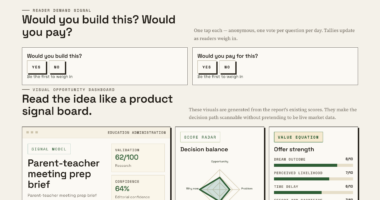
📊 Full opportunity report: A Smarter Way To Track Supplier Charges At Your Restaurants on IdeaNavigator AI — validation score, market gap, and execution plan.

Get business pricing on tech for your team
- Business-only prices and quantity discounts
- Tax-exempt purchasing
- Multiple users, one account, clear invoices
TL;DR

A proposal outlines software for multi-unit restaurant groups to compare supplier invoices against agreed prices, orders and received goods. It recommends testing the workflow against 90 days of paid invoices at three groups; no product launch, trial results or customer adoption are reported.
IdeaNavigator AI has proposed a supplier-invoice auditing tool for independent multi-unit restaurant groups that would compare each billed line with purchase orders, delivery records and contract or quoted prices. The proposal recommends testing the workflow against 90 days of paid invoices at three restaurant groups; it does not report a product launch, completed trial or recovered credits.
The proposed system is aimed at a director of purchasing or controller overseeing several locations that buy food and beverages from broadline and specialty suppliers. Its premise is that invoice discrepancies can be difficult to spot when groups process many bills and restaurant staff do not consistently check deliveries against orders. The proposal identifies unapplied negotiated prices, short-shipped cases billed in full, higher-priced substitutions and gradual increases between orders as possible discrepancies.
For an initial version, IdeaNavigator AI suggests accepting supplier invoices through electronic data interchange where available, with PDFs or photographed documents handled through text recognition. Users would load supplier contracts or quote sheets and the group’s order guide, then compare ordered, received and billed quantities alongside the agreed price. The system would flag possible issues, prepare supplier-specific credit requests and track whether credits appear on later invoices.
The suggested business model is a monthly fee per location, with an optional fee tied to recovered credits for operators who prefer a performance-based charge. To test whether the idea is commercially useful, the proposal calls for reviewing three groups’ prior 90 days of paid invoices and pricing documents, tallying the documented discrepancies and comparing potential credits per location with a planned subscription fee. No audit findings or pricing for a service are provided.
Track Supplier Charges Before They Eat Into Margins
IdeaNavigator AI proposes checking supplier invoices against orders, deliveries and agreed prices. The workflow is a concept; no launch, completed trial or confirmed savings are reported.
What the audit would compare
The proposal connects four records that may otherwise be checked separately.
Review what the restaurant ordered.
Check quantities recorded as received.
Load supplier contracts or quote sheets.
Flag possible mismatches for review.
Issues the tool aims to spot
Negotiated price missed
A billed line may exceed the agreed price.
Short shipment
Cases may be billed in full despite a smaller delivery.
Higher-priced item
A substitute may cost more than the ordered item.
Gradual increases
Prices may rise between orders.
How a first version might work
- Invoices through electronic data interchange where available
- PDFs or photographed invoices processed with text recognition
- Order guides, delivery records and supplier pricing documents
- Flag lines for a person to review
- Prepare supplier-specific credit requests
- Track whether credits appear on later invoices
Test the business case
The proposed review would use paid invoices and pricing documents from three groups to assess whether documented credits per location justify a planned fee.
- Total discrepancies found and their value
- Count credits actually issued by suppliers
- Track resolution time and review costs
- Compare potential credits per location with the subscription fee
Protecting Margins From Invoice Errors
The proposed workflow targets a practical gap between what a restaurant agreed to pay and what appears on a supplier invoice. If discrepancies go unnoticed, the group may pay more than its contracted price or pay for goods that were not delivered as ordered. For a multi-location operator, repeated small differences could add up, though the proposal provides no measured recovery totals or evidence of how often these errors occur.
The timing argument in the proposal rests on food-cost pressure. It cites a USDA Economic Research Service forecast dated September 25, 2026, which projected 2026 retail beef and veal prices to rise 9.4% and wholesale beef prices to rise 8.5%, while food-away-from-home prices were forecast to rise 3.5%. Those figures are forecasts, not reported outcomes. They help explain why the proposal focuses on checking purchasing costs, but do not establish that the suggested software would reduce a particular restaurant’s costs or improve margins.
For operators, the key decision is whether the recoverable, documented discrepancies justify the cost and work of adopting a new system. The proposed three-group review is intended to test that question before a wider build or sale. Results would also help distinguish invoice problems that software can identify from disputes requiring supplier follow-up or better receiving procedures.
Products Worth Considering

Bose QuietComfort Headphones (2nd Gen), Wireless Over-Ear Noise-Cancelling Headphones, Eucalyptus Green

Apple MacBook Air 13.6-inch Laptop with M5 Chip, 16GB Memory, 512GB SSD, Sky Blue

LG UltraGear 32GX850A-B 32-inch 4K UHD OLED Gaming Monitor
As an affiliate, we earn on qualifying purchases.
How the Proposed Audit Would Work
The concept focuses on restaurant procurement and food-cost control, rather than broad accounting automation. It connects four records that may otherwise be reviewed separately: the order, the goods received, the invoice and the supplier’s agreed price. A mismatch among them could prompt a review, but a flag would not by itself prove that a supplier made an error; substitutions, credits, contract terms and timing may affect how a line should be interpreted.
The proposal describes a narrow first use case for one buyer within an independent multi-unit group. That framing limits the initial problem to supplier charges and potential credits, rather than attempting to automate all purchasing or kitchen operations. It also leaves open practical questions about the reliability of delivery records, the quality of scanned invoices and how often suppliers provide machine-readable data.
As background for the suggested validation, IdeaNavigator AI points to projected food-price increases and the possibility that supplier prices can diverge from negotiated terms. The proposal does not include interviews with restaurant operators, supplier responses, market-size estimates or evidence from an existing deployed tool. The recommendation is therefore a business concept and test plan, not a report of an established service or independently verified savings.
Trial Results and Operating Details
No completed test is reported. The proposal does not identify participating restaurant groups, provide invoice samples or show how much money might be recovered. It also does not say whether any software has been built, who would operate it, what the subscription would cost or when a trial might begin.
The accuracy of the proposed comparisons remains untested. In particular, the material does not explain how the system would confirm that a shipment was short, determine whether a substitution was authorized, account for changing contract terms or handle credits that appear on a later bill. It also provides no comparison of manual review costs with the proposed software or evidence that suppliers would accept automatically drafted credit requests.
The cited USDA figures are forecasts for 2026, not final price data. The proposal gives no later update or outcome. Its central commercial claim—that documented credits per location could justify a recurring fee—remains a hypothesis until the suggested review is completed and its findings are made available.
A Three-Group Invoice Review
The next step described is a 90-day review across three restaurant groups. The groups would provide paid invoices and relevant contracts or quote sheets so reviewers could total billed amounts above agreed prices, short-shipped cases charged in full and price changes between orders. The proposed decision rule is to continue if documented credits per location clearly exceed the planned subscription fee.
No schedule, participating operators or reporting date has been announced in the proposal. If a test proceeds, useful results would include the number and value of discrepancies found, how many led to supplier-issued credits, how long resolution took and whether the findings remained worthwhile after review and software costs. Until those details are reported, the tool’s effectiveness and commercial viability remain undetermined.
Source: IdeaNavigator AI
Key Questions
Has a restaurant supplier-auditing product launched?
No launch is reported. The material describes a proposed workflow and a suggested validation test, not an available product or completed deployment.
What would the proposed tool check?
It would compare invoices with orders, delivery quantities and agreed prices, flag possible overcharges, short-ships billed in full, higher-priced substitutions and price increases, then track requested credits.
How would the idea be tested?
The proposal recommends a 90-day lookback at three restaurant groups, using paid invoices and contracts or quote sheets to total documented discrepancies and compare potential credits per location with a planned fee.
Are any savings or credits confirmed?
No savings or recovered credits are reported. Whether the audit would identify enough valid discrepancies to justify its cost remains unknown until a test is completed.
Source: IdeaNavigator AI